
2 Chronicles 4:1 – 22 The Bronze Altar and Molten Sea (1 Kings 7:23-26)
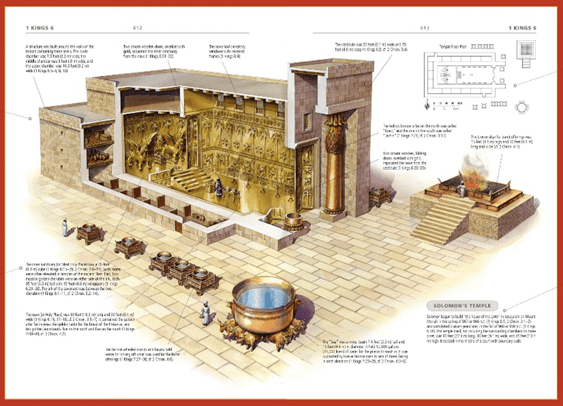
He made a bronze altar twenty cubits long, twenty cubits wide, and ten cubits high. The altar was approximately 30 feet in length and width and 15 feet high (9.1 meters in length and width and 4.6 meters high)
He also made the Sea of cast metal. It was circular in shape, measuring ten cubits from rim to rim, five cubits in height, and thirty cubits in circumference. Below the rim, figures of oxen encircled it, ten per cubit all the way around the Sea, cast in two rows as a part of the Sea. (The Sea was approximately 15 feet from rim to rim, 7.5 feet in height, and 45 feet in circumference (4.6 meters from rim to rim, 2.3 meters in height, and 13.7 meters in circumference).
The Sea stood on twelve oxen, three facing north, three facing west, three facing south, and three facing east. The Sea rested on them with all their hindquarters toward the center. It was a handbreadth thick, and its rim was fashioned like the brim of a cup, like a lily blossom. It could hold three thousand baths. (A handbreadth is approximately 2.9 inches or 7.4 centimeters. 3,000 baths is approximately 17,400 gallons or 66,000 liters.)
The Ten Basins, Lampstands, and Tables (1 Kings 7:38-39)
He also made ten basins for washing and placed five on the south side and five on the north. The parts of the burnt offering were rinsed in them, but the priests used the Sea for washing. He made ten gold lampstands according to their specifications and placed them in the temple, five on the south side and five on the north.
Additionally, he made ten tables and placed them in the temple, five on the south side and five on the north. He also made a hundred gold bowls.
The Courts
He made the courtyard of the priests and the large court with its doors, and he overlaid the doors with bronze. He put the Sea on the south side, at the southeast corner.
Completion of the Bronze Works (1 Kings 7:40-47)
Additionally, Huram made the pots, shovels, and sprinkling bowls. So Huram finished the work that he had undertaken for King Solomon in the house of God: the two pillars; the two bowl-shaped capitals atop the pillars; the two sets of network covering both bowls of the capitals atop the pillars; the four hundred pomegranates for the two sets of network (two rows of pomegranates for each network covering both the bowl-shaped capitals atop the pillars); the stands; the basins on the stands; the Sea; the twelve oxen underneath the Sea; and the pots, shovels, meat forks, and all the other articles.
All these objects that Huram-abi made for King Solomon for the house of the LORD were of polished bronze. The king had them cast in clay molds in the plain of the Jordan between Succoth and Zeredah. Solomon made all these articles in such great abundance that the weight of the bronze could not be determined.
Completion of the Gold Furnishings (1 Kings 7:48-51)
Solomon also made all the furnishings for the house of God: the golden altar; the tables on which was placed the Bread of the Presence; the lampstands of pure gold and their lamps, to burn in front of the inner sanctuary as prescribed; the flowers, lamps, and tongs of gold—of purest gold; the wick trimmers, sprinkling bowls, ladles, and censers of purest gold; and the gold doors of the temple: the inner doors to the Most Holy Place as well as the doors of the main hall.”
It’s amazing how Ezra gives Solomon credit for creating all the precious furnishings of the temple. Strictly speaking, Solomon merely acted as a general contractor; Solomon’s royal fingers never touched a single stone or precious item. It was Huram, or Hiram, the craftsman, who actually oversaw everything and created all these incredible things. All Solomon did was to sign off on the job. But politicians have always taken credit for other people’s work, and Solomon was a consummate politician.
The amount of gold, silver, and bronze that went into the temple was staggering. The size of some of the items was equally staggering. The bronze sea that held water for ritual purification held 17,400 gallons or 66,000 liters. There must have been some means of removing the water from the bronze sea, perhaps with some of the bronze instruments later described. The altar was truly enormous – 30 feet by 30 feet square and fifteen feet high. When a later king moved Solomon’s altar off to the side and replaced it with a pagan one, moving the original altar must have taken a great deal of work.
One interesting question is whether or not Solomon would have used all that gold and bronze had his father David not already provided it, along with the plans for the temple? While Solomon took credit for the temple, it was actually David who developed the plans and who accumulated much of the raw materials. But Solomon had no problem taking credit for everything.
APPLICATION: Yesterday we raised the question of whether or not magnificent church buildings are a good idea. The cathedrals of Europe took decades and sometimes even centuries to build and involved enormous amounts of labor; however, the people who worshiped in them rejoiced in their architecture. In a time when many people were illiterate, the stained-glass windows and tapestries depicted important Bible stories so that illiterate worshipers could be reminded of God’s truths. St. Francis of Assisi instituted living nativity scenes after visiting Bethlehem in 1223 to bring home the message of Christmas to his people.
One mistake we can fall into is judging previous generations by today’s standards. In medieval times, miracle plays, elaborate cathedrals, and living nativities were necessary because many people had no other means of learning about God. These days, many people have cell phones with all kinds of Bible apps on them. There is an app for the series The Chosen. The Jesus Film is now available in more than 2,000 languages. Recently, I downloaded the Jesus Film for a friend in three different Fulani dialects plus the Konkomba language. If my friend’s thumb drive (pen drive) had been larger, I could have downloaded even more copies of the film. (Incidentally, if you have never seen the Jesus Film, go to jesusfilm.org and get a copy for yourself. It really is very powerful.)
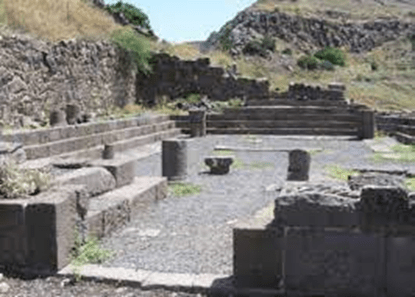
The temple in Jerusalem was to be a national place of worship. Centuries earlier, God through Moses had ordered that all Israelite men should appear at the temple in Jerusalem at least three times a year. But village synagogues were far simpler. This photo of the ruins of a first century synagogue indicates how basic the buildings actually were. There were places for men and women to sit and for the storage of the Torah. There was an altar and a lectern from which the Torah would be read. But there were very few of the rich other accoutrements described in Solomon’s temple.
Once more, the question arises, “How necessary are elaborate buildings? Do people worship any more effectively in an elaborate building than in a simple one? We live and work in Northern Ghana, where church buildings are frequently quite basic. We can tell you that the most important part of worship has nothing to do with the building but everything to do with whether or not the Holy Spirit is welcome. In John 4:24, Jesus told the Samaritan woman that “God is a spirit, and those who worship Him must worship in spirit and in truth.” If you truly want to worship, no building is too simple, and if you are simply going through the motions, elaborate surroundings will have no effect.
Each of us must decide to worship in spirit and in truth wherever we find ourselves. When we are faithful to seek God, He is faithful to show up!
PRAYER: Father God, thank You for loving us and for caring for us. Lord, help us to follow hard after You all the days of our lives. Help us to worship You wherever we are, whether on the job, at home, or when involved in recreation. Help our lives to glorify You in everything we do. In the matchless Name of King Jesus. Amen.
 Burunche's Blog
Leave a comment