
Ezra 4:1 – 24 Adversaries Hinder the Work
When the enemies of Judah and Benjamin heard that the exiles were building a temple for the LORD, the God of Israel, they approached Zerubbabel and the heads of the families, saying, “Let us build with you because, like you, we seek your God and have been sacrificing to Him since the time of King Esar-haddon of Assyria, who brought us here.”
But Zerubbabel, Jeshua, and the other heads of the families of Israel replied, “You have no part with us in building a house for our God, since we alone must build it for the LORD, the God of Israel, as Cyrus the king of Persia has commanded us.”
Then the people of the land set out to discourage the people of Judah and make them afraid to build. They hired counselors against them to frustrate their plans throughout the reign of Cyrus king of Persia and down to the reign of Darius king of Persia.
Opposition under Xerxes and Artaxerxes (Esther 1:1-9)
At the beginning of the reign of Xerxes, (Hebrew “Ahasuerus”) an accusation was lodged against the people of Judah and Jerusalem.
And in the days of Artaxerxes king of Persia, Bishlam, Mithredath, Tabeel, and the rest of his associates wrote a letter to Artaxerxes. It was written in Aramaic and then translated. Rehum the commander and Shimshai the scribe wrote the letter against Jerusalem to King Artaxerxes as follows:
From Rehum the commander, Shimshai the scribe, and the rest of their associates—the judges and officials over Tripolis, Persia, Erech and Babylon, the Elamites of Susa, and the rest of the peoples whom the great and honorable Ashurbanipal deported and settled in the cities of Samaria and elsewhere west of the Euphrates.
(This is the text of the letter they sent to him.)
To King Artaxerxes,
From your servants, the men west of the Euphrates:
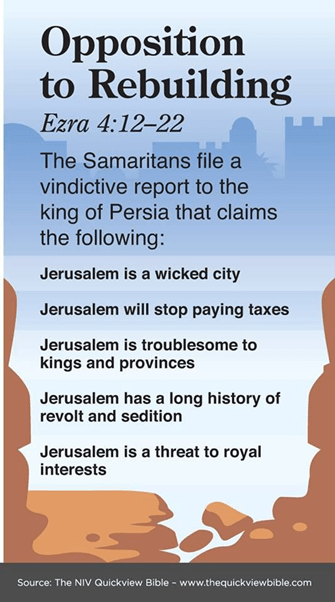
Let it be known to the king that the Jews who came from you to us have returned to Jerusalem. And they are rebuilding that rebellious and wicked city, restoring its walls, and repairing its foundations.
Let it now be known to the king that if that city is rebuilt and its walls are restored, they will not pay tribute, duty, or toll, and the royal treasury will suffer.
Now because we are in the service of the palace (Literally “because the salt of the palace is the salt we eat”) and it is not fitting for us to allow the king to be dishonored, we have sent to inform the king that a search should be made of the record books of your fathers. In these books you will discover and verify that the city is a rebellious city, harmful to kings and provinces, inciting sedition from ancient times. That is why this city was destroyed.
We advise the king that if this city is rebuilt and its walls are restored, you will have no dominion west of the Euphrates.
The Decree of Artaxerxes
Then the king sent this reply:
To Rehum the commander, Shimshai the scribe, and the rest of your associates living in Samaria and elsewhere in the region west of the Euphrates:
Greetings.
The letter you sent us has been translated and read in my presence. I issued a decree, and a search was conducted. It was discovered that this city has revolted against kings from ancient times, engaging in rebellion and sedition. And mighty kings have ruled over Jerusalem and exercised authority over the whole region west of the Euphrates; and tribute, duty, and toll were paid to them.
Now, therefore, issue an order for these men to stop, so that this city will not be rebuilt until I so order. See that you do not neglect this matter. Why allow this threat to increase and the royal interests to suffer? When the text of the letter from King Artaxerxes was read to Rehum, Shimshai the scribe, and their associates, they went immediately to the Jews in Jerusalem and forcibly stopped them.
Thus the construction of the house of God in Jerusalem ceased, and it remained at a standstill until the second year of the reign of King Darius of Persia.”
Just when everything was going well, the Samaritans chose to make trouble. The Samaritans were already angry because the Jews had returned to reclaim their homes and lands. Now the Samaritans demanded that they too should have a share in rebuilding the temple since they had been worshiping God for years. The problem was that the Samaritans had simply tacked on the worship of the God of Israel to the worship they were already offering to all their other pagan gods. The Jews were properly horrified and replied, ““You have no part with us in building a house for our God, since we alone must build it for the LORD, the God of Israel, as Cyrus the king of Persia has commanded us.”
The Jews who had returned fully realized that it was worship of those pagan gods that got their ancestors deported from Israel and Judah. The Jewish leaders were discerning enough to realize that if they allowed the Samaritans to join them, the Jewish young people might lapse back into idolatry.
Whether or not the Samaritans were sincere in their demands is a good question. Perhaps the Samaritans already anticipated that the Jews would refuse their involvement and were simply seeking an occasion to report the Jews to the higher officials. The refusal of the Jewish leaders gave the Samaritans the opportunity they had wanted, and they hired counselors (lawyers?) to write letters against the Jews. These letters were scurrilous, claiming that if Jerusalem were to be rebuilt and its walls restored, the King of Persia would have “no dominion west of the Euphrates.” (HUH??? Like a ragtag band of Jews was going to challenge the largest empire in the world?) While this was a gross exaggeration, it gained favorable attention and a royal edict was issued for construction to cease. Those leading the opposition to the Jews were Rehum, Shimshai the scribe, and their associates. Ezra is careful to record these names so that succeeding generations will remember who the villains were in this situation.
The people who wrote against the Jews knew exactly how to appeal to Artaxerxes and his pride. Artaxerxes promptly issued a royal edict ordering the Jews to cease and desist. At that point, construction stalled until the second year of the reign of Darius the Mede.
APPLICATION: It is a given that when God calls us to do a great work for Him, we can anticipate strong satanic opposition. Those opposing the rebuilding of Jerusalem and the temple were motivated by many things, but Satan was behind all their excuses.
While we shouldn’t be searching for demons under bushes, at the same time, we should also be prepared to be attacked in some fashion. Satanic attack may take many forms: physical illness for us or for those supporting us, family problems, political upheaval, etc. As I am writing this, we know of several families faithfully serving the Lord who are facing labyrinthine problems with their parents’ estates. Others are struggling with chronic illnesses and financial reversals. Years ago, two missionary nurses serving where we now serve developed so many interpersonal problems that they refused to speak to each other unless they were at work and also refused to eat at the same time at the same table. Both these ladies were dedicated Christians; however, they were under intense demonic attack and living in very harsh conditions.
The end of this chapter makes for depressing reading; however, just wait! Even as those critics were attempting to shut down the temple construction, God already had a plan in place. If you are going through a difficult time right now, don’t despair! If God has called you to do something great for Him, then He will certainly make it possible. Remember Hudson Taylor’s maxim:” God’s work, done God’s way, will never lack God’s supply.”
PRAYER: Father God, thank You for loving us and for caring for us. Lord, help us to trust that even when opponents attack, You are bigger than any enemy and that You can surely bring us through safely. In the mighty and precious Name of King Jesus. Amen.
 Burunche's Blog
Leave a comment