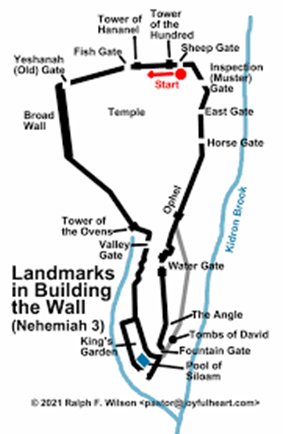
Nehemiah 3:1 – 32 The Builders of the Walls
“At the Sheep Gate, Eliashib the high priest and his fellow priests began rebuilding. They dedicated it and installed its doors. After building as far as the Tower of the Hundred and the Tower of Hananel, they dedicated the wall. The men of Jericho built next to Eliashib, and Zaccur son of Imri built next to them.
The Fish Gate was rebuilt by the sons of Hassenaah. They laid its beams and installed its doors, bolts, and bars. Next to them, Meremoth son of Uriah, the son of Hakkoz, made repairs; next to him, Meshullam son of Berechiah, the son of Meshezabel, made repairs; and next to him, Zadok son of Baana made repairs as well. Next to him, the Tekoites made repairs, but their nobles did not put their shoulders to the work under their supervisors.
The Jeshanah Gate was repaired by Joiada son of Paseah and Meshullam son of Besodeiah. They laid its beams and installed its doors, bolts, and bars. Next to them, repairs were made by Melatiah the Gibeonite, Jadon the Meronothite, and the men of Gibeon and Mizpah, who were under the authority of the governor of the region west of the Euphrates. Next to them, Uzziel son of Harhaiah, one of the goldsmiths, made repairs, and next to him, Hananiah son of the perfumer made repairs. They fortified Jerusalem as far as the Broad Wall.
Next to him, Rephaiah son of Hur, ruler of a half-district of Jerusalem, made repairs; next to him, Jedaiah son of Harumaph made repairs across from his house; and next to him, Hattush son of Hashabneiah made repairs. Malchijah son of Harim and Hasshub son of Pahath-moab made repairs to another section, as well as to the Tower of the Ovens. And next to them, Shallum son of Hallohesh, ruler of a half-district of Jerusalem, made repairs, with the help of his daughters.
The Valley Gate was repaired by Hanun and the residents of Zanoah. They rebuilt it, installed its doors, bolts, and bars, and repaired a thousand cubits of the wall as far as the Dung Gate.
The Dung Gate was repaired by Malchijah son of Rechab, ruler of the district of Beth-haccherem. He rebuilt it and installed its doors, bolts, and bars.
The Fountain Gate was repaired by Shallun son of Col-hozeh, ruler of the district of Mizpah. He rebuilt it, roofed it, and installed its doors, bolts, and bars. He also repaired the wall of the Pool of Shelah near the king’s garden, as far as the stairs that descend from the City of David.
Beyond him, Nehemiah son of Azbuk, ruler of a half-district of Beth-zur, made repairs up to a point opposite the tombs of David, as far as the artificial pool and the House of the Mighty.
Next to him, the Levites made repairs under Rehum son of Bani, and next to him, Hashabiah, ruler of a half-district of Keilah, made repairs for his district. Next to him, their countrymen made repairs under Binnui son of Henadad, ruler of the other half-district of Keilah. And next to him, Ezer son of Jeshua, ruler of Mizpah, made repairs to another section opposite the Ascent to the Armory, near the angle in the wall.
Next to him, Baruch son of Zabbai diligently repaired another section, from the angle to the doorway of the house of Eliashib the high priest. Next to him, Meremoth son of Uriah, the son of Hakkoz, made repairs to another section, from the doorway of the house of Eliashib to the end of it. And next to him, the priests from the surrounding area made repairs.
Beyond them, Benjamin and Hasshub made repairs in front of their house, and next to them, Azariah son of Maaseiah, the son of Ananiah, made repairs beside his house. After him, Binnui son of Henadad repaired another section, from the house of Azariah to the angle and the corner, and Palal son of Uzai made repairs opposite the angle and the tower that juts out from the upper palace of the king near the courtyard of the guard. Next to him, Pedaiah son of Parosh and the temple servants living on the hill of Ophel made repairs opposite the Water Gate toward the east and the tower that juts out. And next to them, the Tekoites made repairs to another section, from a point opposite the great tower that juts out to the wall of Ophel.
Above the Horse Gate, each of the priests made repairs in front of his own house. Next to them, Zadok son of Immer made repairs opposite his house, and next to him, Shemaiah son of Shecaniah, the guard of the East Gate, made repairs.
Next to him, Hananiah son of Shelemiah, as well as Hanun the sixth son of Zalaph, made repairs to another section. Next to them, Meshullam son of Berechiah made repairs opposite his own quarters. Next to him, Malchijah, one of the goldsmiths, made repairs as far as the house of the temple servants and the merchants, opposite the Inspection Gate, and as far as the upper room above the corner. And between the upper room above the corner and the Sheep Gate, the goldsmiths and merchants made repairs.”
WOW! All of a sudden, work on the walls of Jerusalem REALLY takes off. But notice something: most of these people were already in Jerusalem prior to Nehemiah’s arrival; they could have started at any time, but they didn’t. Why didn’t these people go ahead and work on the walls? What made the difference? Nehemiah, cupbearer and confidant to King Artaxerxes arrived, analyzed the situation, and then took the lead. Energized by Nehemiah’s example, the priests and people began rebuilding 11 gates and the walls.
Never misbehave with a scribe present! Today we have cell phone videos, but in Nehemiah’s time they had scribes with long memories. Nehemiah carefully listed those who engaged in the rebuilding, their helpers, and the details of the walls and the gates that they rebuilt. Nehemiah also listed those who wimped out. “Next to him, the Tekoites made repairs, but their nobles did not put their shoulders to the work under their supervisors.” OUCH! Those men died and their bones have long since crumbled to dust, but their reluctance to work still stands as a shameful reminder that God is watching us and taking note of all our actions or non – actions.
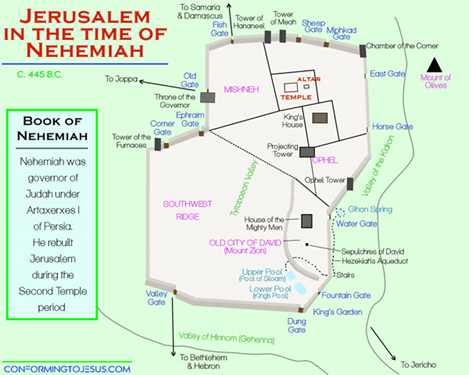
The area enclosed by these walls was much smaller than that enclosed by King Hezekiah; however, the population was smaller and they needed to tailor their construction to the people and materials available.
APPLICATION: Nehemiah faced a tough situation. Those who had already returned to Jerusalem had built good homes for themselves; however, they had neglected work on the city walls. It seems amazing that it took Nehemiah coming all the way from Babylon to jolt people into action.
Blessedly, most of the leaders complied readily, making excellent repairs and restoring the gates. Sadly, some of the very people about whom Nehemiah had high expectations turned out to be foot draggers.
Reading about Nehemiah is very inspiring; however, it can be a different matter when you are the leader fulfilling the same role as Nehemiah. I suspect that whoever recorded this book put the best construction possible on those people who began the work. There were undoubtedly a number of leaders who did not welcome Nehemiah’s arrival. These people had adjusted to a new normal and really didn’t want anyone troubling them. There were those who had already formed underground alliances with local officials. And there may have been those who hoped to wring as much money from Nehemiah as possible while doing as little as possible.
Nehemiah had already prayed and fasted prior to leaving Babylon and now he continued to do so. Anyone choosing to revitalize an institution or an organization should do the same. May God help anyone whom He calls to renew a challenging work!
PRAYER: Father God, thank You for loving us and for caring for us. Lord, help all who are called to revitalize dormant works to seek Your face and to depend on You. In the mighty and precious Name of Jesus. Amen.
 Burunche's Blog
Leave a comment