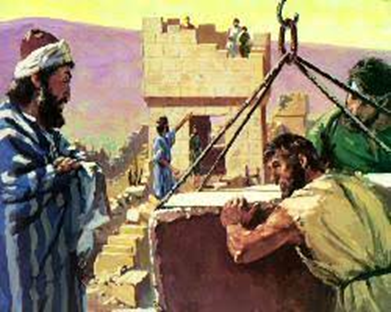
Nehemiah 6:1 – 19 Sanballat’s Conspiracy
“When Sanballat, Tobiah, Geshem the Arab, and the rest of our enemies heard that I had rebuilt the wall and not a gap was left—though to that time I had not yet installed the doors in the gates— Sanballat and Geshem sent me this message: “Come, let us meet together in one of the villages on the plain of Ono.”
But they were planning to harm me. So I sent messengers to them, saying, “I am doing a great work and cannot come down. Why should the work stop while I leave it to go down to you?” Four times they sent me the same message, and each time I gave the same reply.
The fifth time, Sanballat sent me this same message by his young servant, who had in his hand an unsealed letter that read: “It is reported among the nations—and Geshem agrees—that you and the Jews are plotting to revolt, and this is why you are building the wall. According to these reports, you are to become their king, 7and you have even appointed prophets in Jerusalem to proclaim on your behalf: ‘There is a king in Judah.’ Soon these rumors will reach the ears of the king. So come, let us confer together.” Then I sent him this reply: “There is nothing to these rumors you are spreading; you are inventing them in your own mind.” For they were all trying to frighten us, saying, “Their hands will be weakened in the work, and it will never be finished.”
But now, my God, strengthen my hands.
Later, I went to the house of Shemaiah son of Delaiah, the son of Mehetabel, who was confined to his house. He said: “Let us meet at the house of God inside the temple. Let us shut the temple doors because they are coming to kill you— by night they are coming to kill you!” But I replied, “Should a man like me run away? Should one like me go into the temple to save his own life? I will not go!”
I realized that God had not sent him, but that he had uttered this prophecy against me because Tobiah and Sanballat had hired him. He had been hired to intimidate me so that I would sin by doing as he suggested, so they could give me a bad name in order to discredit me. O my God, remember Tobiah and Sanballat for what they have done, and also Noadiah the prophetess and the other prophets who tried to intimidate me.
Completion of the Wall
So the wall was completed in fifty-two days, on the twenty-fifth of Elul. When all our enemies heard about this, all the surrounding nations were afraid and disheartened, for they realized that this task had been accomplished by our God.
Also in those days, the nobles of Judah sent many letters to Tobiah, and Tobiah’s letters came back to them. For many in Judah were bound by oath to him, since he was a son-in-law of Shecaniah son of Arah, and his son Jehohanan had married the daughter of Meshullam son of Berechiah. Moreover, these nobles kept reporting to me Tobiah’s good deeds, and they relayed my words to him. And Tobiah sent letters to intimidate me.”
Poor Nehemiah! When possible attacks failed because Nehemiah organized those building the wall to protect themselves, next Tobiah, Sanballat, and Geshem tried to intimidate him personally. This evil bunch sent invitations to Nehemiah four times, attempting to lure him into an ambush under the guise of meeting with him. Each time, Nehemiah refused and his response was classic: “I am doing a great work and cannot come down. Why should the work stop while I leave it to go down to you?”
The fifth time, Sanballat sent a young servant with an unsealed letter so that anyone could read it accusing Nehemiah and the Jews of planning to revolt. Obviously, Sanballat hoped that as many people as possible would intercept his messenger and read the letter, thus intimidating the maximum number of people. Sanballat included veiled threats of reporting the matter to the king of Persia if Nehemiah failed to meet with them. Again, Nehemiah wisely replied: “There is nothing to these rumors you are spreading; you are inventing them in your own mind.” Nehemiah prayed and continued to work.
Later, a prophet named Shemaiah urged Nehemiah to hide in the temple, an act that contravened the Law of Moses. Nehemiah refused, realizing this man had been hired to intimidate him as well. Again, Nehemiah gave a classic response: “Should a man like me run away? Should one like me go into the temple to save his own life? I will not go!” Evidently, there were other incidents involving Noadiah, a prophetess, and other prophets hired by Tobiah and Sanballat, all with the intent of harming or discouraging Nehemiah.
Despite all the threats and intimidation, Nehemiah and his builders succeeded in completing the wall in 52 days. Was this wall a perfect structure? No. Recent excavations in Jerusalem have uncovered parts of Nehemiah’s wall, and it is true that it was not nearly as solidly built as much of the other ancient architecture. But the important thing was that the wall WAS completed, and it was wide enough for groups of people to walk on top of it.
After spending all this time in Jerusalem, Nehemiah also realized that part of the opposition was coming from the Jewish leaders themselves. Tobiah and his son had both cleverly married daughters of Jewish leaders, thus making themselves sons – in – law and therefore family members. These Jewish leaders were loath to admit that they had made terrible mistakes by allowing Moabites to marry into their families, so they tried to impress Nehemiah with Tobiah’s virtues, as well as reporting everything Nehemiah said and did to Tobiah.
Once more, we realize that the ancient scribes were careful to record the names of those who had failed to keep God’s commands and who had given their daughters in marriage as a form of gaining political advantage. Obviously Shecaniah and Meshullam were far more concerned with currying favor with Tobiah than they were with being observant Jews. One wonders if they had left Babylon with an eye to the main chance, guessing that they might do very well for themselves in Judah if they could ingratiate themselves with the local rulers. Too bad that Nehemiah was also a ruler as well as a close confidante of the king of Persia.
APPLICATION: Sometimes we must settle for a good effort rather than a perfect one. Coming from Babylon with its impressive architecture, Nehemiah undoubtedly knew good walls when he saw them and realized that his wall around Jerusalem was far from perfect. But the wall was completed, and various individuals and families hung the gates so that Jerusalem was again a recognizable city. No matter how many detractors there were, erecting that wall in such a short time and under such circumstances was a major achievement.
One of the most difficult things Nehemiah had to face was the continual threats and rumors, Had Nehemiah not been so close to the king of Persia, he might have believed some of the rumors. But Nehemiah knew the king and the king knew Nehemiah – after all, for years, the king had trusted Nehemiah to taste all his food and drink and to help protect him. Under such circumstances, Nehemiah’s main problem was sorting out truth from lies, and some of the people lying to him were Jewish leaders who had used their daughters as political pawns.
One of the saddest parts of the entire affair was the prophets who had been bought off by Tobiah and Sanballat. These were men and women who allegedly were hearing from God; yet, the only voices they were actually hearing were all too human and evil at that.
I am particularly fond of Nehemiah’s question “Should a man like me run away?” There have been many times during my missionary service when running away seemed quite appealing. But what kept me from deserting my post was the same thing that kept Nehemiah in Jerusalem: both of us were certain that God had sent us and that God had not changed that assignment. Under such circumstances, all one can do is to pray and hold on.
Perhaps you are facing some difficult challenge. Leaving is sounding increasingly appealing. Learn from the story of Mary Slessor. Mary Slessor was a tiny Presbyterian missionary from Scotland who served in the Cross River State area of Nigeria from 1876 – 1915. Slessor was fearless and became fluent in several tribal languages, frequently settling tribal disputes. (She used to knit for hours while listening to tribesmen arguing.) At one point, the British had the choice of sending in 4,000 troops or Mary Slessor. They sent in Mary Slessor, and she settled the problem. One of Slessor’s favorite sayings was “The post of greatest danger is the post of highest honor.” The same God who gave Nehemiah and Mary Slessor their courage can give you courage as well! Should such a person as you run away? Why run when you serve the King of Kings?
PRAYER: Father God, thank You for loving us and for caring for us. Lord, please encourage those of us who are wondering if we are still doing Your will so that we will KNOW what You want us to do. In the mighty and precious Name of King Jesus. Amen.
 Burunche's Blog
Leave a comment