Hezekiah Shows His Treasures (2 Kings 20:12-19)
At that time Merodach-baladan son of Baladan king of Babylon sent letters and a gift to Hezekiah, for he had heard about Hezekiah’s illness and recovery. And Hezekiah welcomed the envoys and showed them what was in his treasure house—the silver, the gold, the spices, and the precious oil, as well as his entire armory—everything that was found in his storehouses. There was nothing in his palace or in all his dominion that Hezekiah did not show them.
Then the prophet Isaiah went to King Hezekiah and asked, “Where did those men come from, and what did they say to you?”
“They came to me from a distant land,” Hezekiah replied, “from Babylon.”
“What have they seen in your palace?” Isaiah asked.
“They have seen everything in my palace,” answered Hezekiah. “There is nothing among my treasures that I did not show them.”
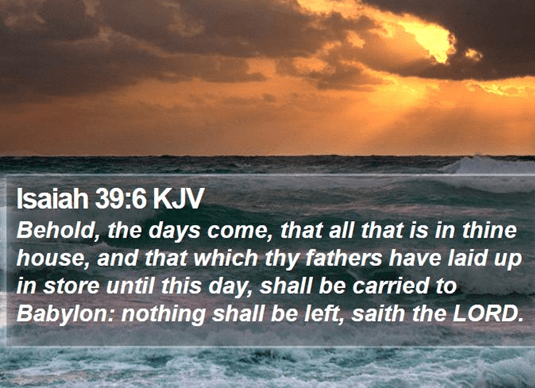
Then Isaiah said to Hezekiah, “Hear the word of the LORD of Hosts: The time will surely come when everything in your palace and all that your fathers have stored up until this day will be carried off to Babylon. Nothing will be left, says the LORD. And some of your descendants, your own flesh and blood, will be taken away to be eunuchs in the palace of the king of Babylon.”
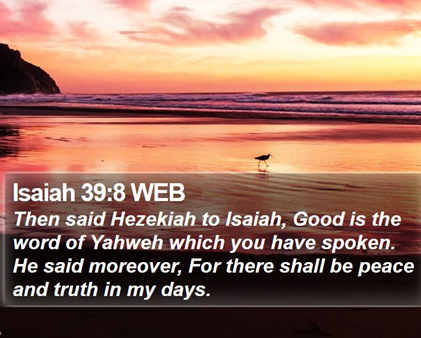
But Hezekiah said to Isaiah, “The word of the LORD that you have spoken is good.” For he thought, “At least there will be peace and security in my lifetime.”
In those days, when a neighboring sovereign was sick and recovered, it was common to send a delegation as a public relations gesture. When the crown prince of Babylon heard about Hezekiah’s recovery, he sent envoys and a gift. While Hezekiah could have received these men nicely, given them a feast, and sent them on their way, he chose to show off all the treasures of his kingdom.
Once the Babylonian delegation returned home, Isiah went to Hezekiah and asked him what he had done. Hezekiah explained that he had entertained men from Babylon by showing them everything in his kingdom. By this point, Isaiah must have been shaking his head in sorrow.
“Then Isaiah said to Hezekiah, “Hear the word of the LORD of Hosts: The time will surely come when everything in your palace and all that your fathers have stored up until this day will be carried off to Babylon. Nothing will be left, says the LORD. And some of your descendants, your own flesh and blood, will be taken away to be eunuchs in the palace of the king of Babylon.” When Hezekiah heard this prophecy, did he repent of his pride and beg God for mercy? No! Hezekiah wasn’t concerned about his descendants, not even the fact that they would be castrated to serve as eunuchs in the palace of the Babylonian king.
In many respects, this is a shocking story. Hezekiah is a man of faith who has trusted God to deliver his people and him from one of the fiercest armies in existence. Hezekiah has brought in sweeping religious reforms. Why after all those good acts would Hezekiah settle for “peace in my time?” Why wouldn’t Hezekiah care about the fate of his descendants? This story takes place right after Hezekiah recovers from his near – fatal illness. Perhaps Hezekiah doesn’t actually have any heirs to the throne at this point. Perhaps Hezekiah’s only offspring are from his concubines. Whatever the situation, Hezekiah seems old and tired, desiring only to have peace for the remainder of his life after surviving the confrontation with the Assyrians and a catastrophic infection.
APPLICATION: How much do we really care about those who will follow us? Do we take thought for our children and grandchildren and for our younger professional colleagues, or do we respond like Hezekiah, “Just give me peace in my time.” King Louis XV of France is frequently quoted as having said, ““Après moi, le déluge” when speaking of those who would succeed him. The phrase means “after me, the flood,” and is said to indicate a total lack of interest in the fate of those coming after him.
A friend is one of a number of children in a large family in which the father played favorites, giving some children resources while ignoring others. Although our friend’s father died several years ago, the anguish from his arbitrary choices continues to fragment the family. This is one of several such problems of which we are aware. But is this how our Heavenly Father wants us to act?
Repeatedly, God says that He does not play favorites and that His love is sufficient for everyone. Jesus reminded his disciples that God makes the rain fall on both the just and the unjust. If we are to truly behave as obedient children we cannot think only of ourselves but must consider those around us and those who will succeed us.
King Hezekiah was a man of great faith, but near the end of his life, he responded in selfishness, rather than in faith. What might have happened had Hezekiah refused to show off? Would his descendants have been safe? What might have happened had Hezekiah received Isaiah’s prophecy and then begged God for mercy for his descendants? We only know that Isaiah’s prophecy was fulfilled in every particular. Now the question is posed to us: will we respond in selfishness or in faith?
PRAYER: Father God, thank You for loving us and for caring for us. Lord, help us to trust You for all of our lives and to make wise decisions that will bless our descendants and not curse them. In the mighty and precious Name of King Jesus. Amen.
 Burunche's Blog
Leave a comment