Archive for January, 2023

JANUARY 2, 2023 A GREAT LIGHT IN THE DARKNESS #18 ISAIAH 17:1- 14 MESS WITH ISRAEL AND GET ANNIHILATED!

January 2, 2023

The Burden against Damascus

Isaiah 17:1 – 14 “This is the burden against Damascus: “Behold, Damascus is no longer a city; it has become a heap of ruins. The cities of Aroer are forsaken; they will be left to the flocks, which will lie down with no one to fear. The fortress will disappear from Ephraim, and the sovereignty from Damascus. The remnant of Aram will be like the splendor of the Israelites,” declares the LORD of Hosts. “In that day the splendor of Jacob will fade, and the fat of his body will waste away, as the reaper gathers the standing grain and harvests the ears with his arm, as one gleans heads of grain in the Valley of Rephaim. Yet gleanings will remain, like an olive tree that has been beaten— two or three berries atop the tree, four or five on its fruitful branches,” declares the LORD, the God of Israel.

In that day men will look to their Maker and turn their eyes to the Holy One of Israel. They will not look to the altars they have fashioned with their hands or to the Asherahs and incense altars they have made with their fingers. In that day their strong cities will be like forsaken thickets and summits, abandoned to the Israelites and to utter desolation. For you have forgotten the God of your salvation and failed to remember the Rock of your refuge. Therefore, though you cultivate delightful plots and set out cuttings from exotic vines— though on the day you plant you make them grow, and on that morning you help your seed sprout— yet the harvest will vanish on the day of disease and incurable pain.

Alas, the tumult of many peoples; they rage like the roaring seas and clamoring nations; they rumble like the crashing of mighty waters. The nations rage like the rush of many waters. He rebukes them, and they flee far away, driven before the wind like chaff on the hills, like tumbleweeds before a gale. In the evening, there is sudden terror! Before morning, they are no more! This is the portion of those who loot us and the lot of those who plunder us.”  

In this prophecy, Isaiah is foretelling the coming of the Assyrians. Eventually, the terrifying armies of Assyria would move relentlessly in from the East, reducing Damascus to a heap of rubble and wiping out most of Israel and Judah. The destruction will be so terrible that only handfuls of people will be left wherever the Assyrians have passed. “Yet gleanings will remain, like an olive tree that has been beaten— two or three berries atop the tree, four or five on its fruitful branches,” declares the LORD, the God of Israel.

Both Israel and Judah have been caught up in idolatry. But when the Assyrians move in, all those idols will prove worthless! Satan always only has one thing in mind: gaining power over people so that they will join him in hell.   Those who refuse to reject their idols and turn to the God of Israel for deliverance will be crushed by the Assyrian juggernaut. Those who reject their idols and trust the Holy One of Israel will be spared. But Isaiah predicts that these people will be very few. Not even the rural areas will be spared. Isaiah describes farmers and vine dressers cultivating delightful plots and setting out cuttings from exotic vines only to see their work completely destroyed. The Assyrians will practice a true scorched earth policy, leaving nothing behind them.

But what’s going to happen to the Assyrians? Are they going to go  free? Isaiah says, “Absolutely not!” The Assyrians themselves will be destroyed. “He rebukes them, and they flee far away, driven before the wind like chaff on the hills, like tumbleweeds before a gale. In the evening, there is sudden terror! Before morning, they are no more! This is the portion of those who loot us and the lot of those who plunder us.” Here, Isaiah is describing the fate of the Assyrians. But how did this enormous empire come to grief?

“By the end of the 7th century B.C.E., this once – proud empire had been destroyed. The Assyrian Empire ruled through brutal military force, so when it showed signs of instability and weakness, its enemies seized the opportunity. A coalition of rebels and other Mesopotamian kingdoms rose up and attacked the Assyrian Empire. This resulted in what was probably one of the largest wars ever fought in the Ancient Near East, which lasted almost 20 years. When it was over, the Assyrian Empire was no more. It was utterly destroyed by several new Mesopotamian kingdoms, which would shape the region’s future in their own ways.” (https://thecollector.com/fall-of-assyrian-empire-mesopotamiankingdom/
APPLICATION: As we enter a new year, we wonder about those who committed injustices in 2022. Each of us can think of some country, some leader, some politician, or some group who spent 2022 lying, cheating, stealing, and generally causing havoc. But will these people get away with their sins? God says, “No!”

Galatians 6:7 tells us, “Be not deceived; God is not mocked: for whatsoever a man soweth, that shall he also reap.” My late stepmother was a highly decorated newspaper editor who had survived newsroom politics for decades. My stepmom’s favorite saying was, “What goes around, comes around.”

As I am writing this, so many situations are on my heart and in my prayers. Whenever I am about to operate, I lay hands on the patient and pray for them, their families, everybody they know, everybody in their towns, everybody in their tribes, for complete healing, for salvation and baptism in the Holy Spirit, and for peace in their areas.

Peace! Forget all the stuff exchanged at Christmas; peace is what we all need – peace of mind and heart, peace in our families, peace in our countries. When we are reading Isaiah’s prophecies, we must read them in the light of the world events that later fulfilled them. Even though Assyria appeared invincible, eventually, the Assyrian Empire was overthrown and reduced to dust. This fate awaits anything and anybody who trusts in any source of help apart from the One True Living God. Today, let us lift up all oppressors to God, begging for Him to deal with them and trusting that He will do so!  

PRAYER: Father God, thank You for loving us and for caring for us. Lord, thank You that You are the One who keeps the books, You are the Holy One of Israel, You are our Sources of help. Let all who read these words trust in You and let them learn that You are wholly trustworthy. In the mighty and precious Name of King Jesus. Amen.
JANUARY 1, 2023 A GREAT LIGHT IN THE DARKNESS #17 ISAIAH 15:1 THROUGH 16:14 WHEN BAD THINGS HAPPEN TO BAD PEOPLE, SHOULD WE REJOICE?

January 1, 2023

Isaiah 15:1 – 9 The Burden against Moab (Jeremiah 48:1-47)

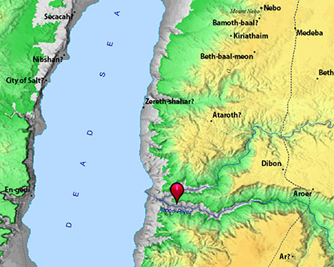
“This is the burden against Moab: Ar in Moab is ruined, destroyed in a night! Kir in Moab is devastated, destroyed in a night! Dibon goes up to its temple to weep at its high places. Moab wails over Nebo, as well as over Medeba.

Every head is shaved, every beard is cut off. In its streets they wear sackcloth; on the rooftops and in the public squares they all wail, falling down weeping. Heshbon and Elealeh cry out; their voices are heard as far as Jahaz. Therefore the soldiers of Moab cry out; their souls tremble within.

My heart cries out over Moab; her fugitives flee as far as Zoar, as far as Eglath-shelishiyah; with weeping they ascend the slope of Luhith; they lament their destruction on the road to Horonaim. The waters of Nimrim are dried up, and the grass is withered; the vegetation is gone, and the greenery is no more. So they carry their wealth and belongings over the Brook of the Willows. For their outcry echoes to the border of Moab. Their wailing reaches Eglaim; it is heard in Beer-elim. The waters of Dimon are full of blood, but I will bring more upon Dimon—a lion on the fugitives of Moab, and on the remnant of the land.”

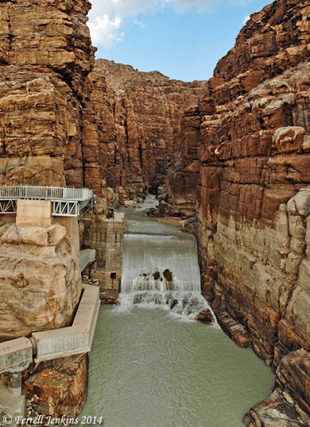
The Arnon River immediately before flowing into the Dead Sea. Photo by Ferrell Jenkins.16:1 – 14

Moab’s Destruction (Zephaniah 2:8-11)

“Send the tribute lambs to the ruler of the land, from Sela in the desert to the mount of Daughter Zion. Like fluttering birds pushed out of the nest, so are the daughters of Moab at the fords of the Arnon: “Give us counsel; render a decision. Shelter us at noonday with shade as dark as night. Hide the refugees; do not betray the one who flees. Let my fugitives stay with you; be a refuge for Moab from the destroyer.”

When the oppressor has gone, destruction has ceased, and the oppressors have vanished from the land, in loving devotion a throne will be established in the tent of David. A judge seeking justice and hastening righteousness will sit on it in faithfulness.

We have heard of Moab’s pride, his exceeding pride and conceit, his overflowing arrogance. But his boasting is empty. Therefore let Moab wail; let them wail together for Moab. Mourn for the raisin cakes of Kir-hareseth, you who are utterly stricken. For the fields of Heshbon have withered, along with the grapevines of Sibmah. The rulers of the nations have trampled its choicest vines that had reached as far as Jazer and spread toward the desert. Their shoots had spread out and passed over the sea.

So I weep with Jazer for the vines of Sibmah; I drench Heshbon and Elealeh with my tears. Triumphant shouts have fallen silent over your summer fruit and your harvest. Joy and gladness are removed from the orchard; no one sings or shouts in the vineyards. No one tramples the grapes in the winepresses; I have put an end to the cheering. Therefore my heart laments for Moab like a harp, my inmost being for Kir-heres. When Moab appears on the high place, when he wearies himself and enters his sanctuary to pray, it will do him no good.

This is the message that the LORD spoke earlier concerning Moab. And now the LORD says, “In three years, as a hired worker counts the years, Moab’s splendor will become an object of contempt, with all her many people. And those who are left will be few and feeble.”

Who, where, and what was the country of Moab? The country of Moab was a country bordering the Dead Sea on the east with the Ammonites to the north and the Edomites to the south. This information comes from the website entitled https://thelonghaulwithisaiah.wordpress.com/category/isaiah-161-14/

“The judgement of God on Moab was premised by centuries of history and their abuse of the people of Israel and Judah. The antiquity of Moab and its relationship with the Jews is a sorry one. For starters Moab was created by acts of incest (Genesis 19:31-37). Lot was Abram’s nephew (Genesis 11:31. Genesis 19:37). Moab grew into nation hood east of the river Jordan and the Dead Sea, from the southern end of the Dead Sea to the river Zered with their northern border about 5 miles above the Red Sea with an approximate straight line drawn from the Jordan eastward about 30-40 miles. Edom were just south of the Zered. Ammon was immediately north of Moab. Their land was originally occupied by giants referred to as the Emim. Moab fought them and drove them out (Deuteronomy 2:10). Sihon, the giant king of the Amorites conquered the northern extremities of Moab. When Israel came out of Egypt Sihon was defeated by them and all his land, as well as the land of Og king of Bashan and the land north of Og became the possession of Reuben, Gad and the half tribe of Manasseh. Even though so closely related, the Moabites were never friends with the Jews. Moab caused great trouble for Israel in their first years in Canaan and they oppressed Israel for 18 years after the death of Joshua (Judges 3:14-21).  Peace did come a little later and in time of famine many Israelites found refuge in Moab (Ruth 1:1. 1 Samuel 22:3). This kindness to Israel, even though it was centuries before, was not forgotten God, and therefore was not forgotten by Isaiah. Saul made them subject to Israel first (1 Samuel 14:47). David consolidated Israel’s status of rule over them (2 Samuel 8:1-12).

After the division of the kingdom, Moab became subject to the Northern Kingdom (2Kings 1:1. 3:4-5.) until Ahab’s reign. Jehoshaphat subdued them without battle (2 Chronicles 20:1-30). Israel lost control of the Transjordan in Jehu’s day, giving way to Syria (2 Kings 10:32 on). Moab vented their spite and spleen on Israel from that time on in various ways. When Jeroboam II regained all the old territory down to the Dead Sea for Israel at the prophetic instruction of Jonah the son of Ammitai, Moab will have been subdued without a doubt even though the scripture does not explicitly say so (2 Kings 14:25). This situation was still prevalent when Tiglath Pileser and Sargon overran Samaria in 722BC. This is the situation as it was in Isaiah’s day at the point of time that we believe Isaiah delivered this prophecy.”

We are considering these two chapters together because breaking them up makes no sense. Obviously, at one point, the country of Moab was very productive with vineyards, orchards, farms, gardens, and all kinds of produce. But the Assyrians were coming, bringing their scorched earth tactics with them. Unlike the Babylonians, who preserved the lands they conquered, the Assyrians were far more interested in leaving a barren  landscape behind them, much like the surface of the moon – no trees, no vegetation, and no people. Successful conquest for the Assyrians meant beheading as many people as possible and ripping open the wombs of as many pregnant women as possible, not to mention skinning people alive so they could entertain the Assyrians with their anguished screams. The Assyrians gave new meaning to the term “scourge of the earth.” Centuries later, the Germans spoke of “blitzkrieg,” or “lightning war.” That term describes the Assyrian approach precisely.

What is Isaiah’s reaction to these prophecies? When Isaiah realizes the fate that is to befall the Moabites, he weeps bitterly. No matter how badly the Moabites have behaved, attack by the Assyrians is something no compassionate person would wish on their worst enemy.

APPLICATION: What do we do when someone has abused us, slandered us, and caused us to suffer repeatedly? Certainly, the country of Moab had a long and nasty history of harassing the Israelites; yet, Isaiah could still weep when he realized the fate that was about to overtake Moab. At that point, Isaiah was not focusing on Moab’s sins but on the terrible fate that was about to overtake the small country.

We are at the start of a new year. Have we forgiven those who hurt us in years before or are we dragging old hurts into the new year with us? Refusing to forgive does nothing to those who have hurt us; we are only hurting ourselves. In Luke 6:27 – 28 Jesus told his followers, “But to those of you who will listen, I say: Love your enemies, do good to those who hate you, bless those who curse you, pray for those who mistreat you. OUCH!

At one point, the disciple Peter came to Jesus and asked Jesus how many times he had to forgive someone who had hurt him. “If I forgive seven times, is that enough?” asked Peter. “Nope! Sorry, Peter, but you must forgive seventy times seven!” replied Jesus. By that point, Peter was probably struggling with the math. “Seventy times seven… but that’s four hundred and ninety times, Lord!” By this point, Jesus was probably snickering a little and nodding his head in agreement.

Forgiving is never easy; nor should we confuse it with forgetting. We don’t have to forget something wrong to forgive the person who has sinned against us. C.S. Lewis struggled for years to forgive his overbearing father for making much of his childhood miserable; yet, one day, Lewis realized that by continuing to choose to forgive his father, he could remember the hurts without suffering the pain. For 2023, let us choose FORGIVENESS!

PRAYER: Father God, thank You for loving us and for caring for us. Lord, help us to forgive those who have wronged us as you have forgiven us all our sins. In the mighty and precious Name of King Jesus. Amen.