
Job: Judgment for the Wicked
“Why does the Almighty not reserve times for judgment? Why may those who know Him never see His days? Men move boundary stones; they pasture stolen flocks. They drive away the donkey of the fatherless and take the widow’s ox in pledge. They push the needy off the road and force all the poor of the land into hiding.
Indeed, like wild donkeys in the desert, the poor go to work foraging for food; the wasteland is food for their children. They gather fodder in the fields and glean the vineyards of the wicked. Without clothing, they spend the night naked; they have no covering against the cold. Drenched by mountain rains, they huddle against the rocks for want of shelter.
The fatherless infant is snatched from the breast; the nursing child of the poor is seized for a debt. Without clothing, they wander about naked. They carry the sheaves, but still go hungry. They crush olives within their walls; they tread the winepresses, but go thirsty. From the city, men groan, and the souls of the wounded cry out, yet God charges no one with wrongdoing.

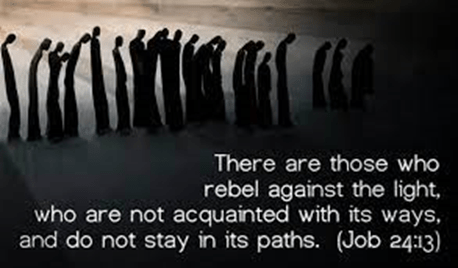
Then there are those who rebel against the light, not knowing its ways or staying on its paths. When daylight is gone, the murderer rises to kill the poor and needy; in the night he is like a thief. The eye of the adulterer watches for twilight. Thinking, ‘No eye will see me,’ he covers his face. In the dark they dig through houses; by day they shut themselves in, never to experience the light. For to them, deep darkness is their morning; surely they are friends with the terrors of darkness! They are but foam on the surface of the water; their portion of the land is cursed, so that no one turns toward their vineyards.
As drought and heat consume the melting snow, so Sheol steals those who have sinned. The womb forgets them; the worm feeds on them; they are remembered no more. So injustice is like a broken tree. They prey on the barren and childless, and show no kindness to the widow. Yet by His power, God drags away the mighty; though rising up, they have no assurance of life. He gives them a sense of security, but His eyes are on their ways. They are exalted for a moment, then they are gone; they are brought low and gathered up like all others; they are cut off like heads of grain. If this is not so, then who can prove me a liar and reduce my words to nothing?”
From Job’s descriptions, it is obvious that he is living in a time of lawlessness. When the Israelites refused to follow God’s commands given through Moses, it was said of them in the Book of Judges that “In those days there was no king in Israel; every man did what was right in his own eyes.” (Judges 21:25) Things in the Land of Uz appear to be in a similar state.
The descriptions of this depravity are chilling: oppression of the poor and needy, of widows and orphans, seizure of even nursing infants to satisfy debts, refusal to pay workers so that they gain nothing from the foodstuffs they handle – the list is stultifying and appalling. Then Job begins to describe thieves who dig through the walls of houses by night, only to rob during the day when owners are away. “For to them, deep darkness is their morning; surely they are friends with the terrors of darkness!” And Job vividly describes the lot of the wicked.“They are but foam on the surface of the water; their portion of the land is cursed, so that no one turns toward their vineyards.”
Job is angry that God does not appear to instantly punish all these evil-doers, and yet, he also vividly describes the fate of the wicked. “As drought and heat consume the melting snow, so Sheol steals those who have sinned. The womb forgets them; the worm feeds on them; they are remembered no more.” “Yet by His power, God drags away the mighty; though rising up, they have no assurance of life. He gives them a sense of security, but His eyes are on their ways. They are exalted for a moment, then they are gone; they are brought low and gathered up like all others; they are cut off like heads of grain.”
Reading these words, you wonder how Job can argue both sides of the question. How can Job be angry with God for not immediately punishing the wicked at the same time he is also describing the horrible fate of the wicked? Sounds confusing; but face it, suffering doesn’t make for logical thinking. If you are miserable enough, your thoughts can race around like demented gerbils on exercise wheels.

APPLICATION: What is really frustrating Job is that he has tried to live righteously his entire life and yet he is suffering horribly. Job has been around a long time and he is fully aware of the activities of the wicked in his area. If you could graph Job’s emotions, they might resemble the ECG of a patient with ventricular fibrillation. How can anybody possibly stay calm when they are suffering as Job is?
“BE AT PEACE!” For the last year, this is the message that God has persistently and consistently given me. During that time, my husband and I have grieved for the loss of my beloved brother and some close friends. We have faced health problems, upheaval in our working situation, and a number of other challenges. At the hospital, the staff and I have struggled to heal patients who have come to us after they have exhausted all other treatments.
Only recently, we lost a handsome five-year-old little boy who had fallen out of a tree. The original injury was mild; however, the family compounded the problem by consulting an herbalist, who fed the child concoctions that destroyed the boy’s kidneys. We found ourselves helpless in the face of overwhelming odds. But our problems pale in the face of those faced by some of my Facebook friends.
Thanks to Facebook, I follow the work of an American missionary couple ministering in Kiev, Ukraine. These folks face Russian air strikes and all kinds of other threats, and the worry about the health of a daughter battling cancer; yet, they continue to live and work in one of the world’s hot spots. How are they managing to do this? Only God can give them peace of mind and heart.
How can we remain at peace when our lives are in chaos? Jesus gave his disciples the answer during his teaching the night before he was crucified. “ “Do not let your hearts be troubled. You believe in God; believe also in me.” We may not control our circumstances, but we can control our reaction to them. We must take authority over our thoughts and refuse to entertain anxiety. God tells us in Isaiah 26:3 “You will keep in perfect peace those whose minds are steadfast, because they trust in you.”

“Well, that’s all very well for you to say,” you might think, “but you don’t know how bad my situation is.” True. But God DOES know, and God wants you to have His peace in the middle of your mess as well! You might feel as if such peace is an impossibility, but God can also give you the strength to reject anxiety and focus on Him. Pray and ask God to help you; He will. Many people have found it helpful to write out a few key scriptures on note cards and post them where they can be seen several times a day. Now that we all carry cell phones, you can keep a list of verses on your phone. Go online and Google “peace Bible verses” and you will get a long list. Next, find one or two verses that speak particularly to you. Those are the verses you need.
There is a meme that says, “Instead of counting sheep, how about talking to the Good Shepherd?” Psalm 61:2 tells us, “From the ends of the earth I call out to You whenever my heart is faint. Lead me to the rock that is higher than I.” Feeling overwhelmed and undone by worry? Ask God for help; He will never disappoint you.
PRAYER: Father God, thank You for loving us and for caring for us. Lord, there are many people who feel overwhelmed and who need peace. Help them to turn to You and give them Your Peace that is beyond all understanding. In the mighty and precious Name of King Jesus. Amen.














 Burunche's Blog