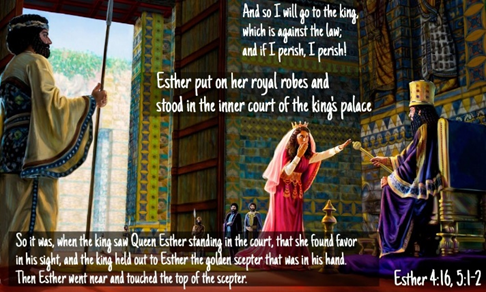
Esther Approaches the King
“On the third day, Esther put on her royal attire and stood in the inner court of the palace across from the king’s quarters. The king was sitting on his royal throne in the royal courtroom, facing the entrance. As soon as the king saw Queen Esther standing in the court, she found favor in his sight. The king extended the gold scepter in his hand toward Esther, and she approached and touched the tip of the scepter.
“What is it, Queen Esther?” the king inquired. “What is your request? Even up to half the kingdom, it will be given to you.” “If it pleases the king,” Esther replied, “may the king and Haman come today to the banquet I have prepared for the king.” “Hurry,” commanded the king, “and bring Haman, so we can do as Esther has requested.”
So the king and Haman went to the banquet that Esther had prepared. And as they drank their wine, the king said to Esther, “What is your petition? It will be given to you. What is your request? Even up to half the kingdom, it will be fulfilled.”
Esther replied, “This is my petition and my request: If I have found favor in the sight of the king, and if it pleases the king to grant my petition and fulfill my request, may the king and Haman come tomorrow to the banquet I will prepare for them. Then I will answer the king’s question.”
Haman’s Plot against Mordecai
That day Haman went out full of joy and glad of heart. At the King’s Gate, however, he saw Mordecai, who did not rise or tremble in fear at his presence. And Haman was filled with rage toward Mordecai. Nevertheless, Haman restrained himself and went home. And calling for his friends and his wife Zeresh, Haman recounted to them his glorious wealth, his many sons, and all the ways the king had honored and promoted him over the other officials and servants.
“What is more,” Haman added, “Queen Esther invited no one but me to join the king at the banquet she prepared, and I am invited back tomorrow along with the king. Yet none of this satisfies me as long as I see Mordecai the Jew sitting at the King’s Gate.”
His wife Zeresh and all his friends told him, “Have them build a gallows fifty cubits high,(75 feet high!) and ask the king in the morning to have Mordecai hanged on it. Then go to the banquet with the king and enjoy yourself.”
The advice pleased Haman, and he had the gallows constructed.”
Reading about Esther’s actions, we wonder what she can possibly be thinking! Here’s Haman, the arch-enemy of the Jews; yet, Esther is inviting him to a banquet along with King Xerxes. But Esther and her maids have been fasting and praying, and God is the One who has instructed Esther in how to proceed. Taking her courage in both hands, Esther enters the outer court, where King Xerxes sees her. King Xerxes extends the golden scepter, Esther touches it, and Xerxes makes a magnificent offer. Would Xerxes actually have given Esther half the kingdom at this point? Who knows? Perhaps Xerxes has been drinking again, but it’s far more likely that Xerxes has been keeping close tabs on Esther and has been receiving glowing reports about her kindness, her gentleness, and her sweet nature. Palace spy systems have always been very efficient, and the eunuchs serving Esther probably report to the king regularly.
Haman is stoked! Not only has Xerxes honored Haman above all the other princes, but now even Queen Esther has issued an exclusive invitation. As Haman is rushing home to share this latest honor with his family, he sees Mordecai just outside the King’s Gate. Mordecai is probably still wearing sackcloth and ashes and looks wretched; moreover, he refuses to rise or bow to Haman as Haman passes. “The very nerve of that abominable Jew!” Haman thinks. “I’ll settle with him as soon as possible.” Later, Haman’s wife and friends advise him to build a towering gallows seventy-five feet high and have Mordecai hanged on it before he goes off to Esther’s banquet. Things are looking black for Mordecai and the Jews.

APPLICATION: What could be more innocuous than a private banquet? A meeting with only King Xerxes and Haman ensures that King Xerxes will not be embarrassed and at the same time allows Esther to test the king’s emotional state at this point. Xerxes is well known for being a mean drunk; look what happened to Queen Vashti. Despite the king’s munificent statements offering Esther up to half his kingdom, Esther knows it’s far better to make modest requests and see what God will do with the situation.
Notice what Esther is NOT doing. Esther is not planning to poison Haman, although that option has probably been used at more than one royal banquet. Instead, Esther is offering her enemy hospitality. If we overlook the significance of this act, we are underestimating its importance. Purim is one of the traditional Jewish festivals and it is helpful to see what the Talmud says about it. Alan D. Corré, Emeritus Professor of Hebrew Studies, University of Wisconsin-Milwaukee has collected the following comments from the Talmud:
“Purim [The Feast of Lots] is a light-hearted festival, and we catch the Rabbis in a festive mood when they discuss in the Talmud this question: Why did Esther invite Haman to a banquet? Presumably, she had no liking for the man; moreover, could she not have persuaded the King to revoke his evil decree against the Jews without having the hated Haman to a banquet? The Rabbis give no less than twelve separate views on what Esther’s motive was.
Rabbi Elazar: Esther hoped that Haman would make some blunder at the banquets, thereby offending the King. Apparently this rabbi felt that there was some danger in accepting dinner invitations from ladies.
Rabbi Joshua: Esther was a religious young woman, and she simply followed the instructions in the book of Proverbs, 25.2 “If thine enemy be hungry, give him food to eat; and if he be thirsty, give him water to drink.” In other words, act the gentleman towards your enemies, and have confidence that God will ultimately right the wrong. Notice the difference in emphasis between these two views. In one, Esther herself is a practical schemer, fighting evil with the same; in the other she is a religious believer, relying on God’s mercies.
Rabbi Meir: He is reputed to be one of the cleverest of the Talmudic rabbis. According to him, Esther had an idea that Haman intended to overthrow the king, and set himself up as monarch. She felt that Haman’s star was in the ascendent and wanted to postpone what she thought would be a successful revolt. So she placated Haman by inviting him to a banquet.
Rabbi Judah
This was a ruse on Esther’s part to avoid recognition as a Jewess. She felt she could work better if no one knew her origin, and her invitation to Haman was a smoke screen, since obviously no Jewess would invite him.
Rabbi Nehemiah
His opinion is psychologically interesting. Esther invited Haman so that the Jews would not say: “We have a friend at the court” and thus not bother to seek God’s mercy. The rabbi knew that for most people God is the last resort. If they can rely on men, however fickle, they prefer it. Esther wanted the people to feel that God had saved them through her, not that she saved them.
Rabbi Jose
Esther wanted to get to know Haman better, and thereby discover his weak spots.
Rabbi Simon ben Menasya
Esther’s action was a very shocking one, which she did deliberately in order, as it were, to delude God into thinking that even Esther had joined Haman, and make him arise in anger and do something about it! Such an explanation seems incredibly naive to us, yet it shows to what degree God was a part of the lives of these people. He was like a friend, whom, when all else failed, you could irritate into doing something for you. Naive, but touching too.
Rabbi Joshua ben Korha
“Cherchez la femme!” He thinks that Esther wanted to give the king the impression that she was in love with Haman, and hence the king would, in best Persian style, do away with them both. No doubt Esther was ready to die for her people, but it is hard to believe that her strategem included her own death.
Rabban Gamliel
She wanted Haman there, so that when she denounced him, the king could point to him and order him executed before he had a chance to change his fickle and not too bright mind. This explanation is so simple that it will appeal only to the least romantic of us.
Rabbi Eliezer of Modin
Esther wanted to make the princes and the court jealous of Haman, whereupon they would arrange for him to be taken for a ride different from the one that, to his chagrin, he had to arrange for Mordecai. The great commentator Rashi cites this explanation with approval.
Rabba
“Pride comes before a fall.” Esther wanted to blow up Haman until he burst (which, of course, he did.)
Abbaye and Rava
A very common theme in literature is the downfall of the wicked while they are steeped in their orgies. Think of the destruction of the suitors in the Odyssey. Think of the death of Job’s sons, and especially the feast of Belshazzar who was too bleary-eyed to read the writing on the wall, and had to call in the sober Daniel to do if for him. Esther wanted to have a Belshazzar’s feast, in which Haman would be the victim.
What can we learn from this? First, there is more in Holy Writ than meets the eye. Second, the rabbis are very ingenious at explaining it. Third, Esther was a very clever young woman.
The end of the tale is this. One of the rabbis had a visitation from Elijah, who, in Jewish folklore, is the man who can answer all questions, a veritable quiz producer’s ideal. The rabbi asked: “Which opinion was right?” He answered: “They all were.” Apparently Esther was cleverer and the rabbis more ingenious even than we thought.”
I feel that God advised Esther to hold this banquet and the subsequent ones and that God knew exactly how He was going to resolve the issue. I also suspect that Esther was acting in accordance with God and going one day at a time. This situation was so precarious that scheming on Esther’s part might have caused the whole thing to fail.
Personally, I have found that God frequently tells me to take one step and then after I have made a start, He will direct the next step. But God rarely tells me His entire plan because I would probably be tempted to try to fix it and I would make a complete mess of the situation. So Esther and her maids planned the first banquet and Esther made the invitation in fear and trembling, setting an example for all of us who must follow God’s leading.
PRAYER: Father God, thank You for loving us and for caring for us. Lord, thank You that even when we encounter problems that seem insurmountable, You still have perfect solutions. Help us to trust You and to take the first steps, knowing that You will give more guidance as we go along. In the mighty and precious Name of King Jesus. Amen.
 Burunche's Blog
Leave a comment