
“On the thirteenth day of the twelfth month, the month of Adar, the edict commanded by the king was to be carried out. On this day the enemies of the Jews had hoped to overpower them, but now the tables were turned and the Jews got the upper hand over those who hated them. The Jews assembled in their cities in all the provinces of King Xerxes to attack those determined to destroy them. No one could stand against them, because the people of all the other nationalities were afraid of them. And all the nobles of the provinces, the satraps, the governors, and the king’s administrators helped the Jews, because fear of Mordecai had seized them. Mordecai was prominent in the palace; his reputation spread throughout the provinces, and he became more and more powerful.
The Jews struck down all their enemies with the sword, killing and destroying them, and they did what they pleased to those who hated them. In the citadel of Susa, the Jews killed and destroyed five hundred men. They also killed Parshandatha, Dalphon, Aspatha, Poratha, Adalia, Aridatha, Parmashta, Arisai, Aridai and Vaizatha, the ten sons of Haman son of Hammedatha, the enemy of the Jews. But they did not lay their hands on the plunder.
The number of those killed in the citadel of Susa was reported to the king that same day. The king said to Queen Esther, “The Jews have killed and destroyed five hundred men and the ten sons of Haman in the citadel of Susa. What have they done in the rest of the king’s provinces? Now what is your petition? It will be given you. What is your request? It will also be granted.”
“If it pleases the king,” Esther answered, “give the Jews in Susa permission to carry out this day’s edict tomorrow also, and let Haman’s ten sons be impaled on poles.” So the king commanded that this be done. An edict was issued in Susa, and they impaled the ten sons of Haman. The Jews in Susa came together on the fourteenth day of the month of Adar, and they put to death in Susa three hundred men, but they did not lay their hands on the plunder.
Meanwhile, the remainder of the Jews who were in the king’s provinces also assembled to protect themselves and get relief from their enemies. They killed seventy-five thousand of them but did not lay their hands on the plunder. This happened on the thirteenth day of the month of Adar, and on the fourteenth they rested and made it a day of feasting and joy. The Jews in Susa, however, had assembled on the thirteenth and fourteenth, and then on the fifteenth they rested and made it a day of feasting and joy. That is why rural Jews—those living in villages—observe the fourteenth of the month of Adar as a day of joy and feasting, a day for giving presents to each other.
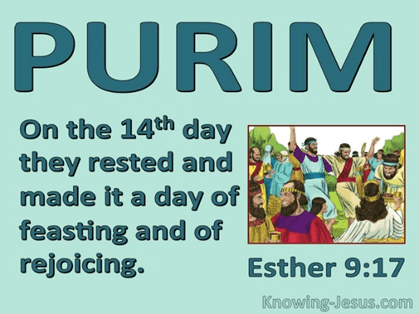
Purim Established Mordecai recorded these events, and he sent letters to all the Jews throughout the provinces of King Xerxes, near and far, to have them celebrate annually the fourteenth and fifteenth days of the month of Adar as the time when the Jews got relief from their enemies, and as the month when their sorrow was turned into joy and their mourning into a day of celebration. He wrote them to observe the days as days of feasting and joy and giving presents of food to one another and gifts to the poor.
So the Jews agreed to continue the celebration they had begun, doing what Mordecai had written to them. For Haman son of Hammedatha, the Agagite, the enemy of all the Jews, had plotted against the Jews to destroy them and had cast the pur (that is, the lot) for their ruin and destruction. But when the plot came to the king’s attention, he issued written orders that the evil scheme Haman had devised against the Jews should come back onto his own head, and that he and his sons should be impaled on poles. (Therefore these days were called Purim, from the word pur.) Because of everything written in this letter and because of what they had seen and what had happened to them, the Jews took it on themselves to establish the custom that they and their descendants and all who join them should without fail observe these two days every year, in the way prescribed and at the time appointed. These days should be remembered and observed in every generation by every family, and in every province and in every city. And these days of Purim should never fail to be celebrated by the Jews—nor should the memory of these days die out among their descendants.
So Queen Esther, daughter of Abihail, along with Mordecai the Jew, wrote with full authority to confirm this second letter concerning Purim. And Mordecai sent letters to all the Jews in the 127 provinces of Xerxes’ kingdom—words of goodwill and assurance—to establish these days of Purim at their designated times, as Mordecai the Jew and Queen Esther had decreed for them, and as they had established for themselves and their descendants in regard to their times of fasting and lamentation. Esther’s decree confirmed these regulations about Purim, and it was written down in the records.”
75,800 people-that’s how many of their enemies the Jews slaughtered throughout the Persian Empire. In the capital of Susa, the Jews killed 800 men. While that figure sounds impressive, the population of the Persian Empire at that time stood at close to fifty million. That means that the percent of citizens killed by the Jews represented 0.15% of that population. Throughout the empire, the Jews refused to lay a hand on the plunder, leaving it for the families of their enemies. “No one could stand against them, because the people of all the other nationalities were afraid of them. And all the nobles of the provinces, the satraps, the governors, and the king’s administrators helped the Jews, because fear of Mordecai had seized them. Mordecai was prominent in the palace; his reputation spread throughout the provinces, and he became more and more powerful.”
Why were these people of other nationalities willing to help the Jews? The prophet Jeremiah had already sent the message to the exiles that they were to seek the peace and prosperity of the kingdoms to which they had been taken. The Jews weren’t trouble makers. There is compelling evidence to suggest that once the Jews were exiled, many of them actually became more serious about their religion than they had been before being captured. It was one thing to play with paganism in Israel where God was protecting the Jews and a different thing when dropped into a culture where paganism was the norm.
The people of other nationalities were also willing to help the Jews because they realized that Haman could just as easily have targeted them for destruction. Mordecai was obviously a wise man and a fair one and not given to making ridiculous decisions while drunk. God gave Mordecai favor and influence with all of these people, and his reputation spread throughout the empire.
APPLICATION: The story of Esther and Mordecai has so many wonderful parts to it. First, there is the obvious love and respect between Esther and Mordecai. Had Mordecai not raised Esther to be kind and virtuous, no amount of physical beauty would have helped. It was Esther’s gentleness, charm, and bright spirit that won her the admiration of the eunuchs who supervised the harem. It was those eunuchs who wisely advised Esther on how to dress and how to comport herself when she was brought to King Xerxes. It was likely those same eunuchs who continued to advise Esther as she navigated the challenges of queenship.
Mordecai was a man of great faith and integrity, well known to the other citizens of Susa. Long before Mordecai came to prominence, there were probably many people who respected him and trusted him as a man of his word. But the real star of the Esther story is the One True Living God of Israel. Mordecai worshiped God, and God arranged for Mordecai to raise Esther. God further arranged for Esther to be taken into the palace and to please the king so that he made her the new queen. Because Mordecai worshiped God, he refused to bow before Haman; evidently, Mordecai had no problems meeting King Xerxes. It was Haman’s irritation at Mordecai’s refusal to bow that led Haman to plot extermination for the Jews. Why Haman? Had Haman not risen to prominence, someone else would have likely attacked the Jews. By soundly and completely defeating Haman and wiping out his family, God sent a strong message throughout the Persian Empire that the Jews were His people and were to be left alone.
Remaining faithful to God can be very difficult, and there are many temptations to relax, give up, give in, etc. At such times, it is good to remember Mordecai, that righteous man who remained faithful even in the face of extreme persecution. We should also take heart! The Bible says that “God is no respecter of persons.” That means that God doesn’t play favorites. The same God who used Mordecai and Esther to deliver the Jews and to preserve other minorities in the Persian Empire is still on the throne of the universe today. And God continues to hear the prayers of those who trust Him.
PRAYER: Father God, thank You for loving us and for caring for us. Lord, help us to trust You even when things seem at their most hopeless. Help us to follow You even when we are not sure where You are leading us. And thank You that You can save and deliver us just as You did Mordecai and Esther and the Jews of the Persian Empire. In the mighty and precious Name of King Jesus. Amen.
 Burunche's Blog
Leave a comment