
Prologue
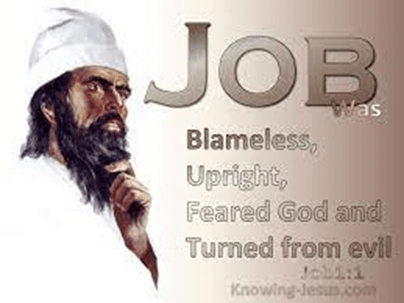
“In the land of Uz there lived a man whose name was Job. This man was blameless and upright; he feared God and shunned evil. He had seven sons and three daughters, and he owned seven thousand sheep, three thousand camels, five hundred yoke of oxen and five hundred donkeys, and had a large number of servants. He was the greatest man among all the people of the East.
His sons used to hold feasts in their homes on their birthdays, and they would invite their three sisters to eat and drink with them. When a period of feasting had run its course, Job would make arrangements for them to be purified. Early in the morning he would sacrifice a burnt offering for each of them, thinking, “Perhaps my children have sinned and cursed God in their hearts.” This was Job’s regular custom.
One day the angels came to present themselves before the Lord, and Satan also came with them. The Lord said to Satan, “Where have you come from?”
Satan answered the Lord, “From roaming throughout the earth, going back and forth on it.”
Then the Lord said to Satan, “Have you considered my servant Job? There is no one on earth like him; he is blameless and upright, a man who fears God and shuns evil.”
“Does Job fear God for nothing?” Satan replied. “Have you not put a hedge around him and his household and everything he has? You have blessed the work of his hands, so that his flocks and herds are spread throughout the land. But now stretch out your hand and strike everything he has, and he will surely curse you to your face.”
The Lord said to Satan, “Very well, then, everything he has is in your power, but on the man himself do not lay a finger.”
Then Satan went out from the presence of the Lord.
One day when Job’s sons and daughters were feasting and drinking wine at the oldest brother’s house, a messenger came to Job and said, “The oxen were plowing and the donkeys were grazing nearby, and the Sabeans attacked and made off with them. They put the servants to the sword, and I am the only one who has escaped to tell you!”
While he was still speaking, another messenger came and said, “The fire of God fell from the heavens and burned up the sheep and the servants, and I am the only one who has escaped to tell you!”
While he was still speaking, another messenger came and said, “The Chaldeans formed three raiding parties and swept down on your camels and made off with them. They put the servants to the sword, and I am the only one who has escaped to tell you!”
While he was still speaking, yet another messenger came and said, “Your sons and daughters were feasting and drinking wine at the oldest brother’s house, when suddenly a mighty wind swept in from the desert and struck the four corners of the house. It collapsed on them and they are dead, and I am the only one who has escaped to tell you!”
At this, Job got up and tore his robe and shaved his head. Then he fell to the ground in worship and said:
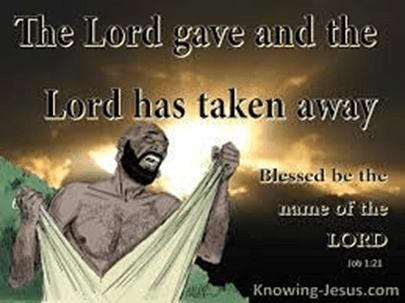
“Naked I came from my mother’s womb, and naked I will depart. The Lord gave and the Lord has taken away; may the name of the Lord be praised.” In all this, Job did not sin by charging God with wrongdoing.”
Many of us are familiar with this story. Job is a righteous God – fearing man who has everything until one day he loses it all! At this point, most of us would be ready to give up, but Job’s response is classic: “Naked I came from my mother’s womb, and naked I will depart. The Lord gave and the Lord has taken away; may the name of the Lord be praised.” The first question is this: How did Job know about God in the first place? Job lived in a society in which there was a plethora of gods of various kinds; how did Job come to know about the One True Living God? Ecclesiastes 3:11 tells us, “ He has also set eternity in the human heart; yet[a] no one can fathom what God has done from beginning to end.” Romans 1:20 says, “ For since the creation of the world God’s invisible qualities—his eternal power and divine nature—have been clearly seen, being understood from what has been made, so that people are without excuse.” The next question is even more difficult: Why does Job trust God so completely?
After all these losses, most fetish worshipers would be scurrying around trying to find animals to sacrifice to propitiate their gods. Others might be cursing the gods for failing them. But Job responds in faith and falls to the ground in worship.
APPLICATION: We have an elderly friend in our village who worked for the missionaries as a cook for many years. Our friend had a large family, and one of his sons was a university student who was also leading the church at his school. Our friend’s son had Hepatitis B that had been dormant for years; however, it suddenly flared up, throwing the young man into liver failure and killing him within 48 hours. Nothing could be done. Our friend responded very similarly to Job. “The Lord gives and the Lord takes away. Blessed be the name of the Lord!”
The following information comes from Wikipedia: J.B. is a 1958 play written in free verse by American playwright and poet Archibald MacLeish, and is a modern-day retelling of the story of the biblical figure Job. The play is about J.B. (a stand-in for Job), a devout millionaire with a happy domestic life whose life is ruined. Plot summary:
The play opens in “a corner inside an enormous circus tent”. Two vendors, Mr. Zuss (evoking the chief Greek god Zeus) and Nickles (i.e. “Old Nick,” a folk name for the Devil) begin the play-within-a-play by assuming the roles of God and Satan, respectively. They overhear J.B., a wealthy New York banker, describe his prosperity as a just reward for his faithfulness to God. Scorning him, Nickles wagers that J.B. will curse God if his life is ruined. Nickles and Zuss then watch as J.B.’s children are killed and his property is ruined and the former millionaire is left to the streets. J.B. is then visited by three Comforters: Bildad, Eliphaz, and Zophar (representing history, science, and religion), who each offer a different explanation for his plight. J.B. declines to believe any of them, instead asking God himself to explain. Instead, he encounters Zuss and Nickles. Nickles urges him to commit suicide to spite God; Zuss offers him his old life back if he will promise to obey God. J.B. rejects them both, and instead finds comfort in the person of his wife Sarah. The play ends with the two building a new life together.”
The ending of the play J.B. undoubtedly reflects MacLeish’s personal faith or lack of it. Blessedly, the Book of Job has a far better ending. In the next few weeks we will journey with Job, examining his trials and his triumphs. Why study Job? While very few of us may lose everything we own plus our families, most of us can identify with Job and his frustrations at God. As we go, let’s see what God wants us to learn.
PRAYER: Father God, thank You for loving us and for caring for us. Lord, help us to have teachable hearts. And thank you for Your mercies. In the mighty and precious Name of Jesus. Amen.
 Burunche's Blog
Leave a comment