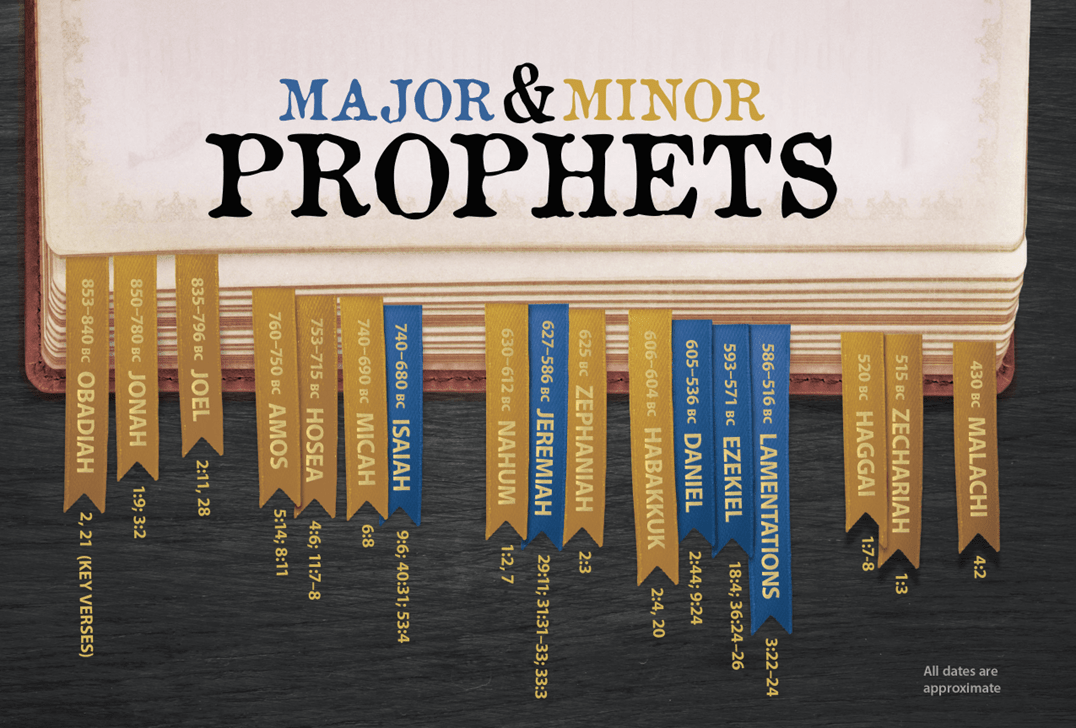
Having considered Micah, we are now turning to study the remaining eleven minor prophets. I must apologize to readers who might wonder why I embarked on a study of one minor prophet before introducing all of them. When I write these Bible studies, I ask God where He wants me to go and then analyze the book that God indicates. I am not working sequentially through the Old Testament. Only God knows the human heart and only God knows the words readers need at a particular moment.
For an excellent explanation of the Minor Prophets, I am copying information from https://clearcreek.org “Four Truths About the Minor Prophets” by Yancey Arrington. The full article can be read at: https://clearcreekresources.org/2020/06/02/four-truths-about-the-minor-prophets
“There are four major prophets in the Old Testament: Isaiah, Jeremiah, Ezekiel, and Daniel. They are called major because of their length. Fun fact: these books are also ordered together in our English Bibles with only Lamentations stuck in the middle. Thus, the minor prophets, twelve books in all, are named so because they are comparatively short, not because they are of lesser importance.
The major and minor prophets are collectively known in the Hebrew Bible as the Latter Prophets (or Writing Prophets, because they authored their own works). This is because they came later in Israel’s history, as opposed to the earlier books of Joshua, Judges, 1st and 2nd Samuel, 1st and 2nd Kings. These books are referred to as the Former Prophets.
The prophetic books aren’t all prophecy. To read any of the minor prophets is to find books composed of different genres of literature in addition to prophetic material. These writings also contain genres such as narrative, apocalyptic, wisdom, poetry, songs, and even sermons. This means that in interpreting these books well we must have different rules for reading different styles of writing. That may sound challenging but it’s worth it because it allows us to better understand the books as they were originally given.
The prophecies in the minor prophets aren’t always about our future. One of the most common misconceptions about the prophetic books is that the prophecies therein are entirely about the days and times still awaiting modern folks. We need to remember that those prophecies were meant for the original audience thousands of years ago. Many of those prophecies, while yet to be fulfilled in the future for them, actually came to pass centuries ago for us. Scholars Gordon Fee and Douglas Stuart point out in their co-authored book, How to Read the Bible for All Its Worth (page 166),that less than 2 percent of Old Testament prophecy has to do with Jesus, less than 5 percent deal with the New Covenant age (e.g., the age we currently reside), and less than 1 percent concerns events yet to come.
Prophets didn’t just spend time foretelling the future. It is true that part of a prophet’s role was to foretell the future. The most popular Hebrew name for prophets was nabi which meant “called” and very likely was tied to the fact that these individuals were “called” by God and also “called out” to the people on God’s behalf. But prophets had additional functions central to their role. One helpful way to see this is in the difference between forthtelling and foretelling.
We rightfully think of the prophets as foretellers of the future. However, the prophets spent a lot of their time forthtelling. As scholar Sidney Greidanus notes, the prophets “uncover and point out the idolatry, the corruption, the injustice that exists under the veneer of religiosity, and they call for a radical change” in God’s people (The Modern Preacher and the Ancient Text, 230). Essentially, the prophets are God’s covenant enforcement mediators for ancient Israel. Much of reading the minor prophets is to see text after text not of a prophet predicting the future but calling Israel to be faithful to God’s ways in the present.”
APPLICATION: There’s a comic strip entitled “It’s all about you.” One of the main characters in the strip is a self-centered office worker who feels that everyone else around him exists to meet his needs. Many times, we approach Scripture with the same attitude as this man: we expect Scripture should meet our immediate needs and speak to our particular situation. If we do not get what we desire out of a piece of Scripture, we are ready to give up immediately. Now God does use His Word to speak to us; however, we are missing a great deal if we refuse to look at the setting in which the prophecies were originally given.
Prophets are called to warn and admonish as well as to foretell future events. Although the circumstances varied, most of the Old Testament prophets spent much of their time warning the nations of Israel and Judah of coming destruction if they failed to return to serving the Lord faithfully.
Morals were deteriorating. Families were falling apart, as indicated by Micah’s lament in Micah 7. Worship services at the temple had lost much of their meaning and had become mere rituals. Rather than bringing choice animals for offerings, worshipers were bringing in the lame and the maimed, something God had expressly forbidden them to do. Forsaking the One True Living God, the Jews were now serving every pagan deity going, including Molech, a demon that demanded child sacrifices.
When a society is willing to approve the killing of the innocent and vulnerable, it has lost much of its moral compass. It is against this setting that we should consider the remaining Minor Prophets. But we must remember that in God’s economy, there are no “minor” or “major” events or individuals. Jesus told his disciples that God even took note when a sparrow would die.
Why should the preservation of the Minor Prophets encourage each one of us? Most of us live lives of obscurity. The existence of these books of prophecy graphically demonstrate that God has thought so much of the words He gave these men that He has preserved them forever. The faithful example of these men can inspire us to be faithful as well, knowing that we serve a God who is eternally faithful.
PRAYER: Father God. Thank You for loving us and for caring for us. Lord, help us to remain faithful even when things are difficult, knowing that others have undergone far worse trials than we have. In the mighty and precious Name of King Jesus. Amen.
 Burunche's Blog
Leave a comment