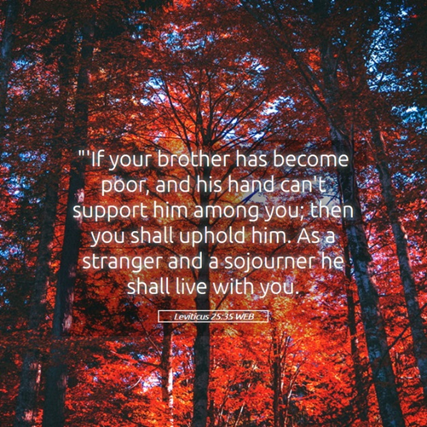
Lending to the Poor “‘If one of your brethren becomes poor, and falls into poverty among you, then you shall help him, like a stranger or a sojourner, that he may live with you. Take no usury or interest from him; but fear your God, that your brother may live with you. You shall not lend him your money for usury, nor lend him your food at a profit. I am the Lord your God, who brought you out of the land of Egypt, to give you the land of Canaan and to be your God.
The Law Concerning Slavery ‘And if one of your brethren who dwells by you becomes poor, and sells himself to you, you shall not compel him to serve as a slave. As a hired servant and a sojourner he shall be with you, and shall serve you until the Year of Jubilee. And then he shall depart from you—he and his children with him—and shall return to his own family. He shall return to the possession of his fathers. For they are My servants, whom I brought out of the land of Egypt; they shall not be sold as slaves. You shall not rule over him with rigor, but you shall fear your God. And as for your male and female slaves whom you may have—from the nations that are around you, from them you may buy male and female slaves. Moreover you may buy the children of the strangers who dwell among you, and their families who are with you, which they beget in your land; and they shall become your property. And you may take them as an inheritance for your children after you, to inherit them as a possession; they shall be your permanent slaves. But regarding your brethren, the children of Israel, you shall not rule over one another with rigor.

‘Now if a sojourner or stranger close to you becomes rich, and one of your brethren who dwells by him becomes poor, and sells himself to the stranger or sojourner close to you, or to a member of the stranger’s family, after he is sold he may be redeemed again. One of his brothers may redeem him; or his uncle or his uncle’s son may redeem him; or anyone who is near of kin to him in his family may redeem him; or if he is able he may redeem himself. Thus he shall reckon with him who bought him: The price of his release shall be according to the number of years, from the year that he was sold to him until the Year of Jubilee; it shall be according to the time of a hired servant for him. If there are still many years remaining, according to them he shall repay the price of his redemption from the money with which he was bought. And if there remain but a few years until the Year of Jubilee, then he shall reckon with him, and according to his years he shall repay him the price of his redemption. He shall be with him as a yearly hired servant, and he shall not rule with rigor over him in your sight. And if he is not redeemed in these years, then he shall be released in the Year of Jubilee—he and his children with him. For the children of Israel are servants to Me; they are My servants whom I brought out of the land of Egypt: I am the Lord your God.”
One of the surprising things about God’s laws is how practical they are. God knows that there will be those who will become so poor that they might be forced to sell themselves into slavery, so He is already providing for that eventuality.
- The poor are not to be taken advantage of. “You shall not lend him your money for usury, nor lend him your food at a profit.” God demands soft loans without interest and free offering of food.
- An Israelite selling himself into slavery to another Israelite will be treated as a hired servant and not as a slave and he and his family will become free in the Year of Jubilee.
- God is allowing the Israelites to buy slaves who are not Israelites. These people will become permanent property that can be passed down to further generations.
- If an Israelite sells himself into slavery to a non-Israelite, he can be redeemed at any time and the price will be calculated based on the length of time left until the Year of Jubilee.
- The Israelites are God’s servants and are to be treated as such.
These verses are highly controversial because they appear to support the idea of slavery in modern society. Tragically, citizens of America, Great Britain, and other countries have used these verses to excuse their practice of slavery on farms and plantations. But slavery was a fact of life in Old Testament times, and even in Old Testament times, God warned His people to treat their slaves kindly. Many of the practices of Old Testament times have been abandoned, and slavery is definitely one of those practices.
APPLICATION: We work with poor people in rural northeastern Ghana and northern Togo. How poor? Recently, one family from Togo had four children sick with typhoid at the same time. The day one daughter was operated for a typhoid perforation at our hospital, her father suffered a heart attack and died! When I began talking with the mother and auntie about getting the child better food, I suddenly realized that they themselves were starving just to have enough money to feed the child. (The girl is now receiving Plumpy Nut and formula plus electrolyte drink with hibiscus powder to give her Vitamin C.) Right now we are in farming season and families who have spent everything on seed, fertilizer, plowing, etc., have nothing left for themselves. We have begun giving the mother and auntie money so their relatives can afford to feed them. This same girl has asked for a popular local fruit juice; however, one box costs as much money as we are giving her mother and auntie for food daily.
Sometimes the regulations in Leviticus seem so exhaustive that we are tempted to overlook the reason for their existence in the first place. God knows there will be poor people and God also knows there will be rich people ready to take full advantage of the poor, hence the proscriptions against usury and collecting interest on loans to other Israelites. God also orders those holding slaves to treat them kindly.
If slavery is so wrong, why isn’t God forbidding slavery completely? These commands are being given within a particular cultural context, one in which slavery is a reality. David Guzik in Enduring Word Commentary says this: “Though it is almost impossible for us to relate to in the modern world, this kind of slavery was necessary and helpful in the ancient world. For most of humanity’s history, the poorest people were sometimes confronted with a choice between death by starvation or becoming a slave. In such circumstances, it is hard to call slavery good, but it was certainly preferred to the alternative (death)… Foreign slaves from debt or poverty did not have the same rights as Israelites who went into servitude because of debt. They could be held as slaves for life (assuming their debt or obligation was never paid), though they had to be treated humanely (Exodus 20:8-11).
i. Exodus 21:16 specifically says that kidnapping a man to sell him was a sin, and not allowed in Israel. Later, the prophet Amos rebuked Tyre for their traffic in slaves as a violation of the covenant of brotherhood (Amos 1:9-10).
ii. This is a subtle yet important difference between slavery as it was (and is) commonly practiced and slavery as regulated in the Bible. Most slavery (ancient and modern) was actually a form of kidnapping – the taking and imprisoning of a person against their will. As regulated in the Bible (and as practiced in some other ancient cultures), slavery was received willingly (usually as payment for debt) or, in the case of war, was an alternative to death. In ancient Israel, people from other cultures were not kidnapped and enslaved (as was the practice in the African slave trade).” (https://enduringword.com/bible-commentary/leviticus-25/)
Slavery still exists throughout the world. The movie The Sound of Freedom has highlighted the horrors of sexual slavery; however, there are many places where child slaves are used in fishing, mining, etc. Those demanding that everyone shift to electric vehicles fail to realize that much of the precious metals used in the batteries are being mined by child slaves.
As we read these verses, let us ask God how we can most practically help the poor among us. Let us band together to abolish slavery in any form throughout the world and pray for a swift end to it. Pray for all those delivering people out of human trafficking, that their efforts will be successful, that they and their families will be protected, and that those delivered from the horrors of slavery will heal emotionally, physically, mentally, and spiritually.
PRAYER: Father God, thank You for loving us and for caring for us. Lord, we confess that we have tried to ignore the poor among us and we have turned away from the horrors of human trafficking. Show us what You want us to do and give us the courage and resources to do it. In the mighty and precious Name of King Jesus. Amen.












 Burunche's Blog