The Burnt Offering
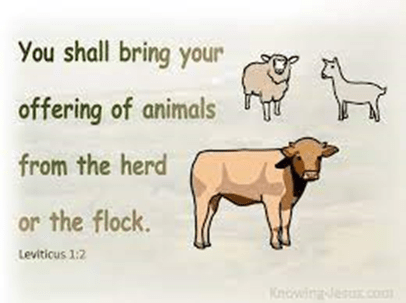
“Now the Lord called to Moses, and spoke to him from the tabernacle of meeting, saying, “Speak to the children of Israel, and say to them: ‘When any one of you brings an offering to the Lord, you shall bring your offering of the livestock—of the herd and of the flock.
‘If his offering is a burnt sacrifice of the herd, let him offer a male without blemish; he shall offer it of his own free will at the door of the tabernacle of meeting before the Lord. Then he shall put his hand on the head of the burnt offering, and it will be accepted on his behalf to make atonement for him. He shall kill the bull before the Lord; and the priests, Aaron’s sons, shall bring the blood and sprinkle the blood all around on the altar that is by the door of the tabernacle of meeting. And he shall skin the burnt offering and cut it into its pieces. The sons of Aaron the priest shall put fire on the altar, and lay the wood in order on the fire. Then the priests, Aaron’s sons, shall lay the parts, the head, and the fat in order on the wood that is on the fire upon the altar; but he shall wash its entrails and its legs with water. And the priest shall burn all on the altar as a burnt sacrifice, an offering made by fire, a sweet aroma to the Lord.
‘If his offering is of the flocks—of the sheep or of the goats—as a burnt sacrifice, he shall bring a male without blemish. He shall kill it on the north side of the altar before the Lord; and the priests, Aaron’s sons, shall sprinkle its blood all around on the altar. And he shall cut it into its pieces, with its head and its fat; and the priest shall lay them in order on the wood that is on the fire upon the altar; but he shall wash the entrails and the legs with water. Then the priest shall bring it all and burn it on the altar; it is a burnt sacrifice, an offering made by fire, a sweet aroma to the Lord.
‘And if the burnt sacrifice of his offering to the Lord is of birds, then he shall bring his offering of turtledoves or young pigeons. The priest shall bring it to the altar, wring off its head, and burn it on the altar; its blood shall be drained out at the side of the altar. And he shall remove its crop with its feathers and cast it beside the altar on the east side, into the place for ashes. Then he shall split it at its wings, but shall not divide it completely; and the priest shall burn it on the altar, on the wood that is on the fire. It is a burnt sacrifice, an offering made by fire, a sweet aroma to the Lord.”
The Book of Leviticus follows the Book of Exodus. Exodus tells the story of the escape of the Israelites from Egypt, the issuing of the Ten Commandments from Mount Sinai, and the instructions for constructing the Tabernacle, the portable temple that will accompany the Israelites throughout their journeys. At this point, the Tabernacle has been completely constructed and equipped. Read the instructions in Exodus and you realize that when the Israelites collected gold and silver from the frightened Egyptians, the amount they collected was staggering.
Now God is setting down the rules for burnt offerings. The reason behind these rules is simple: wrong-doing must be paid for with blood. If men and women are not to die, an animal must die as a substitute. Here is what David Guzik in his Enduring Word Commentary says about the sacrificial system:
“ When any one of you brings an offering: In the covenant God made with Israel at Mount Sinai, there were three major parts. The covenant included the law Israel had to obey, sacrifice to provide for breaking the law, and the choice of blessing or curse that would become Israel’s destiny throughout history.
i. The sacrificial system was an essential element of the Mosaic covenant because it was impossible to live up to the requirements of the law. No one could perfectly obey the law, and sin had to be dealt with through sacrifice. Each commanded sacrifice was significant, and they all pointed toward the perfect sacrifice Jesus would offer by His crucifixion (Hebrews 7:27, 9:11-28).
ii. This was not the beginning of God’s sacrificial system. Adam knew of sacrifice (Genesis 3:21), as did Cain and Abel (Genesis 4:3-4), and Noah (Genesis 8:20-21). Israel offered sacrifice at the Passover (Exodus 12). Job 1:5 and Exodus 10:25 also mention burnt sacrifices before the book of Leviticus.
iii. The idea of sacrifice to the gods was not unique to Israel. Other nations and cultures practiced sacrifice, often ultimately involving human sacrifice. The universality of sacrifice is evidence that this concept was known to man before the flood and was carried to different cultures from the survivors of the flood in Noah’s day.”
Those bringing sacrifices were to bring males without blemish-males because male animals were thought to be stronger and without blemish because offering God anything less would be an insult. These animals had to come from the herd so that the Israelites would not simply go out, catch some random wild animal, and try to bring it as a sacrifice. By the same token, the worshipers bringing animals would lay hands on the animal and kill the animal, thus transferring their guilt, while the priests would handle things after that.
David Guzik tells us about the idea behind these sacrifices: “To make atonement for him: The idea behind the Hebrew word for atonement (kophar) is to cover. The idea was that an individual’s sin and guilt were covered over by the blood of the sacrificial victim.
i. Leviticus is a book all about atonement. “The word kipper (“to make atonement”) is used almost fifty times in Leviticus…. It is used about fifty times more in the rest of the OT.” (Harris)
ii. But there is a difference between the Old Testament idea of atonement and the New Testament idea. In the Old Testament, sin is “covered over” until redemption was completed by Jesus on the cross. In the New Testament, sin is done away with – and a true “at-one-ment” was accomplished by Jesus’ sacrifice. The believer is therefore right with God on the basis of what Jesus has done at the cross, not on the basis of what the believer does. “There are two ruling religions around us at this day, and they mainly differ in tense. The general religion of mankind is ‘Do,’ but the religion of a true Christian is ‘Done.’” (Spurgeon)
iii. Significantly, the burnt offering was more about total surrender to God than about sin. Yet this shows that when we come to God with the greatest surrender possible for us, we are still marked by sin and in great need of atonement. Efforts of greater devotion and surrender to God should, if done properly, drive us to greater dependence on God’s perfect sacrifice of atonement in and through Jesus Christ.
iv. “Our only right to offer anything to God, in any form, is created by the one Offering through which we must be sanctified. Every offering is a symbol still of the One.” (Morgan)
For a more complete explanation of this chapter, you can read Guzik’s full discussion at the following link: https://enduringword.com/bible-commentary/leviticus-1/

APPLICATION: God does not play favorites. The list of possible sacrifices starts with very expensive animals such as bulls and goes all the way down to turtledoves or young pigeons. God does not leave anybody out; even the very poor can still bring some kind of sacrificial offering. Generally, people are the ones who draw class distinctions based on money; in God’s sight, all people are equal. Much later, Jesus will commend a desperately poor widow for offering the smallest coins possible because those coins represent everything she has. While rich men are parading into the temple and flourishing their money before inserting it into the treasury, this lady creeps in unnoticed by anyone apart from Jesus.
These days, we don’t need to sacrifice animals any longer because Jesus has already offered Himself as the ultimate blood sacrifice for our sins. Our part now is to accept what Jesus has done for us, confess our sins to Him, and serve Him the rest of our lives.
PRAYER: Father God, thank You for loving us and for caring for us. Lord, we confess that we are sinners and that nothing we do is good enough to earn us a place in heaven. Thank You for sending Jesus to die as the perfect sinless blood sacrifice. We believe that Jesus has died for our sins. Help us now to live for You the rest of our lives. In the mighty and precious Name of King Jesus. Amen.
 Burunche's Blog
Leave a comment