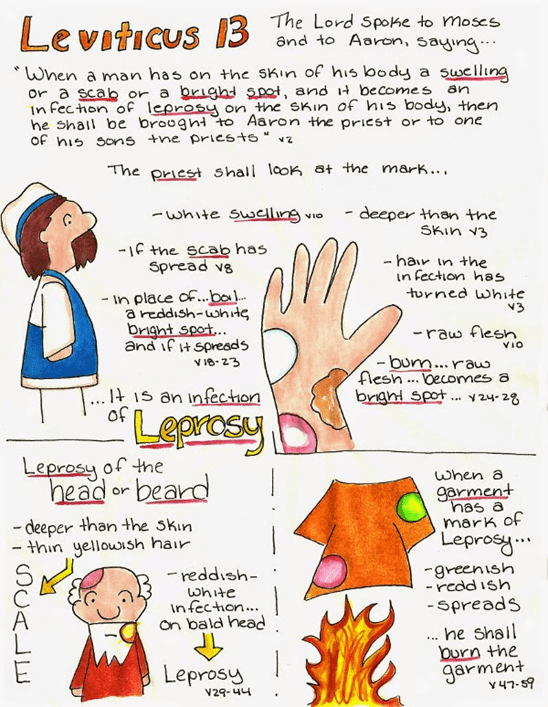
The Law Concerning Leprous Garments
“Also, if a garment has a leprous plague in it, whether it is a woolen garment or a linen garment, whether it is in the warp or woof of linen or wool, whether in leather or in anything made of leather, and if the plague is greenish or reddish in the garment or in the leather, whether in the warp or in the woof, or in anything made of leather, it is a leprous plague and shall be shown to the priest. The priest shall examine the plague and isolate that which has the plague seven days. And he shall examine the plague on the seventh day. If the plague has spread in the garment, either in the warp or in the woof, in the leather or in anything made of leather, the plague is an active leprosy. It is unclean. He shall therefore burn that garment in which is the plague, whether warp or woof, in wool or in linen, or anything of leather, for it is an active leprosy; the garment shall be burned in the fire.
“But if the priest examines it, and indeed the plague has not spread in the garment, either in the warp or in the woof, or in anything made of leather, then the priest shall command that they wash the thing in which is the plague; and he shall isolate it another seven days. Then the priest shall examine the plague after it has been washed; and indeed if the plague has not changed its color, though the plague has not spread, it is unclean, and you shall burn it in the fire; it continues eating away, whether the damage is outside or inside. If the priest examines it, and indeed the plague has faded after washing it, then he shall tear it out of the garment, whether out of the warp or out of the woof, or out of the leather. But if it appears again in the garment, either in the warp or in the woof, or in anything made of leather, it is a spreading plague; you shall burn with fire that in which is the plague. And if you wash the garment, either warp or woof, or whatever is made of leather, if the plague has disappeared from it, then it shall be washed a second time, and shall be clean.
“This is the law of the leprous plague in a garment of wool or linen, either in the warp or woof, or in anything made of leather, to pronounce it clean or to pronounce it unclean.”
The Israelites are traveling through a desert where the humidity is likely around 20%; however, it is still possible for clothing to develop mildew and other problems. Again, the priests are charged with maintaining sound public health and keeping people safe from potential contagions. If a garment develops red or green spots, the priests are to isolate it for seven days and then re-examine it. If the spots are enlarging, the priests are to burn the garment. If the spots are not enlarging, the garment should be washed and then isolated for another seven days. If the color does not change, the priests will burn the garment, but if the color has faded, then the spots will be torn out of the garment. But if the spots recur, the priests will burn the garment. If the spots disappear after washing, then the garment will be washed a second time and be considered clean.
Why is God so particular about clothing? Leviticus tells us a great deal about hygiene, both private and public. God wants His people to be holy and not stinky. How badly would someone smell after wearing a moldy garment in desert heat for most of the day? God also wants to make sure His people remain healthy. Potentially, a garment that is infested with some kind of rot might cause skin problems to the wearers.
APPLICATION: When I was growing up, one of my mother’s rallying cries was this: “You are MY child! I don’t care what other people are doing.” While the Israelites were living in Egypt, they likely became used to lax measures as far as hygiene was concerned. Bathing can be difficult when water is at a premium. These are God’s people and He wants them to be different from the pagans surrounding them. God is playing a very long game; He’s using a forty-year journey through the wilderness to train His people in essential public health and hygiene practices. God is looking down the centuries when the Jews will maintain sanitation while others around them will not. How difficult is it to maintain cleanliness in such a situation? The number of Israelites who have left Egypt is roughly 2 million and people using non-water borne sanitation require 3 gallons of water a day, so this group requires 6 million gallons of water a day for washing and drinking water. That’s 8,760,000,000,000 gallons of water over a forty-year period, not allowing for population growth. Talk about long-term miracles!
(The 3-gallon figure comes from the book Medical Administration for Front-line Doctors by Dr. C. Andrew Pearson, a missionary doctor who ran the Ilesha Methodist Hospital in Nigeria.)
Why all these regulations concerning garments? God wants His people to be healthy, even in the middle of a wilderness. These regulations are specific because God knows His people are going to argue with everything He says and He doesn’t want any gray areas.
When we first came to Kumasi, Ghana, many years ago, there were a lot more trees. Kumasi was in the center of the rain forest, and the humidity was so high that clothing would mildew right in the closet or in a dresser. Many people used naphtha – scented moth balls in a vain effort to fight mildew, and it was a common smell in large gatherings. We swiftly learned not to use wire hangers, lest we wind up with rust spots on our clothing. The only way to halt the mildew was to re-wash the clothes using bleach if appropriate and then iron them with a hot iron and wear them that day. For the ancient Israelites, sunshine would have been the best preventative, since sunlight can kill fungus.
These days, many people no longer struggle with mildewed clothes; however, God’s concern for our health and well-being remains. Jeremiah 29:11 tells us that God wants to give us a hope and a future, one that is not blighted by mold. Let us run after God and serve Him, so that we can move into that hope.
PRAYER: Father God, thank You for loving us and for caring for us. Lord, thank You that You want us to be healthy and productive. Help us to follow hard after You all the days of our lives. In the mighty and precious Name of King Jesus. Amen.
 Burunche's Blog
Leave a comment