
The Place of Sacrifice
“Then the LORD said to Moses, “Speak to Aaron, his sons, and all the Israelites and tell them this is what the LORD has commanded: ‘Anyone from the house of Israel who slaughters an ox, a lamb, or a goat in the camp or outside of it instead of bringing it to the entrance to the Tent of Meeting to present it as an offering to the LORD before His tabernacle—that man shall incur bloodguilt. He has shed blood and must be cut off from his people.
For this reason the Israelites will bring to the LORD the sacrifices they have been offering in the open fields. They are to bring them to the priest at the entrance to the Tent of Meeting and offer them as sacrifices of peace to the LORD. The priest will then sprinkle the blood on the altar of the LORD at the entrance to the Tent of Meeting and burn the fat as a pleasing aroma to the LORD.
They must no longer offer their sacrifices to the goat demons to which they have prostituted themselves. This will be a permanent statute for them for the generations to come.’
Tell them that if anyone from the house of Israel or any foreigner living among them offers a burnt offering or a sacrifice but does not bring it to the entrance to the Tent of Meeting to sacrifice it to the LORD, that man must be cut off from his people.
Laws Against Eating Blood
If anyone from the house of Israel or a foreigner living among them eats any blood, I will set My face against that person and cut him off from among his people. For the life of the flesh is in the blood, and I have given it to you to make atonement for your souls upon the altar; for it is the blood that makes atonement for the soul. Therefore I say to the Israelites, ‘None of you may eat blood, nor may any foreigner living among you eat blood.’
And if any Israelite or foreigner living among them hunts down a wild animal or bird that may be eaten, he must drain its blood and cover it with dirt. For the life of all flesh is its blood. Therefore I have told the Israelites, ‘You must not eat the blood of any living thing, because the life of all flesh is its blood; whoever eats it must be cut off.’ And any person, whether native or foreigner, who eats anything found dead or mauled by wild beasts must wash his clothes and bathe with water, and he will be unclean until evening; then he will be clean. But if he does not wash his clothes and bathe himself, then he shall bear his iniquity.”
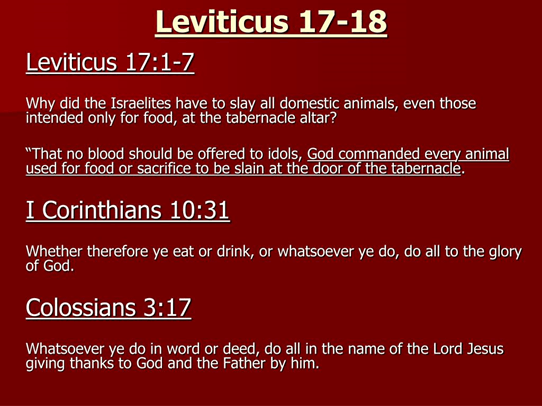
At first, this chapter seems weird! Why is God worried about someone slaughtering an animal? Is God demanding that the Israelites become vegetarians? The verb used here for slaughter is the verb specifically denoting ritual sacrifice, not mere butchering. “They must no longer offer their sacrifices to the goat demons to which they have prostituted themselves. This will be a permanent statute for them for the generations to come.’ Tell them that if anyone from the house of Israel or any foreigner living among them offers a burnt offering or a sacrifice but does not bring it to the entrance to the Tent of Meeting to sacrifice it to the LORD, that man must be cut off from his people.”
HMM! God isn’t forbidding a neighborhood barbecue; God is forbidding people from sneaking off into the desert or up on top of mountains to sacrifice to GOAT DEMONS!!! Another translation says, “Hairy ones.” Here goats are probably serving as representing any demons going. Previously, the people were hung up on the Egyptian goddess Hathor, represented by a cow, hence the golden calf. It seems that the Israelites are more than willing to take up with any demonic god they encounter. “OOH! Child sacrifice? Why not!” “OOH! Fertility rites? Sounds good to me!”
God wants His people to be holy in everything, including their worship. Any sacrifices the Israelites choose to make must be brought to the Tent of Meeting so that the blood can be handled properly, offering it to the Lord. But what if someone is out hunting and kills an animal or even finds a freshly killed animal or bird and wants to cook and eat it? The life of that animal or bird is in the blood, blood that also is used to sacrifice at the altar of the Most High Place. Out of respect for the holiness of blood, the Israelites are enjoined to drain the blood of a freshly killed animal and then cover it with dirt so that no wild animals can get at the blood.
APPLICATION: There are some people who use these verses from Leviticus to justify not giving blood transfusions. But consider the reason for transfusion: Transfusions are only administered when a patient might die otherwise. I work in a part of Ghana where small children came in very pale due to the destruction of their red blood cells by malaria parasites. If we can transfuse quickly enough, the children will be fine; if not, they might die. Blood transfusions are truly life-giving; therefore, in a very real sense, blood transfusion honors God’s principle that blood is life. Any health worker can testify that transfusions are handled very carefully and respectfully, from the screening of donors to the collection of blood to the administration of the transfusion.
Christians have another reason for holding blood in respect: it is the Blood of Jesus sacrificed for us on Calvary that saves us from our sins. When we accept what Jesus has done for us and believe on Him, we are assured of eternal life.
PRAYER: Father God, thank You for loving us and caring for us. Lord, thank You for sending Jesus to shed his priceless blood for our sins so that we might have eternal life. We confess that we are sinners who cannot free ourselves and that only the blood of Jesus will pay for our sins. Thank You that when we believe on Jesus, we are assured of eternal life. In the mighty and precious Name of King Jesus. Amen.
 Burunche's Blog
Leave a comment