Regulations for Conduct of Priests
“And the Lord said to Moses, “Speak to the priests, the sons of Aaron, and say to them: ‘None shall defile himself for the dead among his people, except for his relatives who are nearest to him: his mother, his father, his son, his daughter, and his brother; also his virgin sister who is near to him, who has had no husband, for her he may defile himself. Otherwise he shall not defile himself, being a chief man (master/husband) among his people, to profane himself.
‘They shall not make any bald place on their heads, nor shall they shave the edges of their beards nor make any cuttings in their flesh. They shall be holy to their God and not profane the name of their God, for they offer the offerings of the Lord made by fire, and the bread of their God; therefore they shall be holy. They shall not take a wife who is a harlot or a defiled woman, nor shall they take a woman divorced from her husband; for the priest is holy to his God. Therefore you shall consecrate him, for he offers the bread of your God. He shall be holy to you, for I the Lord, who sanctify you, am holy. The daughter of any priest, if she profanes herself by playing the harlot, she profanes her father. She shall be burned with fire.
‘He who is the high priest among his brethren, on whose head the anointing oil was poured and who is consecrated to wear the garments, shall not uncover his head (in mourning) nor tear his clothes; nor shall he go near any dead body, nor defile himself for his father or his mother; nor shall he go out of the sanctuary, nor profane the sanctuary of his God; for the consecration of the anointing oil of his God is upon him: I am the Lord. And he shall take a wife in her virginity. A widow or a divorced woman or a defiled woman or a harlot—these he shall not marry; but he shall take a virgin of his own people as wife. Nor shall he profane his posterity among his people, for I the Lord sanctify him.’ ”
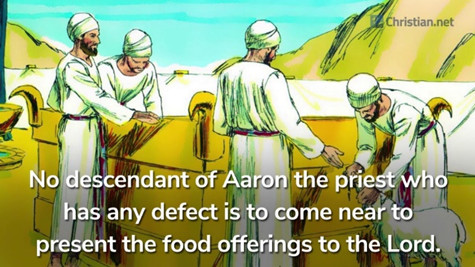
And the Lord spoke to Moses, saying, “Speak to Aaron, saying: ‘No man of your descendants in succeeding generations, who has any defect, may approach to offer the bread of his God. For any man who has a defect shall not approach: a man blind or lame, who has a marred face or any limb too long, a man who has a broken foot or broken hand, or is a hunchback or a dwarf, or a man who has a defect in his eye, or eczema or scab, or is a eunuch. No man of the descendants of Aaron the priest, who has a defect, shall come near to offer the offerings made by fire to the Lord. He has a defect; he shall not come near to offer the bread of his God. He may eat the bread of his God, both the most holy and the holy; only he shall not go near the veil or approach the altar, because he has a defect, lest he profane My sanctuaries; for I the Lord sanctify them.’ ” And Moses told it to Aaron and his sons, and to all the children of Israel.
God is now turning His attention to His priests. Before examining God’s rules, let’s consider the behavior of many pagan priests at the time. Pagan priests might wear strange garments or very few garments. In Exodus God has already ordered that His altars will be approached by ramps and not by steps and for priests to wear linen breeches under their robes so that there will be no opportunity for the priests to exhibit their genitalia as they ascend to the altar. Pagan priests might gash or tattoo themselves. And pagan priests might engage in public ritual sex with temple prostitutes in fertility rites. The list of perversions is endless. Here God is saying that He doesn’t want His priests resembling pagan ones in any fashion.
Here ”defiling oneself for the dead” includes touching the dead, being in the same room with a dead body, walking over the grave, or even sharing in the funeral feast. God is the Giver of Life and He doesn’t want His priests involved with the rituals of death apart from the relatives mentioned.
Priests were not allowed to pull out chunks of hair as a sign of grief or to shave the edges of their beards in a particular pattern or to make ritual cuts on themselves. Priests were to marry only chaste women. Were the daughter of a priest to prostitute herself and be caught, she would be punished by burning.
The high priest had to fulfill very high standards. “He shall not uncover his head (in mourning) nor tear his clothes; nor shall he go near any dead body, nor defile himself for his father or his mother; nor shall he go out of the sanctuary, nor profane the sanctuary of his God; for the consecration of the anointing oil of his God is upon him: I am the Lord. And he shall take a wife in her virginity. A widow or a divorced woman or a defiled woman or a harlot—these he shall not marry; but he shall take a virgin of his own people as wife. Nor shall he profane his posterity among his people.”
Finally, descendants of Aaron with any defects would be able to eat the showbread; however, they would not be able to make offerings of any sort or enter the most holy parts of the tabernacle.
APPLICATION: Several years ago, we had the chance to speak with an instructor at a well-known missionary training organization that saw missionaries from nearly 200 groups pass through their programs each year. Our friend told us sadly that in his more than 35 years of experience, he had never seen church, para-church, or mission groups that ran along Christian principles UNLESS the top leadership were fully committed to those principles. Our friend pointed out that the leadership of any organization sets the tone for that organization. When leadership are righteous, others are far more likely to remain righteous. But when leaders are corrupt, those below them feel they are safe in doing whatever they want. All we need to do to see the proof of this is to look at the political situation in most countries.
When God was establishing the Aaronic priesthood, He wanted to make sure that His priests would inspire worshipers. Many of those worshipers were coming from shaky spiritual backgrounds and would readily revert to idol worship given the slightest opportunity. God’s plan was to bring these people out of the darkness of paganism into the light of His holiness, and only stringent measures would work.
The question for us personally is this: how holy are we willing to allow God to make us? Are we willing for God to change us or are we hoping that God will give us a break and allow us to continue to practice our pet sins?
PRAYER: Father God, thank You for loving us and caring for us. Lord, we aren’t sure we want to be holy, but we know You want us to be. We give You permission to change us into Your likeness. In the mighty and precious Name of King Jesus. Amen.
 Burunche's Blog
Leave a comment