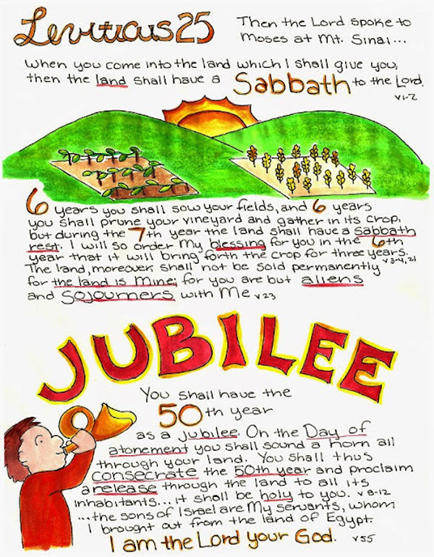
The Sabbath of the Seventh Year
“And the Lord spoke to Moses on Mount Sinai, saying, “Speak to the children of Israel, and say to them: ‘When you come into the land which I give you, then the land shall keep a sabbath to the Lord. Six years you shall sow your field, and six years you shall prune your vineyard, and gather its fruit; but in the seventh year there shall be a sabbath of solemn rest for the land, a sabbath to the Lord. You shall neither sow your field nor prune your vineyard. What grows of its own accord of your harvest you shall not reap, nor gather the grapes of your untended vine, for it is a year of rest for the land. And the sabbath produce of the land shall be food for you: for you, your male and female servants, your hired man, and the stranger who dwells with you, for your livestock and the beasts that are in your land—all its produce shall be for food.
The Year of Jubilee
‘And you shall count seven sabbaths of years for yourself, seven times seven years; and the time of the seven sabbaths of years shall be to you forty-nine years. Then you shall cause the trumpet of the Jubilee to sound on the tenth day of the seventh month; on the Day of Atonement you shall make the trumpet to sound throughout all your land. And you shall consecrate the fiftieth year, and proclaim liberty throughout all the land to all its inhabitants. It shall be a Jubilee for you; and each of you shall return to his possession, and each of you shall return to his family. That fiftieth year shall be a Jubilee to you; in it you shall neither sow nor reap what grows of its own accord, nor gather the grapes of your untended vine. For it is the Jubilee; it shall be holy to you; you shall eat its produce from the field.
‘In this Year of Jubilee, each of you shall return to his possession. And if you sell anything to your neighbor or buy from your neighbor’s hand, you shall not oppress one another. According to the number of years after the Jubilee you shall buy from your neighbor, and according to the number of years of crops he shall sell to you. According to the multitude of years you shall increase its price, and according to the fewer number of years you shall diminish its price; for he sells to you according to the number of the years of the crops. Therefore you shall not oppress one another, but you shall fear your God; for I am the Lord your God.
Provisions for the Seventh Year
‘So you shall observe My statutes and keep My judgments, and perform them; and you will dwell in the land in safety. Then the land will yield its fruit, and you will eat your fill, and dwell there in safety.
‘And if you say, “What shall we eat in the seventh year, since we shall not sow nor gather in our produce?” Then I will command My blessing on you in the sixth year, and it will bring forth produce enough for three years. And you shall sow in the eighth year, and eat old produce until the ninth year; until its produce comes in, you shall eat of the old harvest.
Redemption of Property
‘The land shall not be sold permanently, for the land is Mine; for you are strangers and sojourners with Me. And in all the land of your possession you shall grant redemption of the land.
‘If one of your brethren becomes poor, and has sold some of his possession, and if his redeeming relative comes to redeem it, then he may redeem what his brother sold. Or if the man has no one to redeem it, but he himself becomes able to redeem it, then let him count the years since its sale, and restore the remainder to the man to whom he sold it, that he may return to his possession. But if he is not able to have it restored to himself, then what was sold shall remain in the hand of him who bought it until the Year of Jubilee; and in the Jubilee it shall be released, and he shall return to his possession.
‘If a man sells a house in a walled city, then he may redeem it within a whole year after it is sold; within a full year he may redeem it. But if it is not redeemed within the space of a full year, then the house in the walled city shall belong permanently to him who bought it, throughout his generations. It shall not be released in the Jubilee. However the houses of villages which have no wall around them shall be counted as the fields of the country. They may be redeemed, and they shall be released in the Jubilee. Nevertheless the cities of the Levites, and the houses in the cities of their possession, the Levites may redeem at any time. And if a man purchases a house from the Levites, then the house that was sold in the city of his possession shall be released in the Jubilee; for the houses in the cities of the Levites are their possession among the children of Israel. But the field of the common-land of their cities may not be sold, for it is their perpetual possession.”
There are three main points at issue here: 1. God wants the land to rest every seventh year and promises that if His people will follow His commands, the land will yield enough during the sixth year to carry them through until the ninth year when they will have freshly harvested crops to eat. God orders the people to leave the land alone during that seventh year – neither sowing nor reaping whatever grows by itself. This is to prevent over-tillage of land with a thin layer of topsoil. 2. Land remains the permanent possession of given families as Joshua allots it to them. Every fiftieth year is a year of Jubilee, when land reverts to its original owner. The original owner or one of his relatives may redeem the land prior to the year of Jubilee; however, they must pay the person who bought the land originally at a rate that accounts for the number of years left before the Jubilee. The land belonging to the Levites remains their permanent possession forever; however, land belonging to others may be sold on a temporary basis, with the selling price calculated on the numbers of years left before the Jubilee.
3. What about houses? Houses in walled cities may be sold but redeemed within one year; however, once that year is past, the house becomes the permanent possession of the buyer. Houses in villages without walls will be handled similarly to the land-they may be redeemed but otherwise will revert to the original family in the Jubilee. Levites may sell their houses temporarily and redeem them at any time; however, those houses will automatically revert to the Levites at the Jubilee.
Sounds complicated, right? God is continuing to make provision for people who will argue every little point and try to twist things to their advantage.
APPLICATION: At first, the idea of allowing land to lie fallow every seventh year sounds crazy; however, the principle is ecologically sound. David Guzik in Enduring Word Commentary says this about the concept of the Sabbath year:
“Israel was to do this as a radical demonstration that the land belonged to God, not to them.
i. “During the sabbatical year there must be no systematic harvesting of self-seeding crops, or such fruits as figs and grapes. Anything of this nature that the land produces without human aid is the property of all, and people are to obtain food wherever they can find it, just as the Israelites did in their wilderness wanderings.” (Harrison)
Observing the sabbath year was also a powerful testimony of dependence on God. Israel declared their belief that God would meet their needs. This was truly living by faith, and God wanted His people to live trusting Him.
i. It was wise management of the land. Giving the land some rest every seven years helped restore vital nutrients to the soil that are depleted by constant use.
ii. Matthew Poole gave an interesting additional reason for the sabbath year. He suggested that one of the reasons for the Sabbath year was to put everyone in Israel in the same place as the poor of the land, who had to simply trust that God would provide in unlikely circumstances. This would give them compassion for the poor, who had to live that way every year.
iii. Israel’s failure to keep this command determined the length of their captivity. Leviticus 26:34 said that if Israel was not obedient, God would make sure the land gets its sabbaths by removing the people to the land of an enemy. This was fulfilled in the Babylonian captivity of Israel (2 Chronicles 36:20-21).
iv. Today, some observant Jewish people find a way around the sabbath year law. On the seventh year, they “sell” their land to a Gentile, work it, and then “buy” it back from the Gentile when the Sabbath year is over. The Gentile makes a little money, and the Jewish person could say, “It wasn’t my land on the Sabbath year, so it was all right if I worked it.” Others observe this by only cultivating six-sevenths of their land at any one time, and over seven years the entire land has a year of rest.”
In an age where there were no chemical fertilizers, allowing land to regain its fertility by resting one out of every seven years made perfect sense. The principle remains a sound one. I am not attempting to enter the controversy regarding agrochemicals, residuals in soil or ground water, etc. Land has an amazing ability to heal itself when we allow it to do so.
God wanted His people to trust that if they were faithful to give the land its Sabbaths, the land would produce enough during the sixth year to sustain them until the harvest from the eighth year was in. Land management thus became a matter of faith as well as practicality.
Are there parts of our lives that need a Sabbath? Electronic media has now made it possible for us to work from home, participating in online meetings and sending in our work electronically. But such developments mean that home is no longer a refuge from work; the work can follow us anywhere, leaving us under a constant strain. Let’s ask God to show us when it’s time to turn off phones and computers and really rest.
PRAYER: Father God, thank You for loving us and for caring for us. Lord, help us to carve out Sabbaths for ourselves, time that we can spend with You and rest. In the mighty and precious Name of King Jesus. Amen.
 Burunche's Blog
Leave a comment