Archive for July, 2023

JULY 21, 2023 WHY ALL THESE LAWS? LEVITICUS 18:1-30 GOD LAYS DOWN THE LAW ABOUT SEX

July 21, 2023

Unlawful Sexual Relations (Matthew 5:27-30)

“Then the LORD said to Moses, “Speak to the Israelites and tell them: I am the LORD your God. You must not follow the practices of the land of Egypt, where you used to live, and you must not follow the practices of the land of Canaan, into which I am bringing you. You must not walk in their customs. You are to practice My judgments and keep My statutes by walking in them. I am the LORD your God. Keep My statutes and My judgments, for the man who does these things will live by them. I am the LORD.

None of you are to approach any close relative to have sexual relations. I am the LORD. You must not expose the nakedness of your father by having sexual relations with your mother. She is your mother; you must not have sexual relations with her. You must not have sexual relations with your father’s wife; it would dishonor your father. You must not have sexual relations with your sister, either your father’s daughter or your mother’s daughter, whether she was born in the same home or elsewhere. You must not have sexual relations with your son’s daughter or your daughter’s daughter, for that would shame your family. You must not have sexual relations with the daughter of your father’s wife, born to your father; she is your sister. You must not have sexual relations with your father’s sister; she is your father’s close relative. You must not have sexual relations with your mother’s sister, for she is your mother’s close relative.

You must not dishonor your father’s brother by approaching his wife to have sexual relations with her; she is your aunt. You must not have sexual relations with your daughter-in-law. She is your son’s wife; you are not to have sexual relations with her. You must not have sexual relations with your brother’s wife; that would shame your brother. You must not have sexual relations with both a woman and her daughter. You are not to marry her son’s daughter or her daughter’s daughter and have sexual relations with her. They are close relatives; it is depraved. You must not take your wife’s sister as a rival wife and have sexual relations with her while your wife is still alive.

You must not approach a woman to have sexual relations with her during her menstrual period. You must not lie carnally with your neighbor’s wife and thus defile yourself with her. You must not give any of your children to be sacrificed to Molech, for you must not profane the name of your God. I am the LORD. You must not lie with a man as with a woman; that is an abomination. You must not lie carnally with any animal, thus defiling yourself with it; a woman must not stand before an animal to mate with it; that is a perversion.

Do not defile yourselves by any of these practices, for by all these things the nations I am driving out before you have defiled themselves. Even the land has become defiled, so I am punishing it for its sin, and the land will vomit out its inhabitants.

But you are to keep My statutes and ordinances, and you must not commit any of these abominations—neither your native-born nor the foreigner who lives among you. For the men who were in the land before you committed all these abominations, and the land has become defiled. So if you defile the land, it will vomit you out as it spewed out the nations before you. Therefore anyone who commits any of these abominations must be cut off from among his people. You must keep My charge not to practice any of the abominable customs that were practiced before you, so that you do not defile yourselves by them. I am the LORD your God.”
Having laid out the instructions for appropriate sacrifices, God now turns to  the topic of sex, and the list of “don’ts” is eye-popping. God begins by warning the Israelites to shun the “anything goes” sexual practices of both the Egyptians and the Canaanites. God begins by warning the Israelites, “None of you are to approach any close relative to have sexual relations.”  Having made that blanket statement, God now elucidates in this command in great detail. Why so many different rules? God knows that if He omits a single illicit relationship, the Israelites will indulge in that one. God wants His people to be holy, to honor Him, and to honor one another. Reading this list, we realize that God anticipates that there will be polygamous families with multiple wives and half-siblings. Sex within the family circle is expressly forbidden.

One interesting point is the statement: “You must not take your wife’s sister as a rival wife and have sexual relations with her while your wife is still alive.”  Those of you familiar with Bible stories will immediately ask, “But what about Jacob marrying Leah and Rachel? They were sisters.” True. But those events took place before God gave the Israelites these commandments. And if you remember, things weren’t exactly calm in Jacob’s family; there was constant friction, and Joseph’s older brothers were more than willing to sell him into slavery.

You must not approach a woman to have sexual relations with her during her menstrual period. You must not lie carnally with your neighbor’s wife and thus defile yourself with her. You must not give any of your children to be sacrificed to Molech, for you must not profane the name of your God. I am the LORD. You must not lie with a man as with a woman; that is an abomination. You must not lie carnally with any animal, thus defiling yourself with it; a woman must not stand before an animal to mate with it; that is a perversion.” Sex during menses is forbidden because of respect for menstrual blood and the fact that the woman is ritually unclean. Child sacrifices are forbidden, as is homosexual sex. Finally, sex with animals is also forbidden.

Do not defile yourselves by any of these practices, for by all these things the nations I am driving out before you have defiled themselves. Even the land has become defiled, so I am punishing it for its sin, and the land will vomit out its inhabitants.”  Lands are not spiritually neutral, and the demons that have inspired previous evil practices remain to inspire new groups of people unless those people are properly prepared. God is trying to “demon – proof” the Israelites.

APPLICATION: Why has God given all these regulations? God fully recognizes how important sex is and He wants it to be enjoyed as one of His good gifts and not used to bring dissension in families, murder, or warfare. The evil or good we do can help build up or tear down a land. I have previously mentioned the Transformations film series in which lands as far apart as Fiji and Guatemala have been healed when their inhabitants have forsaken idols and turned to worship the One True Living God. How bad do people have to be for their land to vomit them out? The ancient Israelites entered Canaan but quickly took up many of the pagan practices they found there. Eventually, the citizens of the Northern Kingdom were slaughtered or carried off to Assyria while those in the kingdom of Judah were exiled to Babylon.

We live in an age where pornography and human trafficking are more prevalent than ever before. Parents posting photos of their beautiful children on social media may be unwittingly making them targets for kidnappers. The revolting and degrading practices to which these children may be used are as bad as anything the Egyptians or Canaanites ever thought of. We must continue to fight such evil and to encourage those around us to worship God in the beauty of holiness and to pray for the healing of our lands.

PRAYER: Father God, thank You for loving us and for caring for us. Lord, we confess that we may have sinned in ways that have stained the lands where we live. Lord, heal us! Heal our lands! In the mighty and precious Name of King Jesus. Amen.

JULY 20, 2023 WHY ALL THESE LAWS? LEVITICUS 17:1-16 DOES GOD FORBID BARBECUES?

July 20, 2023

The Place of Sacrifice

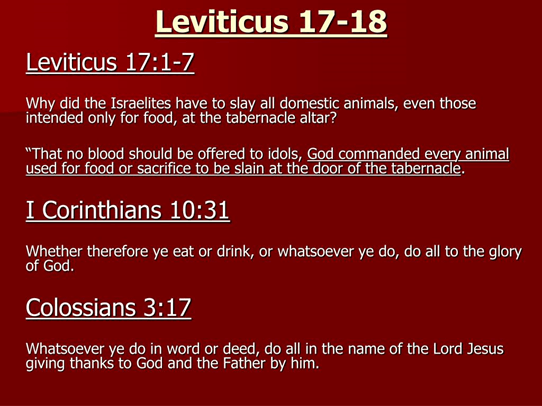
“Then the LORD said to Moses, “Speak to Aaron, his sons, and all the Israelites and tell them this is what the LORD has commanded: ‘Anyone from the house of Israel who slaughters an ox, a lamb, or a goat in the camp or outside of it instead of bringing it to the entrance to the Tent of Meeting to present it as an offering to the LORD before His tabernacle—that man shall incur bloodguilt. He has shed blood and must be cut off from his people.

For this reason the Israelites will bring to the LORD the sacrifices they have been offering in the open fields. They are to bring them to the priest at the entrance to the Tent of Meeting and offer them as sacrifices of peace to the LORD. The priest will then sprinkle the blood on the altar of the LORD at the entrance to the Tent of Meeting and burn the fat as a pleasing aroma to the LORD.

They must no longer offer their sacrifices to the goat demons to which they have prostituted themselves. This will be a permanent statute for them for the generations to come.’

Tell them that if anyone from the house of Israel or any foreigner living among them offers a burnt offering or a sacrifice but does not bring it to the entrance to the Tent of Meeting to sacrifice it to the LORD, that man must be cut off from his people.

Laws Against Eating Blood

If anyone from the house of Israel or a foreigner living among them eats any blood, I will set My face against that person and cut him off from among his people. For the life of the flesh is in the blood, and I have given it to you to make atonement for your souls upon the altar; for it is the blood that makes atonement for the soul. Therefore I say to the Israelites, ‘None of you may eat blood, nor may any foreigner living among you eat blood.’

And if any Israelite or foreigner living among them hunts down a wild animal or bird that may be eaten, he must drain its blood and cover it with dirt. For the life of all flesh is its blood. Therefore I have told the Israelites, ‘You must not eat the blood of any living thing, because the life of all flesh is its blood; whoever eats it must be cut off.’ And any person, whether native or foreigner, who eats anything found dead or mauled by wild beasts must wash his clothes and bathe with water, and he will be unclean until evening; then he will be clean. But if he does not wash his clothes and bathe himself, then he shall bear his iniquity.”


At first, this chapter seems weird! Why is God worried about someone slaughtering an animal? Is God demanding that the Israelites become vegetarians? The verb used here for slaughter is the verb specifically denoting ritual sacrifice, not mere butchering. “They must no longer offer their sacrifices to the goat demons to which they have prostituted themselves. This will be a permanent statute for them for the generations to come.’  Tell them that if anyone from the house of Israel or any foreigner living among them offers a burnt offering or a sacrifice but does not bring it to the entrance to the Tent of Meeting to sacrifice it to the LORD, that man must be cut off from his people.”

HMM! God isn’t forbidding a neighborhood barbecue; God is forbidding people from sneaking off into the desert or up on top of mountains to sacrifice to GOAT DEMONS!!! Another translation says, “Hairy ones.” Here goats are probably serving as representing any demons going. Previously, the people were hung up on the Egyptian goddess Hathor, represented by a cow, hence the golden calf. It seems that the Israelites are more than willing to take up with any demonic god they encounter. “OOH! Child sacrifice? Why not!” “OOH! Fertility rites? Sounds good to me!”

God wants His people to be holy in everything, including their worship. Any sacrifices the Israelites choose to make must be brought to the Tent of Meeting so that the blood can be handled properly, offering it to the Lord. But what if someone is out hunting and kills an animal or even finds a freshly killed animal or bird and wants to cook and eat it? The life of that animal or bird is in the blood, blood that also is used to sacrifice at the altar of the Most High Place. Out of respect for the holiness of blood, the Israelites are enjoined to drain the blood of a freshly killed animal and then cover it with dirt so that no wild animals can get at the blood.

APPLICATION:  There are some people who use these verses from Leviticus to justify not giving blood transfusions. But consider the reason for transfusion: Transfusions are only administered when a patient might die otherwise. I work in a part of Ghana where small children came in very pale due to the destruction of their red blood cells by malaria parasites. If we can transfuse quickly enough, the children will be fine; if not, they might die. Blood transfusions are truly life-giving; therefore, in a very real sense, blood transfusion honors God’s principle that blood is life. Any health worker can testify that transfusions are handled very carefully and respectfully, from the screening of donors to the collection of blood to the administration of the transfusion.  

Christians have another reason for holding blood in respect: it is the Blood of Jesus sacrificed for us on Calvary that saves us from our sins. When we accept what Jesus has done for us and believe on Him, we are assured of eternal life.

PRAYER: Father God, thank You for loving us and caring for us. Lord, thank You for sending Jesus to shed his priceless blood for our sins so that we might have eternal life. We confess that we are sinners who cannot free ourselves and that only the blood of Jesus will pay for our sins. Thank You that when we believe on Jesus, we are assured of eternal life. In the mighty and precious Name of King Jesus. Amen.
JULY 19, 2023 WHY ALL THESE LAWS? LEVITICUS 16:1-34 WHAT’S A SCAPEGOAT? 

July 19, 2023

The Day of Atonement

”Now the Lord spoke to Moses after the death of the two sons of Aaron, when they offered profane fire before the Lord, and died; and the Lord said to Moses: “Tell Aaron your brother not to come at just any time into the Holy Place inside the veil, before the mercy seat which is on the ark, lest he die; for I will appear in the cloud above the mercy seat.

“Thus Aaron shall come into the Holy Place: with the blood of a young bull as a sin offering, and of a ram as a burnt offering. He shall put the holy linen tunic and the linen trousers on his body; he shall be girded with a linen sash, and with the linen turban he shall be attired. These are holy garments. Therefore he shall wash his body in water, and put them on. And he shall take from the congregation of the children of Israel two kids of the goats as a sin offering, and one ram as a burnt offering.

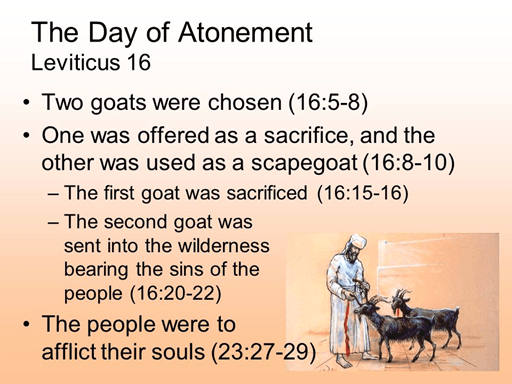
“Aaron shall offer the bull as a sin offering, which is for himself, and make atonement for himself and for his house. He shall take the two goats and present them before the Lord at the door of the tabernacle of meeting. Then Aaron shall cast lots for the two goats: one lot for the Lord and the other lot for the scapegoat. And Aaron shall bring the goat on which the Lord’s lot fell, and offer it as a sin offering. But the goat on which the lot fell to be the scapegoat shall be presented alive before the Lord, to make atonement upon it, and to let it go as the scapegoat into the wilderness.

“And Aaron shall bring the bull of the sin offering, which is for himself, and make atonement for himself and for his house, and shall kill the bull as the sin offering which is for himself. Then he shall take a censer full of burning coals of fire from the altar before the Lord, with his hands full of sweet incense beaten fine, and bring it inside the veil. And he shall put the incense on the fire before the Lord, that the cloud of incense may cover the mercy seat that is on the Testimony, lest he die. He shall take some of the blood of the bull and sprinkle it with his finger on the mercy seat on the east side; and before the mercy seat he shall sprinkle some of the blood with his finger seven times.

“Then he shall kill the goat of the sin offering, which is for the people, bring its blood inside the veil, do with that blood as he did with the blood of the bull, and sprinkle it on the mercy seat and before the mercy seat. So he shall make atonement for the Holy Place, because of the uncleanness of the children of Israel, and because of their transgressions, for all their sins; and so he shall do for the tabernacle of meeting which remains among them in the midst of their uncleanness. There shall be no man in the tabernacle of meeting when he goes in to make atonement in the Holy Place, until he comes out, that he may make atonement for himself, for his household, and for all the assembly of Israel. And he shall go out to the altar that is before the Lord, and make atonement for it, and shall take some of the blood of the bull and some of the blood of the goat, and put it on the horns of the altar all around. Then he shall sprinkle some of the blood on it with his finger seven times, cleanse it, and consecrate it from the uncleanness of the children of Israel.

“And when he has made an end of atoning for the Holy Place, the tabernacle of meeting, and the altar, he shall bring the live goat. Aaron shall lay both his hands on the head of the live goat, confess over it all the iniquities of the children of Israel, and all their transgressions, concerning all their sins, putting them on the head of the goat, and shall send it away into the wilderness by the hand of a suitable man. The goat shall bear on itself all their iniquities to an uninhabited land; and he shall release the goat in the wilderness.

“Then Aaron shall come into the tabernacle of meeting, shall take off the linen garments which he put on when he went into the Holy Place, and shall leave them there. And he shall wash his body with water in a holy place, put on his garments, come out and offer his burnt offering and the burnt offering of the people, and make atonement for himself and for the people. The fat of the sin offering he shall burn on the altar. And he who released the goat as the scapegoat shall wash his clothes and bathe his body in water, and afterward he may come into the camp. The bull for the sin offering and the goat for the sin offering, whose blood was brought in to make atonement in the Holy Place, shall be carried outside the camp. And they shall burn in the fire their skins, their flesh, and their offal. Then he who burns them shall wash his clothes and bathe his body in water, and afterward he may come into the camp.

“This shall be a statute forever for you: In the seventh month, on the tenth day of the month, you shall afflict your souls, and do no work at all, whether a native of your own country or a stranger who dwells among you. For on that day the priest shall make atonement for you, to cleanse you, that you may be clean from all your sins before the Lord. It is a sabbath of solemn rest for you, and you shall afflict your souls. It is a statute forever. And the priest, who is anointed and consecrated to minister as priest in his father’s place, shall make atonement, and put on the linen clothes, the holy garments; then he shall make atonement for the Holy Sanctuary, and he shall make atonement for the tabernacle of meeting and for the altar, and he shall make atonement for the priests and for all the people of the assembly. This shall be an everlasting statute for you, to make atonement for the children of Israel, for all their sins, once a year.” And he did as the Lord commanded Moses.”

When these ordinances are given, Aaron has just watched two of his sons be consumed by holy fire because they have gotten drunk and invaded the Most Holy Place, waving around censors with fire that God has not commanded. Aaron has gotten so distracted that he has allowed the animal for the sin offering to be totally burnt up and has then offered a specious excuse to Moses. Now God is laying down rules for high priests to make atonement for the entire nation.

God starts by warning Aaron not to come at just any time into the Holy Place inside the veil, before the mercy seat which is on the ark, “lest he die.” Then God orders Aaron to bathe and to dress appropriately, bringing a young bull as a sin offering and a ram as a burnt offering. The congregation of Israel is to provide a ram for a sin offering and two other goats. The priest must first slaughter the young bull to atone for his own sin before he can act on behalf of the people. Next, the priest must slaughter the goat for the sin offering for the people. Each time, the priest must burn incense, covering the mercy seat with incense, and sprinkle the blood of the sacrifice on the mercy seat and before the mercy seat. By so doing, the priest is making atonement for the Holy Place, the tabernacle of meeting, and the altar. WHY? Because all these things, wonderful as they are, have been created by humans and are not perfect; therefore, they need to be reconsecrated at intervals.

“And when he has made an end of atoning for the Holy Place, the tabernacle of meeting, and the altar, he shall bring the live goat. Aaron shall lay both his hands on the head of the live goat, confess over it all the iniquities of the children of Israel, and all their transgressions, concerning all their sins, putting them on the head of the goat, and shall send it away into the wilderness by the hand of a suitable man. The goat shall bear on itself all their iniquities to an uninhabited land; and he shall release the goat in the wilderness.”

Ever wonder where the phrase “scape goat” originated? Here you go! One goat goes up in smoke while the other gets set free but must symbolically bear the sins of the people into an unknown place. After certain parts of the sin sacrifices are offered on the altar, the remainder of the bodies are carried outside the camp and burned.

These are God’s instructions for establishing the annual Day of Atonement, now known as Yom Kippur. “This shall be a statute forever for you: In the seventh month, on the tenth day of the month, you shall afflict your souls, and do no work at all, whether a native of your own country or a stranger who dwells among you. For on that day the priest shall make atonement for you, to cleanse you, that you may be clean from all your sins before the Lord. It is a sabbath of solemn rest for you, and you shall afflict your souls. It is a statute forever. “

Why does God insist that the Day of Atonement be a day of absolute rest for everyone? God wants His people and everyone associated with them to be totally focused on Him and not on anything else. Even today, observant Jews celebrate Yom Kippur with prayers, fasting, and religious services.

APPLICATION: Why must the high priest make atonement for his own sins? Hebrews 5:1 tells us, Every high priest is appointed from among men to represent them in matters relating to God, to offer gifts and sacrifices for sins. He is able to deal gently with those who are ignorant and misguided, since he himself is beset by weakness. That is why he is obligated to offer sacrifices for his own sins, as well as for the sins of the people.”

Sin can only be paid for with blood, but the blood of animals can never serve as a permanent sacrifice, hence the institution of the annual observance. But Jesus Christ has come as a sinless, blameless, perfect man and has shed his blood on Calvary. Jesus has become the ultimate sacrifice for the sins of mankind. John 3:16-18 tells us, For God so loved the world that He gave His one and only Son, that everyone who believes in Him shall not perish but have eternal life. For God did not send His Son into the world to condemn the world, but to save the world through Him. Whoever believes in Him is not condemned, but whoever does not believe has already been condemned, because he has not believed in the name of God’s one and only Son.”  We don’t have to wait for an annual celebration; we can celebrate this magnificent gift of eternal life on a daily basis. Let’s pray!

PRAYER: Father God, thank You for loving us and praying for us. Lord Jesus, thank You for living as a man and shedding Your blood on Calvary for us. Lord, we believe in You; help our unbelief! In Your mighty and precious Name, Lord Jesus. Amen.

JULY 18, 2023 WHY ALL THESE LAWS? LEVITICUS 15:1-33 WHERE’S THAT SMELL COMING FROM?

July 18, 2023

The Law Concerning Bodily Discharges

”And the Lord spoke to Moses and Aaron, saying, “Speak to the children of Israel, and say to them: ‘When any man has a discharge from his body, his discharge is unclean. And this shall be his uncleanness in regard to his discharge—whether his body runs with his discharge, or his body is stopped up by his discharge, it is his uncleanness. Every bed is unclean on which he who has the discharge lies, and everything on which he sits shall be unclean. 

And whoever touches his bed shall wash his clothes and bathe in water, and be unclean until evening. He who sits on anything on which he who has the discharge sat shall wash his clothes and bathe in water, and be unclean until evening. And he who touches the body of him who has the discharge shall wash his clothes and bathe in water, and be unclean until evening. If he who has the discharge spits on him who is clean, then he shall wash his clothes and bathe in water, and be unclean until evening. 

Any saddle on which he who has the discharge rides shall be unclean. Whoever touches anything that was under him shall be unclean until evening. He who carries any of those things shall wash his clothes and bathe in water, and be unclean until evening. And whomever the one who has the discharge touches, and has not rinsed his hands in water, he shall wash his clothes and bathe in water, and be unclean until evening. The vessel of earth that he who has the discharge touches shall be broken, and every vessel of wood shall be rinsed in water.

‘And when he who has a discharge is cleansed of his discharge, then he shall count for himself seven days for his cleansing, wash his clothes, and bathe his body in running water; then he shall be clean. On the eighth day he shall take for himself two turtledoves or two young pigeons, and come before the Lord, to the door of the tabernacle of meeting, and give them to the priest. Then the priest shall offer them, the one as a sin offering and the other as a burnt offering. So the priest shall make atonement for him before the Lord because of his discharge.

‘If any man has an emission of semen, then he shall wash all his body in water, and be unclean until evening. And any garment and any leather on which there is semen, it shall be washed with water, and be unclean until evening. Also, when a woman lies with a man, and there is an emission of semen, they shall bathe in water, and be unclean until evening.

‘If a woman has a discharge, and the discharge from her body is blood, she shall be set apart seven days; and whoever touches her shall be unclean until evening. Everything that she lies on during her impurity shall be unclean; also everything that she sits on shall be unclean. Whoever touches her bed shall wash his clothes and bathe in water, and be unclean until evening. And whoever touches anything that she sat on shall wash his clothes and bathe in water, and be unclean until evening. If anything is on her bed or on anything on which she sits, when he touches it, he shall be unclean until evening. And if any man lies with her at all, so that her impurity is on him, he shall be unclean seven days; and every bed on which he lies shall be unclean.

‘If a woman has a discharge of blood for many days, other than at the time of her customary impurity, or if it runs beyond her usual time of impurity, all the days of her unclean discharge shall be as the days of her customary impurity. She shall be unclean. Every bed on which she lies all the days of her discharge shall be to her as the bed of her impurity; and whatever she sits on shall be unclean, as the uncleanness of her impurity. Whoever touches those things shall be unclean; he shall wash his clothes and bathe in water, and be unclean until evening. ‘But if she is cleansed of her discharge, then she shall count for herself seven days, and after that she shall be clean. And on the eighth day she shall take for

herself two turtledoves or two young pigeons, and bring them to the priest, to the door of the tabernacle of meeting. Then the priest shall offer the one as a sin offering and the other as a burnt offering, and the priest shall make atonement for her before the Lord for the discharge of her uncleanness.

‘Thus you shall separate the children of Israel from their uncleanness, lest they die in their uncleanness when they defile My tabernacle that is among them. This is the law for one who has a discharge, and for him who emits semen and is unclean thereby, and for her who is indisposed because of her customary impurity, and for one who has a discharge, either man or woman, and for him who lies with her who is unclean.’ ”

God is infinitely practical, and He knows that His people are going to develop various kinds of discharges. The rules for men and women are basically the same. If anybody with a discharge touches anything, that object must be considered as unclean. Those having chronic discharges are barred from entering the temple or going out into society so that they won’t infect anyone. Anybody touching a contaminated object must wash and be considered unclean until evening.

Men having sex with a woman with a discharge will be considered unclean. Women with discharges will be unclean until the discharge stops. Once a discharge stops, the patient is to wash and count seven days. On the eighth day, the patient is to offer a sacrifice; two turtle doves or two young pigeons. One bird will be sacrificed and the blood used to anoint the patient while the second bird will be set free as a symbol of the patient being freed from the curse of the discharge.

APPLICATION: Reading these regulations, we might wonder what happens if someone has a discharge and never gets healed. On the other hand, what potential danger would such individuals pose to those around them? Without any antibiotics, someone with a bad case of running sores from staphylococcus could spread their illness to untold numbers of others in crowded places such as the market, worship services, etc. Ask any school nurse how quickly impetigo can race through an entire classroom or even through an entire school!

Luke 8:43-48 tells the story of a woman with a chronic discharge who had already suffered for twelve years when she saw Jesus passing. This poor woman had spent all her money and was still a social outcast. Taking courage, this lady crawled close to Jesus, touching the hem of his garment. Immediately, the lady was healed and Jesus realized that power had gone out from him. Jesus encouraged the woman to go her way because her faith had made her well. Presumably, after the healing, the lady went on to the priests and underwent the rituals described here.

These days, patients with discharges no longer are social outcasts, nor do we still need to make sacrifices for healing. But there are still arguments for some forms of isolation in certain illnesses such as meningitis, pneumonia, TB, etc. Once more we realize that God is giving His people rules so that they can remain as healthy as possible. This is the same God who promises to give us “a hope and a future.” (Jeremiah 29:11) Let us follow Him!

PRAYER: Father God, thank You for loving us and for caring for us. Thank You that it is Your perfect will for us to be healthy. Help us to follow hard after You all the days of our lives. In the mighty and precious Name of King Jesus. Amen.
July 17, 2023 WHY ALL THESE LAWS? LEVITICUS 14:33-57 ARE SOME PLACES INHERENTLY EVIL?

July 17, 2023

Signs of Home Contamination

Then the LORD said to Moses and Aaron, “When you enter the land of Canaan, which I am giving you as your possession, and I put a contamination of mildew into a house in that land, the owner of the house shall come and tell the priest, ‘Something like mildew has appeared in my house.’

The priest must order that the house be cleared before he enters it to examine the mildew, so that nothing in the house will become unclean. After this, the priest shall go in to inspect the house.

He is to examine the house, and if the mildew on the walls consists of green or red depressions that appear to be beneath the surface of the wall, the priest shall go outside the doorway of the house and close it up for seven days.

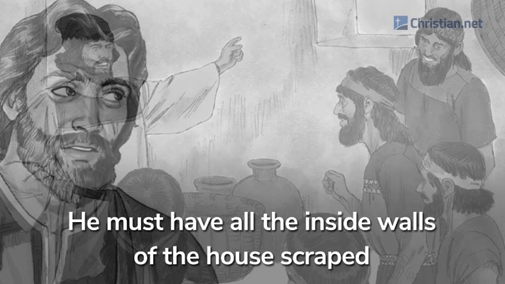
On the seventh day the priest is to return and inspect the house. If the mildew has spread on the walls, he must order that the contaminated stones be pulled out and thrown into an unclean place outside the city. And he shall order that the inside of the house be completely scraped, and that the plaster that is scraped off be dumped into an unclean place outside the city. So different stones must be obtained to replace the contaminated ones, as well as additional mortar to replaster the house.

If the mildew reappears in the house after the stones have been torn out and the house has been scraped and replastered, the priest must come and inspect it. If the mildew has spread in the house, it is a destructive mildew; the house is unclean. It must be torn down with its stones, its timbers, and all its plaster, and taken outside the city to an unclean place. Anyone who enters the house during any of the days that it is closed up will be unclean until evening. And anyone who sleeps in the house or eats in it must wash his clothes.

Cleansing a Home

If, however, the priest comes and inspects it, and the mildew has not spread after the house has been replastered, he shall pronounce the house clean, because the mildew is gone.

He is to take two birds, cedar wood, scarlet yarn, and hyssop to purify the house; and he shall slaughter one of the birds over fresh water in a clay pot.

Then he shall take the cedar wood, the hyssop, the scarlet yarn, and the live bird, dip them in the blood of the slaughtered bird and the fresh water, and sprinkle the house seven times. And he shall cleanse the house with the bird’s blood, the fresh water, the live bird, the cedar wood, the hyssop, and the scarlet yarn. Finally, he is to release the live bird into the open fields outside the city. In this way he will make atonement for the house, and it will be clean. This is the law for any infectious skin disease, for a scaly outbreak, for mildew in clothing or in a house, and for a swelling, rash, or spot, to determine when something is clean or unclean. This is the law regarding skin diseases and mildew.”

Now that we have dealt with skin diseases and contamination of clothing, we turn to contamination of buildings. Although these precautions may sound like overkill, they are not. Failing cleansing, buildings infested with mold and mildew can make their occupants very sick, particularly if those occupants suffer from asthma. While the Israelites might never have heard of asthma and allergies as such, they are still at risk.

Such buildings are to have their contents cleared allowing the priest to inspect the house. If the priest sees red and green depressions below the surface of the walls, the priest will lock up the house for seven days, at which time, he will re-inspect it. If the mold has spread further, the affected stones will be removed, the walls will be scraped, and the stones will be replaced and the walls re-plastered. If the mildew recurs, the entire house must be torn down and the stones, plaster, and timbers dumped in an unclean place outside the city. “Anyone who enters the house during any of the days that it is closed up will be unclean until evening. And anyone who sleeps in the house or eats in it must wash his clothes.”  On the other hand, if the mildew does not spread, the priest will perform a ritual similar to that for cleansing of an individual, making atonement for the house.

APPLICATION: In the wake of Katrina and other hurricanes, many homes in the Gulf Coast have had to be destroyed or extensively decontaminated. Mold and contamination from asbestos have forced older buildings in the U.S. to be destroyed or rehabilitated. It’s interesting that God is giving the Israelites these regulations while they are still wandering in the desert living in tents. God isn’t leaving anything to chance.

We read these regulations and think, “Why would anybody need to make a blood sacrifice on behalf of a house? Generally, blood sacrifices are only done to atone for sin; aren’t buildings spiritually neutral?”  Actually, the jury is out on that one. People leave spiritual stains behind them on places they live and sometimes even the places where they have worked.

For nearly two years, we lived in New Orleans. Although there are many people who rave about the beauties of the French Quarter, we found it a very disturbing place. There are many dark stories about things that happened in the French Quarter centuries ago, some of them true. We have lived in Memphis, Tennessee and Charleston, South Carolina. Although each of these cities has places of serene beauty, there are other parts in which the evil is palpable. We believe that it is no accident that each of these cities has a history of being involved in the slave trade. Slavery is a horrific evil that stains anyone involved with it.   

These days, we don’t need to make blood sacrifices for places where we live and work. But if you find yourself uncomfortable in a building, don’t disregard your feelings; you may be picking up on something. Pray and break off curses in the Name of Jesus.

PRAYER: Father God, thank You for loving us and caring for us. Lord, thank You that there is more power in one drop of the Blood of Jesus than in all the forces of hell. Thank You that when we pray in Your Name, You will protect us. In the mighty and precious Name of King Jesus. Amen.
July 16, 2023 WHY ALL THESE LAWS? LEVITICUS 14:1-32 HOW CAN YOU PROVE YOUR SKIN DISEASE IS OVER?

July 16, 2023

Cleansing from Skin Diseases (Matthew 8:1-4; Mark 1:40-45; Luke 5:12-16)

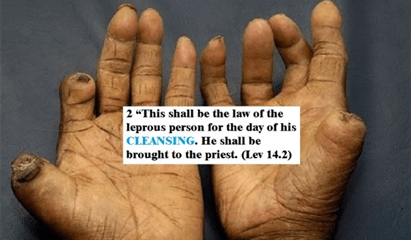
“Then the LORD said to Moses, “This is the law of the one afflicted with a skin disease on the day of his cleansing, when he is brought to the priest. The priest is to go outside the camp to examine him, and if the skin disease of the afflicted person has healed, the priest shall order that two live clean birds, cedar wood, scarlet yarn, and hyssop be brought for the one to be cleansed. Then the priest shall command that one of the birds be slaughtered over fresh water in a clay pot. And he is to take the live bird together with the cedar wood, scarlet yarn, and hyssop, and dip them into the blood of the bird that was slaughtered over the fresh water. Seven times he shall sprinkle the one to be cleansed of the skin disease. Then he shall pronounce him clean and release the live bird into the open field.

The one being cleansed must wash his clothes, shave off all his hair, and bathe with water; then he will be ceremonially clean. Afterward, he may enter the camp, but he must remain outside his tent for seven days. On the seventh day he must shave off all his hair—his head, his beard, his eyebrows, and the rest of his hair. He must wash his clothes and bathe himself with water, and he will be clean.

On the eighth day he is to bring two unblemished male lambs, an unblemished ewe lamb a year old, a grain offering of three-tenths of an ephah of fine flour mixed with olive oil, and one log of olive oil. The priest who performs the cleansing shall present the one to be cleansed, together with these offerings, before the LORD at the entrance to the Tent of Meeting. Then the priest is to take one of the male lambs and present it as a guilt offering, along with the log of olive oil; and he must wave them as a wave offering before the LORD. Then he is to slaughter the lamb in the sanctuary area where the sin offering and burnt offering are slaughtered. Like the sin offering, the guilt offering belongs to the priest; it is most holy.

The priest is to take some of the blood from the guilt offering and put it on the lobe of the right ear of the one to be cleansed, on the thumb of his right hand, and on the big toe of his right foot. Then the priest shall take some of the log of olive oil, pour it into his left palm, dip his right forefinger into the oil in his left palm, and sprinkle some of the oil with his finger seven times before the LORD. And the priest is to put some of the oil remaining in his palm on the lobe of the right ear of the one to be cleansed, on the thumb of his right hand, and on the big toe of his right foot, on top of the blood of the guilt offering.

The rest of the oil in his palm, the priest is to put on the head of the one to be cleansed, to make atonement for him before the LORD. Then the priest is to sacrifice the sin offering and make atonement for the one to be cleansed from his uncleanness. After that, the priest shall slaughter the burnt offering and offer it on the altar, with the grain offering, to make atonement for him, and he will be clean. If, however, the person is poor and cannot afford these offerings, he is to take one male lamb as a guilt offering to be waved to make atonement for him, along with a tenth an ephah of fine flour mixed with olive oil for a grain offering, a log of olive oil, and two turtledoves or two young pigeons, whichever he can afford, one to be a sin offering and the other a burnt offering.

On the eighth day he is to bring them for his cleansing to the priest at the entrance to the Tent of Meeting before the LORD. The priest shall take the lamb for the guilt offering, along with the log of olive oil, and wave them as a wave offering before the LORD. And after he slaughters the lamb for the guilt offering, the priest is to take some of the blood of the guilt offering and put it on the right earlobe of the one to be cleansed, on the thumb of his right hand, and on the big toe of his right foot. Then the priest is to pour some of the oil into his left palm and sprinkle with his right forefinger some of the oil in his left palm seven times before the LORD. The priest shall also put some of the oil in his palm on the right earlobe of the one to be cleansed, on the thumb of his right hand, and on the big toe of his right foot—on the same places as the blood of the guilt offering.

The rest of the oil in his palm, the priest is to put on the head of the one to be cleansed, to make atonement for him before the LORD. Then he must sacrifice one of the turtledoves or young pigeons, whichever he can afford, one as a sin offering and the other as a burnt offering, together with the grain offering. In this way the priest will make atonement before the LORD for the one to be cleansed.

This is the law for someone who has a skin disease and cannot afford the cost of his cleansing.”

Having described the diagnostic process for skin diseases, Moses now describes the rituals to be followed to declare someone clean and ready to re-enter society. Why are these rituals so long and involved? God wants people to be assured that anyone returning to society will pose no threat to their families and their neighbors. The priests are to go to the diseased person outside the camp and examine him. If the disease has cleared, the priests sacrifice one clean bird over a pot with clean water, sprinkle the patient and the other bird seven times with the blood, and set the other bird free.

The patient is to shave off all his hair and bathe; then he may enter the camp but he may not enter his tent until the eighth day when he shaves all his hair again and makes an offering of three lambs, a grain offering, and an olive oil offering. If the patient cannot afford three lambs, he can offer turtle doves or pigeons. During this ritual, the priests will anoint the patient on his right earlobe, his right thumb, and his right big toe as a sign that from then on he will hear only righteousness, do only righteousness, and walk righteously.

APPLICATION: We might wonder why God is ordaining such complicated rituals. God wants to make sure that people realize that these patients have truly been declared clean and that they are no longer to be social outcasts. What must it be like to be a cured patient and to watch that one bird fly free? Now the patient himself/herself will also be free.

The late President Theodore Roosevelt has been quoted as saying that, “If you could kick the person in the pants responsible for most of your trouble, you wouldn’t sit for a month.” If we are honest with ourselves, we can agree with that statement. While we might not be suffering from a skin disease, but each one of us suffers from a disease of congenital sin. Romans 7:21-25 tells us, “I find then a law, that evil is present with me, the one who wills to do good. For I delight in the law of God according to the inward man. But I see another law in my members, warring against the law of my mind, and bringing me into captivity to the law of sin which is in my members. O wretched man that I am! Who will deliver me from this body of death? I thank God—through Jesus Christ our Lord! So then, with the mind I myself serve the law of God, but with the flesh the law of sin.” No matter how hard we try, we sin. But there is good news.

We are on the After side of Calvary. Rather than offering animals or birds, we can trust in the blood of Jesus that cleanses us from all sin. But we must believe that Jesus has done this for us. Let’s pray.

PRAYER: Father God, thank You for loving us and for caring for us. Lord Jesus, help us to trust that You have shed Your blood for our sins. Help us to follow hard after You all the days of our lives. In Your mighty and precious Name, King Jesus. Amen.

JULY 15, 2023 WHY ALL THESE LAWS? LEVITICUS 13:47-59 WHAT IS A “LEPROUS GARMENT?”

July 15, 2023

The Law Concerning Leprous Garments

“Also, if a garment has a leprous plague in it, whether it is a woolen garment or a linen garment, whether it is in the warp or woof of linen or wool, whether in leather or in anything made of leather, and if the plague is greenish or reddish in the garment or in the leather, whether in the warp or in the woof, or in anything made of leather, it is a leprous plague and shall be shown to the priest. The priest shall examine the plague and isolate that which has the plague seven days. And he shall examine the plague on the seventh day. If the plague has spread in the garment, either in the warp or in the woof, in the leather or in anything made of leather, the plague is an active leprosy. It is unclean. He shall therefore burn that garment in which is the plague, whether warp or woof, in wool or in linen, or anything of leather, for it is an active leprosy; the garment shall be burned in the fire.

“But if the priest examines it, and indeed the plague has not spread in the garment, either in the warp or in the woof, or in anything made of leather, then the priest shall command that they wash the thing in which is the plague; and he shall isolate it another seven days. Then the priest shall examine the plague after it has been washed; and indeed if the plague has not changed its color, though the plague has not spread, it is unclean, and you shall burn it in the fire; it continues eating away, whether the damage is outside or inside. If the priest examines it, and indeed the plague has faded after washing it, then he shall tear it out of the garment, whether out of the warp or out of the woof, or out of the leather. But if it appears again in the garment, either in the warp or in the woof, or in anything made of leather, it is a spreading plague; you shall burn with fire that in which is the plague. And if you wash the garment, either warp or woof, or whatever is made of leather, if the plague has disappeared from it, then it shall be washed a second time, and shall be clean.

“This is the law of the leprous plague in a garment of wool or linen, either in the warp or woof, or in anything made of leather, to pronounce it clean or to pronounce it unclean.”

The Israelites are traveling through a desert where the humidity is likely around 20%; however, it is still possible for clothing to develop mildew and other problems. Again, the priests are charged with maintaining sound public health and keeping people safe from potential contagions. If a garment develops red or green spots, the priests are to isolate it for seven days and then re-examine it. If the spots are enlarging, the priests are to burn the garment. If the spots are not enlarging, the garment should be washed and then isolated for another seven days. If the color does not change, the priests will burn the garment, but if the color has faded, then the spots will be torn out of the garment. But if the spots recur, the priests will burn the garment. If the spots disappear after washing, then the garment will be washed a second time and be considered clean.  

Why is God so particular about clothing? Leviticus tells us a great deal about hygiene, both private and public. God wants His people to be holy and not stinky. How badly would someone smell after wearing a moldy garment in desert heat for most of the day? God also wants to make sure His people remain healthy. Potentially, a garment that is infested with some kind of rot might cause skin problems to the wearers.

APPLICATION: When I was growing up, one of my mother’s rallying cries was this: “You are MY child! I don’t care what other people are doing.” While the Israelites were living in Egypt, they likely became used to lax measures as far as hygiene was concerned. Bathing can be difficult when water is at a premium. These are God’s people and He wants them to be different from the pagans surrounding them. God is playing a very long game; He’s using a forty-year journey through the wilderness to train His people in essential public health and hygiene practices. God is looking down the centuries when the Jews will maintain sanitation while others around them will not. How difficult is it to maintain cleanliness in such a situation? The number of Israelites who have left Egypt is roughly 2 million and people using non-water borne sanitation require 3 gallons of water a day, so this group requires 6 million gallons of water a day for washing and drinking water. That’s 8,760,000,000,000 gallons of water over a forty-year period, not allowing for population growth. Talk about long-term miracles!

(The 3-gallon figure comes from the book Medical Administration for Front-line Doctors by Dr. C. Andrew Pearson, a missionary doctor who ran the Ilesha Methodist Hospital in Nigeria.)

Why all these regulations concerning garments? God wants His people to be healthy, even in the middle of a wilderness. These regulations are specific because God knows His people are going to argue with everything He says and He doesn’t want any gray areas.

When we first came to Kumasi, Ghana, many years ago, there were a lot more trees. Kumasi was in the center of the rain forest, and the humidity was so high that clothing would mildew right in the closet or in a dresser. Many people used naphtha – scented moth balls in a vain effort to fight mildew, and it was a common smell in large gatherings. We swiftly learned not to use wire hangers, lest we wind up with rust spots on our clothing. The only way to halt the mildew was to re-wash the clothes using bleach if appropriate and then iron them with a hot iron and wear them that day. For the ancient Israelites, sunshine would have been the best preventative, since sunlight can kill fungus.

These days, many people no longer struggle with mildewed clothes; however, God’s concern for our health and well-being remains. Jeremiah 29:11 tells us that God wants to give us a hope and a future, one that is not blighted by mold. Let us run after God and serve Him, so that we can move into that hope.

PRAYER: Father God, thank You for loving us and for caring for us. Lord, thank You that You want us to be healthy and productive. Help us to follow hard after You all the days of our lives. In the mighty and precious Name of King Jesus. Amen.
JULY 14, 2023 WHY ALL THESE LAWS? LEVITICUS 13:1-46 WHAT DID IT REALLY MEAN TO BE A LEPER?

July 14, 2023

The Law Concerning Leprosy

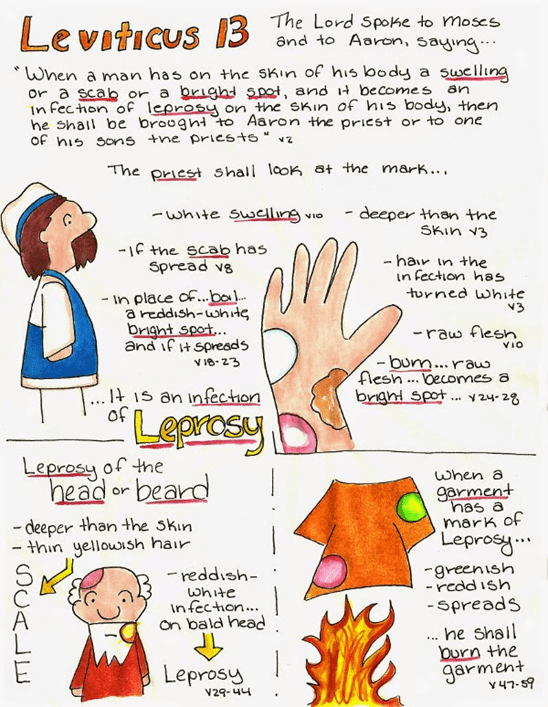
“And the Lord spoke to Moses and Aaron, saying: “When a man has on the skin of his body a swelling, a scab, or a bright spot, and it becomes on the skin of his body like a leprous sore, then he shall be brought to Aaron the priest or to one of his sons the priests. The priest shall examine the sore on the skin of the body; and if the hair on the sore has turned white, and the sore appears to be deeper than the skin of his body, it is a leprous sore. Then the priest shall examine him, and pronounce him unclean. But if the bright spot is white on the skin of his body, and does not appear to be deeper than the skin, and its hair has not turned white, then the priest shall isolate the one who has the sore seven days. And the priest shall examine him on the seventh day; and indeed if the sore appears to be as it was, and the sore has not spread on the skin, then the priest shall isolate him another seven days. Then the priest shall examine him again on the seventh day; and indeed if the sore has faded, and the sore has not spread on the skin, then the priest shall pronounce him clean; it is only a scab, and he shall wash his clothes and be clean. But if the scab should at all spread over the skin, after he has been seen by the priest for his cleansing, he shall be seen by the priest again. And if the priest sees that the scab has indeed spread on the skin, then the priest shall pronounce him unclean. It is leprosy.

“When the leprous sore is on a person, then he shall be brought to the priest. And the priest shall examine him; and indeed if the swelling on the skin is white, and it has turned the hair white, and there is a spot of raw flesh in the swelling, it is an old leprosy on the skin of his body. The priest shall pronounce him unclean, and shall not isolate him, for he is unclean.

“And if leprosy breaks out all over the skin, and the leprosy covers all the skin of the one who has the sore, from his head to his foot, wherever the priest looks, then the priest shall consider; and indeed if the leprosy has covered all his body, he shall pronounce him clean who has the sore. It has all turned white. He is clean. But when raw flesh appears on him, he shall be unclean. And the priest shall examine the raw flesh and pronounce him to be unclean; for the raw flesh is unclean. It is leprosy. Or if the raw flesh changes and turns white again, he shall come to the priest. And the priest shall examine him; and indeed if the sore has turned white, then the priest shall pronounce him clean who has the sore. He is clean.

 “If the body develops a boil in the skin, and it is healed, and in the place of the boil there comes a white swelling or a bright spot, reddish-white, then it shall be shown to the priest; and if, when the priest sees it, it indeed appears deeper than the skin, and its hair has turned white, the priest shall pronounce him unclean. It is a leprous sore which has broken out of the boil. But if the priest examines it, and indeed there are no white hairs in it, and it is not deeper than the skin, but has faded, then the priest shall isolate him seven days; and if it should at all spread over the skin, then the priest shall pronounce him unclean. It is a leprous sore. But if the bright spot stays in one place, and has not spread, it is the scar of the boil; and the priest shall pronounce him clean.

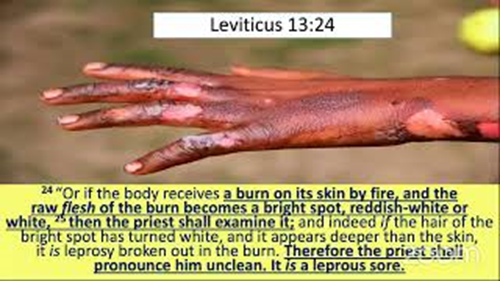
“Or if the body receives a burn on its skin by fire, and the raw flesh of the burn becomes a bright spot, reddish-white or white, then the priest shall examine it; and indeed if the hair of the bright spot has turned white, and it appears deeper than the skin, it is leprosy broken out in the burn. Therefore the priest shall pronounce him unclean. It is a leprous sore. But if the priest examines it, and indeed there are no white hairs in the bright spot, and it is not deeper than the skin, but has faded, then the priest shall isolate him seven days. And the priest shall examine him on the seventh day. If it has at all spread over the skin, then the priest shall pronounce him unclean. It is a leprous sore. But if the bright spot stays in one place, and has not spread on the skin, but has faded, it is a swelling from the burn. The priest shall pronounce him clean, for it is the scar from the burn.

“If a man or woman has a sore on the head or the beard, then the priest shall examine the sore; and indeed if it appears deeper than the skin, and there is in it thin yellow hair, then the priest shall pronounce him unclean. It is a scaly leprosy of the head or beard. But if the priest examines the scaly sore, and indeed it does not appear deeper than the skin, and there is no black hair in it, then the priest shall isolate the one who has the scale seven days. And on the seventh day the priest shall examine the sore; and indeed if the scale has not spread, and there is no yellow hair in it, and the scale does not appear deeper than the skin, he shall shave himself, but the scale he shall not shave. And the priest shall isolate the one who has the scale another seven days. On the seventh day the priest shall examine the scale; and indeed if the scale has not spread over the skin, and does not appear deeper than the skin, then the priest shall pronounce him clean. He shall wash his clothes and be clean. But if the scale should at all spread over the skin after his cleansing, then the priest shall examine him; and indeed if the scale has spread over the skin, the priest need not seek for yellow hair. He is unclean. But if the scale appears to be at a standstill, and there is black hair grown up in it, the scale has healed. He is clean, and the priest shall pronounce him clean.

“If a man or a woman has bright spots on the skin of the body, specifically white bright spots, then the priest shall look; and indeed if the bright spots on the skin of the body are dull white, it is a white spot that grows on the skin. He is clean.

“As for the man whose hair has fallen from his head, he is bald, but he is clean. He whose hair has fallen from his forehead, he is bald on the forehead, but he is clean. And if there is on the bald head or bald forehead a reddish-white sore, it is leprosy breaking out on his bald head or his bald forehead. Then the priest shall examine it; and indeed if the swelling of the sore is reddish-white on his bald head or on his bald forehead, as the appearance of leprosy on the skin of the body, he is a leprous man. He is unclean. The priest shall surely pronounce him unclean; his sore is on his head.

“Now the leper on whom the sore is, his clothes shall be torn and his head bare; and he shall cover his mustache, and cry, ‘Unclean! Unclean!’ He shall be unclean. All the days he has the sore he shall be unclean. He is unclean, and he shall dwell alone; his dwelling shall be outside the camp.


LEPROSY! One of the most feared diagnoses one can have. This disease is caused by Mycobacterium leprae, a bacterium related to the bug that causes TB. The priests are acting as public health officials to protect the populace as they carry out their inspections. But how can people be certain that the priests have gotten it right? That is where these detailed instructions come in.

Basically, the priests are supposed to judge based on the color of the sore, the depth of the sore, the color of the hair associated with the sore, and whether the sore becomes deeper and/or more extensive or heals during an extended period of observation. ““Now the leper on whom the sore is, his clothes shall be torn and his head bare; and he shall cover his mustache, and cry, ‘Unclean! Unclean!’ He shall be unclean. All the days he has the sore he shall be unclean. He is unclean, and he shall dwell alone; his dwelling shall be outside the camp.”

The World Health Organization tells us that “the disease is transmitted through droplets from the nose and mouth. Prolonged close contact over months with someone with untreated leprosy is needed to catch the disease.” Nobody knows exactly where leprosy began, although it has been known in Africa and the Middle East for thousands of years. But what are the priests to do with a group of millions of people moving together in the desert and living in tents where they will automatically cough and sneeze on one another? That is where inspection and isolation practices come in.  

Why have such complicated rules for diagnosing leprosy? If there were not iron-clad rules, a priest might be tempted to take out his resentment on anyone he hates; after all, what could be worse than social isolation? By the time of Jesus, lepers are known as social outcasts; however, Jesus heals many of them, touching them in violation of these regulations. (Matthew 8) 

These days, there are highly effective medicines to treat leprosy, so lepers are no longer isolated as they once were. Treatment regimens range between six and twelve months. But family members should be closely monitored.

APPLICATION: While very few of us will ever have to worry about leprosy, each one of us has a problem that we cannot overcome by ourselves: sin. Romans 3:23 tells us that “all have sinned and have fallen short of the glory of God.” No matter how hard we try, we are still stuck. That is why we all need a Savior who can deliver us from ourselves. Sin must be paid for in blood, and only the blood of a sinless Man will be sufficient to wipe out our sins. This is why Jesus has come to earth, has been born as a man, and has died on Calvary and has risen.

PRAYER:  Father God, thank You for loving us and for caring for us. Lord, help us to trust in what Jesus has already done for us. Send dreams, send experiences, speak to our hearts so that we will truly know the depth of Your love for us. In the mighty and precious Name of King Jesus. Amen.
JULY 13, 2023 WHY ALL THESE LAWS? LEVITICUS 12:1-8  IS GOD A MALE CHAUVINIST?

July 13, 2023

The Ritual After Childbirth

Then the Lord spoke to Moses, saying, “Speak to the children of Israel, saying: ‘If a woman has conceived, and borne a male child, then she shall be unclean seven days; as in the days of her customary impurity she shall be unclean. And on the eighth day the flesh of his foreskin shall be circumcised. She shall then continue in the blood of her purification thirty-three days. She shall not touch any hallowed thing, nor come into the sanctuary until the days of her purification are fulfilled.

‘But if she bears a female child, then she shall be unclean two weeks, as in her customary impurity, and she shall continue in the blood of her purification sixty-six days.

‘When the days of her purification are fulfilled, whether for a son or a daughter, she shall bring to the priest a lamb of the first year as a burnt offering, and a young pigeon or a turtledove as a sin offering, to the door of the tabernacle of meeting. Then he shall offer it before the Lord, and make atonement for her. And she shall be clean from the flow of her blood. This is the law for her who has borne a male or a female.

‘And if she is not able to bring a lamb, then she may bring two turtledoves or two young pigeons—one as a burnt offering and the other as a sin offering. So the priest shall make atonement for her, and she will be clean.’ ”

Why consider a woman unclean for seven days after she bears a male child? Seven days gives time for the lochia, the bleeding after childbirth, to stop. People with any kind of discharge are barred from open society. This time period also allows the woman to recover from childbirth. Although the Jews have practiced circumcision from the time of Abraham, now God is giving a time period for the circumcision. Eight days is long enough to ensure that the baby is going to live. But the mother is still going to continue in seclusion for thirty-three more days, giving the mother a chance to rest and to bond with the baby.

Circumcision has been a sign of the covenant between God and the Israelites ever since the time of Abraham. There are also sound hygienic reasons for circumcision; it helps prevent penile cancer and greatly reduces the incidence of cervical cancer among women having sex with circumcised men. For an in-depth discussion of the meaning of circumcision, check out David Guzik’s Enduring Word commentary on Leviticus 12.

At first glance, when we read these few verses, we wonder if God is discriminating against girl babies. Why is the mother of a girl infant considered unclean for two weeks and secluded for sixty-six days? Girl babies are generally a little smaller and might take longer to gain strength. Since sons are more prized, this extended seclusion allows the family to better bond with the little girl. Guzik also suggests that this extended time of impurity is for the symbolic responsibility of bringing other sinners into the world. “When giving birth to a female, a mother brings a sinner into the world who will bring till other sinners into the world.” (David Guzik, Enduring Word Commentary Leviticus 12)

Once the time of seclusion ends, the mother is to bring an offering and a sin offering to the temple. The requirements are the same for both boy and girl babies. God makes allowances for the very poor by allowing them to offer two turtle doves or two young pigeons. When Mary and Joseph present Jesus at the temple in Jerusalem, they offer a pair of turtle doves, indicating that their family is quite poor.

APPLICATION: These days, maternity leave is a given for women in many countries; however, in the past, many women were forced to return to work as soon as they delivered. Maternity leave allows a mother’s body to recover while she also copes with the strident demands of an ever-hungry newborn. It is both touching and amazing to realize that even in the time of Moses, God was already instituting maternity leave.

Sometimes we view God as an angry old man in the sky who is simply waiting to zap people with a lightning bolt. In this short chapter, God reveals Himself as caring for infants, for mothers, for families, and particularly for the poor. If God cares so much for people in these situations, we can also be certain that He cares for us as individuals.

Please note that these instructions apply to all the Israelite mothers. There is no indication that a particular mother must be unusually virtuous or hard-working to qualify. God refuses to demand that a mother fulfill a set of requirements before she is allowed to enjoy her seclusion; all she must do is to give birth. By the same token, God wants to bless each one of us with rest if we will only allow Him. Jesus told the crowds, “Come to Me, all you who are weary and burdened, and I will give you rest. Take My yoke upon you and learn from Me; for I am gentle and humble in heart, and you will find rest for your souls. For My yoke is easy and My burden is light.” (Matthew 11:28-30) Today, why not ask God to give you the rest you need -physical, mental, emotional, and spiritual. God stands ready if we will let Him.

PRAYER: Father God, thank You for Your ordinances. Thank You that You don’t play favorites and that You stand ready to help any of us to find rest if we will only let You. Help us to trust You and to follow hard after You all the days of our lives. In the mighty and precious Name of King Jesus. Amen.
JULY 12, 2023 WHY ALL THESE LAWS? LEVITICUS 11:1-47 PICKY! PICKY! WHY THESE COMPLICATED DIETARY LAWS?

July 12, 2023

Clean and Unclean Animals (Deuteronomy 14:1-21; Acts 10:9-16)

“The LORD spoke again to Moses and Aaron, telling them, “Say to the Israelites, ‘Of all the beasts of the earth, these ones you may eat: You may eat any animal that has a split hoof completely divided and that chews the cud. But of those that only chew the cud or only have a divided hoof, you are not to eat the following: The camel, though it chews the cud, does not have a divided hoof; it is unclean for you.

The rock badger, though it chews the cud, does not have a divided hoof; it is unclean for you. The rabbit, though it chews the cud, does not have a divided hoof; it is unclean for you. And the pig, though it has a split hoof completely divided, does not chew the cud; it is unclean for you. You must not eat their meat or touch their carcasses; they are unclean for you.

Of all the creatures that live in the water, whether in the seas or in the streams, you may eat anything with fins and scales. But the following among all the teeming life and creatures in the water are detestable to you: everything in the seas or streams that does not have fins and scales. They shall be an abomination to you; you must not eat their meat, and you must detest their carcasses. Everything in the water that does not have fins and scales shall be detestable to you.

Additionally, you are to detest the following birds, and they must not be eaten because they are detestable: the eagle, the bearded vulture, the black vulture, the kite, any kind of falcon, any kind of raven, the ostrich, the screech owl, the gull, any kind of hawk, the little owl, the cormorant, the great owl, the white owl, the desert owl, the osprey, the stork, any kind of heron, the hoopoe, and the bat.

All flying insects that walk on all fours are detestable to you. However, you may eat the following kinds of winged creatures that walk on all fours: those having jointed legs above their feet for hopping on the ground. Of these you may eat any kind of locust, katydid, cricket, or grasshopper. All other winged creatures that have four legs are detestable to you. These creatures will make you unclean. Whoever touches their carcasses will be unclean until evening, and whoever picks up one of their carcasses must wash his clothes, and he will be unclean until evening.

Every animal with hooves not completely divided or that does not chew the cud is unclean for you. Whoever touches any of them will be unclean. All the four-footed animals that walk on their paws are unclean for you; whoever touches their carcasses will be unclean until evening, and anyone who picks up a carcass must wash his clothes, and he will be unclean until evening. They are unclean for you.

The following creatures that move along the ground are unclean for you: the mole, the mouse, any kind of great lizard, the gecko, the monitor lizard, the common lizard, the skink, and the chameleon.

These animals are unclean for you among all the crawling creatures. Whoever touches them when they are dead shall be unclean until evening. When one of them dies and falls on something, that article becomes unclean; any article of wood, clothing, leather, sackcloth, or any implement used for work must be rinsed with water and will remain unclean until evening; then it will be clean. If any of them falls into a clay pot, everything in it will be unclean; you must break the pot. Any food coming into contact with water from that pot will be unclean, and any drink in such a container will be unclean.

Anything upon which one of their carcasses falls will be unclean. If it is an oven or cooking pot, it must be smashed; it is unclean and will remain unclean for you. Nevertheless, a spring or cistern containing water will remain clean, but one who touches a carcass in it will be unclean. If a carcass falls on any seed for sowing, the seed is clean; but if water has been put on the seed and a carcass falls on it, it is unclean for you.

If an animal that you may eat dies, anyone who touches the carcass will be unclean until evening. Anyone who eats from the carcass must wash his clothes and will be unclean until evening, and anyone who picks up the carcass must wash his clothes and will be unclean until evening. Every creature that moves along the ground is detestable; it must not be eaten. Do not eat any creature that moves along the ground, whether it crawls on its belly or walks on four or more feet; for such creatures are detestable.

Do not defile yourselves by any crawling creature; do not become unclean or defiled by them. For I am the LORD your God; consecrate yourselves, therefore, and be holy, because I am holy. You must not defile yourselves by any creature that crawls along the ground. For I am the LORD, who brought you up out of the land of Egypt so that I would be your God; therefore be holy, because I am holy.

This is the law regarding animals, birds, all living creatures that move in the water, and all creatures that crawl along the ground. You must distinguish between the unclean and the clean, between animals that may be eaten and those that may not.’”

This chapter is one of the most complicated in Leviticus. Why all these detailed regulations? God wants His people to stay healthy and holy. The illustration is from a site entitled “Doodling through the Bible.”

Basically, God lists clean and unclean animals. Reading the list of unclean animals, we realize that even then, some of those animals may have carried diseases such as tularemia in rabbits. The list of seafood eliminates shellfish that might also carry diseases. Four-footed animals that walk on their paws are likely to be scavengers, as are the prohibited birds. Moles, mice, and lizards of all shapes and sizes are also likely to carry various kinds of diseases.

Of prohibited animals, God says, “Whoever touches them when they are dead shall be unclean until evening. When one of them dies and falls on something, that article becomes unclean; any article of wood, clothing, leather, sackcloth, or any implement used for work must be rinsed with water and will remain unclean until evening; then it will be clean. If any of them falls into a clay pot, everything in it will be unclean; you must break the pot. Any food coming into contact with water from that pot will be unclean, and any drink in such a container will be unclean. Anything upon which one of their carcasses falls will be unclean. If it is an oven or cooking pot, it must be smashed; it is unclean and will remain unclean for you. Nevertheless, a spring or cistern containing water will remain clean, but one who touches a carcass in it will be unclean. If a carcass falls on any seed for sowing, the seed is clean; but if water has been put on the seed and a carcass falls on it, it is unclean for you.”

Even if a clean animal dies, anybody who touches it or eats the carcass will be unclean until he washes at evening.

Why all these complicated rules? God knows His people and God knows their propensity for arguing, splitting hairs, and pushing the envelope. Give these people a millimeter and they will definitely take a kilometer! These people must remain healthy without antibiotics, so stringent public health measures are essential.

APPLICATION: We read theses lists of rules and think, “YIPES! How can anybody possibly keep up with this stuff?” But given the alternatives of sickness and death, following these dietary rules begins to make sense. Do we have to observe all these rules? Yes and no. Some people are vegans while others are vegetarians or follow macrobiotic diets. Others follow many of the Jewish dietary rules as part of their religion. But even if you love surf and turf, it still makes sense to be careful about your food, especially when even your breakfast oatmeal can expose you to herbicides.

God always has many different purposes in His commandments. These commandments have been given to keep the Israelites healthy; however, God is also hauling His people out of pagan practices. For many pagans, anything goes, and God wants His people to seek holiness.

How far will we go to be holy? God wants us to be healthy so that we can serve Him and others better. How much are we willing to give up? No matter where you live, food additives can be a problem. Watered down honey, fake cooking oils, frozen food that has thawed and has then been re-frozen-these are all challenges that we face even in northern Ghana. And many of us need to be careful about our diets because we are diabetic or hypertensive.

As we continue to study Leviticus, let’s remember that God loves us and wants us to be healthy and productive. While very few of us are about to chow down on grasshoppers, we still need to be careful about our food.

PRAYER: Father God, thank You for loving us and for caring for us. Lord, help us to realize how deep Your concern is for us and how much You want us to be healthy. In the mighty and precious Name of King Jesus. Amen.