Archive for August, 2023

AUGUST 31, 2023 BOOKKEEPING? AARGH! #28 NUMBERS 25:1-18 COMPROMISE CAN BE DEADLY!

August 31, 2023

Israel’s Harlotry in Moab

”Now Israel remained in Acacia Grove, and the people began to commit harlotry with the women of Moab. They invited the people to the sacrifices of their gods, and the people ate and bowed down to their gods. So Israel was joined to Baal of Peor, and the anger of the Lord was aroused against Israel.

Then the Lord said to Moses, “Take all the leaders of the people and hang the offenders before the Lord, out in the sun, that the fierce anger of the Lord may turn away from Israel.”

So Moses said to the judges of Israel, “Every one of you kill his men who were joined to Baal of Peor.”

And indeed, one of the children of Israel came and presented to his brethren a Midianite woman in the sight of Moses and in the sight of all the congregation of the children of Israel, who were weeping at the door of the tabernacle of meeting. Now when Phinehas the son of Eleazar, the son of Aaron the priest, saw it, he rose from among the congregation and took a javelin in his hand; and he went after the man of Israel into the tent and thrust both of them through, the man of Israel, and the woman through her body. So the plague was stopped among the children of Israel. And those who died in the plague were twenty-four thousand.

Then the Lord spoke to Moses, saying: “Phinehas the son of Eleazar, the son of Aaron the priest, has turned back My wrath from the children of Israel, because he was zealous with My zeal among them, so that I did not consume the children of Israel in My zeal. Therefore say, ‘Behold, I give to him My covenant of peace; and it shall be to him and his descendants after him a covenant of an everlasting priesthood, because he was zealous for his God, and made atonement for the children of Israel.’ ”

Now the name of the Israelite who was killed, who was killed with the Midianite woman, was Zimri the son of Salu, a leader of a father’s house among the Simeonites. And the name of the Midianite woman who was killed was Cozbi the daughter of Zur; he was head of the people of a father’s house in Midian.

Then the Lord spoke to Moses, saying: “Harass the Midianites, and attack them; for they harassed you with their schemes by which they seduced you in the matter of Peor and in the matter of Cozbi, the daughter of a leader of Midian, their sister, who was killed in the day of the plague because of Peor.”

Ah, the Israelites! God’s chosen people. Witnesses of incredible miracles. Recipients of God’s divine protection. Surely, gratitude for all God has done for them will keep them faithful…….WHAT?!?! Are you kidding? Given the opportunity for a good orgy, a bunch of the Israelites are off immediately to do sacrifices to Baal, to eat steak from the sacrificial meat, and to engage in sex with alluring Midianite maidens.

The inspiration for this might have come from Balaam. Although Numbers 24 tells us that Balaam returned home, other sources suggest differently. It’s possible that having failed to succeed in cursing the Israelites, Balaam comes up with another plan that will get him back into favor with King Balak. Wikipedia tells us, “Numbers 25:1–9 describes how Israel engaged in the Heresy of Peor. Numbers 31:16 blames this on Balaam’s advice and because of his culpability in the incident, which resulted in deadly divine judgements against the Israelites who participated, he was eventually killed in a retaliatory battle against Midian in Numbers 31:8.

Deuteronomy 23:3–6 summarizes these incidents, and further states that the Ammonites were associated with the Moabites. Joshua, in his farewell speech, also makes reference to it. With God’s protection taken from him, Balaam is later listed among the Midianites who were killed in revenge for the “matter of Peor”. Joshua 13:22 records that Balaam died “by the sword” during a battle for the Reubenite occupation of Moabite land. Revelation also states that Balaam “taught Balak to cast a stumbling block before the children of Israel.”

This time God isn’t messing around! “Take all the leaders of the people and hang the offenders before the Lord, out in the sun, that the fierce anger of the Lord may turn away from Israel.” While the orgy is still on-going, people are beginning to drop like flies from some kind of plague. If the leaders are not killed promptly, the plague might spread through the entire camp. Spurred on by indignation and zeal for the Lord, Phinehas, Aaron’s grandson, slaughters an Israelite man and his Moabite girlfriend. Since this man was allegedly a leader in Israel, he might have been one of Phinehas’ close friends, but Phinehas proceeds anyway. This sacrificial act helps stop the plague, but not before 24,000 people die.

From a public health standpoint, we might wonder what kind of plague could kill so swiftly. Read some of Rudyard Kipling’s stories from his time in India, and you realize that cholera epidemics can sweep through entire groups within hours. In the book The Secret Garden, the little girl is orphaned because her parents and most of the other people in the house die suddenly from cholera, leaving her alone. Dodgy sanitary conditions and a crowd of drunken people would be a set-up for a cholera outbreak.  Although Balaam’s name never appears in this account, other sources claim he is responsible for inciting the Moabites to invite the Israelites to worship Baal with an orgy. Of course, many of the Israelites probably don’t need much persuading.

APPLICATION: While it’s tempting to criticize the Israelites, how quick are many of us to compromise when temptation offers itself? Temptations come in all sorts of disguises, not necessarily sexual temptations. We know a Catholic priest who chose to be initiated as a traditional diviner as the basis for his doctoral thesis in Anthropology. In this case, it was the lure of secret knowledge that influenced our friend; yet, what did he sacrifice spiritually in the process and to what did he commit himself without realizing it?

How do we avoid temptation and compromise? Pray! Ask God for guidance, and refuse to deceive yourself. James 1:13-15 tells us, “When tempted, no one should say, “God is tempting me.” For God cannot be tempted by evil, nor does He tempt anyone. But each one is tempted when by his own evil desires he is lured away and enticed. Then after desire has conceived, it gives birth to sin; and sin, when it is full-grown, gives birth to death.” Those Israelites who went in for Baal worship probably gave themselves all kinds of excuses. “We’re just being neighborly; besides, what harm could it do?” But they died anyway, indulging in rituals God had strictly forbidden. May God help us, so that we will follow hard after Him all the days of our lives!

PRAYER: Father God, thank You for loving us and for caring for us. Lord, help us to be careful about the temptations that surround us. Thank You for Your promises of guidance. In the mighty and precious Name of King Jesus. Amen.

AUGUST 30, 2023 BOOKKEEPING? AARGH! #27 NUMBERS 24:1-25 BALAAM GIVES A FINAL PREDICTION AND WINDS UP EMPTY-HANDED

August 30, 2023

Balaam’s Third Oracle

“And when Balaam saw that it pleased the LORD to bless Israel, he did not resort to sorcery as on previous occasions, but he turned his face toward the wilderness. When Balaam looked up and saw Israel encamped tribe by tribe, the Spirit of God came upon him, and he lifted up an oracle, saying: “This is the prophecy of Balaam son of Beor, the prophecy of a man whose eyes are open, the prophecy of one who hears the words of God, who sees a vision from the Almighty, who bows down with eyes wide open: How beautiful are your tents, O Jacob, your dwellings, O Israel! They spread out like palm groves, like gardens beside a stream, like aloes the LORD has planted, like cedars beside the waters. Water will flow from his buckets, and his seed will have abundant water. His king will be greater than Agag, and his kingdom will be exalted. God brought him out of Egypt with strength like a wild ox, to devour hostile nations and crush their bones, to pierce them with arrows. He crouches, he lies down like a lion; like a lioness, who dares to rouse him? Blessed are those who bless you and cursed are those who curse you.”

Balak Dismisses Balaam

“Then Balak’s anger burned against Balaam, and he struck his hands together and said to Balaam, “I summoned you to curse my enemies, but behold, you have persisted in blessing them these three times. Therefore, flee at once to your home! I said I would richly reward you, but instead the LORD has denied your reward.”

Balaam answered Balak, “Did I not already tell the messengers you sent me that even if Balak were to give me his house full of silver and gold, I could not do anything of my own accord, good or bad, to go beyond the command of the LORD? I will speak whatever the LORD says. Now I am going back to my people, but come, let me warn you what this people will do to your people in the days to come.”

Balaam’s Fourth Oracle

Then Balaam lifted up an oracle, saying, “This is the prophecy of Balaam son of Beor, the prophecy of a man whose eyes are open, the prophecy of one who hears the words of God, who has knowledge from the Most High, who sees a vision from the Almighty, who bows down with eyes wide open: I see him, but not now; I behold him, but not near. A star will come forth from Jacob, and a scepter will arise from Israel. He will crush the skulls of Moab and strike down all the sons of Sheth. Edom will become a possession, as will Seir, his enemy; but Israel will perform with valor. A ruler will come from Jacob and destroy the survivors of the city.”

Balaam’s Final Three Oracles

Then Balaam saw Amalek and lifted up an oracle, saying: “Amalek was first among the nations, but his end is destruction.” Next he saw the Kenites and lifted up an oracle, saying: “Your dwelling place is secure, and your nest is set in a cliff. Yet Kain will be destroyed when Asshur (Assyria) takes you captive.” Once more Balaam lifted up an oracle, saying: “Ah, who can live unless God has ordained it? Ships will come from the coasts of Cyprus; they will subdue Asshur and Eber, but they too will perish forever.” Then Balaam arose and returned to his homeland, and Balak also went on his way.”

Balaam is winding up his prophecies and Balak is fed up. “And when Balaam saw that it pleased the LORD to bless Israel, he did not resort to sorcery as on previous occasions, but he turned his face toward the wilderness.” Sorcery? Balaam has been contacting God using sorcery but God has been giving Balaam valid prophecies. God will use anybody at any level when they will let Him. This time, Balaam doesn’t bother with sorcery but turns his face toward the Israelite camp and opens himself to the Spirit of God.

Once more, God gives Balaam a magnificent blessing for Israel. “How beautiful are your tents, O Jacob, your dwellings, O Israel! They spread out like palm groves, like gardens beside a stream, like aloes the LORD has planted, like cedars beside the waters. Water will flow from his buckets, and his seed will have abundant water. His king will be greater than Agag, and his kingdom will be exalted. God brought him out of Egypt with strength like a wild ox, to devour hostile nations and crush their bones, to pierce them with arrows. He crouches, he lies down like a lion; like a lioness, who dares to rouse him? Blessed are those who bless you and cursed are those who curse you.”

Balak is so angry at Balaam that he says, “The Lord has denied you your reward.” “No problem,” says, Balaam. “I’m going home, but before I do, I will tell you what God will do to Moab in the future.” Balaam continues to predict that a ruler will come out of Israel that will destroy Moab. Then Balaam predicts that the Amalekites, the Kenites, and the Assyrians will eventually be destroyed.

APPLICATION: Some people have argued that these predictions must have been added later; however, Moses is credited with writing the Book of Numbers and there is no reason to doubt that these predictions are authentic. After all, Moses has regularly met God face to face and has also received the Ten Commandments at God’s hand. It’s ironic that many of the same people who will try to deride the prophecies in Numbers 24 are more than willing to accept all kinds of theories about ancient aliens visiting earth from other planets, the lost continent of Atlantis, etc.

One fascinating point is this possible reference: ”I see him, but not now; I behold him, but not near. A star will come forth from Jacob, and a scepter will arise from Israel. He will crush the skulls of Moab and strike down all the sons of Sheth. Edom will become a possession, as will Seir, his enemy; but Israel will perform with valor. A ruler will come from Jacob and destroy the survivors of the city.”  Is this a prediction about King David or does it concern Jesus the Messiah or does it refer to both? Many of God’s prophecies work on multiple levels. Personally, I feel that God has blessed Balaam by allowing him to give one of the first Messianic prophecies.

What happens to Balaam? We’ll find out the details of Balaam’s fate tomorrow, but it is not a happy one. This man who has received God’s Word and God’s commands on several occasions dies ingloriously. Rather than serving the One True Living God whole-heartedly, Balaam tries to worm his way back into Balak’s good graces with disastrous results. Balaam’s story serves as a reminder that just because God has used us does not mean we cannot fall from grace if we remain disobedient.

PRAYER: Father God, thank You for loving us and for caring for us. Lord, help us never to take You or Your service for granted. Help us to remember that obedience to You and to Your Word must be paramount in our lives. In the mighty and precious Name of King Jesus. Amen.

AUGUST 29, 2023 BOOKKEEPING? AARGH! #26 NUMBERS 23:1-30 WHEN GOD HAS BLESSED YOU, NO CURSES WILL WORK!

August 29, 2023

Balaam’s First Oracle

“Then Balaam said to Balak, “Build me seven altars here, and prepare for me seven bulls and seven rams.” So Balak did as Balaam had directed, and Balak and Balaam offered a bull and a ram on each altar.

“Stay here by your burnt offering while I am gone,” Balaam said to Balak. “Perhaps the LORD will meet with me. And whatever He reveals to me, I will tell you.”

So Balaam went off to a barren height, and God met with him. “I have set up seven altars,” Balaam said, “and on each altar I have offered a bull and a ram.” Then the LORD put a message in Balaam’s mouth, saying, “Return to Balak and give him this message.” So he returned to Balak, who was standing there beside his burnt offering, with all the princes of Moab.

And Balaam lifted up an oracle, saying: “Balak brought me from Aram, the king of Moab from the mountains of the east. ‘Come,’ he said, ‘put a curse on Jacob for me; Come and denounce Israel!’ How can I curse what God has not cursed? How can I denounce what the LORD has not denounced? For I see them from atop the rocky cliffs, and I watch them from the hills. Behold, a people dwelling apart, not reckoning themselves among the nations. Who can count the dust of Jacob or number even a fourth of Israel? Let me die the death of the righteous; let my end be like theirs!”

Then Balak said to Balaam, “What have you done to me? I brought you here to curse my enemies, and behold, you have only blessed them!” But Balaam replied, “Should I not speak exactly what the LORD puts in my mouth?”

Balaam’s Second Oracle

Then Balak said to him, “Please come with me to another place where you can see them. You will only see the outskirts of their camp—not all of them. And from there, curse them for me.”

So Balak took him to the field of Zophim, to the top of Pisgah, where he built seven altars and offered a bull and a ram on each altar.

Balaam said to Balak, “Stay here beside your burnt offering while I meet the LORD over there.”

And the LORD met with Balaam and put a message in his mouth, saying, “Return to Balak and speak what I tell you.” So he returned to Balak, who was standing there by his burnt offering with the princes of Moab. “What did the LORD say?” Balak asked. Then Balaam lifted up an oracle, saying: “Arise, O Balak, and listen; give ear to me, O son of Zippor. God is not a man, that He should lie, or a son of man, that He should change His mind. Does He speak and not act? Does He promise and not fulfill? I have indeed received a command to bless; He has blessed, and I cannot change it. He considers no disaster for Jacob; He sees no trouble for Israel.

The LORD their God is with them, and the shout of the King is among them. God brought them out of Egypt with strength like a wild ox. For there is no spell against Jacob and no divination against Israel. It will now be said of Jacob and Israel, ‘What great things God has done!’ Behold, the people rise like a lioness; they rouse themselves like a lion, not resting until they devour their prey and drink the blood of the slain.”

Then Balak said to Balaam, “Neither curse them at all nor bless them at all!” But Balaam replied, “Did I not tell you that whatever the LORD says, I must do?” “Please come,” said Balak, “I will take you to another place. Perhaps it will please God that you curse them for me from there.” And Balak took Balaam to the top of Peor, which overlooks the wasteland. “Build me seven altars here,” Balaam said, “and prepare for me seven bulls and seven rams.” So Balak did as Balaam had instructed, and he offered a bull and a ram on each altar.”

Balak is really frustrated! Here he has brought Balaam at great expense to curse the Israelites, but all Balaam will do is to bless them. When God gives Balaam the first message, Balak is horrified. “How can I curse what God has not cursed? How can I denounce what the LORD has not denounced? For I see them from atop the rocky cliffs, and I watch them from the hills. Behold, a people dwelling apart, not reckoning themselves among the nations. Who can count the dust of Jacob or number even a fourth of Israel? Let me die the death of the righteous; let my end be like theirs!”

Balak sends Balaam to another location where he can only see part of the Israelite camp in hopes that Balaam will now be able to curse them. But God’s next message is a harsh rebuke. ““Arise, O Balak, and listen; give ear to me, O son of Zippor. God is not a man, that He should lie, or a son of man, that He should change His mind. Does He speak and not act? Does He promise and not fulfill? I have indeed

received a command to bless; He has blessed, and I cannot change it. He considers no disaster for Jacob; He sees no trouble for Israel. The LORD their God is with them, and the shout of the King is among them. God brought them out of Egypt with strength like a wild ox. For there is no spell against Jacob and no divination against Israel. It will now be said of Jacob and Israel, ‘What great things God has done!’ Behold, the people rise like a lioness; they rouse themselves like a lion, not resting until they devour their prey and drink the blood of the slain.” At this point, Balak’s reaction is,”Aargh!” As the chapter closes, Balak is moving Balaam into yet a third area, despite God’s rebukes. Balak is a slow learner.

APPLICATION: One popular chorus here in Ghana says, “Who has the final say? Jesus Christ has the final say!” God has the final say, no matter what we might think. Balaam would be happy to satisfy Balak’s demands were it not for God having confronted him on the way to Moab. But God insists on Balaam blessing Israel abundantly.  It’s likely that Balak has already attempted other kinds of witchcraft without any success. But nothing is working.

Witchcraft is real and we fool ourselves if we ignore that reality. But God is also real and His power to protect is still very real. How can we qualify for God’s protection? Obedience to God’s will is the key. When we commit our lives to God and persistently seek His will for our lives, we qualify for His protection. But when we are living and acting in rebellion against God, we have removed ourselves from God’s protection. Rebellion can take several different forms, including rebellion against those in authority above us. 1 Samuel 15:23 tells us that “rebellion is as the sin of witchcraft.”

If we don’t want to become a target of evil, we must be sure to obey God. We served faithfully in one location, only to be refused the opportunity to return there, despite the fact that the local people really wanted us to come back and take up the work. We had to relocate and move all our belongings that we had stored in a container in the village to another location several hundred miles away. We worked in two different places for several years until being invited to return to that remote village. (The parent group couldn’t find any other doctor willing to work there.) God showed us that the only way we would survive would be to repudiate all traces of bitterness over the way we had been treated. For months we quoted Ephesians 4:31-32 several times a day.  Let all bitterness, wrath, anger, clamor, and evil speaking be put away from you, with all malice. And be kind to one another, tenderhearted, forgiving one another, even as God in Christ forgave you.”  This village was a satanic stronghold. Had we failed to reject bitterness, we could have fallen sick or died. Only God and His Word protected us.

PRAYER: Father God, thank You for loving us and caring for us. Lord, help us to obey You at all times so that You can guard and keep us. Thank You for Your powerful protection. In the mighty and precious Name of King Jesus. Amen.

AUGUST 28, 2023 BOOKKEEPING? AARGH! #25 NUMBERS 22:1-41 WHEN GOD PROTECTS YOU, WITCHCRAFT WON’T WORK AGAINST YOU!

August 28, 2023

Balak Sends for Balaam

“Then the children of Israel moved, and camped in the plains of Moab on the side of the Jordan across from Jericho.

Now Balak the son of Zippor saw all that Israel had done to the Amorites. And Moab was exceedingly afraid of the people because they were many, and Moab was sick with dread because of the children of Israel. So Moab said to the elders of Midian, “Now this company will lick up everything around us, as an ox licks up the grass of the field.” And Balak the son of Zippor was king of the Moabites at that time. Then he sent messengers to Balaam the son of Beor at Pethor, which is near the River in the land of the sons of his people, to call him, saying: “Look, a people has come from Egypt. See, they cover the face of the earth, and are settling next to me! Therefore please come at once, curse this people for me, for they are too mighty for me. Perhaps I shall be able to defeat them and drive them out of the land, for I know that he whom you bless is blessed, and he whom you curse is cursed.”

So the elders of Moab and the elders of Midian departed with the diviner’s fee in their hand, and they came to Balaam and spoke to him the words of Balak. And he said to them, “Lodge here tonight, and I will bring back word to you, as the Lord speaks to me.” So the princes of Moab stayed with Balaam.

Then God came to Balaam and said, “Who are these men with you?” So Balaam said to God, “Balak the son of Zippor, king of Moab, has sent to me, saying, ‘Look, a people has come out of Egypt, and they cover the face of the earth. Come now, curse them for me; perhaps I shall be able to overpower them and drive them out.’ ” And God said to Balaam, “You shall not go with them; you shall not curse the people, for they are blessed.”

So Balaam rose in the morning and said to the princes of Balak, “Go back to your land, for the Lord has refused to give me permission to go with you.” And the princes of Moab rose and went to Balak, and said, “Balaam refuses to come with us.” Then Balak again sent princes, more numerous and more honorable than they. And they came to Balaam and said to him, “Thus says Balak the son of Zippor: ‘Please let nothing hinder you from coming to me; for I will certainly honor you greatly, and I will do whatever you say to me. Therefore please come, curse this people for me.’ ”

Then Balaam answered and said to the servants of Balak, “Though Balak were to give me his house full of silver and gold, I could not go beyond the word of the Lord my God, to do less or more. Now therefore, please, you also stay here tonight, that I may know what more the Lord will say to me.”

And God came to Balaam at night and said to him, “If the men come to call you, rise and go with them; but only the word which I speak to you—that you shall do.” So Balaam rose in the morning, saddled his donkey, and went with the princes of Moab.

Balaam, the Donkey, and the Angel

Then God’s anger was aroused because he went, and the Angel of the Lord took His stand in the way as an adversary against him. And he was riding on his donkey, and his two servants were with him. Now the donkey saw the Angel of the Lord standing in the way with His drawn sword in His hand, and the donkey turned aside out of the way and went into the field. So Balaam struck the donkey to turn her back onto the road. Then the Angel of the Lord stood in a narrow path between the vineyards, with a wall on this side and a wall on that side. And when the donkey saw the Angel of the Lord, she pushed herself against the wall and crushed Balaam’s foot against the wall; so he struck her again. Then the Angel of the Lord went further, and stood in a narrow place where there was no way to turn either to the right hand or to the left. And when the donkey saw the Angel of the Lord, she lay down under Balaam; so Balaam’s anger was aroused, and he struck the donkey with his staff.

Then the Lord opened the mouth of the donkey, and she said to Balaam, “What have I done to you, that you have struck me these three times?” And Balaam said to the donkey, “Because you have abused me. I wish there were a sword in my hand, for now I would kill you!” So the donkey said to Balaam, “Am I not your donkey on which you have ridden, ever since I became yours, to this day? Was I ever disposed to do this to you?” And he said, “No.” Then the Lord opened Balaam’s eyes, and he saw the Angel of the Lord standing in the way with His drawn sword in His hand; and he bowed his head and fell flat on his face. And the Angel of the Lord said to him, “Why have you struck your donkey these three times? Behold, I have come out to stand against you, because your way is perverse before Me. The donkey saw Me and turned aside from Me these three times. If she had not turned aside from Me, surely I would also have killed you by now, and let her live.”

And Balaam said to the Angel of the Lord, “I have sinned, for I did not know You stood in the way against me. Now therefore, if it displeases You, I will turn back.” Then the Angel of the Lord said to Balaam, “Go with the men, but only the word that I speak to you, that you shall speak.” So Balaam went with the princes of Balak.

Now when Balak heard that Balaam was coming, he went out to meet him at the city of Moab, which is on the border at the Arnon, the boundary of the territory. Then Balak said to Balaam, “Did I not earnestly send to you, calling for you? Why did you not come to me? Am I not able to honor you?” And Balaam said to Balak, “Look, I have come to you! Now, have I any power at all to say anything? The word that God puts in my mouth, that I must speak.” So Balaam went with Balak, and they came to Kirjath Huzoth. Then Balak offered oxen and sheep, and he sent some to Balaam and to the princes who were with him.

Balaam’s First Prophecy

So it was, the next day, that Balak took Balaam and brought him up to the high places of Baal, that from there he might observe the extent of the people.”

The name “Baalam” means “destroyer of people.” There have always been people who have known God in some form, and evidently, Balaam, the son of Beor at Pethor, is one of these people. Balaam has been making a profitable business of blessings and cursings. When messengers from King Balak of Moab turn up, Balaam must be rubbing his hands in glee. This is going to be the crowning point of Balaam’s career…..until God tells him, “No.” When Balaam refuses the first time, Balak sends other princes who are richer and more honorable than the first delegation. Notice Balaam’s negotiations: “Though Balak were to give me his house full of silver and gold, I could not go beyond the word of the Lord my God, to do less or more.” This statement is not mere hyperbole; Balaam is actually quoting the price of his services, an entire house full of gold and silver!  

“And God came to Balaam at night and said to him, “If the men come to call you, rise and go with them; but only the word which I speak to you—that you shall do.” So Balaam rose in the morning, saddled his donkey, and went with the princes of Moab.” This part of the story is confusing. God appears to give Balaam permission to go with Balak’s envoys; yet, on the way, God confronts Balaam because He is angry that Balaam has ignored His commands. This might be an example of God’s permissive will, rather than His perfect will. Balaam’s poor little donkey tries to dodge the Angel of the Lord three times until God finally reveals Himself.

God warns Balaam to say ONLY the words God wants him to. Faced with the reality of instant destruction, Balaam gulps and agrees. It’s little wonder that Balaam informs Balak that he can only say whatever God gives him to say. Balak ignores Balaam’s warnings, assuming that he can persuade Balaam to do whatever he wants.

APPLICATION: Can God move someone who is not serving Him to speak His words anyway? Absolutely! During the 1994 Northern Ethnic Conflict in northern Ghana, a godly pastor and his family fled into the bush to save themselves. Entering a small village, the pastor met a village leader who was a fetish priest. After a brief conversation with the pastor, the fetish priest said, “Pastor, we see that you are a man of God. . Stay with us and we will help you find your way through the bush.” Eventually, the fetish priest and his people conducted the pastor and his family to a safe area.

Balaam REALLY wants this commission! If Balaam can fulfill Balak’s demands, he will be set for life. But there’s a small problem; God doesn’t want Balaam to curse the Israelites. Frightened into obedience, Balaam is prepared to deliver God’s blessings. Sadly, Balaam’s story will not have a happy ending. Eventually, Balaam delays his return home for too long and is killed along with the people who have employed him. Balaam would have done better had he stayed home in the first place.

God allows Balaam to go, but this is not God’s perfect will for Balaam. Reading this story, it is easy to forget that God loves Balaam and Balak just as much as He loves the Israelites. “God is not willing that any should perish, but that all should come to repentance.” (2 Peter 3:9) The whole mess begins because Balak fears that the Israelites are going to destroy his nation and wants spiritual power to protect it. Were Balak to allow the Israelites to pass and to pay for their food and water, he might  save Moab.

How committed are we to doing God’s will and how many times do we try to do our will in God’s Name? Balaam’s obedience is only partial; he’s still thinking about all that gold and silver he’s going to collect. Many times, we claim to want God’s will; however, our motives are frequently mixed. God knows us better than we know ourselves; we are not deceiving God, but ourselves. Let us truly seek God’s will for our lives and stop playing games.

PRAYER: Father God, thank You for loving us and for caring for us. Lord, help us to follow hard after You all the days of our lives and to truly love You and serve You without playing games. In the mighty and precious Name of King Jesus. Amen.

AUGUST 27, 2023 BOOKKEEPING? AARGH! #24 NUMBERS 21:1-35 WHAT’S THAT SNAKE DOING ON THAT POLE?

August 27, 2023

The Defeat of Arad

“When the Canaanite king of Arad, who lived in the Negev, heard that Israel was coming along the road to Atharim, he attacked Israel and captured some prisoners. So Israel made a vow to the LORD: “If You will deliver this people into our hands, we will devote their cities to destruction.” (The Hebrew term refers to giving over things or persons to the LORD, either by destroying them or by giving them as an offering.) And the LORD heard Israel’s plea and delivered up the Canaanites. Israel devoted them and their cities to destruction; so they named the place Hormah (Destruction.)

The Bronze Serpent

Then they set out from Mount Hor along the route to the Red Sea, in order to bypass the land of Edom. But the people grew impatient on the journey and spoke against God and against Moses: “Why have you led us up out of Egypt to die in the wilderness? There is no bread or water, and we detest this wretched food!”

So the LORD sent venomous snakes among the people, and many of the Israelites were bitten and died.

Then the people came to Moses and said, “We have sinned by speaking against the LORD and against you. Intercede with the LORD to take the snakes away from us.” So Moses interceded for the people.

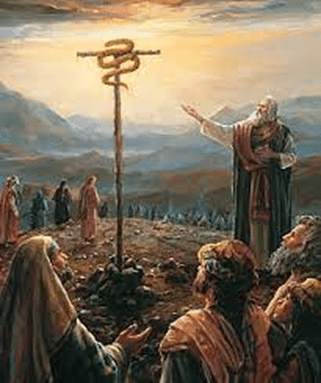
Then the LORD said to Moses, “Make a fiery serpent and mount it on a pole. When anyone who is bitten looks at it, he will live.” So Moses made a bronze snake and mounted it on a pole. If anyone who was bitten looked at the bronze snake, he would live.

The Journey to Moab

Then the Israelites set out and camped at Oboth. They journeyed from Oboth and camped at Iye-abarim in the wilderness opposite Moab to the east. From there they set out and camped in the Valley of Zered. From there they moved on and camped on the other side of the Arnon, in the wilderness that extends into the Amorite territory.

Now the Arnon is the border between the Moabites and the Amorites. 14Therefore it is stated in the Book of the Wars of the LORD: “Waheb in Suphah and the wadis of the Arnon, seven the slopes of the wadis that extend to the site of Ar and lie along the border of Moab.”

From there they went on to Beer, the well where the LORD said to Moses, “Gather the people so that I may give them water.” Then Israel sang this song: “Spring up, O well, all of you sing to it! The princes dug the well; the nobles of the people hollowed it out with their scepters and with their staffs.”

From the wilderness the Israelites went on to Mattanah, and from Mattanah to Nahaliel, and from Nahaliel to Bamoth, and from Bamoth to the valley in Moab where the top of Pisgah overlooks the wasteland.

The Defeat of Sihon (Deuteronomy 2:24-37) Then Israel sent messengers to Sihon king of the Amorites, saying, “Let us pass through your land. We will not cut through any field or vineyard, or drink water from any well. We will stay on the King’s Highway until we have passed through your territory.”

But Sihon would not let Israel pass through his territory. Instead, he gathered his whole army and went out to confront Israel in the wilderness. When he came to Jahaz, he fought against Israel. And Israel put him to the sword and took possession of his land, from the Arnon to the Jabbok—but only up to the border of the Ammonites, because it was fortified.

Israel captured all the cities of the Amorites and occupied them, including Heshbon and all its villages. Heshbon was the city of Sihon king of the Amorites, who had fought against the former king of Moab and taken all his land as far as the Arnon. That is why the poets say: “Come to Heshbon, let it be rebuilt;

let the city of Sihon be restored. For a fire went out from Heshbon, a blaze from the city of Sihon. It consumed Ar of Moab, the rulers of Arnon’s heights. Woe to you, O Moab! You are destroyed, O people of Chemosh! He gave up his sons as refugees, and his daughters into captivity to Sihon king of the Amorites. But we have overthrown them; Heshbon is destroyed as far as Dibon. We demolished them as far as Nophah, which reaches to Medeba.”

The Defeat of Og (Deuteronomy 3:1-11)

So Israel lived in the land of the Amorites. After Moses had sent spies to Jazer, Israel captured its villages and drove out the Amorites who were there. Then they turned and went up the road to Bashan, and Og king of Bashan marched out against them with his whole army to do battle at Edrei. But the LORD said to Moses, “Do not fear him, for I have delivered him into your hands, with all his people and his land. Do to him as you did to Sihon king of the Amorites, who lived in Heshbon.”

So they struck down Og, along with his sons and his whole army, until no remnant was left. And they took possession of his land.”

One slogan much beloved by citizens of Texas is “Don’t mess with Texas!” In this case, the slogan should read “Don’t mess with God’s people!” The Canaanites in the Negev try and their cities are destroyed. Such a victory should encourage the Israelites to trust God, right? Um, no. Ignoring this latest miracle, the Israelites are griping again. “Why have you led us up out of Egypt to die in the wilderness? There is no bread or water, and we detest this wretched food!”  YIPES! What a bunch of whiners! Notice the Israelites aren’t going hungry; they are just bored with manna. Moses has recently forfeited his chance to enter the Promised Land while God has miraculously supplied water gushing out of a rock, but hey! That was yesterday. Moses, what are you going to do today?

This time God deals with the gripers by sending venomous snakes in that bite them so they die. How do these snakes know which people to bite? Perhaps these snakes respond to the evil in people’s hearts. Those people who are not complaining are safe while those who are complaining put themselves at risk for death by snakebite. After watching friends and neighbors die, the elders come to Moses, “Um, maybe we have made a small mistake. Ask God to take the snakes away.” When Moses asks God for advice, God orders Moses to create a bronze serpent and mount it on a tall pole so that anyone bitten by a snake can look at the image of the serpent. God’s healing power will then flow to that person and they will live. Notice that God does not immediately remove the snakes.

The Israelites continue to journey to a place called Beer, or well. This time, all the Israelites sing to the water and God causes it to spring up. Perhaps the elders tap into an underground river or aquifer with their staffs. At any rate, the Israelites have water again. The chapter concludes with the Israelites defeating the Amorites and the citizens of Bashan under King Og. Og is one of the giants, a fact that is mentioned elsewhere because his huge bedstead is kept as a reminder. (Deuteronomy 3:11 “Og king of Bashan was the last of the Rephaites. His bed was decorated with iron and was more than nine cubits long and four cubits wide. It is still in Rabbah of the Ammonites.”)

APPLICATION: Proverbs 15:15 tells us, “All the days of the oppressed are wretched, but the cheerful heart has a continual feast.” Now we see why God has allowed Moses to spend forty years herding sheep; the Israelites are every bit as willfully stupid as any sheep can possibly be! Why send venomous serpents to bite the ungrateful? Ingratitude is as deadly as the venom from any snake ever known. Ungrateful people always stir up problems with others, spreading their unhappiness. Nothing good can come from complaining.

Why has God ordered Moses to create a bronze serpent on a pole? Sadly, this serpent will receive the name “Nehushtan” and will become an idol for many Israelites. But God has a greater purpose. This serpent is a hint of what will happen to Jesus Christ. The story is found in John 3. Nicodemus, a Jewish religious ruler and a sincere seeker after God, visits Jesus at night to avoid criticism by his fellow religious leaders. Jesus tells Nicodemus, “ And as Moses lifted up the serpent in the wilderness, even so must the Son of Man be lifted up, that whoever believes in Him should not perish but have eternal life. For God so loved the world that He gave His only begotten Son, that whoever believes in Him should not perish but have everlasting life. For God did not send His Son into the world to condemn the world, but that the world through Him might be saved.” (John 3:14-17)

During the attack of venomous snakes, those who were bitten and who looked at the image of the snake on the pole were healed. Those who thought they could cope on their own died. Nothing has changed. None of us can do sufficient good deeds to earn our way into heaven. Only Jesus and His sacrifice on the cross at Calvary can save us from our sins. We have two choices: Look at Jesus and live or turn our heads away and die in our sins. The choice is yours; choose wisely!

PRAYER: Father God, thank You for loving us and for caring for us. Lord, help all who read these words to look to Jesus for salvation and healing. In the mighty and precious Name of King Jesus we pray with thanksgiving. Amen.

AUGUST 26, 2023 BOOKKEEPING? AARGH! #23 NUMBERS 20:1-29 THE ISRAELITES GET ON MOSES’ LAST NERVE AND HE LOSES IT!

August 26, 2023

Moses’ Error at Kadesh

“Then the children of Israel, the whole congregation, came into the Wilderness of Zin in the first month, and the people stayed in Kadesh; and Miriam died there and was buried there. Now there was no water for the congregation; so they gathered together against Moses and Aaron. And the people contended with Moses and spoke, saying: “If only we had died when our brethren died before the Lord! Why have you brought up the assembly of the Lord into this wilderness, that we and our animals should die here? And why have you made us come up out of Egypt, to bring us to this evil place? It is not a place of grain or figs or vines or pomegranates; nor is there any water to drink.” So Moses and Aaron went from the presence of the assembly to the door of the tabernacle of meeting, and they fell on their faces. And the glory of the Lord appeared to them.

Then the Lord spoke to Moses, saying, “Take the rod; you and your brother Aaron gather the congregation together. Speak to the rock before their eyes, and it will yield its water; thus you shall bring water for them out of the rock, and give drink to the congregation and their animals.” So Moses took the rod from before the Lord as He commanded him.

And Moses and Aaron gathered the assembly together before the rock; and he said to them, “Hear now, you rebels! Must we bring water for you out of this rock?” Then Moses lifted his hand and struck the rock twice with his rod; and water came out abundantly, and the congregation and their animals drank.

Then the Lord spoke to Moses and Aaron, “Because you did not believe Me, to hallow Me in the eyes of the children of Israel, therefore you shall not bring this assembly into the land which I have given them. “This was the water of Meribah (Contention), because the children of Israel contended with the Lord, and He was hallowed among them.

Passage Through Edom Refused

Now Moses sent messengers from Kadesh to the king of Edom. “Thus says your brother Israel: ‘You know all the hardship that has befallen us, how our fathers went down to Egypt, and we dwelt in Egypt a long time, and the Egyptians afflicted us and our fathers. When we cried out to the Lord, He heard our voice and sent the Angel and brought us up out of Egypt; now here we are in Kadesh, a city on the edge of your border. Please let us pass through your country. We will not pass through fields or vineyards, nor will we drink water from wells; we will go along the King’s Highway; we will not turn aside to the right hand or to the left until we have passed through your territory.’ ”

Then Edom said to him, “You shall not pass through my land, lest I come out against you with the sword.” So the children of Israel said to him, “We will go by the Highway, and if I or my livestock drink any of your water, then I will pay for it; let me only pass through on foot, nothing more.” Then he said, “You shall not pass through.” So Edom came out against them with many men and with a strong hand. Thus Edom refused to give Israel passage through his territory; so Israel turned away from him.

Death of Aaron

Now the children of Israel, the whole congregation, journeyed from Kadesh and came to Mount Hor. And the Lord spoke to Moses and Aaron in Mount Hor by the border of the land of Edom, saying: “Aaron shall be gathered to his people, for he shall not enter the land which I have given to the children of Israel, because you rebelled against My word at the water of Meribah. Take Aaron and Eleazar his son, and bring them up to Mount Hor; and strip Aaron of his garments and put them on Eleazar his son; for Aaron shall be gathered to his people and die there.” So Moses did just as the Lord commanded, and they went up to Mount Hor in the sight of all the congregation. Moses stripped Aaron of his garments and put them on Eleazar his son; and Aaron died there on the top of the mountain. Then Moses and Eleazar came down from the mountain. Now when all the congregation saw that Aaron was dead, all the house of Israel mourned for Aaron thirty days.”

Poor Moses and Aaron! The Israelites are at it again! The Israelites have camped at Kadesh, where Miriam, Moses,’ and Aaron’s sister, dies. But there’s another water crisis. Last time, God ordered Moses to strike the rock and water would gush out. This time God orders Moses to SPEAK to the rock, indicating a higher degree of trust in God’s provision. Earlier, we learned that Moses is the most humble man in all the earth; however, even the meekest man in all the earth has a breaking point, and Moses has reached his. Moses demands, “Hear now, you rebels! Must we bring water for you out of this rock?” Even though Aaron doesn’t say anything, he still agrees with Moses. The upshot of this mistake is that both Moses and Aaron lose the chance to enter the Promised Land.

The nation of Edom has its origins in Esau, Jacob’s brother. As distant relatives, the Edomites should be willing to help the Israelites, but they refuse, even though the Israelites promise to pay for everything and to remain on the King’s Highway. Centuries later, this mistake will prove the undoing of the Edomites. Then the Israelites move on to Mount Hor, where Aaron dies. Before Aaron dies, God orders Moses to strip Aaron’s priestly robes and place them on Eleazer, his son.

james 1:19 – I Live For JESUS !APPLICATION: James 1:19-20 tells us, Let every person be quick to hear, slow to speak, slow to anger; for the anger of man does not produce the righteousness of God.”  No matter how patient we might think we are, Moses’ failure at Kadesh demonstrates that even the most humble among us may still lose it if sufficiently provoked. When we lose our tempers, we hand those around us the chance to take advantage of us and manipulate us. When angry, we may readily say things we will bitterly regret later. We may lash out unreasonably, hurting those we love the most.

Today’s story is a terribly sad one. Moses has done so well for so many years. Moses has faced all kinds of rebellions, food and water crises, and continual death threats from the very people whom he has led out of Egypt. Even though Moses’ brother Aaron is a smooth talker, he is a weakling with all the backbone of a limp noodle. When the going gets tough, Aaron can be spotted by the dust cloud raised by his feet as he runs away. The only One on whom Moses can truly rely is God. But the stress has been building and this time, Moses finally loses his patience. Little does Moses realize that he will also lose his opportunity to enter the Promised Land.  

How well do most of us handle stress? The Perceived Stress Scale is a widely used measuring tool for determining cumulative stress in one’s life. The tool involves a variety of questions regarding stressful events with scores being assigned depending on the degree of stress one has faced. Had the PSS existed when Moses and Aaron were alive, their stress points would have been astronomical. Several years ago, we attended a training on missionary stress shortly after weathering a small tribal war. Our stress points were through the roof.

Could Moses have avoided his failure? Who knows? It’s likely that we don’t even know all the horrible things the Israelites have pulled against Moses and Aaron. Would any of us have done any better? Highly unlikely! The first time the Israelites began whining, we might have been willing to let them go back to slavery in Egypt.

What can we learn from this chapter? No matter how faithful we are, no matter how patiently we behave, any of us can have a bad day and lose not only our tempers but also a chance to enter the Promised Land. May God help us to trust Him and to confide our stresses in Him!

 PRAYER: Father God, thank You for loving us and for caring for us. Lord, help us to trust You when things become stressful and let You handle the stress instead of us. In the mighty and precious Name of King Jesus. Amen.

AUGUST 25, 2023 BOOKKEEPING? AARGH! #22 NUMBERS 19:1-22 HOW CAN THE ASHES OF A COW PURIFY ANYBODY FROM SIN?

August 25, 2023

The Red Heifer

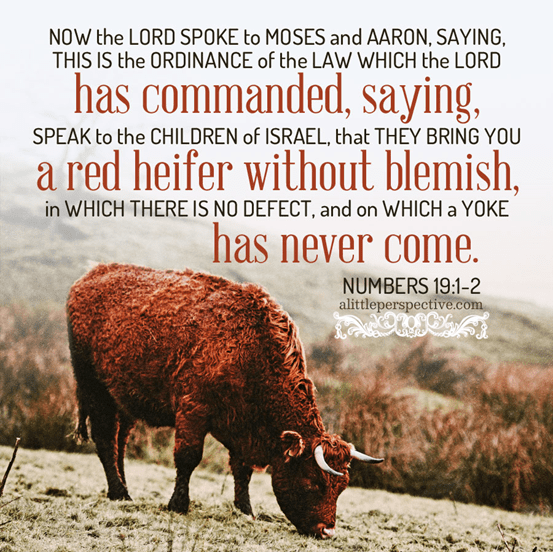
“Then the LORD said to Moses and Aaron, “This is the statute of the law that the LORD has commanded: Instruct the Israelites to bring you an unblemished red heifer that has no defect and has never been placed under a yoke. Give it to Eleazar the priest, and he will have it brought outside the camp and slaughtered in his presence.

Eleazar the priest is to take some of its blood with his finger and sprinkle it seven times toward the front of the Tent of Meeting. Then the heifer must be burned in his sight. Its hide, its flesh, and its blood are to be burned, along with its dung. The priest is to take cedar wood, hyssop, and scarlet wool and throw them onto the burning heifer.

Then the priest must wash his clothes and bathe his body in water; after that he may enter the camp, but he will be ceremonially unclean until evening. The one who burned the heifer must also wash his clothes and bathe his body in water, and he too will be ceremonially unclean until evening.

Then a man who is ceremonially clean is to gather up the ashes of the heifer and store them in a ceremonially clean place outside the camp. They must be kept by the congregation of Israel for preparing the water of purification; this is for purification from sin. The man who has gathered up the ashes of the heifer must also wash his clothes, and he will be ceremonially unclean until evening. This is a permanent statute for the Israelites and for the foreigner residing among them.

Purification of the Unclean

Whoever touches any dead body will be unclean for seven days. He must purify himself with the water on the third day and the seventh day; then he will be clean. But if he does not purify himself on the third and seventh days, he will not be clean. Anyone who touches a human corpse and fails to purify himself defiles the tabernacle of the LORD. That person must be cut off from Israel. He remains unclean, because the water of purification has not been sprinkled on him, and his uncleanness is still on him.

This is the law when a person dies in a tent: Everyone who enters the tent and everyone already in the tent will be unclean for seven days, and any open container without a lid fastened on it is unclean.

Anyone in the open field who touches someone who has been killed by the sword or has died of natural causes, or anyone who touches a human bone or a grave, will be unclean for seven days.

For the purification of the unclean person, take some of the ashes of the burnt purification offering, put them in a jar, and pour fresh running water over them. Then a man who is ceremonially clean is to take some hyssop, dip it in the water, and sprinkle the tent, all the furnishings, and the people who were there. He is also to sprinkle the one who touched a bone, grave, or person who has died or been slain.

The man who is ceremonially clean is to sprinkle the unclean person on the third day and on the seventh day. After he purifies the unclean person on the seventh day, the one being cleansed must wash his clothes and bathe in water, and that evening he will be clean. But if a person who is unclean does not purify himself, he will be cut off from the assembly, because he has defiled the sanctuary of the LORD. The water of purification has not been sprinkled on him; he is unclean.

This is a permanent statute for the people: The one who sprinkles the water of purification must wash his clothes, and whoever touches the water of purification will be unclean until evening. Anything the unclean person touches will become unclean, and anyone who touches it will be unclean until evening.”

This chapter has two parts: first, the creation of ashes of purification and second, the application of those ashes in the water of purification. God instructs the high priest to take a red heifer that has never been pregnant and has never been used to plow outside the camp, and have it slaughtered in his presence. The high priest will then take some of the blood and sprinkle it seven times toward the front of the Tent of Meeting. Then the heifer is to be cut into pieces and burned completely, along with cedar wood, hyssop, and scarlet wool. David Guzik in his Enduring Word Commentary says the following: Cedar wood is resistant to disease and rot and is well known for its quality, preciousness, and fragrant aroma. These properties may be the reason for including it here – as well as a symbolic reference to the wood of the cross. Some suppose the cross Jesus was crucified on was made of cedar wood.

iii. Because hyssop was used for the cleansing ceremony for lepers, when David asked God purge me with hyssop in Psalm 51:7, he associated himself with the leper who needed cleansing. As well, on the cross Jesus was offered a drink from a hyssop branch (John 19:29).

iv. Scarlet, the color of blood, was used in the veil and curtains of the tabernacle (Exodus 26:31), in the garments of the high priest (Exodus 28:5-6), and for the covering for the table of showbread (Numbers 4:8). Scarlet was the sign of Rahab’s salvation (Joshua 2:21), and the color of the “king’s robe” mockingly set on Jesus by Roman soldiers (Matthew 27:28).

i. The water of purification was only made effective when the ash remains of the red heifer (along with the cedar, hyssop, and scarlet) were added to the water.

ii. This water of purification was necessary because of sin and its many effects. “The most serious and obvious type of human uncleanness was that caused by death. Anyone who touched a corpse or a human bone or a grave, or entered the tent of a dead man, became unclean (Numbers 19:14-16). Furthermore, this uncleanness was contagious: anything the unclean man touched would itself become unclean and infect others (Numbers 19:22; cf. Leviticus 15).” (Wenham)

iii. This water of purification showed God’s kindness in providing another way of cleansing from ritual impurity. Leviticus gives a ritual for cleansing that included washing in water and waiting until evening (Leviticus 11:2811:39-4015:16-18). In more serious cases (such as contact with a dead body), one must wait seven days and then offer an animal sacrifice (Leviticus 14:10-32). This provides an alternative to the long and expensive ritual described in Leviticus 14. With the water of purification, instead of being cleansed by a sin offering, the unclean person was sprinkled with water that included all the ingredients of a sin offering.

iv. Taken together the offering of the red heifer and the water of purification associated with that offering are a powerful picture pointing to the perfect work of Jesus Christ.

· Like the red heifer, Jesus was “red” in His sacrifice, “Christ covered with his own blood.” (Trapp)

· Like the red heifer, Jesus was pure and without spot.

· Like the red heifer, Jesus was never under the yoke (of sin).

· Like the red heifer, Jesus was sacrificed outside the camp.

· Like the red heifer, the sacrifice of Jesus was unique.

· Like the red heifer, Jesus was completely offered.

· Like the red heifer, the sacrifice of Jesus is effective for all who claim it, including the stranger and sojourner (Numbers 19:10).

v. The water of purification made with the ashes of the red heifer did not create a different purification from ritual uncleanness. In some sense, it did what the longer, more costly, and more elaborate ceremony of Leviticus 14 did. Instead, this water of purification made a better way (more accessible and virtually instant) to ritually purify even the most unclean ones among God’s people. It did this by building on existing principles of sacrifice, but making a different offering, one that did not need to be constantly repeated, but only referred to again and again. One might say that the water of purification offered a better way to be made clean, something of a God-approved shortcut – but it wasn’t easy for the red heifer. The red heifer and water of purification are a wonderful illustration of the perfect work of Jesus Christ on the cross, as a substitute for His people (Hebrews 9:13-14). In both cases, a better sacrifice replaced a previous system for cleansing.”

APPLICATION: For the complete discussion, see Enduring Word Commentary for Numbers 19. Part of the reason for proscriptions against people handling dead bodies has to do with the Egyptian obsession with death, mummification, etc. God wants His people to be concerned about life and not death. While this might seem a bit much, recent events indicate there are many young people also obsessed with death as well. Recently, the term “back to school necklace” has made its way into current jargon. Unfortunately, this term has nothing to do with jewelry!

On Urban Dictionary, a back-to-school necklace is described as “another name for a noose. This is due to the utter despair you feel when school starts back up again.” Some examples of its use include: “I’m about to buy my back-to-school necklace,” “I can’t wait to get a back-to-school necklace,” “Thinking about that back-to-school necklace,” “That back-to-school necklace is calling me,” “I can’t wait to wear my back-to-school necklace,” etc.” (https://parade.com/living/what-is-back-to-school-necklace) Young people who should have everything to look forward to are obsessing about hanging themselves because school makes them so miserable.

Jesus told his disciples, “The thief does not come except to steal, and to kill, and to destroy. I have come that they may have life, and that they may have it more abundantly.” From the beginning of the world, Satan has always brought death while God has always brought life. The ceremonies involving the ashes of the red heifer were designed to bring people forgiveness and restoration. But the ceremonies involved had to be repeated whenever an individual committed a particular sin. Jesus has shed his blood on Calvary so that we can have forgiveness for our sins. 1 John 1:8-9 tells us,  If we say that we have no sin, we deceive ourselves, and the truth is not in us. If we confess our sins, He is faithful and just to forgive us our sins and to cleanse us from all unrighteousness.”  Let us thank God for His provision, His mercy, and His forgiveness!

PRAYER: Father God, thank You for loving us and for caring for us. Lord, we confess that we have repeatedly sinned and grieved You. Thank You for Your forgiveness and for Your promises of salvation. In the mighty and precious Name of King Jesus. Amen.  
AUGUST 24, 2023 BOOKKEEPING? AARGH! #21 NUMBERS 18:1-32 GOD BLESS JANITORS!

August 24, 2023

Duties of Priests and Levites

“So the LORD said to Aaron, “You, your sons, and your father’s house must bear the iniquity involving the sanctuary. And you and your sons alone must bear the iniquity involving your priesthood. But bring with you also your brothers from the tribe of Levi, the tribe of your father, that they may join you and assist you and your sons before the Tent of the Testimony. And they shall attend to your duties and to the duties of all the Tent; but they must not come near to the furnishings of the sanctuary or the altar, or both they and you will die. They are to join you and attend to the duties of the Tent of Meeting, doing all the work at the Tent; but no outsider may come near you.

And you shall attend to the duties of the sanctuary and of the altar, so that wrath may not fall on the Israelites again. Behold, I Myself have selected your fellow Levites from the Israelites as a gift to you, dedicated to the LORD to perform the service for the Tent of Meeting. But only you and your sons shall attend to your priesthood for everything concerning the altar and what is inside the veil, and you are to perform that service. I am giving you the work of the priesthood as a gift, but any outsider who comes near the sanctuary must be put to death.”

Offerings for Priests and Levites

Then the LORD said to Aaron, “Behold, I have put you in charge of My offerings. As for all the sacred offerings of the Israelites, I have given them to you and your sons as a portion and a permanent statute. A portion of the most holy offerings reserved from the fire will be yours. From all the offerings they render to Me as most holy offerings, whether grain offerings or sin offerings or guilt offerings, that part belongs to you and your sons. You are to eat it as a most holy offering. Every male may eat it; it shall be holy to you.

And this is yours as well: the offering of their gifts, along with all the wave offerings of the Israelites. I have given this to you and your sons and daughters as a permanent statute. Every ceremonially clean person in your household may eat it. I give you all the freshest olive oil and all the finest new wine and grain that the Israelites give to the LORD as their firstfruits. The firstfruits of everything in their land that they bring to the LORD will belong to you. Every ceremonially clean person in your household may eat them. Every devoted thing in Israel belongs to you. The firstborn of every womb, whether man or beast, that is offered to the LORD belongs to you. But you must surely redeem every firstborn son and every firstborn male of unclean animals. You are to pay the redemption price for a month-old male according to your valuation: five shekels of silver, according to the sanctuary shekel, which is twenty gerahs. (5 shekels is approximately 2 ounces or 57 grams of silver. 16 d 20 gerahs is equivalent to one shekel (approximately 0.4 ounce or 11.4 grams).

But you must not redeem the firstborn of an ox, a sheep, or a goat; they are holy. You are to sprinkle their blood on the altar and burn their fat as an offering made by fire, a pleasing aroma to the LORD. And their meat belongs to you, just as the breast and right thigh of the wave offering belong to you.

All the holy offerings that the Israelites present to the LORD I give to you and to your sons and daughters as a permanent statute. It is a permanent covenant of salt before the LORD for you and your offspring.”

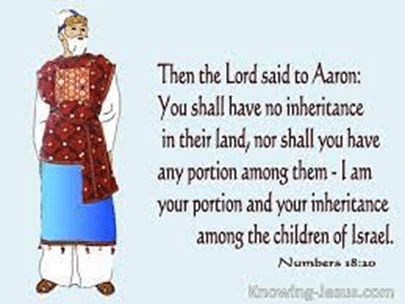
Then the LORD said to Aaron, “You will have no inheritance in their land, nor will you have any portion among them. I am your portion and your inheritance among the Israelites.

Behold, I have given to the Levites all the tithes in Israel as an inheritance in return for the work they do, the service of the Tent of Meeting. No longer may the Israelites come near the Tent of Meeting, or they will they incur guilt and die.

The Levites are to perform the work of the Tent of Meeting, and they must bear their iniquity. This is a permanent statute for the generations to come. The Levites will not receive an inheritance among the Israelites. For I have given the Levites as their inheritance the tithe that the Israelites present to the LORD as a contribution. That is why I told them that they would not receive an inheritance among the Israelites.”

And the LORD instructed Moses, “Speak to the Levites and tell them: ‘When you receive from the Israelites the tithe that I have given you as your inheritance, you must present part of it as an offering to the LORD—a tithe of the tithe. Your offering will be reckoned to you as grain from the threshing floor or juice from the winepress. So you are to present an offering to the LORD from every tithe you receive from the Israelites, and from it give the LORD’s offering to Aaron the priest. You must present the offering due the LORD from all the best of every gift, the holiest part of it.’

Therefore say to the Levites, ‘When you have presented the best part, it will be reckoned to you as the produce of the threshing floor or the winepress. And you and your households may eat the rest of it anywhere; it is the compensation for your work at the Tent of Meeting. Once you have presented the best part of it, you will not incur guilt because of it. But you must not defile the sacred offerings of the Israelites, or else you will die.’”

Organograms showing the distribution of authority are critically important. Here God is laying out a divine organogram. The priests are descendants of Aaron, and the remainder of the Levites are to assist in the work of the temple. The Levites will not have an inheritance in the Promised Land; however, they will receive the tithes on which they also must tithe. They will receive a portion of the most holy offerings reserved from the fire, part of the wave offerings, and all the holy offerings that the Israelites will present.

The firstborn of every womb, whether man or beast, that is offered to the LORD belongs to the Levites, but they must redeem every firstborn son and every firstborn male of unclean animals. The firstborn of an ox, a sheep or a goat become offerings to the Lord. Finally, God warns the Levites, “So you are to present an offering to the LORD from every tithe you receive from the Israelites, and from it give the LORD’s offering to Aaron the priest. You must present the offering due the LORD from all the best of every gift, the holiest part of it.’ If the Levites fail to offer the best part of the tithes of the Israelites as their tithe, they will die. Why such a stringent requirement? God knows that the Levites will cheat if at all possible, and He wants to make sure they take His tithes seriously.

APPLICATION: God is very fair and just. He realizes that the Levites can’t handle all the glorified janitorial work around the temple and farm or run businesses in addition, so He makes provision for them. God also wants to make sure that only the Levites enter the central parts of the temple to avoid having curious onlookers tramping through the Holy of Holies, profaning it in the process. At the same time, God wants to make the rules clear to the Levites so that they can’t manipulate and twist things later.

Maintenance of any public space always requires lots of work. Consider all the various tasks involved in temple worship, particularly cleaning up after those burnt offerings. At the same time, the Levites have to take orders from the priests, Aaron’s sons. If tempted to rebel, it’s likely those Levites are going to remember Aaron’s rod that has bloomed and produced almonds and all those other rods that just sat there.

Notice that God orders the Levites to give the very best parts of the tithes as their tithes. Centuries later, David will say, “nor will I offer to the Lord my God with that which costs me nothing.” God deserves our very best, not leftovers. When we offer ourselves to the Lord, He will always receive us gladly.

PRAYER: Father God, thank You for loving us and for caring for us. Lord, help us to give You our very best efforts. Thank You that You will always receive us with love and joy. In the mighty and precious Name of King Jesus. Amen.

AUGUST 23, 2023 BOOKKEEPING? AARGH! #20 NUMBERS 17:1-13 GOD HAS THE FINAL SAY!

August 23, 2023


Aaron’s Staff Buds

“And the LORD said to Moses, “Speak to the Israelites and take from them twelve staffs, one from the leader of each tribe. Write each man’s name on his staff, and write Aaron’s name on the staff of Levi, because there must be one staff for the head of each tribe. Place the staffs in the Tent of Meeting in front of the Testimony, where I meet with you. The staff belonging to the man I choose will sprout, and I will rid Myself of the constant grumbling of the Israelites against you.”

So Moses spoke to the Israelites, and each of their leaders gave him a staff—one for each of the leaders of their tribes, twelve staffs in all. And Aaron’s staff was among them. Then Moses placed the staffs before the LORD in the Tent of the Testimony.

The next day Moses entered the Tent of the Testimony and saw that Aaron’s staff, representing the house of Levi, had sprouted, put forth buds, blossomed, and produced almonds. Then Moses brought out all the staffs from the LORD’s presence to all the Israelites. They saw them, and each man took his own staff. The LORD said to Moses, “Put Aaron’s staff back in front of the Testimony, to be kept as a sign for the rebellious, so that you may put an end to their grumbling against Me, lest they die.” So Moses did as the LORD had commanded him.

Then the Israelites declared to Moses, “Look, we are perishing! We are lost; we are all lost! Anyone who comes near the tabernacle of the LORD will die. Are we all going to perish?”

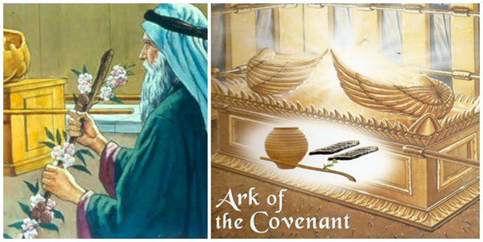
Even after watching three rebellious families be swallowed up by the earth, even after watching 250 rebellious leaders be consumed by fire – even still, the Israelites are ready to criticize Moses and Aaron all over again. God knows people’s hearts and God wants to put an end to the criticisms once and for all. Each tribal leader contributes his staff and Aaron contributes his staff to represent the tribe of Levi. The staffs are labeled with the leaders’ names and placed before the Lord in the Tent of Meeting. By the next day, not only has Aaron’s rod sprouted, but it has also put forth buds, blossomed, and is now producing almonds! The other staffs remain inanimate pieces of wood. God orders Aaron’s rod to be kept in the Ark along with the stone tablets containing the Ten Commandments as a witness to the grumblers.

Belatedly, the Israelites panic and begin wailing that they are lost and they might all die. WHY? When Aaron’s rod has blossomed while the others have not, this indicates that God has chosen Aaron (and Moses) and the tribe of Levi above the rest of the leaders and their tribes and that God can and will cut off those people any time they rebel in the future. For now, the Israelites will stop their grumbling; however, give them a few days or weeks and they will probably be at it again.

APPLICATION:

Why are some people so ungrateful while others are thankful for the smallest of favors? The story is told of two elderly ladies in a nursing home who were complaining about the food. “Oh this food is terrible!” said one lady. “Yes, and the portions are so small!” said the other. If you don’t like the food, smaller portions should be a plus, not a problem.

The Israelites have been miraculously removed from Egypt and fed and watered throughout their wanderings in the desert. God has led these people by manifesting Himself to them as a pillar of cloud by day and a pillar of fire by night, frightening away any would – be attackers. God has brought water gushing out of bare rocks and manna enough for two million people. God has even struck key rebels dead or allowed the earth to swallow them without the Israelites repenting. Up to now, the Israelites have been able to blame Moses and Aaron; however, now God is sending a message directly to the Israelites and finally they are frightened that God might cut off all the other tribes, leaving the tribe of Levi alone.

Before we criticize the Israelites too severely, let’s examine ourselves. How many miracles has God done for us? We are alive and healthy with hearts beating roughly 80 times a minute. We take our health for granted until we fall sick or are injured; then we complain. But few of us thank God for the blessings of good health. We complain that our children are driving us crazy…until something happens to one of our children. But how many of us thank God for our children? Around the world, there are millions of couples who would rejoice if they could have just one healthy child. In many cultures, childless women face ostracism, ridicule and divorce while childless men are shamed by their friends and encouraged to take additional wives. We complain about our jobs until we lose them. The list of our acts of ingratitude is endless. Only God who is all-kind, all-loving, and all-patient can tolerate us.

Aaron was elderly when that rod blossomed and produced almonds. The key to aging gracefully is simple: stay grateful and don’t let the grass grow under your feet. Keep thanking God for whatever you have and keep moving and helping others. Benjamin Franklin has remarked that “A man wrapped up in himself makes a very small bundle.”

Today, try to remind yourself of God’s blessings in your life and then share some of those blessings with others, even if you simply make phone calls and act as a listening ear. Your rod can still produce blossoms and almonds at any age!

PRAYER: Father God, thank You for loving us and for caring for us. Lord, thank You for life, for health, for work, for our families, for our friends, and for the calling You have on each of our lives. Help us to look to You for guidance throughout our lives. In the mighty and precious Name of King Jesus. Amen.

AUGUST 22, 2023 BOOKKEEPING? AARGH! #19 NUMBERS 16:1-50 REBEL AND DIE!

August 22, 2023

Korah’s Rebellion

Now Korah son of Izhar, the son of Kohath son of Levi, along with some Reubenites—Dathan and Abiram, sons of Eliab, and On son of Peleth—conducted a rebellion against Moses, along with 250 men of Israel renowned as leaders of the congregation and representatives in the assembly. They came together against Moses and Aaron and told them, “You have taken too much upon yourselves! (Figuratively You have gone too far or You have appropriated too much authority to yourselves) For everyone in the entire congregation is holy, and the LORD is in their midst. Why then do you exalt yourselves above the assembly of the LORD?”

When Moses heard this, he fell facedown. Then he said to Korah and all his followers, “Tomorrow morning the LORD will reveal who belongs to Him (God has visited and knows those who are His; cited in 2 Timothy 2:19) and who is holy, and He will bring that person near to Himself. The one He chooses, He will bring near to Himself. You, Korah, and all your followers are to do as follows: Take censers, and tomorrow you are to place fire and incense in them in the presence of the LORD. Then the man the LORD chooses will be the one who is holy. It is you sons of Levi who have taken too much upon yourselves!”

Moses also said to Korah, “Now listen, you sons of Levi! Is it not enough for you that the God of Israel has separated you from the congregation of Israel and brought you near to Himself to perform the work at the LORD’s tabernacle, and to stand before the congregation to minister to them? He has brought you near, you and all your fellow Levites, but you are seeking the priesthood as well. Therefore, it is you and all your followers who have conspired against the LORD! As for Aaron, who is he that you should grumble against him?”

Then Moses summoned Dathan and Abiram, the sons of Eliab, but they said, “We will not come! Is it not enough that you have brought us up out of a land flowing with milk and honey to kill us in the wilderness? Must you also appoint yourself as ruler over us? Moreover, you have not brought us into a land flowing with milk and honey or given us an inheritance of fields and vineyards. Will you gouge out the eyes of these men? No, we will not come!”

Then Moses became very angry and said to the LORD, “Do not regard their offering. I have not taken one donkey from them or mistreated a single one of them.”

So Moses told Korah, “You and all your followers are to appear before the LORD tomorrow—you and they and Aaron. Each man is to take his censer, place incense in it, and present it before the LORD—250 censers. You and Aaron are to present your censers as well.”

So each man took his censer, put fire and incense in it, and stood with Moses and Aaron at the entrance to the Tent of Meeting. When Korah had gathered his whole assembly against them at the entrance to the Tent of Meeting, the glory of the LORD appeared to the whole congregation. And the LORD said to Moses and Aaron, “Separate yourselves from this congregation so that I may consume them in an instant.”

But Moses and Aaron fell facedown and said, “O God, the God of the spirits of all flesh, when one man sins, will You be angry with the whole congregation?”

Moses Separates the People

Then the LORD said to Moses, “Tell the congregation to move away from the dwellings of Korah, Dathan, and Abiram.”

So Moses got up and went to Dathan and Abiram, and the elders of Israel followed him. And he warned the congregation, “Move away now from the tents of these wicked men. Do not touch anything that belongs to them, or you will be swept away because of all their sins.”

So they moved away from the dwellings of Korah, Dathan, and Abiram. Meanwhile, Dathan and Abiram had come out and stood at the entrances to their tents with their wives and children and infants.

The Earth Swallows Korah

Then Moses said, “This is how you will know that the LORD has sent me to do all these things, for it was not my own doing: If these men die a natural death, or if they suffer the fate of all men, then the LORD has not sent me. But if the LORD brings about something unprecedented, and the earth opens its mouth and swallows them and all that belongs to them so that they go down alive into Sheol, then you will know that these men have treated the LORD with contempt.”

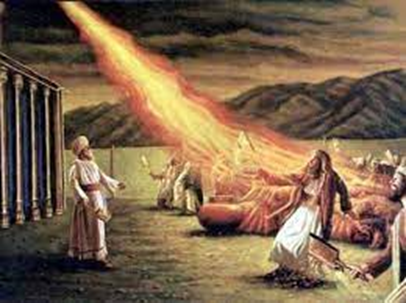
As soon as Moses had finished saying all this, the ground beneath them split open, and the earth opened its mouth and swallowed them and their households—all Korah’s men and all their possessions. They went down alive into Sheol with all they owned. The earth closed over them, and they vanished from the assembly.

At their cries, all the people of Israel who were around them fled, saying, “The earth may swallow us too!” And fire came forth from the LORD and consumed the 250 men who were offering the incense.

The Censers Reserved for Holy Use

Then the LORD said to Moses, “Tell Eleazar son of Aaron the priest to remove the censers from the flames, because they are holy, and to scatter the coals far away. As for the censers of those who sinned at the cost of their own lives, hammer them into sheets to overlay the altar, for these were presented before the LORD, and so have become holy. They will serve as a sign to the Israelites.”

So Eleazar the priest took the bronze censers brought by those who had been burned up, and he had them hammered out to overlay the altar, just as the LORD commanded him through Moses. This was to be a reminder to the Israelites that no outsider who is not a descendant of Aaron should approach to offer incense before the LORD, lest he become like Korah and his followers.

Murmuring and Plague (Numbers 25:1-5; 1 Corinthians 10:1-13)

The next day the whole congregation of Israel grumbled against Moses and Aaron, saying, “You have killed the LORD’s people!” But when the congregation gathered against them, Moses and Aaron turned toward the Tent of Meeting, and suddenly the cloud covered it and the glory of the LORD appeared.

Then Moses and Aaron went to the front of the Tent of Meeting, and the LORD said to Moses, “Get away from this congregation so that I may consume them in an instant.” And they fell facedown.

Moses said to Aaron, “Take your censer, place fire from the altar in it, and add incense. Go quickly to the congregation and make atonement for them, because wrath has come out from the LORD; the plague has begun.”

So Aaron took the censer as Moses had ordered and ran into the midst of the assembly. And seeing that the plague had begun among the people, he offered the incense and made atonement for the people. He stood between the living and the dead, and the plague was halted. But those who died from the plague numbered 14,700, in addition to those who had died on account of Korah.

Then Aaron returned to Moses at the entrance to the Tent of Meeting, since the plague had been halted.”

There are three main leaders of this rebellion. Korah is a Levite; however, Dathan and Abiram are Reubenites, and they are joined by 250 other leaders from various tribes. It’s quite possible that Moses has appointed some or all these leaders to adjudicate disputes; in which case, they would feel even more qualified to lead worship. But God has already selected Aaron and his sons to the exclusion of all the other Levites to be priests. Nothing is said about Moses’ sons serving as priests, even though Moses himself is in authority over Aaron. God has specifically designated the remainder of the Levites to serve in the Tent of Meeting in various capacities. While serving God is a big honor, it’s not enough for these guys, who long to be front and center, wearing the fancy clothes and waving those censers where everyone can see and admire them. Maintaining the temple and cleaning up after burnt offerings, toting the ashes, and cleaning up bloody messes has no appeal for these men. Let somebody else do the grunt work!

Fueled by their own ambition, these rebels make several charges against Moses and Aaron: 1. All the Israelites are holy, so why are Moses and Aaron taking so much authority? (Are we talking about the same Israelites who are still hiding Egyptian images, amulets, etc., in their tents? The same Israelites  who are ready to go off on an orgy at a moment’s notice? How holy are these people?) 2. Dathan and Abiram are claiming that Moses has brought the Israelites “out of a land flowing with milk and honey” to kill them and that Moses has failed to lead them into a rich land with fields and vineyards . (HUH? Moses has done his best to deliver these people from slavery. It’s these guys who have helped convince the Israelites that they are too small and weak to enter the Promised Land. Dathan and Abiram and the 250 other leaders were probably part of the group rejecting the testimonies of Caleb and Joshua.)

The following day, Korah, Dathan, Abiram and the 250 other leaders appear at the Tent of Meeting along with a mob of supporters. All these men plus Moses and Aaron take censers and put fire in them, and then God shows up in a cloud of glory. God is so angry that He is ready to wipe out all the Israelites; however, Moses and Aaron fall on their faces and beg God, “O God, the God of the spirits of all flesh, when one man sins, will You be angry with the whole congregation?”  

Moses orders everyone to move far away from the tents of Korah, Dathan, and Abiram. The ground opens up and swallows these men, their families, and everyone cooperating with them. Next, God sends holy fire to consume the 250 leaders offering profane incense, leaving only their censers. Moses orders Aaron to have these bronze censers hammered into sheets to overlay the altar as a permanent reminder to the Israelites that “no outsider who is not a descendant of Aaron should approach to offer incense before the LORD, lest he become like Korah and his followers.”

You might think that after watching 250 men be burnt by holy fire and three entire families swallowed up by the earth, the Israelites would stop complaining. Wrong! The very next day, the Israelites accuse Moses and Aaron of “killing God’s people,” as if Moses and Aaron have made all these things happen. (If Moses and Aaron are so powerful, WHY are these people taunting and accusing them?)

 At this point, God has had enough. A plague breaks out, and 14,700 people die. At Moses’ orders, Aaron puts fire in his censer and rushes into the center of the people, standing between the living and the dead, offering atonement for the people so the plague stops. (What kind of plague would kill that many people instantly? Possibly pulmonary anthrax or really bad cholera-the point is don’t mess with the Ruler of the Universe! Or perhaps God simply descends in holiness and those who are truly rebellious can’t stand to be near Him.)

APPLICATION: After all the complaints and all the rebellion, God has finally had enough! It’s quite likely that Korah, Dathan, and Abiram have been working behind the scenes for weeks to undermine the authority of Moses and Aaron. This thing did not start “today-today,” as the Ghanaians would say. Organizing 250 leaders to support your cause takes time and effort. The Terrible Three have probably been slithering around the Israelite camp, sounding out tribal leaders to find the malcontents.

Personally, my sympathies are with Moses and Aaron. One of the biggest miracles in this story is the willingness of Moses and Aaron to repeatedly intercede on behalf of the same people who have been castigating them for weeks. Moses and Aaron literally throw themselves on the ground in front of these people as a sign of humility, a quality sadly lacking in their detractors. I have worked in situations in which someone in authority has made poor decisions, leaving me to face the criticism. At least Moses and Aaron are representing a holy God who is omniscient, omnipresent, and omnipotent.

How can we face scathing criticism? A line from the old Walt Disney shows about Davy Crockett seems to apply: “Be sure you’re right and then go ahead.” If we are serving the One True Living God, we can always seek His perfect Will. If we are following God’s guidance, then our part is to obey while He handles the results.

PRAYER: Father God, thank You for loving us and for caring for us. Lord, many of us find ourselves facing criticism for the mistakes of our superiors. Help all in this position to find their rest in You and to trust that You can and will bring things to a peaceful and successful conclusion. In the mighty and precious Name of King Jesus. Amen.