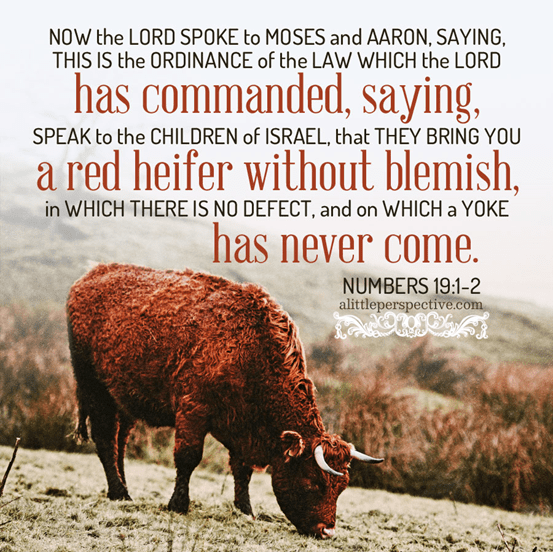
The Red Heifer
“Then the LORD said to Moses and Aaron, “This is the statute of the law that the LORD has commanded: Instruct the Israelites to bring you an unblemished red heifer that has no defect and has never been placed under a yoke. Give it to Eleazar the priest, and he will have it brought outside the camp and slaughtered in his presence.
Eleazar the priest is to take some of its blood with his finger and sprinkle it seven times toward the front of the Tent of Meeting. Then the heifer must be burned in his sight. Its hide, its flesh, and its blood are to be burned, along with its dung. The priest is to take cedar wood, hyssop, and scarlet wool and throw them onto the burning heifer.
Then the priest must wash his clothes and bathe his body in water; after that he may enter the camp, but he will be ceremonially unclean until evening. The one who burned the heifer must also wash his clothes and bathe his body in water, and he too will be ceremonially unclean until evening.
Then a man who is ceremonially clean is to gather up the ashes of the heifer and store them in a ceremonially clean place outside the camp. They must be kept by the congregation of Israel for preparing the water of purification; this is for purification from sin. The man who has gathered up the ashes of the heifer must also wash his clothes, and he will be ceremonially unclean until evening. This is a permanent statute for the Israelites and for the foreigner residing among them.
Purification of the Unclean
Whoever touches any dead body will be unclean for seven days. He must purify himself with the water on the third day and the seventh day; then he will be clean. But if he does not purify himself on the third and seventh days, he will not be clean. Anyone who touches a human corpse and fails to purify himself defiles the tabernacle of the LORD. That person must be cut off from Israel. He remains unclean, because the water of purification has not been sprinkled on him, and his uncleanness is still on him.
This is the law when a person dies in a tent: Everyone who enters the tent and everyone already in the tent will be unclean for seven days, and any open container without a lid fastened on it is unclean.
Anyone in the open field who touches someone who has been killed by the sword or has died of natural causes, or anyone who touches a human bone or a grave, will be unclean for seven days.
For the purification of the unclean person, take some of the ashes of the burnt purification offering, put them in a jar, and pour fresh running water over them. Then a man who is ceremonially clean is to take some hyssop, dip it in the water, and sprinkle the tent, all the furnishings, and the people who were there. He is also to sprinkle the one who touched a bone, grave, or person who has died or been slain.
The man who is ceremonially clean is to sprinkle the unclean person on the third day and on the seventh day. After he purifies the unclean person on the seventh day, the one being cleansed must wash his clothes and bathe in water, and that evening he will be clean. But if a person who is unclean does not purify himself, he will be cut off from the assembly, because he has defiled the sanctuary of the LORD. The water of purification has not been sprinkled on him; he is unclean.
This is a permanent statute for the people: The one who sprinkles the water of purification must wash his clothes, and whoever touches the water of purification will be unclean until evening. Anything the unclean person touches will become unclean, and anyone who touches it will be unclean until evening.”
This chapter has two parts: first, the creation of ashes of purification and second, the application of those ashes in the water of purification. God instructs the high priest to take a red heifer that has never been pregnant and has never been used to plow outside the camp, and have it slaughtered in his presence. The high priest will then take some of the blood and sprinkle it seven times toward the front of the Tent of Meeting. Then the heifer is to be cut into pieces and burned completely, along with cedar wood, hyssop, and scarlet wool. David Guzik in his Enduring Word Commentary says the following: “Cedar wood is resistant to disease and rot and is well known for its quality, preciousness, and fragrant aroma. These properties may be the reason for including it here – as well as a symbolic reference to the wood of the cross. Some suppose the cross Jesus was crucified on was made of cedar wood.
iii. Because hyssop was used for the cleansing ceremony for lepers, when David asked God purge me with hyssop in Psalm 51:7, he associated himself with the leper who needed cleansing. As well, on the cross Jesus was offered a drink from a hyssop branch (John 19:29).
iv. Scarlet, the color of blood, was used in the veil and curtains of the tabernacle (Exodus 26:31), in the garments of the high priest (Exodus 28:5-6), and for the covering for the table of showbread (Numbers 4:8). Scarlet was the sign of Rahab’s salvation (Joshua 2:21), and the color of the “king’s robe” mockingly set on Jesus by Roman soldiers (Matthew 27:28).
i. The water of purification was only made effective when the ash remains of the red heifer (along with the cedar, hyssop, and scarlet) were added to the water.
ii. This water of purification was necessary because of sin and its many effects. “The most serious and obvious type of human uncleanness was that caused by death. Anyone who touched a corpse or a human bone or a grave, or entered the tent of a dead man, became unclean (Numbers 19:14-16). Furthermore, this uncleanness was contagious: anything the unclean man touched would itself become unclean and infect others (Numbers 19:22; cf. Leviticus 15).” (Wenham)
iii. This water of purification showed God’s kindness in providing another way of cleansing from ritual impurity. Leviticus gives a ritual for cleansing that included washing in water and waiting until evening (Leviticus 11:28, 11:39-40, 15:16-18). In more serious cases (such as contact with a dead body), one must wait seven days and then offer an animal sacrifice (Leviticus 14:10-32). This provides an alternative to the long and expensive ritual described in Leviticus 14. With the water of purification, instead of being cleansed by a sin offering, the unclean person was sprinkled with water that included all the ingredients of a sin offering.
iv. Taken together the offering of the red heifer and the water of purification associated with that offering are a powerful picture pointing to the perfect work of Jesus Christ.
· Like the red heifer, Jesus was “red” in His sacrifice, “Christ covered with his own blood.” (Trapp)
· Like the red heifer, Jesus was pure and without spot.
· Like the red heifer, Jesus was never under the yoke (of sin).
· Like the red heifer, Jesus was sacrificed outside the camp.
· Like the red heifer, the sacrifice of Jesus was unique.
· Like the red heifer, Jesus was completely offered.
· Like the red heifer, the sacrifice of Jesus is effective for all who claim it, including the stranger and sojourner (Numbers 19:10).
v. The water of purification made with the ashes of the red heifer did not create a different purification from ritual uncleanness. In some sense, it did what the longer, more costly, and more elaborate ceremony of Leviticus 14 did. Instead, this water of purification made a better way (more accessible and virtually instant) to ritually purify even the most unclean ones among God’s people. It did this by building on existing principles of sacrifice, but making a different offering, one that did not need to be constantly repeated, but only referred to again and again. One might say that the water of purification offered a better way to be made clean, something of a God-approved shortcut – but it wasn’t easy for the red heifer. The red heifer and water of purification are a wonderful illustration of the perfect work of Jesus Christ on the cross, as a substitute for His people (Hebrews 9:13-14). In both cases, a better sacrifice replaced a previous system for cleansing.”
APPLICATION: For the complete discussion, see Enduring Word Commentary for Numbers 19. Part of the reason for proscriptions against people handling dead bodies has to do with the Egyptian obsession with death, mummification, etc. God wants His people to be concerned about life and not death. While this might seem a bit much, recent events indicate there are many young people also obsessed with death as well. Recently, the term “back to school necklace” has made its way into current jargon. Unfortunately, this term has nothing to do with jewelry!
“On Urban Dictionary, a back-to-school necklace is described as “another name for a noose. This is due to the utter despair you feel when school starts back up again.” Some examples of its use include: “I’m about to buy my back-to-school necklace,” “I can’t wait to get a back-to-school necklace,” “Thinking about that back-to-school necklace,” “That back-to-school necklace is calling me,” “I can’t wait to wear my back-to-school necklace,” etc.” (https://parade.com/living/what-is-back-to-school-necklace) Young people who should have everything to look forward to are obsessing about hanging themselves because school makes them so miserable.
Jesus told his disciples, “The thief does not come except to steal, and to kill, and to destroy. I have come that they may have life, and that they may have it more abundantly.” From the beginning of the world, Satan has always brought death while God has always brought life. The ceremonies involving the ashes of the red heifer were designed to bring people forgiveness and restoration. But the ceremonies involved had to be repeated whenever an individual committed a particular sin. Jesus has shed his blood on Calvary so that we can have forgiveness for our sins. 1 John 1:8-9 tells us, “ If we say that we have no sin, we deceive ourselves, and the truth is not in us. If we confess our sins, He is faithful and just to forgive us our sins and to cleanse us from all unrighteousness.” Let us thank God for His provision, His mercy, and His forgiveness!
PRAYER: Father God, thank You for loving us and for caring for us. Lord, we confess that we have repeatedly sinned and grieved You. Thank You for Your forgiveness and for Your promises of salvation. In the mighty and precious Name of King Jesus. Amen.
 Burunche's Blog
Leave a comment