Archive for August, 2023

AUGUST 11, 2023 BOOKKEEPING? AARGH! #8 NUMBERS 5:1-31 HOW CAN YOU HANDLE GUILT?

August 11, 2023

Ceremonially Unclean Persons Isolated

“And the Lord spoke to Moses, saying: “Command the children of Israel that they put out of the camp every leper, everyone who has a discharge, and whoever becomes defiled by a corpse. You shall put out both male and female; you shall put them outside the camp, that they may not defile their camps in the midst of which I dwell.” And the children of Israel did so, and put them outside the camp; as the Lord spoke to Moses, so the children of Israel did.

Confession and Restitution

Then the Lord spoke to Moses, saying, “Speak to the children of Israel: ‘When a man or woman commits any sin that men commit in unfaithfulness against the Lord, and that person is guilty, then he shall confess the sin which he has committed. He shall make restitution for his trespass in full, plus one-fifth of it, and give it to the one he has wronged. But if the man has no relative to whom restitution may be made for the wrong, the restitution for the wrong must go to the Lord for the priest, in addition to the ram of the atonement with which atonement is made for him. Every offering of all the holy things of the children of Israel, which they bring to the priest, shall be his. And every man’s holy things shall be his; whatever any man gives the priest shall be his.’ ”

Concerning Unfaithful Wives

And the Lord spoke to Moses, saying, “Speak to the children of Israel, and say to them: ‘If any man’s wife goes astray and behaves unfaithfully toward him, and a man lies with her carnally, and it is hidden from the eyes of her husband, and it is concealed that she has defiled herself, and there was no witness against her, nor was she caught— if the spirit of jealousy comes upon him and he becomes jealous of his wife, who has defiled herself; or if the spirit of jealousy comes upon him and he becomes jealous of his wife, although she has not defiled herself— then the man shall bring his wife to the priest. He shall bring the offering required for her, one-tenth of an ephah of barley meal; he shall pour no oil on it and put no frankincense on it, because it is a grain offering of jealousy, an offering for remembering, for bringing iniquity to remembrance.

‘And the priest shall bring her near, and set her before the Lord. The priest shall take holy water in an earthen vessel, and take some of the dust that is on the floor of the tabernacle and put it into the water. Then the priest shall stand the woman before the Lord, uncover the woman’s head, and put the offering for remembering in her hands, which is the grain offering of jealousy. And the priest shall have in his hand the bitter water that brings a curse. And the priest shall put her under oath, and say to the woman, “If no man has lain with you, and if you have not gone astray to uncleanness while under your husband’s authority, be free from this bitter water that brings a curse. But if you have gone astray while under your husband’s authority, and if you have defiled yourself and some man other than your husband has lain with you”— then the priest shall put the woman under the oath of the curse, and he shall say to the woman—“the Lord make you a curse and an oath among your people, when the Lord makes your thigh rot and your belly swell; and may this water that causes the curse go into your stomach, and make your belly swell and your thigh rot.”

‘Then the woman shall say, “Amen, so be it.”

‘Then the priest shall write these curses in a book, and he shall scrape them off into the bitter water. And he shall make the woman drink the bitter water that brings a curse, and the water that brings the curse shall enter her to become bitter. Then the priest shall take the grain offering of jealousy from the woman’s hand, shall wave the offering before the Lord, and bring it to the altar; and the priest shall take a handful of the offering, as its memorial portion, burn it on the altar, and afterward make the woman drink the water. When he has made her drink the water, then it shall be, if she has defiled herself and behaved unfaithfully toward her husband, that the water that brings a curse will enter her and become bitter, and her belly will swell, her thigh will rot, and the woman will become a curse among her people. But if the woman has not defiled herself, and is clean, then she shall be free and may conceive children.

This is the law of jealousy, when a wife, while under her husband’s authority, goes astray and defiles herself, or when the spirit of jealousy comes upon a man, and he becomes jealous of his wife; then he shall stand the woman before the Lord, and the priest shall execute all this law upon her. Then the man shall be free from iniquity, but that woman shall bear her guilt.’ ”

At first, this chapter seems really unfair. Why isolate lepers, people with discharges, and people who have handled corpses? Well, Moses has two million people living closely together in tents. Leprosy is spread by close contact and by droplets when people sneeze and cough. Discharges such as impetigo are spread by direct contact with infected people or items. And what kinds of germs might someone acquire by having handled a corpse? Those who have had to handle corpses can bathe and become ritually clean; however, those in the other categories are being isolated to avoid epidemics. God is also trying to discourage the Israelites from copying the death-focused religious practices of the Egyptians.

Regarding confession and restitution: Here God is being kind. The one who has sinned is to make 120% restitution to the person whom he has offended or to the family or to the priest if the offended person is dead and there are no remaining family members. Without such regulations, an individual or family who feels offended might try to kill the offender, instigating an endless round of blood feuds.

What about the laws of jealousy? Again, God is providing a way of escape for a faithful wife who has been wrongly accused. At the same time, God is also establishing a strong enough punishment that any woman tempted to commit adultery is going to think twice before doing so. At this point, many of the women reading these verses might be asking, “Fine, but what if the MAN commits adultery? What happens to him?” David Guzik in his Enduring Word Commentary suggests the following: “This ceremony only dealt with an adulterous wife and not a husband because, for the most part, the law of Moses was “case law.” It was not meant to anticipate every potential situation, but to give examples that set precedence for other cases. Though not stated, it is likely that a similar ceremony would be practiced if a wife became suspicious of a husband’s adultery.”  The good thing about this ritual is that once the wife has survived unscathed, the husband and the community must assume she is innocent and treat her as such.

Personally, I seriously doubt that any man ever underwent this ceremony. For a man to go through this ritual, his wife would have to get the priests and elders to agree. On the other hand, Guzik goes on to quote a source indicating that the Babylonian Code of Hammurabi ordered a presumed unfaithful woman to fling herself into the Euphrates River. If she drowned, she was guilty; if innocent she would survive and return to her husband! Compared to the Babylonians, God’s commands to the Israelites are amazingly kind. We should note that the reference to the thigh rotting actually is a euphemism for the womb rotting so the woman, if truly guilty, will be barren. Barren women might suffer discrimination and isolation simply due to their lack of children.

In the interests of brevity, I am not addressing the details of the temple ceremonies. For an in-depth discussion of the symbolism involved in these rituals, please see David Guzik’s excellent explanation: https://enduringword.com/bible-commentary/numbers-5/ I find Guzik’s material to be highly informative.

APPLICATION: When necessary, the medical community still isolates certain sicknesses. These days, multiply drug resistant tuberculosis and MRSA are becoming more common, forcing medical personnel to isolate such patients. Thanks to modern leprosy drugs, leprosy is far less common than it used to be and most leprosariums have closed.

Jealous spouses and domestic abuse continue to be a problem, and battered women’s shelters unfortunately remain full much of the time. Sometimes jealous husbands follow their wives to the shelters and murder them on the doorstep. Experienced police officers will tell you that calls for domestic disturbances are very dangerous. At times, an attacking spouse will turn to attack the police answering the call. Sometimes the spouse who initiated the call will also side with his/her attacker and challenge the police officer. Compared to such violence, the temple rituals described here are far more sane.      

God’s purpose in all these regulations is to maintain healthy relationships among people as well as healthy relationships between people and God. Jesus told his disciples, “The thief comes only to steal and kill and destroy; I have come that they may have life and have it to the full.” Sometimes people assume that this verse must refer to material prosperity; however, there are rich people who are miserable. God’s will for us is for us to live in close communication with Him and in peace with those around us. Our income level has little bearing on our relationship with God; in fact, many times, wealth can become a stumbling block.

Today, let’s thank God for His love and watch care and ask Him to help us live as He wants us to in close communion with Him.

PRAYER: Father God, thank You for loving us and for caring for us. Lord, help us to receive Your Word into our hearts and minds so that we can find fellowship with You and those around us. In the mighty and precious Name of King Jesus. Amen.
AUGUST 10, 2023 BOOKKEEPING? AARGH! #7 NUMBERS 4:1-49 GOD BLESS ADMINISTRATORS!

August 10, 2023

The Duties of the Kohathites (Numbers 3:27-32; Numbers 4:34-37; 1 Chronicles 23:12-20)

“Then the LORD said to Moses and Aaron, “Take a census of the Kohathites among the Levites by their clans and families, men from thirty to fifty years old—everyone who is qualified to serve in the work at the Tent of Meeting.

This service of the Kohathites at the Tent of Meeting regards the most holy things. Whenever the camp sets out, Aaron and his sons are to go in, take down the veil of the curtain, and cover the ark of the Testimony with it. They are to place over this a covering of fine leather, spread a solid blue cloth over it, and insert its poles.

Over the table of the Presence they are to spread a blue cloth and place the plates and cups on it, along with the bowls and pitchers for the drink offering. The regular bread offering is to remain on it. And they shall spread a scarlet cloth over them, cover them with fine leather, and insert the poles.

They are to take a blue cloth and cover the lampstand used for light, together with its lamps, wick trimmers, and trays, as well as the jars of oil with which to supply it. Then they shall wrap it and all its utensils inside a covering of fine leather and put it on the carrying frame. Over the gold altar they are to spread a blue cloth, cover it with fine leather, and insert the poles. They are to take all the utensils for serving in the sanctuary, place them in a blue cloth, cover them with fine leather, and put them on the carrying frame.

Then they shall remove the ashes from the bronze altar, spread a purple cloth over it, and place on it all the vessels used to serve there: the firepans, meat forks, shovels, and sprinkling bowls—all the equipment of the altar. They are to spread over it a covering of fine leather and insert the poles.

When Aaron and his sons have finished covering the holy objects and all their equipment, as soon as the camp is ready to move, the Kohathites shall come and do the carrying. But they must not touch the holy objects, or they will die. These are the transportation duties of the Kohathites regarding the Tent of Meeting.

Eleazar son of Aaron the priest shall oversee the oil for the light, the fragrant incense, the daily grain offering, and the anointing oil. He has oversight of the entire tabernacle and everything in it, including the holy objects and their utensils.”

Then the LORD said to Moses and Aaron, “Do not allow the Kohathite tribal clans to be cut off from among the Levites. In order that they may live and not die when they come near the most holy things, do this for them: Aaron and his sons are to go in and assign each man his task and what he is to carry. But the Kohathites are not to go in and look at the holy objects, even for a moment, or they will die.”

The Duties of the Gershonites (Numbers 3:21-26; Numbers 4:38-41; 1 Chronicles 23:7-11)

And the LORD said to Moses, “Take a census of the Gershonites as well, by their families and their clans, from thirty to fifty years old, counting everyone who comes to serve in the work at the Tent of Meeting.

This is the service of the Gershonite clans regarding work and transport: They are to carry the curtains of the tabernacle, the Tent of Meeting with the covering of fine leather over it, the curtains for the entrance to the Tent of Meeting, the curtains of the courtyard, and the curtains for the entrance at the gate of the courtyard that surrounds the tabernacle and altar, along with their ropes and all the equipment for their service. The Gershonites will do all that needs to be done with these items.

All the service of the Gershonites—all their transport duties and other work—is to be done at the direction of Aaron and his sons; you are to assign to them all that they are responsible to carry. This is the service of the Gershonite clans at the Tent of Meeting, and their duties shall be under the direction of Ithamar son of Aaron the priest.

The Duties of the Merarites (Numbers 3:33-37; Numbers 4:42-49; 1 Chronicles 23:21-23)

As for the sons of Merari, you are to register them by their clans and families, from thirty to fifty years old, counting everyone who comes to serve in the work of the Tent of Meeting.

This is the duty for all their service at the Tent of Meeting: to carry the frames of the tabernacle with its crossbars, posts, and bases, the posts of the surrounding courtyard with their bases, tent pegs, and ropes, including all their equipment and everything related to their use. You shall assign by name the items that they are responsible to carry. This is the service of the Merarite clans according to all their work at the Tent of Meeting, under the direction of Ithamar son of Aaron the priest.”

The Numbering of the Levite Clans (Numbers 3:27-32; Numbers 4:1-20; 1 Chronicles 23:12-20)

So Moses, Aaron, and the leaders of the congregation numbered the Kohathites by their clans and families, everyone from thirty to fifty years old who came to serve in the work at the Tent of Meeting. And those numbered by their clans totaled 2,750. These were counted from the Kohathite clans, everyone who could serve at the Tent of Meeting. Moses and Aaron numbered them according to the command of the LORD through Moses.

Then the Gershonites were numbered by their clans and families, everyone from thirty to fifty years old who came to serve in the work at the Tent of Meeting. And those numbered by their clans and families totaled 2,630. These were counted from the Gershonite clans who served at the Tent of Meeting, whom Moses and Aaron counted at the LORD’s command.

And the Merarites were counted by their clans and their families, everyone from thirty to fifty years old who came to serve in the work at the Tent of Meeting. The men registered by their clans numbered 3,200. These were counted from the Merarite clans, whom Moses and Aaron numbered at the LORD’s command through Moses.

So Moses, Aaron, and the leaders of Israel counted by their clans and families all the Levites from thirty to fifty years old who came to do the work of serving and carrying the Tent of Meeting. And the number of men was 8,580. At the LORD’s command they were registered through Moses and each one was assigned his work and burden, as the LORD had commanded Moses.”

Moving the Tabernacle through the wilderness is a very complicated job and not one to be left to chance.  The Kohathites are to transport the most holy things; however, the priests must take stringent measures to ensure that no curious Kohathite decides to sneak a peep at these precious items. God warns Moses, “But the Kohathites are not to go in and look at the holy objects, even for a moment, or they will die.”

The Gershonites are to handle all the curtains and ropes for the Tent of Meeting under the supervision of the priests. The Merarites are to carry the frames of the tabernacle with its crossbars, posts, and bases, the posts of the surrounding courtyard with their bases, tent pegs, and ropes, including all their equipment and everything related to their use. Again, the priests are to supervise these activities. “At the LORD’s command they were registered through Moses and each one was assigned his work and burden, as the LORD had commanded Moses.”

APPLICATION: Sometimes we might think that the practice of administration is a relatively new profession; however, that is far from the truth. When Joseph became the number 2 man in Egypt, he was an administrator with others working below him. Now God is giving Moses specific instructions regarding the duties of the various families of the Levites and also emphasizing that these men must take all their orders from the priests. God wants to ensure that there will be no arguments and that work will go on smoothly.

God is not a God of confusion but a God of peace and order. God is giving Moses specific orders so that Moses won’t face endless argument and friction over the duties of the Levites. This same principle applies when you are facing difficult decisions. When my husband and I are facing dilemmas, we pray together until we receive the same answer. If we don’t receive a clear answer, we assume that we are rushing things and that we need to give God more time to reveal things. Psalm 32:8 promises “I will teach you and instruct you the way you should go. I will guide you with My eye upon you.” God will never leave us without instruction; however, sometimes we must give God time.

PRAYER: Psalm 29:11 tells us, “The Lord will give strength to His people. The Lord will bless His people with peace.” Bible verses are not merely to be read; they are also promises that may be claimed in prayer. For example, using this verse, you might pray like this: “Lord, I thank You that You have promised to give me strength and to bless me with Your peace. You know my trials and my struggles. You know what I am facing today. I thank You that when I need Your strength, You will give it to me. I thank You for Your peace that is beyond understanding. I pray in the mighty and precious Name of King Jesus. Amen.

AUGUST 9, 2023 BOOKKEEPING? AARGH! #6 NUMBERS 3:40-51 LEVITES SUBSTITUTING FOR FIRST BORNS-HUH???

August 9, 2023

Levites Dedicated Instead of the Firstborn

“Then the Lord said to Moses: “Number all the firstborn males of the children of Israel from a month old and above, and take the number of their names. And you shall take the Levites for Me—I am the Lord—instead of all the firstborn among the children of Israel, and the livestock of the Levites instead of all the firstborn among the livestock of the children of Israel.” So Moses numbered all the firstborn among the children of Israel, as the Lord commanded him. And all the firstborn males, according to the number of names from a month old and above, of those who were numbered of them, were twenty-two thousand two hundred and seventy-three (22,273.)

Then the Lord spoke to Moses, saying: “Take the Levites instead of all the firstborn among the children of Israel, and the livestock of the Levites instead of their livestock. The Levites shall be Mine: I am the Lord. And for the redemption of the two hundred and seventy-three of the firstborn of the children of Israel, who are more than the number of the Levites, you shall take five shekels for each one individually; you shall take them in the currency of the shekel of the sanctuary, the shekel of twenty gerahs. And you shall give the money, with which the excess number of them is redeemed, to Aaron and his sons.”

So Moses took the redemption money from those who were over and above those who were redeemed by the Levites. From the firstborn of the children of Israel he took the money, one thousand three hundred and sixty-five shekels, according to the shekel of the sanctuary. (1,365 SHEKELS)And Moses gave their redemption money to Aaron and his sons, according to the word of the Lord, as the Lord commanded Moses.”

What’s so special about the first of anything? Having produced one, we don’t know if there will be any more to follow. Firstborn animals, firstborn infants, first results of any effort-all these are a major achievement. Although God has already ordained particular offerings for firstborn males, once these infant boys have been redeemed, they are free to do whatever they wish. But the Levites are in a different category. God has set the Levites apart to care for the various parts of the Tabernacle. Now God is taking that action even further by choosing males one month and above from the Tribe of Levi as living sacrifices to redeem the other male firstborns of the Israelites. The Levites have twenty-two thousand males one month old and above. There are two hundred seventy-three firstborn males from the other tribes. Each of these males will be redeemed by giving Aaron and his sons 5 shekels for each of the 273 males, making a total of 1,365 shekels. God is also considering the animals belonging to the Levites as being dedicated to Him.

APPLICATION: How precious is a firstborn baby of either sex? Ask any couple who struggle for years to become pregnant and then sustain that pregnancy to delivery; such babies are infinitely precious. Parents expect a great deal from their firstborns; these children carry the hopes and dreams of the family. By selecting the Levite males as substitutes for males from the other tribes, God is honoring that tribe. The Levites not only substitute for males from other tribes but they also carry out special duties caring for the Tabernacle. Even if some of those duties seem very mundane, the Levites can still be proud that God has chosen them.

How special do you feel? Do you find yourself caught in a web of petty details, struggling to maintain any equilibrium? There’s an old saying that when you find yourself up to your rear end in alligators (or crocodiles) it’s difficult to remember that your original objective was to drain the swamp. Some days you might feel as if you are being stoned to death with popcorn as the problems mount.  

One of the pitfalls of social media is the potential for painful comparisons. Face it, most people are going to portray themselves in the best possible light, posting photos of their vacations, their lake homes, their highly successful children, etc. Very few people will confess that their jobs or their children are slowly driving them crazy. But it’s quite likely that life is far from perfect for these people as well.

The work of the world generally moves forward on the backs of many little unsung heroes and heroines-factory workers, store clerks, bus and taxi drivers, teachers, school aids, nurses, nursing assistants-the list is endless. But if any of these categories of people suddenly are unavailable, the ripple effect will result in major upheavals. One way of describing these relationships is “the butterfly effect.”

The butterfly effect refers to the idea that something small, like getting coffee, can have much larger effects, such as altering your career. The butterfly effect rests on the notion that the world is deeply interconnected, such that one small occurrence can influence a much larger complex system.” (https://thedecisionlab.com)

In God’s view, there are no “little people.” Nobody is insignificant. When Moses and his scribes were conducting the census of the Israelite males, God knew each one of those men. God knows each of us, our names, our hopes, our dreams, our struggles, and our failures. God knows us better than we know ourselves. Amazingly, God still loves us despite all this. John 3:16 tells us that “God so loved the world that He gave His only begotten Son, that whoever believes in Him should not perish but have everlasting life.” If you were the only person in the entire world, Jesus would still have shed His blood to pay for your sins. Why not accept what Jesus has done for you and allow Him to change your life?

PRAYER: Father God, thank You for loving us and for caring for us. Lord, we admit that we have sinned and that nothing we can do will pay for that sins. Lord, please forgive us those sins. Thank You for sending Jesus to shed His blood to die for our sins. We accept the sacrifice Jesus has made for us and we thank You for Your promise that when we have made this decision, we will receive eternal life. We pray in the mighty and precious Name of Jesus. Amen.

AUGUST 8, 2023 BOOKKEEPING? AARGH! #5 NUMBERS 3:1-39 SORTING OUT THE LEVITES – WHO’S GOING TO DO THE GRUNT WORK IN THE TEMPLE?

August 8, 2023

The Sons of Aaron

“Now these are the records of Aaron and Moses when the Lord spoke with Moses on Mount Sinai. And these are the names of the sons of Aaron: Nadab, the firstborn, and Abihu, Eleazar, and Ithamar. These are the names of the sons of Aaron, the anointed priests, whom he consecrated to minister as priests. Nadab and Abihu had died before the Lord when they offered profane fire before the Lord in the Wilderness of Sinai; and they had no children. So Eleazar and Ithamar ministered as priests in the presence of Aaron their father.

The Levites Serve in the Tabernacle

And the Lord spoke to Moses, saying: “Bring the tribe of Levi near, and present them before Aaron the priest, that they may serve him. And they shall attend to his needs and the needs of the whole congregation before the tabernacle of meeting, to do the work of the tabernacle. Also they shall attend to all the furnishings of the tabernacle of meeting, and to the needs of the children of Israel, to do the work of the tabernacle. And you shall give the Levites to Aaron and his sons; they are given entirely to him from among the children of Israel. So you shall appoint Aaron and his sons, and they shall attend to their priesthood; but the outsider who comes near shall be put to death.”

Then the Lord spoke to Moses, saying: “Now behold, I Myself have taken the Levites from among the children of Israel instead of every firstborn who opens the womb among the children of Israel. Therefore the Levites shall be Mine, because all the firstborn are Mine. On the day that I struck all the firstborn in the land of Egypt, I sanctified to Myself all the firstborn in Israel, both man and beast. They shall be Mine: I am the Lord.”

Census of the Levites Commanded

Then the Lord spoke to Moses in the Wilderness of Sinai, saying: “Number the children of Levi by their fathers’ houses, by their families; you shall number every male from a month old and above.”

So Moses numbered them according to the word of the Lord, as he was commanded. These were the sons of Levi by their names: Gershon, Kohath, and Merari. And these are the names of the sons of Gershon by their families: Libni and Shimei. And the sons of Kohath by their families: Amram, Izehar, Hebron, and Uzziel. And the sons of Merari by their families: Mahli and Mushi. These are the families of the Levites by their fathers’ houses.

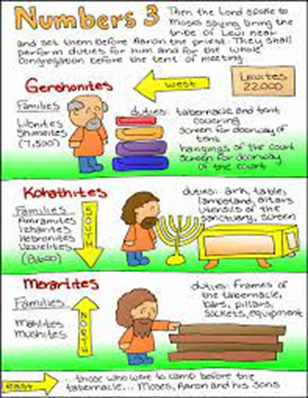
From Gershon came the family of the Libnites and the family of the Shimites; these were the families of the Gershonites. Those who were numbered, according to the number of all the males from a month old and above—of those who were numbered there were seven thousand five hundred. The families of the Gershonites were to camp behind the tabernacle westward. And the leader of the father’s house of the Gershonites was Eliasaph the son of Lael. The duties of the children of Gershon in the tabernacle of meeting included the tabernacle, the tent with its covering, the screen for the door of the tabernacle of meeting, the screen for the door of the court, the hangings of the court which are around the tabernacle and the altar, and their cords, according to all the work relating to them.

From Kohath came the family of the Amramites, the family of the Izharites, the family of the Hebronites, and the family of the Uzzielites; these were the families of the Kohathites. According to the number of all the males, from a month old and above, there were eight thousand six hundred keeping charge of the sanctuaryThe families of the children of Kohath were to camp on the south side of the tabernacle. And the leader of the fathers’ house of the families of the Kohathites was Elizaphan the son of Uzziel. Their duty included the ark, the table, the lampstand, the altars, the utensils of the sanctuary with which they ministered, the screen, and all the work relating to them.

And Eleazar the son of Aaron the priest was to be chief over the leaders of the Levites, with oversight of those who kept charge of the sanctuary.

From Merari came the family of the Mahlites and the family of the Mushites; these were the families of Merari. And those who were numbered, according to the number of all the males from a month old and above, were six thousand two hundred. The leader of the fathers’ house of the families of Merari was Zuriel the son of Abihail. These were to camp on the north side of the tabernacle. And the appointed duty of the children of Merari included the boards of the tabernacle, its bars, its pillars, its sockets, its utensils, all the work relating to them, and the pillars of the court all around, with their sockets, their pegs, and their cords.

Moreover those who were to camp before the tabernacle on the east, before the tabernacle of meeting, were Moses, Aaron, and his sons, keeping charge of the sanctuary, to meet the needs of the children of Israel; but the outsider who came near was to be put to death. All who were numbered of the Levites, whom Moses and Aaron numbered at the commandment of the Lord, by their families, all the males from a month old and above, were twenty-two thousand.

In the beginning, there was the Tribe of Levi; however, the priests were all to be descendants of Aaron. But that portable Tabernacle was to move through the wilderness whenever the Israelites moved. If God did not make some divine assignments, there would be unending wrangling. “Why do we have to do all the dirty work around here? Why can’t someone else do _____ for a change?” This section of Numbers 3 not only assigns duties to specific groups of Levites but also indicates where they will always lodge in relation to the Tabernacle. The Tabernacle is to be protected by a double ring of Israelites with the tribes lodging on the outer ring and the Levites and Aaronic priests and family of Moses lodging on the inner ring. To paraphrase a common advertising slogan, God’s response to any whining was likely to be “Just do it!”

APPLICATION: “I don’t have to clean that toilet! I am not a conservancy laborer!” It was 1993, and we had recently come to Saboba. One poor pregnant lady had failed to make it to the toilet in time and had defecated on the floor. Now the cleaning lady was sounding off at me. As an Illinois farm girl, I had shoveled a lot of manure, so I simply shrugged my shoulders, cleaned up the mess, and went on caring for the patient. (Ironically, several years later, we saved that cleaning lady from going blind when she went into acute angle closure glaucoma on Christmas Eve and we had to rush her 150 miles north to an eye specialist at a mission hospital.)

Had God not assigned these duties to the Levites, who knows how many of them would have been left untouched because someone thought that was beneath their dignity? We all have a job to do in the Body of Christ. Saint Paul faced such a problem with the Corinthian Church and wrote to them,“But God has composed the body and has given greater honor to the parts that lacked it, so that there should be no division in the body, but that its members should have mutual concern for one another. If one part suffers, every part suffers with it; if one part is honored, every part rejoices with it.” (1Corinthians 12:24-26)

The Konkombas have a saying that “One finger does not pick up a pebble.” God has chosen each of us for a particular work and no single work is more important than another. My husband loves to compliment janitors and cleaners as we travel, for if these people fail to perform diligently, airports and train stations will soon turn into pigsties.  The lines of an old hymn by Kittie L. Suffield say it well:

LITTLE IS MUCH WHEN GOD IS IN IT

In the harvest field now ripened
There’s a work for all to do
Hark! the Master’s voice is calling
To the harvest calling you

Does the place you’re called to labor
And does the place you’re called to labor
Seem so small and little known?
It is great if God is in it
For He’ll not forsake His own

Little is much when God is in it!
Labor not for wealth or fame
There’s a crown, and you can win it
If you go in Jesus’ name

And when the conflict has ended
And our race on earth is run
He will say, if you’ve been faithful
“Welcome home, My child—well done!”

Little is much when God is in it!
Labor not for wealth or fame
There’s a crown, and you can win it
If you go in Jesus’ name

PRAYER: Father God, thank You for loving us and for caring for us. Lord, thank You that each of us has a special place in the Kingdom of God. Lord, help us to follow hard after You all the days of our lives. In the mighty and precious Name of King Jesus. Amen.

AUGUST 7, 2023 BOOKKEEPING? AARGH! #3 NUMBERS 2:1-34 ORGANIZE OR FIND YOURSELF HERDING CATS!

August 7, 2023

The Tribes and Leaders by Armies

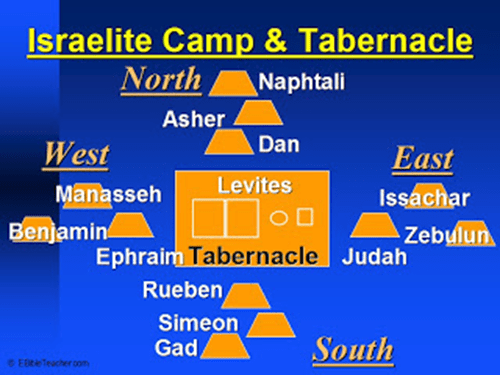
“And the Lord spoke to Moses and Aaron, saying: “Everyone of the children of Israel shall camp by his own standard, beside the emblems of his father’s house; they shall camp some distance from the tabernacle of meeting. On the east side, toward the rising of the sun, those of the standard of the forces with Judah shall camp according to their armies; and Nahshon the son of Amminadab shall be the leader of the children of Judah.” And his army was numbered at seventy-four thousand six hundred.

“Those who camp next to him shall be the tribe of Issachar, and Nethanel the son of Zuar shall be the leader of the children of Issachar.” And his army was numbered at fifty-four thousand four hundred.

“Then comes the tribe of Zebulun, and Eliab the son of Helon shall be the leader of the children of Zebulun.” And his army was numbered at fifty-seven thousand four hundred. “All who were numbered according to their armies of the forces with Judah, one hundred and eighty-six thousand four hundred—these shall break camp first.

“On the south side shall be the standard of the forces with Reuben according to their armies, and the leader of the children of Reuben shall be Elizur the son of Shedeur.”  And his army was numbered at forty-six thousand five hundred.

“Those who camp next to him shall be the tribe of Simeon, and the leader of the children of Simeon shall be Shelumiel the son of Zurishaddai.” And his army was numbered at fifty-nine thousand three hundred.

“Then comes the tribe of Gad, and the leader of the children of Gad shall be Eliasaph the son of [c]Reuel.” And his army was numbered at forty-five thousand six hundred and fifty. “All who were numbered according to their armies of the forces with Reuben, one hundred and fifty-one thousand four hundred and fifty—they shall be the second to break camp.

“And the tabernacle of meeting shall move out with the camp of the Levites in the middle of the camps; as they camp, so they shall move out, everyone in his place, by their standards.

“On the west side shall be the standard of the forces with Ephraim according to their armies, and the leader of the children of Ephraim shall be Elishama the son of Ammihud.” And his army was numbered at forty thousand five hundred.

“Next to him comes the tribe of Manasseh, and the leader of the children of Manasseh shall be Gamaliel the son of Pedahzur.” And his army was numbered at thirty-two thousand two hundred.

“Then comes the tribe of Benjamin, and the leader of the children of Benjamin shall be Abidan the son of Gideoni.” And his army was numbered at thirty-five thousand four hundred. “All who were numbered according to their armies of the forces with Ephraim, one hundred and eight thousand one hundred—they shall be the third to break camp.

“The standard of the forces with Dan shall be on the north side according to their armies, and the leader of the children of Dan shall be Ahiezer the son of Ammishaddai.” And his army was numbered at sixty-two thousand seven hundred.

“Those who camp next to him shall be the tribe of Asher, and the leader of the children of Asher shall be Pagiel the son of Ocran.” And his army was numbered at forty-one thousand five hundred.

 “Then comes the tribe of Naphtali, and the leader of the children of Naphtali shall be Ahira the son of Enan.” And his army was numbered at fifty-three thousand four hundred. “All who were numbered of the forces with Dan, one hundred and fifty-seven thousand six hundred—they shall break camp last, with their standards.”

These are the ones who were numbered of the children of Israel by their fathers’ houses. All who were numbered according to their armies of the forces were six hundred and three thousand five hundred and fifty. But the Levites were not numbered among the children of Israel, just as the Lord commanded Moses.

Thus the children of Israel did according to all that the Lord commanded Moses; so they camped by their standards and so they broke camp, each one by his family, according to their fathers’ houses.”

O.K. So, you’re Moses and you have just crossed the Red Sea with the Israelites, a throng of about two million people. Now you have the tabernacle to protect and God wants you to move all these people across a wilderness in an organized fashion. If you call a meeting of your leaders, there will be nothing but wrangling: “We should be first! We are the biggest tribe!” “No! We should be first! We have the most warriors!” “No, we should be first. We are the most important!” And then there’s the question of tribal leadership, an issue that will lead to even more disputes. Organizing this mob is going to be as easy and predictable as herding cats that will take off in all directions. Meanwhile, you know that there are enemies out there. Everybody knows the Egyptians were so anxious to get rid of the Israelites that the Egyptians loaded up the Israelites with all their treasures. Now the Israelites are a rich prize simply ripe for the plucking by the first band of marauders that comes along. This is when God steps in and gives orders.

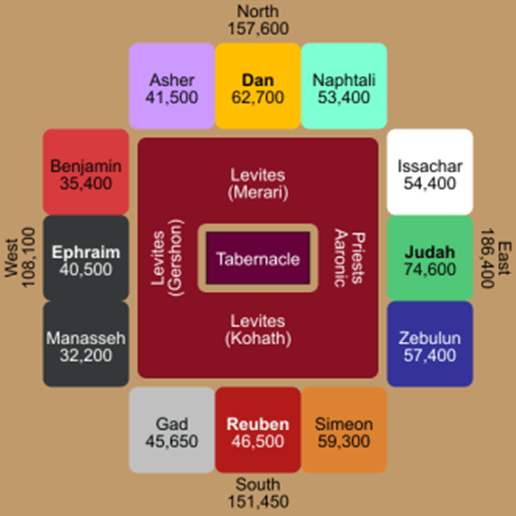
God arranges things so that there are three tribes on each side of the Levites, protecting the Tabernacle and all of its furnishings. Remember that Ephraim and Manasseh are each counted separately, allowing for this arrangement. There are 186,400 warriors on the east, 151,450 on the south, 108,100 on the west, and 157,600 on the north. God not only orders the arrangement but also identifies the commander for each tribe. The tribe of Levi will always be in the center of the group, receiving protection from the other tribes.

APPLICATION: God is a God of order, not a God of confusion. Centuries later, Saint Paul will tell the Corinthians, “ For God is not the author of confusion but of peace, as in all the churches of the saints.” (1 Corinthians 14:33)  Why is this so important for us? If we find ourselves confused, we can ask God for enlightenment, confident that He will give us perfect guidance. But we must be willing to receive that guidance and to act on it. “God, you MUST be kidding!” is not a useful answer.

James 1:5-8 tells us, If any of you lacks wisdom, let him ask of God, who gives to all liberally and without reproach, and it will be given to him. But let him ask in faith, with no doubting, for he who doubts is like a wave of the sea driven and tossed by the wind. For let not that man suppose that he will receive anything from the Lord; he is a double-minded man, unstable in all his ways.” As we study Numbers, we will realize that the Israelites messed up repeatedly; however, when they followed God’s commands, they had peace and order. Are you struggling with a thorny problem? Bring it to God in prayer and ask Him for guidance. But be ready to obey; otherwise, you are wasting  both your time and God’s!

PRAYER: Father God, thank You for loving us and for caring for us. Lord, many of us feel confused and upset. Help us to bring our problems to You and then trust You for perfect solutions. In the mighty and precious Name of King Jesus. Amen.

AUGUST 6, 2023 BOOKKEEPING? AARGH! #2 NUMBERS 1:1-54 WATCH OUT! GOD HATES COMFORT ZONES!

August 6, 2023

The First Census of Israel

Now the Lord spoke to Moses in the Wilderness of Sinai, in the tabernacle of meeting, on the first day of the second month, in the second year after they had come out of the land of Egypt, saying: “Take a census of all the congregation of the children of Israel, by their families, by their fathers’ houses, according to the number of names, every male individually, from twenty years old and above—all who are able to go to war in Israel. You and Aaron shall number them by their armies. And with you there shall be a man from every tribe, each one the head of his father’s house.

“These are the names of the men who shall stand with you: from Reuben, Elizur the son of Shedeur; from Simeon, Shelumiel the son of Zurishaddai; from Judah, Nahshon the son of Amminadab; from Issachar, Nethanel the son of Zuar; from Zebulun, Eliab the son of Helon; from the sons of Joseph: from Ephraim, Elishama the son of Ammihud; from Manasseh, Gamaliel the son of Pedahzur; from Benjamin, Abidan the son of Gideoni; from Dan, Ahiezer the son of Ammishaddai; from Asher, Pagiel the son of Ocran; from Gad, Eliasaph the son of Deuel; from Naphtali, Ahira the son of Enan.” These were chosen from the congregation, leaders of their fathers’ tribes, heads of the divisions in Israel.

Then Moses and Aaron took these men who had been mentioned by name, and they assembled all the congregation together on the first day of the second month; and they recited their ancestry by families, by their fathers’ houses, according to the number of names, from twenty years old and above, each one individually. As the Lord commanded Moses, so he numbered them in the Wilderness of Sinai.

Now the children of Reuben, Israel’s oldest son, their genealogies by their families, by their fathers’ house, according to the number of names, every male individually, from twenty years old and above, all who were able to go to war: those who were numbered of the tribe of Reuben were forty-six thousand five hundred. (46,500)

From the children of Simeon, their genealogies by their families, by their fathers’ house, of those who were numbered, according to the number of names, every male individually, from twenty years old and above, all who were able to go to war: those who were numbered of the tribe of Simeon were fifty-nine thousand three hundred. (59,300)

From the children of Gad, their genealogies by their families, by their fathers’ house, according to the number of names, from twenty years old and above, all who were able to go to war: those who were numbered of the tribe of Gad were forty-five thousand six hundred and fifty. (45,650)

From the children of Judah, their genealogies by their families, by their fathers’ house, according to the number of names, from twenty years old and above, all who were able to go to war: those who were numbered of the tribe of Judah were seventy-four thousand six hundred. (74,600)

From the children of Issachar, their genealogies by their families, by their fathers’ house, according to the number of names, from twenty years old and above, all who were able to go to war: those who were numbered of the tribe of Issachar were fifty-four thousand four hundred. (54,400)

From the children of Zebulun, their genealogies by their families, by their fathers’ house, according to the number of names, from twenty years old and above, all who were able to go to war: those who were numbered of the tribe of Zebulun were fifty-seven thousand four hundred. (57,400)

From the sons of Joseph, the children of Ephraim, their genealogies by their families, by their fathers’ house, according to the number of names, from twenty years old and above, all who were able to go to war: those who were numbered of the tribe of Ephraim were forty thousand five hundred. (40,500)

From the children of Manasseh, their genealogies by their families, by their fathers’ house, according to the number of names, from twenty years old and above, all who were able to go to war: those who were numbered of the tribe of Manasseh were thirty-two thousand two hundred. (32,200)

From the children of Benjamin, their genealogies by their families, by their fathers’ house, according to the number of names, from twenty years old and above, all who were able to go to war: those who were numbered of the tribe of Benjamin were thirty-five thousand four hundred. (35,400)

From the children of Dan, their genealogies by their families, by their fathers’ house, according to the number of names, from twenty years old and above, all who were able to go to war: those who were numbered of the tribe of Dan were sixty-two thousand seven hundred. (62,700)

From the children of Asher, their genealogies by their families, by their fathers’ house, according to the number of names, from twenty years old and above, all who were able to go to war: those who were numbered of the tribe of Asher were forty-one thousand five hundred. (41,500)

From the children of Naphtali, their genealogies by their families, by their fathers’ house, according to the number of names, from twenty years old and above, all who were able to go to war: those who were numbered of the tribe of Naphtali were fifty-three thousand four hundred. (53,400)

These are the ones who were numbered, whom Moses and Aaron numbered, with the leaders of Israel, twelve men, each one representing his father’s house. So all who were numbered of the children of Israel, by their fathers’ houses, from twenty years old and above, all who were able to go to war in Israel— all who were numbered were six hundred and three thousand five hundred and fifty. (603,550)

But the Levites were not numbered among them by their fathers’ tribe; for the Lord had spoken to Moses, saying: “Only the tribe of Levi you shall not number, nor take a census of them among the children of Israel; but you shall appoint the Levites over the tabernacle of the Testimony, over all its furnishings, and over all things that belong to it; they shall carry the tabernacle and all its furnishings; they shall attend to it and camp around the tabernacle. And when the tabernacle is to go forward, the Levites shall take it down; and when the tabernacle is to be set up, the Levites shall set it up. The outsider who comes near shall be put to death. The children of Israel shall pitch their tents, everyone by his own camp, everyone by his own standard, according to their armies; but the Levites shall camp around the tabernacle of the Testimony, that there may be no wrath on the congregation of the children of Israel; and the Levites shall keep charge of the tabernacle of the Testimony.”

Thus the children of Israel did; according to all that the Lord commanded Moses, so they did.”

There are several things to notice about this census: God personally selected the representatives from each tribe to ensure that the record of his tribe was fair and complete. The men so numbered were “age twenty and above and able to go to war.” There is no mention of the elderly or of women and children, nor were the Levites included in the census. The records were first taken orally and then transcribed. All those responding had to be able to recite their genealogies completely. It’s likely that had this census included women and children and the elderly, the total population might have been as much as two million people. The census included only those able to go to war because God was serving notice that they would need to fight in the near future. These people had been slaves for 400 years and warfare had not been part of their skill set until now. God was preparing His people for battle, whether they liked it or not.

APPLICATION: Nobody likes change! Even if our lives have been difficult, at least we are familiar with our current difficulties. But God is in the business of perpetual change and we must flex when necessary. It’s quite likely that the Israelites didn’t want to even think about having to fight; after all, God had miraculously delivered them from the most powerful army on earth. Why couldn’t God simply keep on delivering them so they wouldn’t have to fight? But God had other ideas; He wanted to take a group of slaves and forge them into a mighty army.

During our missionary careers, we have been forced to do many things we would rather not. We arrived in Ghana for our first mission term, only to learn that there were major problems with the project. When we opposed those attempting to hijack funds, we found ourselves in trouble. Our second mission term was marked by a tribal war that forced us to take a small health center building with no electricity or water and turn it into a bush hospital with a functioning laboratory and theater (OR). (We were sterilizing theater instruments and gown packs using a large pressure cooker on a coal pot on the verandah with our one theater laborer fanning the coal pot.) Subsequently, we have faced other challenges. Currently, our biggest problem is meeting the nutritional needs of several critically ill patients with intestinal fistulas. At the moment, our dietetics nurse and I are the ones making various formulas; however, we are trusting that these problems will help us establish a strong nutritional rehabilitation program.

We love comfort zones; however, God does not. God wants us to grow, to expand, and to build His Kingdom while we would just as soon go off in a corner and take a nap. May God help us, so that when He calls us to do more and to climb higher, we don’t resist.

PRAYER: Father God, thank You for loving us and for caring for us. Lord, help us to follow hard after You all the days of our lives, even when we just want to quit. In the mighty and precious Name of King Jesus. Amen.
AUGUST 5, 2023 BOOKKEEPING? AARGH! #1 INTRODUCTION TO NUMBERS DON’T BECOME A KVETCHER!

August 5, 2023

Today we are beginning the study of the Book of Numbers. Although there are lots of lists in this book, there are also some great stories as well. Pastor Chuck Swindoll in Insight for Living describes Numbers this way:

“Who wrote the book?

As it does for the rest of the Pentateuch, universal Jewish and Christian tradition attributes the authorship of the book of Numbers to Moses. Moses is the central figure within the book, and in at least two instances Numbers mentions him recording events by the Lord’s commands (Numbers 33:236:13).

The name “Numbers” is a translation of Arithmoi, from the Septuagint, titled thus because the book contains many statistics, population counts, tribal and priestly figures, and other numerical data. The Hebrew name comes from the first sentence of the book and means “in the desert of ”; it is perhaps an even more accurate description of the book’s content, which follows the Israelites through almost forty years of wandering in the desert.1

Where are we?

The events of the book began in the second year after the Israelites departed Egypt, as they camped at Mount Sinai around 1444 BC (Numbers 1:1). The narrative ends thirty-eight years later “in the plains of Moab by the Jordan opposite Jericho” (36:13) in 1406 BC. Numbers records the people’s long wandering in the desert of Sinai, their time at the oasis of Kadesh-barnea, and their eventual arrival at the banks of the Jordan River across from the Promised Land.

The Lord directed the message of Numbers toward the younger generation, children of the former slaves who escaped through the Red Sea. Except for Joshua, Caleb, and Moses, the older generation—everyone twenty years old or older at the time of the first census—died before the completion of Numbers, due to their disobedience and disbelief (Numbers 14:22–30). Moses completed the book before his death (Deuteronomy 31:24).

Why is Numbers so important?

Numbers takes the reader on a long and winding path through a desert of excruciating detail. The book records census results for all twelve tribes not once, but twice; it documents priestly instructions for handling the Ark of the Covenant and the tabernacle; and it even spells out the placement of the tribes when they camped. But through it all, we cannot doubt God’s unfailing direction over the nation.

As a history of the nation not yet established in the land promised them long ago, this book unveils significant events sometimes referenced later in Scripture. Joshua and Caleb alone among the twelve spies encouraged Israel to take possession of the land (Numbers 13–14Joshua 14:7); Moses struck a rock and water spouted forth (Numbers 20:11Psalm 106:32); Moses lifted up a bronze serpent on a pole so that believing Israelites might be healed of their snake bites (Numbers 21:6–9John 3:14); and Balaam was rebuked by his donkey (Numbers 22:21–34Revelation 2:14).

What’s the big idea?

In this book, the people of Israel tested God’s patience, and He in turn tested their endurance and faithfulness. Though the people failed many times, God showed His own faithfulness by His constant presence leading the way: through a cloud by day and a pillar of fire by night.

More than just a history lesson, the book of Numbers reveals how God reminded Israel that He does not tolerate rebellion, complaining, and disbelief without invoking consequences. He taught His people how to walk with Him—not just with their feet through the wilderness but with their mouths in worship, hands in service, and lives as witnesses to the surrounding nations. He was their God, they were His people, and He expected them to act like it.” 

How do I apply this?

Modern readers can take away from Numbers not only a thorough history of Israel’s early days but also a renewed sense of God’s delight in obedience. He is our God, too, and He wants us to live righteously, worshipping Him through our words and works.

The journey of the Israelites through the wilderness earned the apostle Paul’s notice when he penned his first letter to the Corinthian church. “These things happened,” he wrote in 1 Corinthians 10:6, “as examples for us, so that we would not crave evil things as they also craved.”

Do you see any resemblance between the grumbling, rebellious Israelites and yourself? How can you avoid following their example? With humility and sincerity, pray for a soft heart, open to God’s guiding hand.”

APPLICATION: My feeling regarding the lists in Numbers is “chew up the meat and spit out the bones.” Lists can be tedious; however, just as we find ourselves going to sleep, there will be a nugget of wisdom or insight stuck in the middle of a list.

The big stumbling block for the Israelites was obedience. God deliberately chose a people who had virtually lost their identity during 400 years of slavery to become His people. Were these people grateful and eager to obey? Are you kidding? Once delivered, the Israelites “got the big head,” as people in the American South are likely to say of anyone thinking better of himself than he should.

Despite incredible miracles of food, water, protection, etc., the Israelites were rarely grateful and generally griping. (Some people think that the name “manna” means “what is it?”) Poor Moses! There were undoubtedly times when he wished he were back herding sheep. No matter how many miracles God was doing, the Israelites were kvetching. (The term “kvetch” is a Yiddish term that refers to complaining constantly in a nagging way. A kvetcher never gives up and always finds new things to complain about. An old lady in a nursing home was complaining about the food, “It’s not fit for dogs! They should take it away! And such small portions!” That lady was a chronic kvetcher. One Ghanaian friend recently described an ungrateful person as someone who would eat and then claim he never had touched a bite of food.

As we study Numbers, we must ask ourselves how closely we resemble the ancient Israelites. God has given us life and health-do we thank Him for those things or take them for granted? When God asks us to do something that is unpleasant or difficult, do we obey or argue? It’s all about choices. Today, let’s choose to be grateful and avoid kvetching.

PRAYER: Father God, thank You for loving us and for caring for us. Lord, help us to follow hard after You all the days of our lives and to love You more each day than we did the day before. Help us to remember that You bring hard things into our lives for a variety of reasons. Help us to obey instead of rebelling. In the mighty and precious Name of King Jesus. Amen.
AUGUST 4, 2023 WHY ALL THESE LAWS? LEVITICUS 27:22-34 GOD, YOU WANT ME TO GIVE HOW MUCH??

August 4, 2023

“Now if a man consecrates to the LORD a field he has purchased, which is not a part of his own property, then the priest shall calculate for him the value up to the Year of Jubilee, and the man shall pay the assessed value on that day as a sacred offering to the LORD. In the Year of Jubilee the field shall return to the one from whom it was bought—the original owner of the land. Every valuation will be according to the sanctuary shekel, twenty gerahs to the shekel. (20 gerahs is equivalent to one shekel, approximately 0.4 ounce or 11.4 grams).

But no one may consecrate a firstborn of the livestock, because a firstborn belongs to the LORD. Whether it is an ox or a sheep, it is the LORD’s. But if it is among the unclean animals, then he may redeem it according to your valuation and add a fifth of its value. If it is not redeemed, then it shall be sold according to your valuation.

Nothing that a man sets apart to the LORD from all he owns—whether a man, an animal, or his inherited land—can be sold or redeemed; everything so devoted is most holy to the LORD.

No person set apart for destruction may be ransomed; he must surely be put to death.

Instruction on Tithes (Deuteronomy 14:22-29; Deuteronomy 26:1-15; Nehemiah 13:10-14)

Thus any tithe from the land, whether from the seed of the land or the fruit of the trees, belongs to the LORD; it is holy to the LORD. If a man wishes to redeem part of his tithe, he must add a fifth to its value.

Every tenth animal from the herd or flock that passes under the shepherd’s rod will be holy to the LORD. He must not inspect whether it is good or bad, and he shall not make any substitution. But if he does make a substitution, both the animal and its substitute shall become holy; they cannot be redeemed.’” These are the commandments that the LORD gave to Moses for the Israelites on Mount Sinai.

Again, we borrow from David Guzik. “No person under the ban, who may become doomed to destruction among men, shall be redeemed, but shall surely be put to death: In this sense also, one could not escape execution by being “bought back” from the LORD. They had to face their fate or penalty.

i. An example of this is found in 1 Samuel 15 where King Saul was commanded to bring God’s judgment against the Amalekites. They were devoted and doomed to destruction. Saul failed to do this and greatly displeased the LORD.

ii. “The law mentioned in these two verses has been appealed to by the enemies of Divine revelation as a proof, that under the Mosaic dispensation human sacrifices were offered to God; but this can never be conceded. Had there been such a law, it certainly would have been more explicitly revealed, and not left in the compass of a few words only, where the meaning is very difficult to be ascertained; and the words themselves differently translated by most interpreters.” (Clarke)

7. (30-33) The payment of tithes.

And all the tithe of the land, whether of the seed of the land or of the fruit of the tree, is the LORD’s. It is holy to the LORD. If a man wants at all to redeem any of his tithes, he shall add one-fifth to it. And concerning the tithe of the herd or the flock, of whatever passes under the rod, the tenth one shall be holy to the LORD. He shall not inquire whether it is good or bad, nor shall he exchange it; and if he exchanges it at all, then both it and the one exchanged for it shall be holy; it shall not be redeemed.’”

a. And all the tithe of the land: In this context, the tithe simply means “the tenth” or “ten percent.” Israel gave ten percent of their flocks, of their grain, and of their fruit to God. This tithe, the ten percent, was sacred and separated unto God (It is holy to the LORD).

i. “The word ‘tithe’ (ma aser) is related to the number ‘ten’ (eser) and thus refers to a tenth. The concept of a tithe was not a new one for the Israelites, since we observe the practice before the giving of the Law (Genesis 14:2028:20-22). Thus what we have in Leviticus 27 is a systematization of an earlier practice.” (Rooker)

ii. Ancient Israel observed at least two tithes. Here in Leviticus 27:30-33 is the general tithe, which also seems to be described in Deuteronomy 14:22-27Deuteronomy 14:28-29 describes a second tithe paid every three years and given to the Levite and to the poor. Some believe Leviticus 27:30-33 and Deuteronomy 14:22-27 describe two different required tithes, but there is no compelling reason to think they are different.

iii. While the New Testament does not command or emphasize tithing, it presents giving as a duty for God’s people and does not speak negatively of tithing. Jesus approved of the careful tithing of the religious leaders of His day (Luke 11:42) while rebuking them for what they left undone. Abraham was praised when he gave Melchizedek a tithe of all (Hebrews 7:4-10). The New Testament does give many principles for the giving of believers under the New Covenant.

· Giving is commanded and is not an option (1 Corinthians 16:1-2).

· Giving is to be regular, planned, and proportional. It should never be manipulated (1 Corinthians 16:2).

· True giving comes as we first give ourselves to the Lord, then we will give our financial resources as we should (2 Corinthians 8:5).

· Giving cannot be commanded of any individual believer at a particular moment, not even by an apostle (2 Corinthians 8:8).

· Giving is a valid test of the sincerity of our love for God and others (2 Corinthians 8:8).

· Giving should be seen as investing money, not as spending money (2 Corinthians 9:6).

· Giving should be not grudging or of necessity (2 Corinthians 9:7).

· God loves a cheerful giver (2 Corinthians 9:7).

· Giving must always include giving to the ministries that directly feed us spiritually (1 Corinthians 9:7-13).

iv. Because the New Testament emphasis is on giving more than tithing, there is no one answer to the question, “How much am I supposed to give?” Many people go back to the Old Testament law of the tithe. Since giving is to be proportional (1 Corinthians 16:2), we should be giving some percentage – and ten percent is a good benchmark – a starting place! We should have the attitude of some early Christians, who essentially said: “We’re not under the tithe – we can give more!” Giving and financial management are spiritual issues, not only financial issues (Luke 16:11).

b. If a man wants at all to redeem any of his tithes, he shall add one-fifth to it: Tithes could also be redeemed or “bought back” from the LORD. For example, instead of tithing good seed from his field, a farmer could pay the value of the seed plus 20%.

i. Whatever passes under the rod: “According to Jewish commentators, this expression is an allusion to the way in which animals were selected for the tithe. The animals were counted as they passed single file under the staff of the herdsman. Every tenth animal was marked with a red colored stick, to show that it had been chosen for the tithe.” (Peter-Contesse)

APPLICATION: Guzik concludes his discussion of Leviticus 27 with the following comments:

“These are the commandments which the LORD commanded Moses for the children of Israel on Mount Sinai. a. “These are the commandments”: These were not mere traditions and customs, though men began to attach traditions and customs to these commandments; these were – and are – the commandments (not suggestions) of the LORD.

b. “Which the LORD commanded Moses for the children of Israel on Mount Sinai”: As we have seen before in Leviticus, the phrase before the LORD occurs more than 60 times – more than any other book in the Bible. What happens in Leviticus happens before the LORD, and every point of obedience it calls us to illustrates – either by a specific command or in a precious picture – how to walk before the LORD.

(c) 2021 The Enduring Word Bible Commentary by David Guzik – ewm@enduringword.com

God is omnipresent; He is everywhere at every time and He sees everything we do, everything we think, and the intents of our hearts. No matter what we think or do, we are thinking those thoughts and doing those acts in the presence of the Lord. Sadly, the Israelites will forget that God is always with them and try to deceive and manipulate Him. Later, God will use the prophet Jeremiah to accuse His people. “My people have committed two sins: They have forsaken me, the spring of living water, and have dug their own cisterns, broken cisterns that cannot hold water.” (Jeremiah 2:13)

God is the Source of light and life. God loves us and wants nothing but the best for us. But do we want God’s best or something less? The choice is ours. Choose wisely.

PRAYER: Father God, thank You for loving us and for caring for us. Lord, help us to choose Your ways and nothing else, nothing less. In the mighty and precious Name of King Jesus. Amen.
AUGUST 3, 2023 WHY ALL THESE LAWS? LEVITICUS 27:1-34 DON’T JOKE WITH YOUR OFFERINGS! GOD DOESN’T!

August 3, 2023

Rules about Valuations

“Then the LORD said to Moses, “Speak to the Israelites and say to them, ‘When someone makes a special vow to the LORD involving the value of persons, if the valuation concerns a male from twenty to sixty years of age, then your valuation shall be fifty shekels of silver, according to the sanctuary shekel. Or if it is a female, then your valuation shall be thirty shekels. And if the person is from five to twenty years of age, then your valuation for the male shall be twenty shekels, and for the female ten shekels.

Now if the person is from one month to five years of age, then your valuation for the male shall be five shekels of silver, and for the female three shekels of silver. And if the person is sixty years of age or older, then your valuation shall be fifteen shekels for the male and ten shekels for the female. But if he is poorer than your valuation, he is to present the person before the priest, who shall set the value according to what the one making the vow can afford.

(50 shekels is approximately 1.26 pounds or 569.8 grams of silver; also in verse 16.  A shekel weighed approximately 0.4 ounce or 11.4 grams; also in verse 25. 30 shekels is approximately 12 ounces or 342 grams of silver. 20 shekels is approximately 8 ounces or 228 grams of silver. 10 shekels is approximately 4 ounces or 114 grams of silver; also in verse 7. 5 shekels is approximately 2 ounces or 57 grams of silver. 3 shekels is approximately 1.2 ounces or 34.2 grams of silver. 15 shekels is approximately 6 ounces or 171 grams of silver.)

If he vows an animal that may be brought as an offering to the LORD, any such animal given to the LORD shall be holy. He must not replace it or exchange it, either good for bad or bad for good. But if he does substitute one animal for another, both that animal and its substitute will be holy. But if the vow involves any of the unclean animals that may not be brought as an offering to the LORD, the animal must be presented before the priest. The priest shall set its value, whether high or low; as the priest values it, the price will be set. If, however, the owner decides to redeem the animal, he must add a fifth to its value. (paying 120% of the animal’s value.) Now if a man consecrates his house as holy to the LORD, then the priest shall value it either as good or bad. The price will stand just as the priest values it. But if he who consecrated his house redeems it, he must add a fifth to the assessed value, and it will belong to him. (paying 120% of the value of the house)

If a man consecrates to the LORD a parcel of his land, then your valuation shall be proportionate to the seed required for it—fifty shekels of silver for every homer of barley seed. If he consecrates his field during the Year of Jubilee, the price will stand according to your valuation. (A homer is a dry measure of approximately 6.24 bushels or 220 liters (probably about 291 pounds or 132 kilograms of barley seed.)

But if he consecrates his field after the Jubilee, the priest is to calculate the price in proportion to the years left until the next Year of Jubilee, so that your valuation will be reduced. And if the one who consecrated the field decides to redeem it, he must add a fifth to the assessed value, and it shall belong to him. If, however, he does not redeem the field, or if he has sold it to another man, it may no longer be redeemed. When the field is released in the Jubilee, it will become holy, like a field devoted to the LORD; it becomes the property of the priests.

This chapter is complicated, so we are considering it in two sections. There are good reasons for all these details. David Guzik, Enduring Word Commentary, explains as follows: “This chapter deals with things that are given to God by a vow. That means they were not required by a command of the law, but the vow was a freely promised and given gift to God. In this case, it deals with persons that were promised to the LORD in a vow. “A vow is a promise made to God voluntarily and not in obedience to any divine requirement.” (Morgan) For example, a man from the tribe of Judah, in a time of distress, out of gratitude, or out of a sense of calling, might want to consecrate his son to the LORD. He could not give his son to the service of the tabernacle, because he was not a priestly family. So, to consecrate his son, he would follow the procedures in the following verses.

“According to Judges 11:29–40 and 1 Samuel 1:11, it was possible for a person to dedicate another human being to God…. it was expected that the person so dedicated would serve in the sanctuary. But this passage shows that such a person could be set free by the payment of money.” (Peter-Contesse)

b. When a man consecrates by a vow , certain persons to the LORD: The beauty of these commands is that it gave the one making a vow of consecration something definite to do. The vow of consecration was therefore far more than mere words, it had a definite action associated with it – and prevented people from making empty vows to God.

“It was not a sin to refrain from making a vow (Deuteronomy 23:22), but once a vow was made, it had to be kept (Deuteronomy 23:21–23Numbers 30:2Ecclesiastes 5:4–6). Substitutions could be made, however, and it was this possibility of making a substitution that distinguished the vow from the sacrificial offering made on the altar.” (Rooker)

 “The prices (values) of the individuals should be understood as representing either the wage of a worker (which was a shekel a month in the biblical period) or the relative worth of the value of the person’s services in the tabernacle. If the services included heavy manual labor in working with sacrificial animals or in transporting the tabernacle, it is easy to see why young men would be given higher value.” (Rooker)

  1. Again, if one simply wanted to give their unclean animal (a donkey, for example) to the LORD, he could give it to a priest, who would use it or sell it, giving the money to the tabernacle treasury; but if they desired to keep the animal, while still consecrating it with a vow to the LORD, they had to pay the price of the animal plus 20%. You could give your donkey and use him too, but it would cost you the value of the donkey plus 20%.
  2. a. Every devoted offering is most holy to the LORD: To devote something to the LORD was a further step than consecration by a vow; it often had the meaning of destroying the item (or executing the person) so that it could not be used by anyone else, and all of its value was given to God. Therefore if something was already declared a devoted offering, it could not be given in a vow. It already belonged to God and was most holy to the LORD.
  3. i. Joshua 6:17, among other passages, translates this word devoted with the word accursed – because that thing devoted to God would be destroyed, being used for no other purpose.
  4. b. Nevertheless no devoted offering that a man may devote to the LORD of all that he has: For these reasons, an item devoted to God could not be redeemed for a price. It already belonged to the LORD and had to be given to Him.”

(c) 2021 The Enduring Word Bible Commentary by David Guzik – ewm@enduringword.com

APPLICATION: The fundamental principle is that vows are to be made freely but then to be fulfilled. God gives specific instructions regarding anything that might be dedicated to Him because without specific guidelines, the Israelites will wind up giving God leftovers.

Do we give God leftovers? Do we work as if we are working for God, or do we simply put in our time, waiting for the end of the work day? If we give food to charity, do we take thought for the needs of the recipients, or do we simply dump whatever is left in our kitchen cabinets? Do we donate clothing that is still serviceable, or are we donating dust rags? May God help us, so that we share our best!

PRAYER: Father God, thank You for loving us and for caring for us. Lord, help us to give You our best. In the mighty and precious Name of King Jesus. Amen.

AUGUST 13, 2023 BOOKKEEPING? AARGH! #10 NUMBERS 7:1-89 YES, BEAN COUNTING THE BIBLE!

August 2, 2023

Offerings of Dedication

“On the day Moses finished setting up the tabernacle, he anointed and consecrated it and all its furnishings, along with the altar and all its utensils. And the leaders of Israel, the heads of their families, presented an offering. These men were the tribal leaders who had supervised the registration. They brought as their offering before the LORD six covered carts and twelve oxen—an ox from each leader and a cart from every two leaders—and presented them before the tabernacle.

And the LORD said to Moses, “Accept these gifts from them, that they may be used in the work of the Tent of Meeting. And give them to the Levites, to every man according to his service.”

So Moses took the carts and oxen and gave them to the Levites. He gave the Gershonites two carts and four oxen, as their service required, and he gave the Merarites four carts and eight oxen, as their service required, all under the direction of Ithamar son of Aaron the priest. But he did not give any to the Kohathites, since they were to carry on their shoulders the holy objects for which they were responsible.

When the altar was anointed, the leaders approached with their offerings for its dedication and presented them before the altar. And the LORD said to Moses, “Each day one leader is to present his offering for the dedication of the altar.”

On the first day Nahshon son of Amminadab from the tribe of Judah drew near with his offering. His offering was one silver platter weighing a hundred and thirty shekels(130 shekels is approximately 3.3 pounds or 1.48 kilograms), and one silver bowl weighing seventy shekels, (70 shekels is approximately 1.76 pounds or 797.8 grams) both according to the sanctuary shekel and filled with fine flour mixed with oil for a grain offering; one gold dish weighing ten shekels, (10 shekels is approximately 4 ounces or 114 grams) filled with incense; one young bull, one ram, and one male lamb a year old for a burnt offering; one male goat for a sin offering; and a peace offering of two oxen, five rams, five male goats, and five male lambs a year old. This was the offering of Nahshon son of Amminadab.

On the second day Nethanel son of Zuar, the leader of Issachar, drew near. The offering he presented was one silver platter weighing a hundred and thirty shekels, and one silver bowl weighing seventy shekels, both according to the sanctuary shekel and filled with fine flour mixed with oil for a grain offering; one gold dish weighing ten shekels, filled with incense; one young bull, one ram, and one male lamb a year old for a burnt offering; one male goat for a sin offering; and a peace offering of two oxen, five rams, five male goats, and five male lambs a year old. This was the offering of Nethanel son of Zuar.

On the third day Eliab son of Helon, the leader of the Zebulunites, drew near. His offering was one silver platter weighing a hundred and thirty shekels, and one silver bowl weighing seventy shekels, both according to the sanctuary shekel and filled with fine flour mixed with oil for a grain offering; one gold dish weighing ten shekels, filled with incense; one young bull, one ram, and one male lamb a year old for a burnt offering; one male goat for a sin offering; and a peace offering of two oxen, five rams, five male goats, and five male lambs a year old. This was the offering of Eliab son of Helon.

On the fourth day Elizur son of Shedeur, the leader of the Reubenites, drew near. His offering was one silver platter weighing a hundred and thirty shekels, and one silver bowl weighing seventy shekels, both according to the sanctuary shekel and filled with fine flour mixed with oil for a grain offering; one gold dish weighing ten shekels, filled with incense; one young bull, one ram, and one male lamb a year old for a burnt offering; one male goat for a sin offering; and a peace offering of two oxen, five rams, five male goats, and five male lambs a year old. This was the offering of Elizur son of Shedeur.

On the fifth day Shelumiel son of Zurishaddai, the leader of the Simeonites, drew near. His offering was one silver platter weighing a hundred and thirty shekels, and one silver bowl weighing seventy shekels, both according to the sanctuary shekel and filled with fine flour mixed with oil for a grain offering; one gold dish weighing ten shekels, filled with incense; one young bull, one ram, and one male lamb a year old for a burnt offering; one male goat for a sin offering; and a peace offering of two oxen, five rams, five male goats, and five male lambs a year old. This was the offering of Shelumiel son of Zurishaddai.

On the sixth day Eliasaph son of Deuel, the leader of the Gadites, drew near. His offering was one silver platter weighing a hundred and thirty shekels, and one silver bowl weighing seventy shekels, both according to the sanctuary shekel and filled with fine flour mixed with oil for a grain offering; one gold dish weighing ten shekels, filled with incense; one young bull, one ram, and one male lamb a year old for a burnt offering; one male goat for a sin offering; and a peace offering of two oxen, five rams, five male goats, and five male lambs a year old. This was the offering of Eliasaph son of Deuel.

On the seventh day Elishama son of Ammihud, the leader of the Ephraimites, drew near. His offering was one silver platter weighing a hundred and thirty shekels, and one silver bowl weighing seventy shekels, both according to the sanctuary shekel and filled with fine flour mixed with oil for a grain offering; one gold dish weighing ten shekels, filled with incense; one young bull, one ram, and one male lamb a year old for a burnt offering; one male goat for a sin offering; and a peace offering of two oxen, five rams, five male goats, and five male lambs a year old. This was the offering of Elishama son of Ammihud.

On the eighth day Gamaliel son of Pedahzur, the leader of the Manassites, drew near. His offering was one silver platter weighing a hundred and thirty shekels, and one silver bowl weighing seventy shekels, both according to the sanctuary shekel and filled with fine flour mixed with oil for a grain offering; one gold dish weighing ten shekels, filled with incense; one young bull, one ram, and one male lamb a year old for a burnt offering; one male goat for a sin offering; and a peace offering of two oxen, five rams, five male goats, and five male lambs a year old. This was the offering of Gamaliel son of Pedahzur.

On the ninth day Abidan son of Gideoni, the leader of the Benjamites, drew near. His offering was one silver platter weighing a hundred and thirty shekels, and one silver bowl weighing seventy shekels, both according to the sanctuary shekel and filled with fine flour mixed with oil for a grain offering; one gold dish weighing ten shekels, filled with incense; one young bull, one ram, and one male lamb a year old for a burnt offering; one male goat for a sin offering; and a peace offering of two oxen, five rams, five male goats, and five male lambs a year old. This was the offering of Abidan son of Gideoni.

On the tenth day Ahiezer son of Ammishaddai, the leader of the Danites, drew near. 67His offering was one silver platter weighing a hundred and thirty shekels, and one silver bowl weighing seventy shekels, both according to the sanctuary shekel and filled with fine flour mixed with oil for a grain offering; 68one gold dish weighing ten shekels, filled with incense; one young bull, one ram, and one male lamb a year old for a burnt offering; one male goat for a sin offering; and a peace offering of two oxen, five rams, five male goats, and five male lambs a year old. This was the offering of Ahiezer son of Ammishaddai.

On the eleventh day Pagiel son of Ocran, the leader of the Asherites, drew near. His offering was one silver platter weighing a hundred and thirty shekels, and one silver bowl weighing seventy shekels, both according to the sanctuary shekel and filled with fine flour mixed with oil for a grain offering; one gold dish weighing ten shekels, filled with incense; one young bull, one ram, and one male lamb a year old for a burnt offering; one male goat for a sin offering; and a peace offering of two oxen, five rams, five male goats, and five male lambs a year old. This was the offering of Pagiel son of Ocran.

On the twelfth day Ahira son of Enan, the leader of the Naphtalites, drew near. His offering was one silver platter weighing a hundred and thirty shekels, and one silver bowl weighing seventy shekels, both according to the sanctuary shekel and filled with fine flour mixed with oil for a grain offering; one gold dish weighing ten shekels, filled with incense; one young bull, one ram, and one male lamb a year old for a burnt offering; one male goat for a sin offering; and a peace offering of two oxen, five rams, five male goats, and five male lambs a year old. This was the offering of Ahira son of Enan.

So these were the offerings from the leaders of Israel for the dedication of the altar when it was anointed: twelve silver platters, twelve silver bowls, and twelve gold dishes. Each silver platter weighed a hundred and thirty shekels, and each bowl seventy shekels. The total weight of the silver articles was two thousand four hundred shekels, according to the sanctuary shekel. The twelve gold dishes filled with incense weighed ten shekels each, according to the sanctuary shekel. The total weight of the gold dishes was a hundred and twenty shekels.

All the livestock for the burnt offering totaled twelve bulls, twelve rams, and twelve male lambs a year old—together with their grain offerings—and twelve male goats for the sin offering. All the livestock sacrificed for the peace offering totaled twenty-four bulls, sixty rams, sixty male goats, and sixty male lambs a year old. This was the dedication offering for the altar after it was anointed.

When Moses entered the Tent of Meeting to speak with the LORD, he heard the voice speaking to him from between the two cherubim above the mercy seat on the ark of the Testimony. Thus the LORD spoke to him.”

Reading through these exhaustive lists, we wonder why they couldn’t just list all the offerings once and then append the names. Why not just insert ditto marks, for goodness’ sake? But these lists were necessary so that nobody would feel slighted or left out. These records were being kept for future generations and had to be as complete as possible. Where did the Israelites get all this wealth? From the Egyptians, who were so anxious for them to leave that they loaded the Israelites up with all their valuables. The most amazing part of this entire chapter is the fact that God speaks to Moses. God’s instructions will appear in Chapter 7.

APPLICATION: While these lists are tedious, one thing is clear: God has allowed the names of these tribal leaders to be preserved for several thousand years to honor their faithfulness. Sometimes we might wonder if God really knows we exist. We occupy positions of obscurity, performing tasks that merit little attention. But take heart! God sees! God knows! Your faithfulness is being noted and approved of. The same God who has preserved those names and donations over centuries is still watching over you.

PRAYER: Father God, thank You for loving us and for caring for us. Lord, thank You that You know every detail of our lives. Help us to trust that You will lead us and guide us if we will only ask. In the mighty and precious Name of King Jesus. Amen.