
Yearning for God in the Midst of Distresses
To the Chief Musician. A Contemplation of the sons of Korah.
“As the deer pants for the water brooks, so pants my soul for You, O God. My soul thirsts for God, for the living God. When shall I come and appear before God? My tears have been my food day and night, while they continually say to me, “Where is your God?”
When I remember these things, I pour out my soul within me. For I used to go with the multitude; I went with them to the house of God, with the voice of joy and praise, with a multitude that kept a pilgrim feast.
Why are you cast down, O my soul? And why are you disquieted within me? Hope in God, for I shall yet praise Him for the help of His countenance.
O my God, my soul is cast down within me; therefore I will remember You from the land of the Jordan, and from the heights of Hermon, from the Hill Mizar. Deep calls unto deep at the noise of Your waterfalls; all Your waves and billows have gone over me.
The Lord will command His lovingkindness in the daytime, and in the night His song shall be with me—a prayer to the God of my life. I will say to God my Rock, “Why have You forgotten me? Why do I go mourning because of the oppression of the enemy?” As with a breaking of my bones, my enemies reproach me, while they say to me all day long, “Where is your God?”
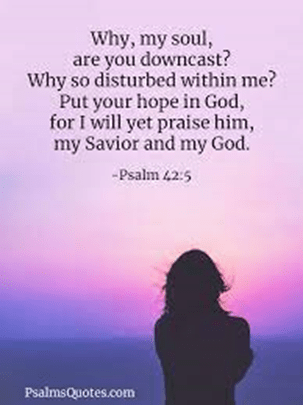
Why are you cast down, O my soul? And why are you disquieted within me? Hope in God; for I shall yet praise Him, the help of my countenance and my God.”
“As the deer pants for the water brooks, so pants my soul for You, O God. My soul thirsts for God, for the living God. When shall I come and appear before God? My tears have been my food day and night, while they continually say to me, “Where is your God?” It’s likely that David wrote this psalm while he was fleeing from King Saul, hiding in caves and separated from family and friends. Under such circumstances, worship becomes a tough proposition. When you’re trying to stay alive, it’s difficult to focus on anything else. David is not surrounded by believers but by people who mock his faith and criticize. “If your God is so great, why is He allowing you to suffer so much?
“When I remember these things, I pour out my soul within me. For I used to go with the multitude; I went with them to the house of God, with the voice of joy and praise, with a multitude that kept a pilgrim feast.” Being with other believers is energizing and exhilarating. David has always enjoyed corporate worship, but now he doesn’t dare appear in public for fear someone will report him and Saul will murder him.
“Why are you cast down, O my soul? And why are you disquieted within me? Hope in God, for I shall yet praise Him for the help of His countenance.” Despite all appearances, David continues to hope that someday things will be better.
“O my God, my soul is cast down within me; therefore I will remember You from the land of the Jordan, and from the heights of Hermon, from the Hill Mizar. Deep calls unto deep at the noise of Your waterfalls; all Your waves and billows have gone over me.” During David’s wanderings, he has covered practically all of Israel. No matter where David goes, he continues to see evidence of God at work.
“The Lord will command His lovingkindness in the daytime, and in the night His song shall be with me—a prayer to the God of my life. I will say to God my Rock, “Why have You forgotten me? Why do I go mourning because of the oppression of the enemy?” As with a breaking of my bones, my enemies reproach me, while they say to me all day long, “Where is your God?” Even though David is under continuous criticism for his faith, he continues to trust God. Those around David might be sneaking off to sacrifice to foreign gods, but David remains true.
“Why are you cast down, O my soul? And why are you disquieted within me? Hope in God; for I shall yet praise Him, the help of my countenance and my God.” David’s final conclusion is triumphant. David is confident that he WILL worship God again and that God will justify his faith.
PRAYER: It’s tempting to read these psalms and think, “Oh yeah, David, big deal! Things can’t really be as bad as you are asserting.” But if you read the accounts of David’s life in 1 Samuel and 1 Chronicles, you get an entirely different picture. The prophet Samuel anointed David as the next king of Israel, even though David’s own father thought so little of him that he failed to even present David to Samuel. David joined King Saul’s entourage as a musician, and things went well until David killed Goliath with his slingshot. When Saul realized that David was a threat and that he was becoming incredibly popular, Saul embarked on a long campaign to kill David, hounding him throughout most of Israel. At one point, David sent his family to a neighboring country for their safety. David and his men hid in caves and foraged, never being certain that the same people they were defending would not betray them to Saul in hopes of a reward. It was during these years that David wrote this psalm.
Perhaps you too feel oppressed and hounded. Your job supervisor wants you to do all his/her work while he/she denies you a well-deserved promotion. You wonder why you don’t simply quit; however, jobs are scarce and times are difficult. Perhaps your family is facing a stressful situation. A beloved parent has developed Alzheimer’s and you are agonizing over the cost of long-term care even as you struggle to keep that loved one from making fatal mistakes. Or perhaps a child who was previously a delight has entered the teen years and has turned into a snarling selfish monster. At such times, it’s easy to forget that God is still on the throne and that He has answers that we do not, even if the answers are difficult.
“Why are you cast down, O my soul? And why are you disquieted within me? Hope in God; for I shall yet praise Him, the help of my countenance and my God.” No matter how bad things get, God is still sovereign and therefore we can remain hopeful. Harold Hill, a Christian businessman two generations ago was fond of saying that “It isn’t a sacrifice of praise until you are pushing it out through clenched teeth.” Sometimes we must praise God even when we don’t feel like it, but the results are worth it. Praise lifts us out of ourselves and refocuses our attention on God.
I endured five years of training in general surgery and four years of training in pediatric surgery. At one point, I was under such stress that I found myself chanting “Praise you Jesus! Praise you Jesus!” as I moved between general wards and the ICU. But that experience taught me the same lesson Harold Hill had learned; you CAN push praise out through clenched teeth and praising God gives you the strength to continue.
Follow David’s example. Trust God and praise Him, even if you have to push the praise out through clenched teeth to do it. It’s worth it.
PRAYER: Father God, thank You for loving us and for caring for us. Lord, many who read these words feel trapped in terrible circumstances beyond their control. But You are still the Lord of the universe and You are still our only Source of help. Send Your light and Your truth into hearts and give them Your hope. In the mighty and precious Name of King Jesus. Amen.
 Burunche's Blog
Leave a comment