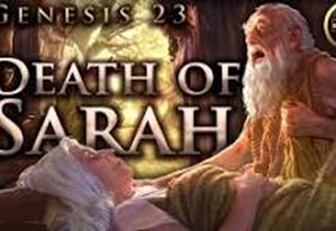
Genesis 23:1-20 The Death and Burial of Sarah
“Now Sarah lived to be 127 years old. She died in Kiriath-arba (that is, Hebron) in the land of Canaan, and Abraham went out to mourn and to weep for her.
Then Abraham got up from beside his dead wife and said to the Hittites, “I am a stranger and an outsider among you. Give me a burial site among you so that I can bury my dead.”
The Hittites replied to Abraham, “Listen to us, sir. You are God’s chosen one among us. Bury your dead in the finest of our tombs. None of us will withhold his tomb for burying your dead.”
Then Abraham rose and bowed down before the people of the land, the Hittites. “If you are willing for me to bury my dead,” he said to them, “listen to me, and approach Ephron son of Zohar on my behalf to sell me the cave of Machpelah that belongs to him; it is at the end of his field. Let him sell it to me in your presence for full price, so that I may have a burial site.”
Now Ephron was sitting among the sons of Heth. So in the presence of all the Hittites who had come to the gate of his city, Ephron the Hittite answered Abraham, “No, my lord. Listen to me. I give you the field, and I give you the cave that is in it. I give it to you in the presence of my people. Bury your dead.”
Again Abraham bowed down before the people of the land and said to Ephron in their presence, “If you will please listen to me, I will pay you the price of the field. Accept it from me, so that I may bury my dead there.” (10.1 pounds)
Ephron answered Abraham, “Listen to me, my lord. The land is worth four hundred shekels of silver, but what is that between you and me? Bury your dead.”
Abraham agreed to Ephron’s terms and weighed out for him the price he had named in the hearing of the Hittites: four hundred shekels of silver, according to the standard of the merchants.
So Ephron’s field at Machpelah near Mamre, the cave that was in it, and all the trees within the boundaries of the field, were deeded over to Abraham’s possession in the presence of all the Hittites
who had come to the gate of his city. After this, Abraham buried his wife Sarah in the cave of the field at Machpelah near Mamre (that is, Hebron) in the land of Canaan. So the field and its cave were deeded by the Hittites to Abraham as a burial site.”
Sarah has died at age 127. This means Isaac is 37 and Abraham is probably 137. After suitably grieving for Sarah, Abraham now needs a fitting burial place. Despite the fact that Abraham is a very wealthy and powerful man, notice the way he handles the negotiations.
- Abraham humbles himself, going to his Hittite neighbors and stating that he is a stranger and an outsider. Abraham doesn’t just go out and bury Sarah in any old location because he doesn’t know the intricacies of the local burial practices. If Abraham is not careful, he can needlessly offend his neighbors, violating taboos. By these actions, Abraham is demonstrating respect for those among whom he lives.
- After Abraham’s Hittite neighbors make extravagant promises about burial sites, Abraham next asks for their help in interceding on his behalf with Ephron. Abraham wants to buy Ephron’s field, along with its trees and the cave at the end of the field. If Abraham fails to buy the field, he might not have access to the cave in the future.
- Formal negotiations commence. The threefold repetition of the phrase “I give it to you” is an ancient bargaining formula indicating that the seller is willing to bargain. The use of this phrase does NOT mean that Ephron is ready to make Abraham a gift of the field, the trees, and the cave.
- After Abraham pledges to pay the full price, Ephron casually mentions how much he wants. You can almost see Ephron shrugging his shoulders as he says, “Listen to me, my lord. The land is worth four hundred shekels of silver, but what is that between you and me? Bury your dead.”
- Abraham does not haggle but pays the full asking price. Perhaps Abraham’s friends have already checked and have informed him of the going rate for land. Abraham’s acceptance of Ephron’s price indicates that Abraham trusts Ephron not to cheat him and that he wants to remain on good terms with all his neighbors.
- By Abraham’s conduct in this situation, he is assuring himself of peace with his neighbors.
In an age when electronic media have assumed such importance, it is necessary to remember that we need to maintain personal relationships with family, friends, and neighbors if we are really to have peace. Abraham could conduct himself in a very high-handed fashion; he could also find his herds and flocks being stolen in bits, his herdsmen slaughtered, and he and his family in danger.
We have spent a significant part of our lives functioning in cultures not our own. Interestingly, the worst cross-cultural mistakes we have made took place in our own country, and our experiences are quite typical. When traveling abroad, visitors expect things to be different and are willing to adjust; however, when traveling within one’s own country, we expect that the culture will be the same wherever we go. Wrong! When we Yankees moved to Memphis, Tennessee, in 1983, we had no idea how the Southern culture functioned. It was particularly tricky for me as a female surgeon because I faced a host of cultural expectations for which I was totally unprepared. By the time I had adjusted, I faced a great deal of relational rebuilding, all because I had no idea of the differences between the culture of my Midwestern childhood and the culture of the Midsouth. As one horrible example, when the pediatric surgeons with whom I was going to work invited us to a picnic, I wore the same clothes I would have worn in Illinois…shorts and a tee shirt…WRONG!!! I should have dressed only one step down from the clothes I would have worn to church! My hostess took pity on me and lent me some clothes; otherwise, I might have had to leave. (I had tried to get costume advice; however, the local ladies whom I consulted had no idea of my deprived background.)
Here in Ghana, we have to be careful about the colors we wear. While white, black and white, or blue and white are colors for celebration, black, black and red, or black and orange or brown are considered traditional funeral colors to be worn only on specific occasions. Any woman wearing a black head scarf is considered to be in mourning for a friend or relative. I used to whistle while walking around the hospital. At that time, we had a physician assistant from a particular tribal group working with us. It was only years after this man had moved on that I learned that his tribe believed anyone whistling was trying to capture someone’s soul.
The story of Abraham’s negotiations for a gravesite for his wife can serve as a great example for us. Never take those around you for granted and try to be sensitive to subtle cultural differences. Understanding and compassion will bring peace.
PRAYER: Father God, thank You for loving us and for caring for us. Lord, help us to be sensitive to those around us and not to jump to conclusions or to take them for granted. In the mighty and precious Name of King Jesus. Amen.
 Burunche's Blog
Leave a comment