Genesis 35:1-15 Jacob Returns to Bethel
Then God said to Jacob, “Arise, go up to Bethel, and settle there. Build an altar there to the God who appeared to you when you fled from your brother Esau.”
So Jacob told his household and all who were with him, “Get rid of the foreign gods that are among you. Purify yourselves and change your garments. Then let us arise and go to Bethel. I will build an altar there to the God who answered me in my day of distress. He has been with me wherever I have gone.”
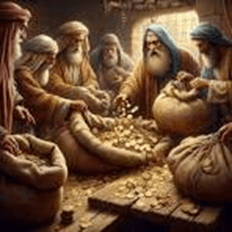
So they gave Jacob all their foreign gods and all their earrings, and Jacob buried them under the oak (great tree) near Shechem.
As they set out, a terror from God fell over the surrounding cities, so that they did not pursue Jacob’s sons. So Jacob and everyone with him arrived in Luz (that is, Bethel) in the land of Canaan. There Jacob built an altar, and he called that place El-bethel (God of Bethel), because it was there that God had revealed Himself to him as he fled from his brother.
Now Deborah, Rebekah’s nurse, died and was buried under the oak below Bethel. So Jacob named it Allon-bachuth. (Oak of weeping)
After Jacob had returned from Paddan-aram, (northwest Mesopotamia) God appeared to him again and blessed him. And God said to him, “Though your name is Jacob, (he deceives) you will no longer be called Jacob. Instead, your name will be Israel. (He struggles with God.)” So God named him Israel.
And God told him, “I am God Almighty. (El-shaddai) Be fruitful and multiply. A nation—even a company of nations—shall come from you, and kings shall descnd from you. The land that I gave to Abraham and Isaac I will give to you, and I will give this land to your descendants after you.”
Then God went up from the place where He had spoken with him.
So Jacob set up a pillar in the place where God had spoken to him—a stone marker—and he poured out a drink offering on it and anointed it with oil. Jacob called the place where God had spoken with him Bethel. (House of God)

Even though God has already given Jacob the name Israel, until now, Jacob has been living down to his birth name that means “deceiver.” Jacob has even manipulated his sons into destroying the city of Shechem and all its men and looting it. Now God steps in and orders Jacob to leave Shechem, the city his sons have devastated, and return to Bethel, where God has previously appeared to Jacob. God also reminds Jacob that He has already given Jacob a new name, Israel, “he struggles with God.” But there’s a problem, actually lots of problems.
Throughout Jacob’s household, there are those cherishing foreign gods and wearing garments that indicate their loyalty to these demons. Jewelry bearing images of the gods, amulets, charms, veils-the list is endless. But God is calling all of them to come to Him, and they must choose to either keep their idols and not approach God or to get rid of the idols and all the items dedicated to these false gods, to change their clothing, and to purify themselves in preparation for meeting God. Jacob succeeds in convincing his entire household, including his servants, to give up all their idols and jewelry and Jacob buries all this by a massive oak tree near Shechem.
Shortly after this, everyone in the company must be relieved that they have complied with Jacob’s orders because a terror from God now falls on all the surrounding cities “so that they did not pursue Jacob’s sons.” Why would these people want to pursue Jacob’s sons? Because Jacob’s sons have slaughtered all the men of Shechem and have looted the city, capturing the women and children. Naturally, those in surrounding cities might take vengeance for these horrible deeds. But God protects Jacob and his family, allowing them to reach Bethel without incident. Once this company reaches the spiritual safety of Bethel, Deborah, Rachel’s nurse, dies and is buried just below a huge oak tree at Bethel.
We all need Bethels, spiritually safe places where we can meet God, worship Him, and be at peace. God always wants to meet with us; however, many times we are not prepared to meet with Him. God wants all our attention, not a few brief glances while we play on our cell phones. If there’s one thing that has become a near-universal idol, it’s the cell phone. I have to continue to remind our nurses to pay attention to operations during surgery and not to their phones. We do many of our operations under spinal anesthesia, meaning the patient is awake, although numb below the level of the spinal. It sends a very negative message to patients if we appear to care more for our phones than we do for them. Scores of complaints are now surfacing on social media regarding parents who care more for their phones than for their children. I too must watch myself, lest I waste more time on an absorbing game than I do on more worthwhile things. But cell phones are not the only idols we need to leave behind.
Jacob is dealing summarily with the idols and jewelry from his household by burying it deeply and then moving away from the burial site. What idols are we cherishing? Are we clinging to money or possessions or houses or a sense of importance from social position or professional achievements? What drives us? What do we really worship? Whatever we worship apart from the One True Living God is an idol and needs to be rejected when we come to worship God.
In Luke 10:10-14 Jesus tells the story of two men who went up to the temple to pray. One of these men was a Pharisee, a professional religious man with the resources to follow every dictate of the Mosaic Law, while the other was a tax collector, making money by over-charging clients. The Pharisee stood and prayed silently, “God, I thank you that I am not as other men-extortioners, unjust, or even like this tax collector! I fast twice a week and give tithes of all that I possess.” Obviously, this man is impressed with himself, but is God equally impressed? Meanwhile, the tax collector is standing back in a corner weeping from remorse and beating his breast while crying, “God, be merciful to me, a sinner!” Jesus tells his disciples that it is the tax collector who goes home justified, rather than the Pharisee. “For he who exalts himself will be humbled, and he who humbles himself will be exalted.”
God doesn’t want fancy language or a recitation of your CV or even extravagant gestures that might mean nothing. God wants you to shed your idols and to come to Him just as you are. God already knows more about you than you know about yourself, and He wants to meet with you anyway. Come!
PRAYER: Father God, thank You for loving us and caring for us. Lord, help us to leave all our idols behind and to come to You just as we are. In the mighty and precious Name of King Jesus. Amen.
 Burunche's Blog
Leave a comment