Archive for July, 2024

JULY 21, 2024 JESUS IS TELLING STORIES-COME LISTEN! #37 YOU CAN BE RICH AND STILL BE A FOOL! LUKE 16:13-21

July 21, 2024

The Parable of the Rich Fool

Luke 16:13-21 “Someone in the crowd said to Him, “Teacher, tell my brother to divide the inheritance with me.”

But Jesus replied, “Man, who appointed Me judge or executor between you?” And He said to them, “Watch out! Guard yourselves against every form of greed, for one’s life does not consist in the abundance of his possessions.”

Then He told them a parable: “The ground of a certain rich man produced an abundance. So he thought to himself, ‘What shall I do, since I have nowhere to store my crops?’ Then he said, ‘This is what I will do: I will tear down my barns and will build bigger ones, and there I will store up all my grain and my goods. Then I will say to myself, “You have plenty of good things laid up for many years. Take it easy. Eat, drink, and be merry!”’

But God said to him, ‘You fool! This very night your life will be required of you. Then who will own what you have accumulated?’

This is how it will be for anyone who stores up treasure for himself but is not rich toward God.”

Jesus frequently starts off with something happening with his listeners or with recent events known to everyone. Here an unhappy guy in the crowd demands Jesus settle his family matter for him. Generally, inheritances won’t be divided until a father dies, and then the eldest son takes a double portion while everyone else takes a single portion. With a clear idea of God’s calling on his life, Jesus refuses to act as a judge or executor. Note that Jesus also refuses to even ask the most basic question: is your father dead or alive? Here Jesus demonstrates a very important point: know your mission and don’t get distracted.

Next, Jesus questions this man’s motives: “And He said to them, “Watch out! Guard yourselves against every form of greed, for one’s life does not consist in the abundance of his possessions.” OUCH! In case this man hasn’t gotten Jesus’ message clearly, now Jesus is spelling it out for him. To drive home this point, Jesus now tells a story.

“The ground of a certain rich man produced an abundance. So he thought to himself, ‘What shall I do, since I have nowhere to store my crops?’ Then he said, ‘This is what I will do: I will tear down my barns and will build bigger ones, and there I will store up all my grain and my goods. Then I will say to myself, “You have plenty of good things laid up for many years. Take it easy. Eat, drink, and be merry!”’

But God said to him, ‘You fool! This very night your life will be required of you. Then who will own what you have accumulated?’

Jesus tells the story of a rich man who has lived his entire life caring only for himself despite numerous warnings throughout the Mosaic law to care for the poor and marginalized. Leviticus 19:9-10 says, “When you reap the harvest of your land, you are not to reap to the very edges of your field or gather the gleanings of your harvest. You must not strip your vineyard bare or gather its fallen grapes. Leave them for the poor and the foreigner. I am the LORD your God.” 

The rich man Jesus describes is busy harvesting as much as he can from his ground. This is the kind of fellow who will order his servants to reap to the very edges of the field, gathering the gleanings and stripping his vineyards bare. When this man’s fields yield an abundant harvest, this man has choices: he can share this abundance with the poor and the foreigner-a move that would make him a hero in the community-or he can keep it all for himself. But this guy thinks only of himself and his immediate reaction is to tear down his current barns, build bigger ones, and then indulge himself for the rest of his life. Too bad his life is about to end abruptly. “But God said to him, ‘You fool! This very night your life will be required of you. Then who will own what you have accumulated?’”

Years ago, C. J. Studd, the founder of the Worldwide Evangelism Crusade, stated, “Only one life-twill soon be past. Only what’s done for God will last.” Life does not come with any guarantees. Jesus ends his story by commenting, “This is how it will be for anyone who stores up treasure for himself but is not rich toward God.”

At this moment, Elon Musk is rated as the richest man in the world with a net worth of  $252.4 billion. But God is not impressed by wealth, for He is the Lord of the universe. At some point, Mr. Musk will stand before the judgment seat of God and will have to account for the way he has handled that wealth.

How can we be “rich toward God?” Micah 6:8 tells us, “He has shown you, O mankind, what is good.

And what does the LORD require of you but to act justly, to love mercy, and to walk humbly with your God?” Leviticus 19:9-10 advises us to care for the poor and the foreigners. We need to realize that everything we have is a gift from God, and that we should hold everything loosely, realizing that at any moment God might want us to pass things on to others. As long as we receive things from God with open hands, we will keep acting as channels of blessing. God will bless us as we bless others. May God help us to continue to trust God for His provision.

PRAYER: Father God, thank You for loving us and for caring for us. Lord, help us to hold things loosely so that at any moment we may pass them on to someone else. Help us not to be selfish. In the mighty and precious Name of King Jesus. Amen.


JULY 20, 2024 JESUS IS TELLING STORIES-COME LISTEN! #36 HOW CAN THAT GUY BE MY NEIGHBOR WHEN HE DOESN’T LOOK LIKE ME?

July 20, 2024

The Story of the Good Samaritan Luke 10:25-37

“One day an expert in the law stood up to test Him. “Teacher,” he asked, “what must I do to inherit eternal life?”

“What is written in the Law?” Jesus replied. “How do you read it?”

He answered, “‘Love the Lord your God with all your heart and with all your soul and with all your strength and with all your mind’ and ‘Love your neighbor as yourself.’”

“You have answered correctly,” Jesus said. “Do this and you will live.”

But wanting to justify himself, he asked Jesus, “And who is my neighbor?”

Jesus took up this question and said, “A man was going down from Jerusalem to Jericho when he fell into the hands of robbers. They stripped him, beat him, and went away, leaving him half dead.

Now by chance a priest was going down the same road, but when he saw him, he passed by on the other side. So too, when a Levite came to that spot and saw him, he passed by on the other side.

But when a Samaritan on a journey came upon him, he looked at him and had compassion. He went to him and bandaged his wounds, pouring on oil and wine. Then he put him on his own animal, brought him to an inn, and took care of him.

The next day he took out two denarii (two days’ wages for a working man) and gave them to the innkeeper. ‘Take care of him,’ he said, ‘and on my return I will repay you for any additional expense.’

Which of these three do you think was a neighbor to the man who fell into the hands of robbers?”

“The one who showed him mercy,” replied the expert in the law.

Then Jesus told him, “Go and do likewise.”

A teacher of the Law has sidled up to Jesus and is now quizzing him. First, the man asks Jesus what he must do to inherit eternal life. Jesus turns the question back on his examiner, whose answer is straight out of the Scriptures as he quotes Deuteronomy 6:5 ”You shall love the Lord your God with all your heart, and with all your strength.” and Leviticus 19:18 “…you shall love your neighbor as yourself.” “You have answered correctly,” Jesus said. “Do this and you will live.”

This guy isn’t satisfied; he wants to know whom God considers his neighbor. That’s when Jesus tells this story. But before we go into the story, you need to understand who the Samaritans were and why the Jews despised them so.

The city of Samaria was the capital of the northern kingdom of Israel. Samaria was founded by Omri, the father of wicked King Ahab, and got its name from Shemer, the man from whom Omri bought the hilltop on which he founded the city. When the Northern Kingdom was destroyed by the Assyrians, most of its citizens were slaughtered or carried off into exile. The Assyrians moved in a mixed rabble who began worshiping their own gods. But God sent lions among these people and they had to import a priest to teach them about the worship of the One True Living God. The Samaritans eventually combined worship of their traditional gods with worship of Yaweh, causing the Jews to despise them as heretics. During the time of Jesus, Samaria was located between Galilee to the north and Judea to the south.

Biblestudytools.com tells us, “They established as their center of worship a temple on Mount Gerizim, claiming it was where Moses had originally intended for the Israelites to worship. They had their own unique version of the five books written by Moses, the Pentateuch, but rejected the writings of the prophets and Jewish traditions. The Samaritans saw themselves as the true descendants of Israel and preservers of the true religion, while considering the Jerusalem temple and Levitical priesthood illegitimate. 

When Jews returned to rebuild Jerusalem (under Ezra and Nehemiah), they were opposed by Samaritans. This led to further ill-will as the two sects were established in the land in opposition to one another. To the Jews, a Samaritan was more revolting than a Gentile (pagan); Samaritans were half-breeds who defiled the true religion.”

Jesus begins his story very simply. ““A man was going down from Jerusalem to Jericho when he fell into the hands of robbers. They stripped him, beat him, and went away, leaving him half dead.” Everybody knows the dangerous road between Jerusalem and Jericho that runs through the desert. There are many places where the road is so narrow that robbers can easily block the road, assault travelers, strip them of everything, and then escape. Those traveling that road try to go in large groups to discourage robbers.   

“Now by chance a priest was going down the same road, but when he saw him, he passed by on the other side. So too, when a Levite came to that spot and saw him, he passed by on the other side.” Why wouldn’t either of these men stop to help this poor fellow? Perhaps the priest and the Levite feared that the robbers were still near and wanted to escape as rapidly as possible; after all, each of them is traveling alone. Perhaps this man appeared to be dead; as religious men, they didn’t want to become ritually unclean by touching a dead body and then having to go through the rituals of purification. Perhaps they failed to stop because the robbery victim was not of their social class or his skin was darker than theirs. Perhaps night was falling and they didn’t want to be out on that road at night. And perhaps they failed to stop because they feared the victim might be a Samaritan or a Gentile and they wanted nothing to do with Samaritans or Gentiles.

By now, the legal expert is hooked and wants to know how the story will play out. Imagine his surprise when the hero turns out to be a hated Samaritan. Not only does this pagan tend the man’s wounds but he also loads the injured man on his own donkey, takes him to an inn, and even leaves two days’ wages for a working man as a down payment on the injured man’s expenses, promising to make up the difference on his way back. And now Jesus asks the key question: “Which of these three do you think was a neighbor to the man who fell into the hands of robbers?”  What’s the legal expert to do? He must answer honestly. “The one who showed him mercy,” replied the expert in the law. Then Jesus told him, “Go and do likewise.”

Jesus uses the hated Samaritan as the hero to demonstrate that God has no interest in our pet prejudices. Assuming the injured man is a Jew, the Samaritan might easily pass by on the other side as have the priest and Levite. But the Samaritan is more interested in mercy than in racism. Jesus’ point is simple: everyone is our neighbor and everyone deserves mercy.

How many of us have been tempted to behave like the fictional priest and Levite? So many times we criticize others while being blind to our own prejudices. We have lived in Charleston, SC, Memphis, TN, and New Orleans. Each of these cities was once a center for the slave trade, and each of these cities is riddled with pools of spiritual darkness and racial tension. I have listened while doctors have expressed all kinds of general racial prejudices, only to work tirelessly to save individual members of the same race they have just criticized.

Here in Ghana, tensions among tribes may have existed for hundreds of years. There is a general prejudice among those from the South against Northerners, much of which may have its roots in the short-sighted policies of British colonialism. While the British brought education to the south and established schools even in small villages, they left the North alone, preferring to use uneducated Northerners to work in the gold mines and cocoa farms of the South. Those managing various operations would train a few Northerners as translators while using educated Southerners as clerks. I have spoken in Southern churches, urging their members to help us at the hospital. As soon as I have begun describing spiritual darkness in Northern Ghana, my translator has stopped, assuming that I have so little command of his language that I don’t realize what he is doing. (WRONG! I hear more than I can speak!)  

The TV icon Mr. Fred Rogers inspired and comforted millions of viewers by creating an imaginary neighborhood to which he invited them, singing, “It’s a beautiful day in the neighborhood….won’t you be my neighbor?” Rogers was an ordained Presbyterian minister with additional training in early childhood development. For 33 years  Rogers invited viewers to be his neighbors while he tackled a whole range of problems children might face such as death, trauma of various kinds, criticism from school mates, etc. Although the program was aimed at pre-school children, Rogers’ kind approach and loving manner attracted viewers of all ages. There are many adults today who credit Rogers with being the single most important influence in their lives as they grew up.  

Many of us are kind to people when they are kind to us, but how many of us are willing to attack when people disappoint us or fail to please us? When we fail to give mercy, we are behaving like those who left the man bleeding and dying on the roadside, or worse-like the robbers! Jesus’ message to us is clear: we are always to give mercy. And remember this: one of the immutable laws of the kingdom of God is that the measure you give out is the measure you will receive. We all want mercy, but we must first give it if we are to receive it.

PRAYER: Father God, thank You for loving us and for caring for us. Lord, help us to be merciful to all those around us. In the mighty and precious Name of King Jesus. Amen.

JULY 19, 2024 JESUS IS TELLING STORIES-COME LISTEN! HOW IMPORTANT DO YOU THINK YOU ARE?

July 20, 2024

The Parable of the Guests

Luke 14:7-11 “When Jesus noticed how the guests chose the places of honor, He told them a parable: “When you are invited to a wedding banquet, do not sit in the place of honor, in case someone more distinguished than you has been invited. Then the host who invited both of you will come and tell you, ‘Give this man your seat.’ And in humiliation, you will have to take the last place.

But when you are invited, go and sit in the last place, so that your host will come and tell you, ‘Friend, move up to a better place.’ Then you will be honored in front of everyone at the table with you. For everyone who exalts himself will be humbled, and the one who humbles himself will be exalted.”

Jesus is sharing a Sabbath meal at the home of a leading Pharisee. As the religious leaders file in, Jesus can only smile. First, the host chooses his place at the dinner table, but after that, it’s a free-for-all. As leader after leader enters the room, there’s a mass movement down both sides of the table. One leader seats himself, only to be forced to shift further away from the host as someone else more important arrives. Jesus remains standing until everyone else is seated and then takes the place indicated by the host. It’s after everyone has finally been seated that Jesus tells this story.

Pride is as old as the human race, and jockeying for position is equally as old. Jesus has had to deal with this same problem with his disciples. Once the mother of James and John comes to him, requesting that her sons should occupy the most honorable places in his Messianic kingdom. Jesus has to explain that the decision is not up to him but to his Heavenly Father.

There are many constants in the kingdom of God and Jesus states one at the end of this parable. “For everyone who exalts himself will be humbled, and the one who humbles himself will be exalted.” Proverbs 3:34 says, “He (God) scorns the scornful, but gives grace to the humble.” Proverbs 11:2 says, “When pride comes, then comes shame; but with the humble is wisdom.”

When we first came to Ghana and began attending church, it was fascinating to observe the “big men” jockeying for position on the front rows of the church. First, no big man would ever arrive at the beginning of the church service but would wait in hopes that others would have preceded him. When the big men began to arrive, there were scenes reminiscent of this story. In many parts of Ghana, chiefs parade around under huge umbrellas that are carried by strong young men. If the day is hot, the umbrella carriers might even have to move the umbrella up and down, fanning the chief.

In public meetings called durbars, it is common to see chiefs and other dignitaries scrutinizing one another, trying to determine who is the most important.

Because of our position in the community, many times we are escorted to seats of honor in the front of meetings. Unfortunately, many times we find ourselves in direct line with a huge bank of loud speakers. As my husband has grown older, he has noticed the ravages of age and noise exposure on his hearing. Once the loud speakers are cranked up and the base boost and echo are going full-blast, not even ear plugs will save my husband from pain. We try to sit as far away from loud speakers as possible. Sometimes this problem becomes a cultural one because those who are unaware of my husband’s hearing difficulties may assume that the organizers of the meeting don’t know how to treat honored guests. Our struggle is to find a compromise so that we don’t cause unnecessary embarrassment to those trying to be kind to us.

Humility can be quite protective. Jesus himself is a very humble man, born to a village carpenter and a young maiden in the midst of the confusion of a government census. If Jesus had been born to a socially prominent family, he might have been considered a threat to the Roman government. As it was, King Herod tried to murder any little boy of the appropriate age. Only an angelic warning saved the small family from destruction. When Jesus’ family returned from Egypt, they settled back in the small village of Nazareth where Jesus could grow up unnoticed by the government or religious leaders. As Jesus moves around, he depends on others for feeding and lodging. And Jesus walks everywhere. The only time Jesus rides a donkey is on Palm Sunday when he enters Jerusalem, fulfilling Messianic prophecy.

When the Communists overran China, they targeted highly visible established churches. But the China Inland Mission had spent years training national Bible teachers who lived at the same level as those whom they were teaching. These brave men and women moved from village to village using local transportation. The results were amazing; these humble individuals continued to effectively spread the Gospel, resulting in millions of new believers.

Why should we insist on promoting ourselves in public gatherings? Part of our problem is judgement; we judge others, forgetting that God is the only One who truly can judge. But if we remember Jesus’ story, we will take the lowest seat, allowing the host to promote us. May God help us to remain humble, no matter what.

PRAYER: Father God, thank You for loving us and for caring for us. Lord, help us to remain humble, realizing that You are the only Perfect One. In the mighty and precious Name of King Jesus. Amen.

JULY 18, 2024 JESUS IS TELLING STORIES-COME LISTEN! #34 GOD IS INVITING YOU, PLEASE COME!

July 18, 2024

Matthew 22: 1-14 The Parable of the Banquet (Luke 14:15-24)

“Once again, Jesus spoke to them in parables: “The kingdom of heaven is like a king who prepared a wedding banquet for his son. He sent his servants to call those he had invited to the banquet, but they refused to come.

Again, he sent other servants and said, ‘Tell those who have been invited that I have prepared my dinner. My oxen and fattened cattle have been killed, and everything is ready. Come to the wedding banquet.’

But they paid no attention and went away, one to his field, another to his business. The rest seized his servants, mistreated them, and killed them.

The king was enraged, and he sent his troops to destroy those murderers and burn their city. Then he said to his servants, ‘The wedding banquet is ready, but those I invited were not worthy. Go therefore to the crossroads and invite to the banquet as many as you can find.’

So the servants went out into the streets and gathered everyone they could find, both evil and good, and the wedding hall was filled with guests.

But when the king came in to see the guests, he spotted a man who was not dressed in wedding clothes. (Traditionally, wedding clothes were provided.) ‘Friend,’ he asked, ‘how did you get in here without wedding clothes?’

But the man was speechless.

Then the king told the servants, ‘Tie him hand and foot and throw him outside into the outer darkness, where there will be weeping and gnashing of teeth.’ For many are called, but few are chosen.”

Sometimes, we must compare versions of Jesus’ stories to get the full picture. Matthew is a former tax collector, writing as a Jew for Jews and wants to highlight the main points of a story. Luke, by tradition, is a Greek physician. I have always thought that if Luke were practicing today, he would be a specialist in Neurology, because Luke is a detail man, obsessed with transmitting as much information as possible.

Here is Luke’s introduction to the story of the banquet: “One Sabbath, Jesus went to eat in the home of a leading Pharisee, and those in attendance were watching Him closely. Right there before Him was a man with dropsy. So Jesus asked the experts in the law and the Pharisees, “Is it lawful to heal on the Sabbath or not?” But they remained silent. Then Jesus took hold of the man, healed him, and sent him on his way. And He asked them, “Which of you whose son or ox falls into a pit on the Sabbath day will not immediately pull him out?” And they were unable to answer these questions.” (Luke 14:1-6)

Jesus is at it again, scandalizing religious leaders while fulfilling the Will of his Heavenly Father. One of the religious leaders reclining at table makes a pious statement. “Blessed is everyone who will eat at the feast in the kingdom of God.” What a lovely sentiment! How can Jesus possibly turn this earnest observation on its head? You can practically see all the other religious leaders nodding in polite agreement. “Way to go, Abner! Show this upstart that we are men of discernment!”

Jesus only smiles and then begins telling another story. This time, Jesus tells of a ruler who throws a huge banquet to celebrate his son’s wedding. Since Jesus generally uses recent events as the basis for his stories, it’s possible that such a celebration has just occurred in Jerusalem. This man sends out invitations to friends, neighbors, and relatives in the expectation that everyone will want to share in his joy. After all, what can be better than free delicious food, wine, dancing, and music? Surely nobody will be crazy enough to turn down such an offer.

But in this story, the invited guests not only offer ridiculous excuses, but even seize the ruler’s servants, mistreat them, and even kill them. By now, those in the crowd are shaking their heads. Who could be stupid enough to do such things, especially to the servants of a powerful ruler? Don’t these people realize this ruler can ruin their lives for their refusal to honor him or kill them because they have murdered his servants? These people must be crazy!

In revulsion, the ruler orders his servants to go to the crossroads and invite as many people as they can possibly find. (Luke adds “Then the owner of the house became angry and said to his servant, ‘Go out quickly into the streets and alleys of the city, and bring in the poor, the crippled, the blind, and the lame.’ ‘Sir,’ the servant replied, ‘what you ordered has been done, and there is still room.’ So the master told his servant, ‘Go out to the highways and hedges and compel them to come in, so that my house will be full. For I tell you, not one of those men who were invited will taste my banquet.’” (Luke 14:21-24)

Now we return to Matthew’s version, for he makes another important point. To avoid offending any important people attending, it’s the custom at such events for the host to supply wedding garments so that everyone attending will be properly clothed. Again, the religious leaders are nodding in agreement. Certainly, nobody will be stupid enough to refuse to exchange his old rags for beautiful new raiment. But in Jesus’ story, one man strides in, certain that his clothing is so good that he doesn’t need the wedding garments the host has provided. This guy is not only wrong but has made a fatal mistake.

But when the king came in to see the guests, he spotted a man who was not dressed in wedding clothes. (Traditionally, wedding clothes were provided.) ‘Friend,’ he asked, ‘how did you get in here without wedding clothes?’ But the man was speechless.

Then the king told the servants, ‘Tie him hand and foot and throw him outside into the outer darkness, where there will be weeping and gnashing of teeth.’ For many are called, but few are chosen.”

Right about now, some of the more insightful religious leaders are beginning to feel quite uncomfortable. Surely, Jesus can’t be indicting them with this story? Some of the more thoughtful ones realize that Jesus might be referring to God sending untold numbers of prophets, only for many of them to be murdered in ghastly ways. Is Jesus trying to imply that these religious leaders are like the man without a wedding garment who has trusted in his own clothes? The host is beginning to remember all the warnings his friends have given him about Jesus being a very awkward dinner guest.

Let’s leave this embarrassed host and his guests because Jesus’ story is not just aimed at them but also at us. We are the incidental guests at God’s banquet, and He is inviting us to be with Him forever. But nothing we do will be good enough for us to earn our way into heaven. Unless God helps us, we are like that man who refused to wear the wedding garments provided by the host because he thought his clothing was good enough.

Each of us is born with a sin problem, and nothing we can do will ever make up for the sins we commit. The Bible tells us that “without the shedding of blood, there is no forgiveness of sin.” (Hebrews 9:22) But praise God, God the Father has done for us what we cannot do for ourselves. Jesus has come and has lived a sinless life and has died an innocent death for our sins. We can choose to accept what Jesus has done or to refuse it. But when we refuse it, we are like that man who thought his clothing was good enough when it wasn’t. God never sends anyone to hell; people choose to go to hell. And if we refuse to accept what Jesus has done for us, we will find ourselves forever condemned to that outer darkness where there is weeping and gnashing of teeth.

Don’t delay this decision, thinking you will reconsider tomorrow. As I am writing this, America is mourning the tragic death of a good man who attended a political rally, only to be shot down by a sniper as he sheltered his wife and children with his body. Nobody expected a gunman to appear at that rally, but he did. 2 Corinthians 6:1 tells us, “For he says, “In the time of my favor I heard you, and in the day of salvation I helped you.” I tell you, now is the time of God’s favor, now is the day of salvation.” We are not promised tomorrow; today, right now, is the only time you have to make this decision. Please hear your Heavenly Father’s call! Please come and follow Jesus!

PRAYER: Father God, thank You for loving us and for caring for us. Lord, thank You for sending Jesus to die for our sins so that we have the opportunity for eternal life with You. Help all who read these words to trust in Your mercy. In the mighty and precious Name of King Jesus. Amen.
JULY 17, 2024 JESUS IS TELLING STORIES – COME LISTEN! # 33 WHAT IF GOD ANSWERS YOUR PRAYERS IN A WAY YOU DON’T EXPECT?

July 17, 2024

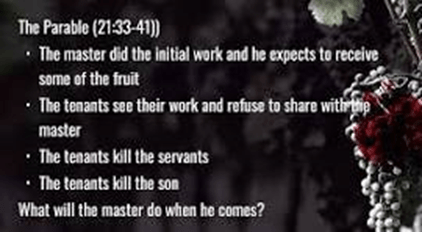
Matthew 21:33-44

The Parable of the Wicked Tenants (Mark 12:1-12; Luke 20:9-18)

“Listen to another parable: There was a landowner who planted a vineyard. He put a wall around it, dug a winepress in it, and built a tower. Then he rented it out to some tenants and went away on a journey.

When the harvest time drew near, he sent his servants to the tenants to collect his share of the fruit. But the tenants seized his servants. They beat one, killed another, and stoned a third.

Again, he sent other servants, more than the first group. But the tenants did the same to them.

Finally, he sent his son to them. ‘They will respect my son,’ he said.

But when the tenants saw the son, they said to one another, ‘This is the heir. Come, let us kill him and take his inheritance.’ So they seized him and threw him out of the vineyard and killed him.

Therefore, when the owner of the vineyard returns, what will he do to those tenants?”

“He will bring those wretches to a wretched end,” they replied, “and will rent out the vineyard to other tenants who will give him his share of the fruit at harvest time.”

Jesus said to them, “Have you never read in the Scriptures: ‘The stone the builders rejected has become the cornerstone. This is from the Lord, and it is marvelous in our eyes’?

Therefore I tell you that the kingdom of God will be taken away from you and given to a people who will produce its fruit. He who falls on this stone will be broken to pieces, but he on whom it falls will be crushed.”

When the chief priests and Pharisees heard Jesus’ parables, they knew He was speaking about them. Although they wanted to arrest Him, they feared the crowds, because they considered Jesus a prophet.”

Jesus, WHAT ARE YOU TRYING TO DO? Jesus has just told the story of the two sons, describing the one who has given lip service to obeying his father, only to fail, while the second has eventually obeyed his father, spending a hot dirty day in the vineyards. At this point, the scribes and Pharisees are fuming! One story told against them is bad enough, but now Jesus is following up with a second story, just in case any of his listeners have failed to get the point.

The professional religious people have spent centuries debating the coming of the Messiah-what will he look like? How will he behave? How should they welcome the Messiah? What place will they have in the Messiah’s kingdom? Now here comes Jesus, exploding all these lovely theories. Surely, surely, surely, Jesus can’t be the Messiah-he doesn’t come from the right place or the right family. Jesus isn’t saying any of the things these men expect the Messiah to say. But what are these men to do with Jesus’ stories?

Jesus is effectively saying that everything these men have treasured for so long is wrong, that they have wasted their lives in arguing over picky points of theology while they discourage common people from following God. These men think they have been looking for the Messiah, but now Messiah has come and he doesn’t fit their preconceived notions.

When the harvest time drew near, he sent his servants to the tenants to collect his share of the fruit. But the tenants seized his servants. They beat one, killed another, and stoned a third. Again, he sent other servants, more than the first group. But the tenants did the same to them.” The dirty secret these religious professionals refuse to acknowledge is the abuse, torture, and murder of multiple prophets. Later, Jesus will weep over Jerusalem because of these murders. For example, righteous Isaiah was sawed in two by wicked King Manasseh while the professional religious people remained silent.

Finally, he sent his son to them. ‘They will respect my son,’ he said. But when the tenants saw the son, they said to one another, ‘This is the heir. Come, let us kill him and take his inheritance.’ So they seized him and threw him out of the vineyard and killed him.”  Now the scribes and Pharisees are really incensed! How dare Jesus imply that they would fail to recognize God’s son and that they would kill him? Perhaps some of the rabble listening so intently to Jesus might do something of the sort, but they would certainly never make such a terrible mistake. We know that Jesus is not merely telling a story but also predicting his eventual death at the hands of these same religious leaders.

Therefore, when the owner of the vineyard returns, what will he do to those tenants?” “He will bring those wretches to a wretched end,” they replied, “and will rent out the vineyard to other tenants who will give him his share of the fruit at harvest time.” By this point, the crowd is fully engaged and is screaming for those horrible men to get the punishment they so richly deserve. The religious leaders, on the other hand, are beginning to wonder if they need to make a strategic retreat.

“Jesus said to them, “Have you never read in the Scriptures: ‘The stone the builders rejected has become the cornerstone. This is from the Lord, and it is marvelous in our eyes’?

Therefore I tell you that the kingdom of God will be taken away from you and given to a people who will produce its fruit. He who falls on this stone will be broken to pieces, but he on whom it falls will be crushed.”

When the chief priests and Pharisees heard Jesus’ parables, they knew He was speaking about them. Although they wanted to arrest Him, they feared the crowds, because they considered Jesus a prophet.”

Jesus is referring to himself as “the stone the builders rejected.” Nobody has to tell Jesus what the religious leaders think of him; he certainly knows and that is why he is telling this story. But Jesus is also trying to reach out to these same men, warning them to re-think their whole view of him.

One of the amazing things about Jesus that we may fail to understand is that Jesus loves those sneering religious leaders just as much as he does everyone else in the crowd. Jesus realizes that some of these men truly do want to know God, that not all of them are simply indulging in religious one-upmanship. All the time Jesus is telling these stories, he is hoping and praying that something he says will penetrate their preconceived notions, catching them unawares and prying them out of the hardened carapaces of beliefs in which they have imprisoned their hearts and minds. Jesus hopes that somewhere in that group, those who have been searching for God’s presence will experience a sudden moment of enlightenment and think “Aha!”

The question for us is simple: what kind of vineyard tenants are we? Are we willing to accept Jesus as the son of God, accept what Jesus has done for us, and follow hard after God for the rest of our lives? Are we willing to allow Jesus to turn our cherished beliefs upside down?

PRAYER: Father God, thank You for loving us and for caring for us. Lord, thank You for sending Jesus to die for our sins. Thank You, that You will give us the power to follow hard after You if we only will ask. In the mighty and precious Name of King Jesus. Amen.

JULY 16, 2024 JESUS IS TELLING STORIES-COME LISTEN! ARE YOU SITTING DOWN ON THE OUTSIDE BUT STANDING UP ON THE INSIDE?

July 16, 2024

MATTHEW 21:28-32 The Parable of the Two Sons

“But what do you think? A man had two sons, and he came to the first and said, ‘Son, go, work today in my vineyard.’ He answered and said, ‘I will not,’ but afterward he regretted it and went. Then he came to the second and said likewise. And he answered and said, ‘I go, sir,’ but he did not go.  Which of the two did the will of his father?”

They said to Him, “The first.”

Jesus said to them, “Assuredly, I say to you that tax collectors and harlots enter the kingdom of God before you. For John came to you in the way of righteousness, and you did not believe him; but tax collectors and harlots believed him; and when you saw it, you did not afterward relent and believe him.”

Well, there Jesus goes again, offending the religious establishment big-time! Unless you understand the context of this story, you won’t appreciate its full impact to those following Jesus. Jesus has just made a triumphal entry into Jerusalem and has immediately thrown the money changers and sellers of animals out of the temple. The religious teachers are incensed-after all, THEY know what should be happening in the temple and THEY have never seen anything wrong with turning it into a miniature Noah’s ark! There’s also a strong possibility that these same men have been quietly pocketing part of the profits from the sale of animals for sacrifices and the changing of regular money into temple money.

Matthew 21:23-27 tells the story. “Now when He came into the temple, the chief priests and the elders of the people confronted Him as He was teaching, and said, “By what authority are You doing these things? And who gave You this authority?”

But Jesus answered and said to them, “I also will ask you one thing, which if you tell Me, I likewise will tell you by what authority I do these things: The baptism of John—where was it from? From heaven or from men?”

And they reasoned among themselves, saying, “If we say, ‘From heaven,’ He will say to us, ‘Why then did you not believe him?’ But if we say, ‘From men,’ we fear the multitude, for all count John as a prophet.” So they answered Jesus and said, “We do not know.”

And He said to them, “Neither will I tell you by what authority I do these things.”

It is after this exchange that Jesus tells the story of the two sons. When John the Baptist came preaching repentance, prostitutes, tax collectors, Roman soldiers, and all kinds of other socially undesirable people swarmed to John, repenting and being baptized. These people never flattered themselves that they were anything other than abject sinners in need of salvation. Those who repented went away with heaven in their faces and changed lives; meanwhile, the religious leaders stood at a distance, mocking them and criticizing them for their failure of doctrinal correctness. The common people KNEW that John was a prophet while the religious establishment refused to accept John’s ministry because they didn’t think he wasn’t one of them. Never mind that John’s father Zachariah was active in the priesthood at the time of John’s birth, for these men, John was a shameless renegade. 

The moral of the story of the two sons is obvious: obedience is better than any amount of words. Centuries earlier, the prophet Samuel informed King Saul that obedience was better than sacrificing lots of perfect animals. The tax collectors and prostitutes and other sinners who repented under John’s ministry are represented by the son who first refused but then obeyed. The second son represents the religious leaders who have given lip service to serving God but who have really been serving themselves and their prejudices instead.

There’s a story about a little boy who misbehaved and whose mother ordered him to go sit in a corner to think about his misdeeds. As the boy hauled a chair over to the corner and plopped down on it, he proclaimed, “I MIGHT BE SITTING DOWN ON THE OUTSIDE, BUT I’M STANDING UP ON THE INSIDE!”  That child was so bent on getting his own way that no amount of discipline was going to change his mind. Perhaps he felt entitled to misbehave. In the same way, many of the religious leaders in Jesus’ day are so bent on doing what they want that when God sends His long-awaited Messiah, they reject him because he doesn’t fit their preconceptions. For these men, their minds are already made up; don’t confuse them with the facts.

And now the question for us: Are we obedient or disobedient children of our Heavenly Father? When God asks us to do something, do we obey or do we argue, finding every excuse in the book to avoid anything unpleasant or difficult?

Many people are familiar with the story of Hudson Taylor, the founder of the China Inland Mission; however, fewer people realize that Taylor began training himself quite early to live by faith. When Taylor was apprenticed to a doctor in Liverpool, the doctor frequently forgot to pay Hudson promptly. Hudson learned to trust God to remind the doctor. During that same time, Hudson also trained himself to live on food that was nourishing but not appetizing so that when he reached the mission field, that adjustment would not be difficult. At the height of the China Inland Mission in China, there were 1500 or more mission stations plus untold numbers of Bible men and women circulating throughout villages. CIM focused on training believers rather than erecting big buildings. When the Communists took over China, many of those trained by CIM continued to quietly spread the Gospel, despite all opposition.

God never asks us to do something difficult or nasty for Him without promising that eventually there will be a blessing. But we must be willing to be obedient children. The son who went to the vineyard got sweaty and dirty and tired while the one who stayed in the house remained cool and clean. But which son did the father appreciate more? Certainly the son who obeyed gladdened his father’s heart while the son who stayed in the house disappointed his father.

Throughout the world, there are those working for God who may suffer and even die while completing their duties. We had a doctor friend named Sister Veronika Theresa Rakova, a Catholic nun. In the spring of 2016, Sister Veronika was working in Yei, in southern Sudan and had just used the clinic ambulance to send a laboring mother in critical condition to a local hospital. As Sister Veronika was returning to her small clinic, drunken soldiers saw her vehicle and shot at it several times, severely wounding Veronika. Sadly, Sister Veronika died from those wounds four days later. When Veronika left for the hospital that night with that patient, she knew she was taking risks, but for Veronika, the will of God was far more important than anything else. For the people of that area, Veronika is now regarded as a martyr, someone who graphically demonstrated God’s love while laying down her life.

When we do God’s will, God will give us His peace. We don’t know what Sister Veronika thought during those four days she lay dying, but we do know that she loved God and was willing to be obedient. May we all be willing to obey, even if it costs us our lives, remembering that God is the One who keeps the records and He is the One who can reward our obedience.

PRAYER: Father God, thank You for loving us and for caring for us. Lord, help us to follow hard after You all the days of our lives, no matter the cost. In the mighty and precious Name of King Jesus. Amen.  

JULY 15, 0224 JESUS IS TELLING STORIES-COME LISTEN! #31 GO AHEAD AND PESTER GOD! LUKE 18:1-8

July 15, 2024

Luke 18:1-8 The Persistent Widow

“Then Jesus told them a parable about their need to pray at all times and not lose heart: “In a certain town there was a judge who neither feared God nor respected men. And there was a widow in that town who kept appealing to him, ‘Give me justice against my adversary.’

For a while he refused, but later he said to himself, ‘Even though I do not fear God or respect men, yet because this widow keeps pestering me, I will give her justice. Then she will stop wearing me out with her perpetual requests.’”

And the Lord said, “Listen to the words of the unjust judge. Will not God bring about justice for His elect who cry out to Him day and night? Will He continue to defer their help? I tell you, He will promptly carry out justice on their behalf. Nevertheless, when the Son of Man comes, will He find faith on earth?”

It’s an age-old question: Why doesn’t God answer prayers immediately, or at least quickly? Why do we sometimes pray for years without seeing an answer? Is it really worth it to continue to pray? Evidently, somebody has asked Jesus those questions, and now Jesus is telling this story in answer.

As soon as judicial systems began developing, unjust judges began appearing. Some judges respond only to money while others respond to political influence. For Jesus’ listeners, unjust judges are a fact of life, as are widows. In a patriarchal society, widows without sons to protect them are among the most vulnerable group possible. Every village has a few widows living a bare existence on the fringe of society, and for women, finding themselves in such a marginalized group is a living nightmare that they hope never to experience. But here is Jesus telling a story in which a humble little widow lady gets the best of a haughty corrupt judge.

We don’t know the issue the widow is fighting but whatever it is, she refuses to give up or give in. Daily, this lady shows up at the court, reminding the judge of her need for assistance. The first few times, the judge scoffs at this woman and orders his servants to escort her out of the court. But this widow, sweet as she is, simply refuses to give up. Every morning, as soon as the judge arrives, this lady is at the court, greeting him and reminding him that she needs help. If the judge goes out on the street, the widow is there greeting him politely and asking when he is going to settle her case for her. If the judge’s wife goes out in public, the widow is there, greeting her respectfully and asking her to remind her husband to settle her case. The situation reaches the point that the judge’s friends are beginning to make fun of him, questioning why he doesn’t simply settle the widow’s case. Perhaps religious leaders are getting involved as well, asking similar questions.

Finally, the judge has had enough. While he doesn’t fear God or respect men, he wants this widow lady off his back. The judge calls the lady in and settles the case in her favor. What has led to this success? Persistence! This humble little lady has simply refused to give up or give in and has worn this wicked man out. But why does Jesus compare those who pray with this happy lady?  

“Then Jesus told them a parable about their need to pray at all times and not lose heart..”  Jesus wants his followers, including us, to realize that we NEED to pray at all times. Remember that this widow hasn’t simply shown up at the court every morning, but has also kept appearing anyplace she knows the judge will appear. There may have been days when this lady would have liked to stay home, but she has kept at it. There may have been times when this lady’s friends have mocked her or criticized her or even tried to discourage her. “Mariam,” they have asked, why are you still following that man? Don’t you know that he doesn’t care and he’s going to keep ignoring you?”

In the same fashion, we are to press our concerns to God in prayer regularly and repeatedly. “Why must I keep pestering God?” you might ask. “Is God deaf or indifferent to my pleas for help?” No. God is neither deaf nor indifferent; however, we are not praying in a spiritual vacuum. Satan is alive and well and working to destroy anything good and beautiful in the world, and he is the one who can hinder the answers to our prayers. The prophet Daniel, living in Babylon, interceded for his people. Daniel had studied the scriptures and realized that the time of exile should end soon; however, nothing was changing in Babylon.  The Book of Daniel tells us that Daniel prayed three times a day for his people.

Late in Daniel’s life, he had a vision and prayed for three and fasted for three weeks without any explanations coming from God. Then an angel appeared and gave this explanation: “Then he said to me, “Do not fear, Daniel, for from the first day that you set your heart to understand, and to humble yourself before your God, your words were heard; and I have come because of your words. But the prince of the kingdom of Persia withstood me twenty-one days; and behold, Michael, one of the chief princes, came to help me, for I had been left alone there with the kings of Persia. Now I have come to make you understand what will happen to your people in the latter days, for the vision refers to many days yet to come.” (Daniel 10:12-14)

Nothing was wrong with Daniel’s prayers. God was pleased with Daniel’s prayers; however, Satan was opposing those prayers. What if Daniel had quit after two weeks, or even after twenty days rather than persisting for twenty-one days? It was Daniel’s prayers that released heavenly power to overcome massive Satanic opposition.

George Mueller was a man of enormous faith who founded orphanages in Bristol, England that eventually served more than 10,000 orphans at a time. Mueller depended on God for provision and there were many stories of the orphans sitting at the breakfast table with no food, only for milkmen and bakers to suddenly turn up with sufficient supplies for their needs. One of Mueller’s friends had a son who rejected God and ran off to Canada to escape his father’s godly influence. Mueller prayed for that man’s salvation for many years. Long after Mueller’s friend had died, Mueller continued to pray for the son. Eventually, Mueller himself died, and it was when the son read of Mueller’s death in a Canadian paper that he came under conviction of sin and repented, giving his life to Christ.

What did George Mueller and Daniel have in common? They prayed and refused to lose heart, no matter how daunting the circumstances appeared to be. Perhaps you are in a situation like that of Daniel’s. You are in a place that is not of your choosing, longing for restoration and reconciliation. You have prayed for decades for the salvation of your loved ones but have seen little evidence of change. Don’t give up! For all you know, the answers to all your prayers may be right around the corner.

When I was a child, both my grandfathers were alive. One grandfather was a Christian while the other was a cynical unbeliever for whose salvation I prayed with childish faith. Eventually that grandfather walked out into a wintry night in his sleep, going outside his house and falling, fracturing a hip. My grandfather lingered ten days in hospital and then died. Later, God revealed to me that it was during that ten days that my grandfather finally repented, fulfilling those prayers I had prayed decades before.

No matter your circumstances, God knows your struggles and your trials. God is neither deaf nor sleeping. Hang on! Don’t give up and stop praying on day #20 when the spiritual battle might be won on day #21! This quote from Franklin D. Roosevelt advises to tie a knot at the end of your rope and hang on. I would add, “Tie a knot at the end of your rope, hang on, and PRAY!!!”

PRAYER: Father God, thank You for loving us and for caring for us. Lord, help us to be constant in prayer and persistent in prayer. Help us never to give up or to lose heart, realizing that You are the One who will cause things to happen in Your time. In the mighty and precious Name of King Jesus. Amen.

JULY 14, 2924 JESUS IS TELLING STORIES-COME LISTEN!#30 WHY FORGIVE IF YOU CAN GET REVENGE? MATTHEW 18:21-35

July 14, 2024

Matthew 18:21-35 “Then Peter came to Jesus and asked, “Lord, how many times shall I forgive my brother who sins against me? Up to seven times?”

Jesus answered, “I tell you, not just seven times, but seventy-seven times!

Because of this, the kingdom of heaven is like a king who wanted to settle accounts with his servants. As he began the settlements, a debtor was brought to him owing ten thousand talents. (A talent was worth about twenty years’ wages for a laborer.) Since the man was unable to pay, the master ordered that he be sold to pay his debt, along with his wife and children and everything he owned.

Then the servant fell on his knees before him. ‘Have patience with me,’ he begged, ‘and I will pay back everything.’

His master had compassion on him, forgave his debt, and released him.

But when that servant went out, he found one of his fellow servants who owed him a hundred denarii. (A denarius was customarily a day’s wage for a laborer.) He grabbed him and began to choke him, saying, ‘Pay back what you owe me.’

So his fellow servant fell down and begged him, ‘Have patience with me, and I will pay you back.’

But he refused. Instead, he went and had the man thrown into prison until he could pay his debt.

When his fellow servants saw what had happened, they were greatly distressed, and they went and recounted all of this to their master.

Then the master summoned him and declared, ‘You wicked servant! I forgave all your debt because you begged me. Shouldn’t you have had mercy on your fellow servant, just as I had on you?’ In anger his master turned him over to the jailers to be tortured, until he should repay all that he owed.

That is how My Heavenly Father will treat each of you unless you forgive your brother from your heart.”

Here’s Peter, posing a theoretical question and thinking that he is really doing well. After all, Peter is suggesting that he forgive his brother seven times; isn’t that quite a lot? Certainly, Peter has a real situation in mind and is seeking to justify himself. Peter is probably standing there, preening and thinking how magnanimous he really is when Jesus tells this story, knocking the props out from under Peter’s self-satisfaction and complacency.

The story is quite simple. One man owes a very wealthy ruler an incalculable amount of money. Why and how has this guy run up such a ginormous debt in the first place? Doing the math, this man owes the equivalent of 200,000 years’ worth of salary for a working man. Why the ruler has allowed this man to borrow this much money is a mystery; however, the ruler forgives that entire debt. Poof! Debt gone, just like that. Then this same man refuses to forgive a fellow servant a debt representing 100 days’ wages, little more than three months’ debt. By now Jesus’ listeners are becoming incensed. How can this wicked man get away with this? Doesn’t he have any sense of decency?

Having grabbed the attention of the crowd, Jesus now delivers the stinger in the story: “In anger his master turned him over to the jailers to be tortured, until he should repay all that he owed. That is how My Heavenly Father will treat each of you unless you forgive your brother from your heart.”

OUCH! Jesus! What are you doing to us? What are you demanding?

Notice that Jesus doesn’t criticize either man for going into debt. Evidently, borrowing money is a common practice and everybody in the audience knows it. Jesus deliberately constructs this story by describing the first debtor as owing so much money that he can never possibly repay it. The second debtor owes a significant sum; however, this amount might be doable. But what is the point of this story?

Each of us is a sinner and we owe a sin-debt to God that we can never possibly repay. As sinners, we offend a holy and righteous God many times a day. Compared with our debts to God, anything our fellow human beings do to us is miniscule. In the story, the ruler originally is going to sell the first man and his family along with his belongings to recover a small part of the debt. When this man refuses to forgive his fellow servant, the ruler hands over the ungrateful servant to the jailers to be tortured, not merely kept in prison. The lessons are clear: God has forgiven us debts that we can never repay so we too should forgive all those around us, no matter how many times we have to do so. If we refuse to forgive, we are choosing to imprison ourselves spiritually and opening ourselves up to satanic torment.

Many of us have heard bitter statements such as “Revenge is a dish best served cold.” The idea there is that we can plot revenge for years and then take it, confident that we will gain satisfaction. But in God’s eyes, revenge is a dish best discarded. Our unforgiveness doesn’t generally do anything to those against whom we have grudges; however, the longer we refuse to forgive, the more we are poisoning ourselves. In effect, we are turning ourselves over to the torturers.

Years ago, there was a missionary who was extremely effective. Since the house in which she had been living was falling apart, this lady raised money for a new building while she was on leave. But when this lady returned to the field, her field director flatly refused to allow her to proceed with that building and confiscated the supplies she had purchased. This woman became so bitter that she left the mission field permanently, refusing to forgive those who had mishandled her. Later, when citizens of the area traveled to the U.S. to beg this woman to return, she had to inform them that she had nothing left to give. When we spoke with this woman, she warned us against allowing bitterness to creep in because bitterness and unforgiveness could destroy our ministry just as it had destroyed hers.

Face it, nothing anyone does to you is as bad as the things you do to offend God daily. Forgive those around you, realizing that they may be struggling to forgive you as well. Most of us have no idea how many times we wound others.

PRAYER: Father God, thank You for loving us and for caring for us. Lord, we confess that we are sinners and that we offend You repeatedly each day. Please forgive us our sins and help us to forgive others freely. In the mighty and precious Name of King Jesus. Amen.

JULY 13, 2024 JESUS IS TELLING STORIES-COME LISTEN! #29 WHO’S A PRODIGAL? LUKE 15:11-32

July 13, 2024

The Parable of the Prodigal Son (Deuteronomy 21:18-21)

“Then Jesus said, “There was a man who had two sons. The younger son said to him, ‘Father, give me my share of the estate.’ So he divided his property between them. After a few days, the younger son got everything together and journeyed to a distant country, where he squandered his wealth in wild living.

After he had spent all he had, a severe famine swept through that country, and he began to be in need. So he went and hired himself out to a citizen of that country, who sent him into his fields to feed the pigs. He longed to fill his belly with the pods the pigs were eating, but no one would give him a thing.
Finally he came to his senses and said, ‘How many of my father’s hired servants have plenty of food? But here I am, starving to death! I will get up and go back to my father and say to him, “Father, I have sinned against heaven and against you. I am no longer worthy to be called your son. Make me like one of your hired servants.”’

So he got up and went to his father. But while he was still in the distance, his father saw him and was filled with compassion. He ran to his son, embraced him, and kissed him.
The son declared, ‘Father, I have sinned against heaven and against you. I am no longer worthy to be called your son.’

But the father said to his servants, ‘Quick! Bring the best robe and put it on him. Put a ring on his finger and sandals on his feet. Bring the fattened calf and kill it. Let us feast and celebrate. For this son of mine was dead and is alive again! He was lost and is found!’ So they began to celebrate.
Meanwhile the older son was in the field, and as he approached the house, he heard music and dancing. So he called one of the servants and asked what was going on. ‘Your brother has returned,’ he said, ‘and your father has killed the fattened calf, because he has him back safe and sound.’

The older son became angry and refused to go in. So his father came out and pleaded with him.
But he answered his father, ‘Look, all these years I have served you and never disobeyed a commandment of yours. Yet you never gave me even a young goat so I could celebrate with my friends. But when this son of yours returns from squandering your wealth with prostitutes, you kill the fattened calf for him!’

‘Son, you are always with me,’ the father said, ‘and all that is mine is yours. But it was fitting to celebrate and be glad, because this brother of yours was dead and is alive again; he was lost and is found.’”

Unless we understand the cultural context behind this story, we won’t feel its full impact as do Jesus’ hearers. First, the younger son doesn’t just wake up one morning and suddenly turn into a rounder; he’s been misbehaving for quite some time.

What does the Law of Moses say about misbehaving sons? “If a man has a stubborn and rebellious son who will not obey the voice of his father or the voice of his mother, and who, when they have chastened him, will not heed them, then his father and his mother shall take hold of him and bring him out to the elders of his city, to the gate of his city. And they shall say to the elders of his city, ‘This son of ours is stubborn and rebellious; he will not obey our voice; he is a glutton and a drunkard.’ Then all the men of his city shall stone him to death with stones; so you shall put away the evil from among you, and all Israel shall hear and fear.”

This boy’s father doesn’t have to tolerate his bad behavior but might send him to the elders, who will stone him to death. But the father keeps hoping that the boy will improve; instead, the boy demands his inheritance as if the father is already dead. By this action, this young man is essentially wishing his father will die immediately. The elder son doesn’t protest at all but allows his father to carry out this action, making him effectively as guilty as the younger son.

Notice that the father divides his property between the two sons, leaving little for himself. The elder son is now enjoying the larger share of the property as his birthright. The elder son smugly remains at home while the younger son runs off and blows his inheritance in partying.

Eventually the money runs out and the younger son finds himself forced to care for pigs to earn a bare living. (At this point, all the observant Jews in Jesus’ audience are horrified! Few things are more shameful than caring for pigs.) Even the pigs are eating better than the younger son. It’s at this point that the younger son decides to return home, humble himself, and beg for a position as a hired servant in his father’s household. And that’s when the miracle takes place.

This father truly loves both of his sons and has grieved over the younger son’s behavior. Night after night, the father has begged God to take care of his son and to bring him home safely. Daily, the father scans the road for any sign of his son’s return. When the father sees the son at a distance, he runs to him, embracing him and kissing him while he weeps tears of joy.

When the son starts in on his prepared speech, the father brushes that aside and begins shouting to his servants to help the son clean up and then change the son’s garments for the best robe, the best sandals, and a ring. These items are always kept ready for any honored guest who might arrive, and the father is so overjoyed that only these garments will do. The father throws a big party.

Now the elder son hears music and dancing as he is coming in from the field and learns that all this celebration is for his degenerate younger brother. The elder brother is furious! All these years, the elder brother has worked faithfully for his father without being celebrated. Today, the younger brother shows up and their father is throwing an enormous party. The elder brother is so infuriated that he won’t even set foot in the house, but sits out in the compound sulking and forcing his father to come out to explain.

While the elder brother is complaining bitterly, let’s note that when the father was dividing the inheritance, the elder brother didn’t protest at all. All this time, the elder brother could have slaughtered his own goat and thrown a party for his friends, but he did not. All this time, the elder brother had the opportunity to enjoy his father’s company, but did he enjoy being with his father or was he simply biding his time until his father would die? Although the elder brother has been with his father, it appears that he has simply continued to work, never appreciating the chance to fellowship with a good and loving man.

There are not one but two prodigals in this story. There is the younger son who has partied away his inheritance and then there is the elder son who has failed to appreciate his loving caring father. The elder son has wasted much of his life feeling smug and superior to his younger brother, despising him for his profligate lifestyle. Eventually, the younger son comes to his senses when he realizes that no amount of money will make up for his father’s love. But the elder son has a far worse problem because he has been with his father and has taken refuge in self-righteousness, totally failing to enjoy his father’s love. The elder son’s spirit has dried up into a husk as shriveled as the ones the pigs were eating.

Of the two prodigals in the story, the younger son is actually more blessed because he has come to appreciate his father’s worth. The elder son has wasted long years as a workaholic, refusing to acknowledge his father’s kindness, goodness, and love. How many times has the father tried to reach out to the elder son, only to be rebuffed? How many times has the father tried to hug the elder son and tell him he loves him, only for the elder son to stiffen and turn away?

For some of Jesus’ listeners, the description of the elder son must remind them of the Pharisees. While Jesus speaks of his Heavenly Father in tones of love, the Pharisees portray God as a stern taskmaster, ever ready to penalize anyone who does not measure up to the standards that they have set. The Pharisees are so certain that they know what God wants that they haven’t bothered to listen to Him in years, if ever. It doesn’t require much imagination for these people to picture the elder son as a Pharisee, pouting in the courtyard while sinners flock in and receive forgiveness and love from God the Father.

Do any of the Pharisees see themselves in this story? Only in heaven will we learn the answer to that question. But the lesson for us is simple: God the Father loves us and longs for fellowship with us. There is no sin so terrible that we cannot confess it to God, be forgiven, and be swept up in His love. Wherever this story is told, Jesus wants people to know that God the Father stands ready to forgive them and to receive them into his kingdom. All we have to do is to confess our sins, ask forgiveness, and then follow God.

PRAYER: Father God, thank You for loving us and for caring for us. Lord, we know that we are sinners and that nothing we can do is good enough to earn our way into heaven. Please forgive us our sins and help us to live for You and not for ourselves from this time onward. In the mighty and precious Name of King Jesus. Amen.

JULY 12, 2024 JESUS IS TELLING STORIES-COME LISTEN! #28 SO YOU FOUND A COIN? SO WHAT? LUKE 15:8-10

July 12, 2024

The Parable of the Lost Coin Luke 15:8-10

“Or what woman who has ten silver coins and loses one of them does not light a lamp, sweep her house, and search carefully until she finds it? And when she finds it, she calls together her friends and neighbors to say, ‘Rejoice with me, for I have found my lost coin.’ In the same way, I tell you, there is joy in the presence of God’s angels over one sinner who repents.”

Jesus has just eaten a meal with a bunch of tax collectors and “sinners.” Who are these “sinners?” Well, some of them might be local merchants who sell catfish and pork to Greeks and Romans. After all, both these items would be considered unclean. Perhaps some of them deal in things the Jews consider as unclean but the Gentiles consider necessary. Perhaps one of the sinners owns a local brothel. At any rate, as Jesus comes out from lunch, the scribes and Pharisees are waiting outside the gate of the house, ready to pounce on him and criticize. After all, THEY KNOW what God really demands of people.

As these supercilious individuals stand there fixing Jesus and his companions with icy stares, Jesus begins telling stories to explain just how much his Heavenly Father longs to see sinners repent. Jesus leads off with the story of the lost sheep, causing a few of his critics to become bemused; perhaps they haven’t been as correct as they have thought. Now Jesus is following up with this story.

In a day when electric lighting illuminates every space, it’s difficult to realize just what people in earlier ages dealt with. Abraham Lincoln is said to have read books by lying close to a fireplace so he could read by the light of the fire. In Charleston, South Carolina, many of the fine old houses have mirrors to reflect the light of candles or lamps, spreading it around the room. When we first came to our little village 31 years ago, everyone depended on kerosene lamps. Battery-operated lamps were a startling innovation. I have delivered a number of babies by kerosene lamp and I have sewn up lacerations holding a small torch (flashlight) in my mouth. When my husband rigged two twelve-volt lights on hospital bed stands, we thought we were in heaven.

Lighting in Jesus’ day consists of small clay lamps with wicks that burn olive oil. Even if you put one of these lamps on a lampstand, there will still be dark corners. According to Biblecourses.com, that silver coin is a drachma worth approximately $100 in today’s currency. (The Value of a Soul #17 The Lost Coin-Biblecourses.com http://www.biblecourses.com › material › value17)

For a poor village lady, losing such a coin represents financial disaster. Of course, this lady will go over every inch of her house, looking in all the cracks and crevices, even running her fingernails through those cracks, until she finds that coin and then calls her friends to rejoice with her. That woman’s joy and relief will be palpable, for that coin represents one-tenth of her life savings.

As Jesus is telling this story, you can see heads nodding throughout the crowd. Many of those listening have had similar experiences, losing small items and then sweeping and searching until they have found them. But what’s this? Jesus is saying that heaven rejoices over sinners who repent just as much as village people rejoice over finding something precious that has been lost. Jesus’ listeners know they are sinners. Can it be true that God really cares about sinners that much? Most of these people have spent years feeling inferior to the scribes and Pharisees, the “professional religious men.” Does the Lord God, Ruler of the Universe really care about little people to that degree? What an amazing idea!

We really don’t understand how precious we are to God. God loves us in spite of our sins but He also loves us too much to leave us in our sins. When we repent, heaven rejoices. Let’s pray.

PRAYER: Father God, thank You for loving us and for caring for us. Lord, we know that we are sinners and that nothing we can do will make up for our sins. Thank You for sending Jesus to die for our sins. We trust in Jesus and in what he has done for us. Help us to follow hard after You all the days of our lives. In the mighty and precious Name of King Jesus. Amen.