Matthew 5: 31-32 Marriage Is Sacred and Binding
“Furthermore it has been said, ‘Whoever divorces his wife, let him give her a certificate of divorce.’ But I say to you that whoever divorces his wife for any reason except sexual immorality causes her to commit adultery; and whoever marries a woman who is divorced commits adultery.”
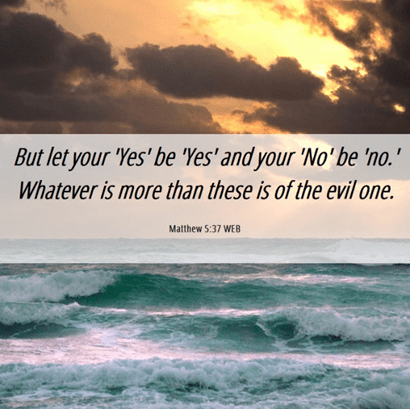
Jesus Forbids Oaths Matthew 5:33-37 “Again you have heard that it was said to those of old, ‘You shall not swear falsely, but shall perform your oaths to the Lord.’ But I say to you, do not swear at all: neither by heaven, for it is God’s throne; nor by the earth, for it is His footstool; nor by Jerusalem, for it is the city of the great King. Nor shall you swear by your head, because you cannot make one hair white or black. But let your ‘Yes’ be ‘Yes,’ and your ‘No,’ ‘No.’ For whatever is more than these is from the evil one.”
Huge amounts of been written about divorce, but it’s helpful to examine divorce as it was practiced in Jesus’ day. Even Pharisees could simply hand their wives certificates of divorce, forcing the women to leave the house and face an uncertain future. The reasons for divorce were myriad. The Hillel school of rabbinic thought included the poor woman burning the dinner, the husband seeing another woman he liked better, the woman “causing embarrassment,” or “for any other reason.” A second school of rabbinic thought, the Shammai school, only countenanced divorce on the grounds of sexual unfaithfulness or adultery; however, the men were the ones who could demand divorces while women could not. Unmarried women or widows frequently found themselves at the mercy of the men around them, so divorce robbed a woman of social and physical protection, as well as throwing her into poverty.
Here Jesus is advising those around him that if they want to be his disciples, they must honor all the covenants they make, including the marriage covenant. Jesus goes on to forbid oaths and to urge people to keep their word when they make an agreement. Disciples must be trustworthy, and someone who will break a marriage covenant on the slightest pretext is not.
But what about the issue of divorce? Many churches take this particular statement of Jesus without examining the rest of the New Testament and use it to attack divorced people. But there are as many reasons for divorce as there are couples, and such harsh judgements have frequently resulted in people rejecting God because those claiming to follow Him have behaved viciously.
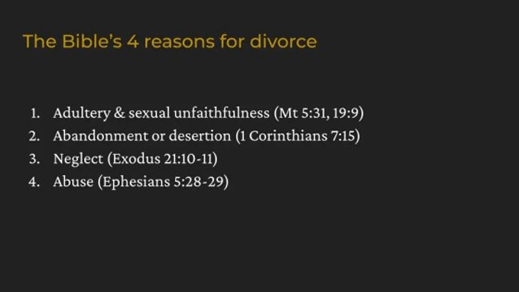
Phil Whitall pastors Grace Church Stockholm in his blog thesimplepastor.co.uk describes 4 Biblical reasons for divorce as described in this illustration: Adultery and sexual unfaithfulness, Abandonment or desertion, Neglect, Abuse. It should be noted that abuse can be physical, mental, emotional, or some combination of all three. What do we say to the man or woman who faces daily doses of vitriol pouring from the mouth of their spouse? What about women who must go underground with their children in hopes of escaping physical abuse or even death? What about the man whose wife has become so addicted to drugs that she has impoverished the family, leaving her children to face ridicule wherever they go? And what about women who have given everything they can to their marriages, only to find that nothing is enough? Some Christians appear more willing to accept a murderer who has repented than a divorced man or woman who has suffered abuse, desertion, neglect, or other suffering? Is divorce really an unpardonable sin? The short answer is “No!”
One of the problems we face when discussing sin is the question of which sins are worse? Are addictions to drugs, gambling, food, shopping, etc. worse than gossiping or betraying one’s friends or co-workers? Is homosexuality or lesbianism worse than murder? Again, the answer is “NO!” God does not grade on a curve or rate some sins as worse than others. Romans 3:23 tells us “For ALL have sinned and have fallen short of the glory of God.” Some of us have sins that are more visible than others, but all of us are sinners in need of a Savior.
God has instituted marriage so that men and women and children can live in a loving environment. Jesus adds his teaching against oath taking or breaking to his discourse on divorce because marriage is a covenant relationship, one that should not be broken if at all possible. But bad things happen to good people. Some of us may marry someone, believing that we understand their personality, only to find that we have created a false figure that has little relationship to reality. Sometimes a spouse may prove to be bipolar or psychotic, with ever-worsening behavior. Other times, the same spouse who appeared incredibly attentive and affectionate during courtship turns out to be obsessively controlling and physically abusive after marriage. Only God really knows the human heart sufficiently to judge; the rest of us need to leave judgment to God.
Years ago, we worked in a mission group with a woman who was very difficult. At one point, I was venting to one of our friends, complaining at length about this woman. Our friend looked at me kindly and then said, “Well, I have noticed that suffering is 100% for everybody.” This statement is one of the wisest I have heard. Things that bother me don’t bother others and vice versa. That statement illustrates the fact that none of us are qualified to judge or criticize.
Here Jesus is trying to urge his disciples to honor covenants but also to act in love, both in their families and with their neighbors. Jesus is actually protesting the harsh attitude of the Pharisees and scribes against women. It behooves all of us to act in love, comforting rather than viciously pronouncing judgment. Am I in favor of fidelity? Absolutely! I have been married more than four decades and my husband is my best friend. But the longer I go on this journey of faith, the less qualified I feel to judge others. Am I advocating divorce? No. But I recognize there are times when that is the only option left to someone who has already suffered much.
PRAYER: Father God, thank You for loving us and caring for us. Lord, help us to be compassionate but to honor covenants and to let our “yes be yes and our no be no.” In the mighty and precious Name of King Jesus. Amen.
 Burunche's Blog
Leave a comment