Matthew 6:5-15 The Model Prayer
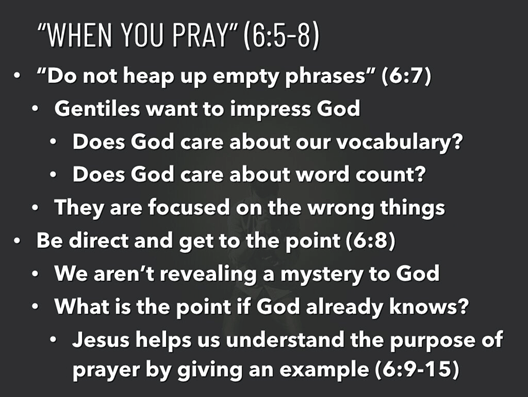
“And when you pray, you shall not be like the hypocrites. For they love to pray standing in the synagogues and on the corners of the streets, that they may be seen by men. Assuredly, I say to you, they have their reward. But you, when you pray, go into your room, and when you have shut your door, pray to your Father who is in the secret place; and your Father who sees in secret will reward you openly. And when you pray, do not use vain repetitions as the heathen do. For they think that they will be heard for their many words.
“Therefore do not be like them. For your Father knows the things you have need of before you ask Him. In this manner, therefore, pray:
Our Father in heaven, Hallowed be Your name.
Your kingdom come. Your will be done on earth as it is in heaven.
Give us this day our daily bread.
And forgive us our debts, as we forgive our debtors.
And do not lead us into temptation, but deliver us from the evil one.
For Yours is the kingdom and the power and the glory forever. Amen.”
“For if you forgive men their trespasses, your heavenly Father will also forgive you. But if you do not forgive men their trespasses, neither will your Father forgive your trespasses.”
Ah, Jerusalem! Such a holy city! And if you don’t believe it, just wait a little. Avram, the Pharisee, is coming to stand on the street corner to pray so that everyone can see him and admire him. Surely the prayers of an outstanding religious person such as Avram will sanctify the city even further…..won’t they….or will they? And even if you miss Avram’s performance on the street corner, you can still catch it inside the temple, for Avram promises to proceed into the temple and stand where everyone can see him and hear him while he prays some more….actually, a lot more.
The names don’t matter, but when Jesus begins teaching about prayer, everybody in the crowd knows what he’s talking about because they have all witnessed the professional religious people showing off, displaying their piety. Not only do such people select heavily trafficked public places for their prayers, but they also pray LONG prayers, quoting as much Scripture as possible to demonstrate their grasp of holy writings. Those unfortunate enough to enter the temple during one of these performances are in for a long siege before they too can pray and then go.
Jesus is encouraging us to speak with God simply and quietly in a private location. If you wanted to talk with your best friend, you won’t do it in the middle of a busy street, but in a quiet place where you have time to communicate. And when you speak with friends, you don’t repeat the same phrases over and over, but you state things plainly, knowing your friend will understand. You also use a normal tone of voice, not some “woo-woo” sanctimonious quaver; neither do you scream. Why scream at someone sitting right next to you? How rude!
Now Jesus turns to the content of the prayers. We are to regard God as our Father, the most perfect Father there is. The fatherhood of God is a tough concept for many people because they’ve had bad or disappointing experiences with their earthly fathers. Some fathers are weak or emotionally absent. Some fathers have only served as sperm donors, deserting mothers and children. Other fathers have been verbally, emotionally, or physically and sexually abusive. But in the Jewish culture, a good father provides for his family, protects his family, and guides his family. As the ultimate perfect Father, God can do all these things better than anybody else.
We are to call God’s Name as holy, sacred, not something to be mishandled or to be used in casual expressions such as “OMG!” We are praying to a perfectly pure and holy God, not one of the pagan deities noted for sexual or other immorality. During the conversation with the Samaritan woman at the well, Jesus tells her that “God is a spirit, and they who worship him must worship in spirit and in truth.”
“Your kingdom come. Your will be done on earth as it is in heaven.” If we want the very best for ourselves and for others, we should be longing for God’s kingdom to come and for His perfect will to be done in all things, for then everything will work properly and will be peaceful. When faced with a conundrum, it is helpful to ask God for His perfect will to be done in a situation. As we make this request, we are handing over our right to decide what’s best, trading it for God’s best instead. We are acknowledging that God knows the facts of the situation better than we do and that He can handle things far better than we can. You can’t go wrong making such a request.
“Give us this day our daily bread.“ Here we are acknowledging our total dependence on God for everything, including our food. No matter how much we choose to ignore this fact, none of us are self-made individuals. If God does not supply us, we will have nothing.
“And forgive us our debts, as we forgive our debtors.” Why is this statement an important part of the prayer? We must first forgive before God can forgive us. If we harbor unforgiveness in our hearts, we block God from forgiving us. When we forgive freely, then God can freely forgive us. One of the fundamental laws of the Kingdom of God is that the measure you give out is the measure you will receive. We limit God’s forgiveness for us when we harbor unforgiveness.
“And do not lead us into temptation, but deliver us from the evil one.” God does not lead us into temptation but we court temptation ourselves. We constantly need deliverance from Satan and only God can protect us.
“For Yours is the kingdom and the power and the glory forever. Amen.” Here we acknowledge God as Sovereign of the universe, almighty, all-powerful, all-glorious, and ruler of all. “Amen” translates to “Let it be so!”
Large numbers of books have been written about this prayer and studying it in depth is very worthwhile. But we miss a great deal if we ignore Jesus’ instructions that precede it. These days, there are many prayer meetings that go on for hours while people scream at God as loudly as possible, repeating their petitions as rapidly as possible. Sometimes people claim to be waging spiritual warfare; however, when Jesus confronted demons, he simply told them to leave and they did. While there is nothing wrong with praying for long periods of time, the content of the prayers and the mode of delivery are important. Prayer is a two-way conversation, not a monologue. We should listen far more than we should speak. God is not deaf, and He knows our hearts; however, when we speak out our petitions and even record them, we can later record God’s answers. This practice will build our faith. When Jesus is advising us to go into a secret place, he is not advising that we copy the Pharisees or any other group. We need to be careful, lest we find ourselves copying the wrong model for prayer rather than the one Jesus has advised. May God help us, so that our prayers will glorify Him and not us!
PRAYER: Father God, thank You for loving us and for caring for us. Lord, help us to pray as You want us to, realizing that You always hear us. We ask this in the mighty and precious Name of King Jesus. Amen.
 Burunche's Blog
Leave a comment