Archive for August, 2024

AUGUST 10, 2024 SO YOU WANT TO BE A DISCIPLE?#10 AWE, JESUS, DO I REALLY HAVE TO DO THAT?

August 10, 2024

Go the Second Mile Matthew 5:38-42

“You have heard that it was said, ‘An eye for an eye and a tooth for a tooth.’ But I tell you not to resist an evil person. But whoever slaps you on your right cheek, turn the other to him also. If anyone wants to sue you and take away your tunic, let him have your cloak also. And whoever compels you to go one mile, go with him two. Give to him who asks you, and from him who wants to borrow from you do not turn away.

Love Your Enemies
“You have heard that it was said, ‘You shall love your neighbor and hate your enemy.’ But I say to you, love your enemies, bless those who curse you, do good to those who hate you, and pray for those who spitefully use you and persecute you, that you may be sons of your Father in heaven; for He makes His sun rise on the evil and on the good, and sends rain on the just and on the unjust. For if you love those who love you, what reward have you? Do not even the tax collectors do the same? And if you greet your brethren only, what do you do more than others? Do not even the tax collectors do so? Therefore you shall be perfect, just as your Father in heaven is perfect.”

For those listening to Jesus, the quote about “an eye for an eye and a tooth for a tooth” is a familiar saying, but where does it come from? Exodus 21:22-23 tells us, “If men fight, and hurt a woman with child, so that she gives birth prematurely, yet no harm follows, he shall surely be punished accordingly as the woman’s husband imposes on him; and he shall pay as the judges determine. But if any harm follows, then you shall give life for life, eye for eye, tooth for tooth, hand for hand, foot for foot, burn for burn, wound for wound, stripe for stripe.” Although that statement appears harsh, it is actually a step forward. Previously, people took any revenge they wanted to, including murder, for a relatively minor injury. All these years, the crowd has been following the tenets of Moses, but now Jesus is saying that retaliation in any form has no place in the Kingdom of heaven.

Many in the crowd must be growing restless, wondering why Jesus is saying these things. Some of these people are so poor that they only have one tunic or one cloak; if they give those things away, they will walk around naked with no protection from the cold. And what is Jesus referring to when he advises to go an extra mile? Remember that Israel is under Roman occupation. It is common for Roman soldiers to demand that ordinary citizens drop what they are doing to carry the soldiers’ equipment. Jesus is advising that if a soldier compels you to carry his equipment one mile, you should offer to carry it a second mile as well, doing more than has been expected or asked.

Sharing is another difficult concept for many in the crowd. Money lenders have existed ever since money has been used, and the regulations for these people have been spelled out in the Law of Moses. But Jesus is advocating sharing without collecting interest or even expecting any return and allowing people to borrow freely. The beggars are always present; is Jesus demanding that the crowd give everything away to beggars?

Jesus habitually makes radical statements to shake up the crowd and to grab their attention. Just as Jesus has advised dismemberment rather than disgrace, now Jesus is advising radical sharing rather than greed.

These teachings have always troubled missionaries who find themselves as wealthy people in poor countries where needs are overwhelming. Questions come quickly: “Must I give away all my child’s toys, leaving my child with nothing? Is Jesus really demanding that I give away all my clothes and walk around naked? What about the vehicle I use for ministry?” There are no cut and dried answers to these questions. The only answer possible is to view all one’s possessions as belonging to Jesus and then asking Jesus to direct the giving. We have given away vehicles to others in ministry and have been blessed in doing so, for those recipients are routinely sharing their God-given resources with others. On the other hand, there are those who will visit us and then ask for everything in the house, even though we know that they may have better possessions than we do. We try not to give to leeches or to create dependency.
“You have heard that it was said, ‘You shall love your neighbor and hate your enemy.’ But I say to you, love your enemies, bless those who curse you, do good to those who hate you, and pray for those who spitefully use you and persecute you, that you may be sons of your Father in heaven; for He makes His sun rise on the evil and on the good, and sends rain on the just and on the unjust. For if you love those who love you, what reward have you? Do not even the tax collectors do the same? And if you greet your brethren only, what do you do more than others? Do not even the tax collectors do so? Therefore you shall be perfect, just as your Father in heaven is perfect.”

Here is a teaching which brooks no argument. God hates revenge. How many people curse God and do everything to provoke Him; meanwhile, God continues to send sunshine and rain impartially? Why should we love our enemies and bless them, doing good for them, and praying for them? This teaching is one of the thorniest teachings of Jesus, but it is necessary. As long as we are plotting revenge, we are digging an ever-deepening spiritual hole for ourselves. When we pray for our enemies or for those who spitefully use us, we release God’s power to change them. There are many testimonies from those working in companies that when they began praying for their difficult bosses, their bosses changed. Think about it: if you don’t intercede for people, how will they ever change for the better? The more irritating someone is, the more you need to pray God’s richest blessings on that person, for only God knows the way to that person’s heart and only God knows their circumstances.

How can you pray for someone who is spitefully using you? Here is a model prayer:

PRAYER: Father God, thank You for loving us and for caring for us. Lord, many of us are surrounded by critics and enemies. We pray Your richest blessings of love, joy, peace, patience, kindness, goodness, faithfulness, gentleness, and self-control on all these people. You have told us in Galatians 5:22-23 that these are the fruits of Your Holy Spirit; if their lives are full of Your Holy Spirit, they will be transformed. . We pray that You send the Love of Jesus, the Blood of Jesus, and the Fire of the Holy Spirit upon our critics and on us as well. In the mighty and precious Name of King Jesus. Amen.


AUGUST 9, 2024 SO YOU WANT TO BE A DISCIPLE?#9 IS DIVORCE AN UNPARDONABLE SIN?

August 9, 2024

 Matthew 5: 31-32 Marriage Is Sacred and Binding

“Furthermore it has been said, ‘Whoever divorces his wife, let him give her a certificate of divorce.’ But I say to you that whoever divorces his wife for any reason except sexual immorality causes her to commit adultery; and whoever marries a woman who is divorced commits adultery.”

Jesus Forbids Oaths Matthew 5:33-37 “Again you have heard that it was said to those of old, ‘You shall not swear falsely, but shall perform your oaths to the Lord.’ But I say to you, do not swear at all: neither by heaven, for it is God’s throne; nor by the earth, for it is His footstool; nor by Jerusalem, for it is the city of the great King. Nor shall you swear by your head, because you cannot make one hair white or black.  But let your ‘Yes’ be ‘Yes,’ and your ‘No,’ ‘No.’ For whatever is more than these is from the evil one.”

Huge amounts of been written about divorce, but it’s helpful to examine divorce as it was practiced in Jesus’ day. Even Pharisees could simply hand their wives certificates of divorce, forcing the women to leave the house and face an uncertain future. The reasons for divorce were myriad. The Hillel school of rabbinic thought included the poor woman burning the dinner, the husband seeing another woman he liked better, the woman “causing embarrassment,” or “for any other reason.” A second school of rabbinic thought, the Shammai school, only countenanced divorce on the grounds of sexual unfaithfulness or adultery; however, the men were the ones who could demand divorces while women could not. Unmarried women or widows frequently found themselves at the mercy of the men around them, so divorce robbed a woman of social and physical protection, as well as throwing her into poverty.

Here Jesus is advising those around him that if they want to be his disciples, they must honor all the covenants they make, including the marriage covenant. Jesus goes on to forbid oaths and to urge people to keep their word when they make an agreement. Disciples must be trustworthy, and someone who will break a marriage covenant on the slightest pretext is not.

But what about the issue of divorce? Many churches take this particular statement of Jesus without examining the rest of the New Testament and use it to attack divorced people. But there are as many reasons for divorce as there are couples, and such harsh judgements have frequently resulted in people rejecting God because those claiming to follow Him have behaved viciously.

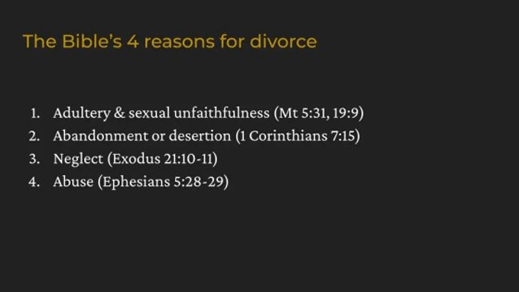
Phil Whitall pastors Grace Church Stockholm in his blog thesimplepastor.co.uk describes 4 Biblical reasons for divorce as described in this illustration: Adultery and sexual unfaithfulness, Abandonment or desertion, Neglect, Abuse. It should be noted that abuse can be physical, mental, emotional, or some combination of all three. What do we say to the man or woman who faces daily doses of vitriol pouring from the mouth of their spouse? What about women who must go underground with their children in hopes of escaping physical abuse or even death? What about the man whose wife has become so addicted to drugs that she has impoverished the family, leaving her children to face ridicule wherever they go? And what about women who have given everything they can to their marriages, only to find that nothing is enough? Some Christians appear more willing to accept a murderer who has repented than a divorced man or woman who has suffered abuse, desertion, neglect, or other suffering? Is divorce really an unpardonable sin? The short answer is “No!”

One of the problems we face when discussing sin is the question of which sins are worse? Are addictions to drugs, gambling, food, shopping, etc. worse than gossiping or betraying one’s friends or co-workers? Is homosexuality or lesbianism worse than murder? Again, the answer is “NO!” God does not grade on a curve or rate some sins as worse than others. Romans 3:23 tells us “For ALL have sinned and have fallen short of the glory of God.” Some of us have sins that are more visible than others, but all of us are sinners in need of a Savior.  

God has instituted marriage so that men and women and children can live in a loving environment. Jesus adds his teaching against oath taking or breaking to his discourse on divorce because marriage is a covenant relationship, one that should not be broken if at all possible. But bad things happen to good people. Some of us may marry someone, believing that we understand their personality, only to find that we have created a false figure that has little relationship to reality. Sometimes a spouse may prove to be bipolar or psychotic, with ever-worsening behavior. Other times, the same spouse who appeared incredibly attentive and affectionate during courtship turns out to be obsessively controlling and physically abusive after marriage. Only God really knows the human heart sufficiently to judge; the rest of us need to leave judgment to God.

Years ago, we worked in a mission group with a woman who was very difficult. At one point, I was venting to one of our friends, complaining at length about this woman. Our friend looked at me kindly and then said, “Well, I have noticed that suffering is 100% for everybody.” This statement is one of the wisest I have heard. Things that bother me don’t bother others and vice versa. That statement illustrates the fact that none of us are qualified to judge or criticize.

Here Jesus is trying to urge his disciples to honor covenants but also to act in love, both in their families and with their neighbors. Jesus is actually protesting the harsh attitude of the Pharisees and scribes against women. It behooves all of us to act in love, comforting rather than viciously pronouncing judgment. Am I in favor of fidelity? Absolutely! I have been married more than four decades and my husband is my best friend. But the longer I go on this journey of faith, the less qualified I feel to judge others. Am I advocating divorce? No. But I recognize there are times when that is the only option left to someone who has already suffered much.

PRAYER: Father God, thank You for loving us and caring for us. Lord, help us to be compassionate but to honor covenants and to let our “yes be yes and our no be no.” In the mighty and precious Name of King Jesus. Amen.
AUGUST 8, 2024 SO YOU WANT TO BE A DISCIPLE? #8 CHECK YOUR HEART!

August 8, 2024

Murder Begins in the Heart

Matthew 5: 21-26 “You have heard that it was said to those of old, ‘You shall not murder, and whoever murders will be in danger of the judgment.’ But I say to you that whoever is angry with his brother without a cause shall be in danger of the judgment. And whoever says to his brother, ‘Raca!’ shall be in danger of the council. But whoever says,  ‘You fool!’ shall be in danger of hell fire. Therefore if you bring your gift to the altar, and there remember that your brother has something against you, leave your gift there before the altar, and go your way. First be reconciled to your brother, and then come and offer your gift. Agree with your adversary quickly, while you are on the way with him, lest your adversary deliver you to the judge, the judge hand you over to the officer, and you be thrown into prison. Assuredly, I say to you, you will by no means get out of there till you have paid the last penny.

Adultery in the Heart

27-30 “You have heard that it was said to those of old, ‘You shall not commit adultery.’ But I say to you that whoever looks at a woman to lust for her has already committed adultery with her in his heart. If your right eye causes you to sin, pluck it out and cast it from you; for it is more profitable for you that one of your members perish, than for your whole body to be cast into hell. And if your right hand causes you to sin, cut it off and cast it from you; for it is more profitable for you that one of your members perish, than for your whole body to be cast into hell.”

Well, Jesus has just quit preachin’ and gone to meddlin’. As long as someone is simply preaching, we can listen or not, and remain unchanged. But when anyone begins truly proclaiming the Word of God, we will have one of two reactions: either we will be changed or our hearts will become even harder.

Here Jesus is telling us that anger begins with the little things, calling someone “Raca” or “empty head” or proclaiming him as a fool. We must continue to watch our hearts closely for sin begins in our hearts. The more we feed our anger and resentment, the stronger it will become until we will do something regrettable.

Now Jesus moves into another area: worship with a dirty heart. Jesus advises that if we want to worship God and we know we have sinned against someone else, we must go and apologize to that person and make things right. Failing to reconcile means our worship will be worthless.

What if someone has a legal case against us? Again, Jesus advises to settle the matter before it reaches court. Evidently, even in Jesus’ day, the only people who were really winning in court cases were the lawyers and not the plaintiffs.

Now Jesus moves into another problem area: SEX. Lust has been around as long as the human race. Jesus is advising not to allow lust to even get going, for once those lustful ideas start, it will be very difficult to stop them, particularly if they are entertaining. Those who have struggled with addictions to on-line pornography can testify to the truth of Jesus’ teachings.

Is Jesus really advocating that we maim ourselves? No. But Jesus wants us to realize just how serious these heart matters are so that we will be serious about repudiating bad thoughts as soon as they appear. If we begin to be entertained by thoughts of revenge, we may progress to physical acts of revenge. Far better to confess our problems to God and allow Him to handle them.

PRAYER: Father God, thank You for loving us and for caring for us. Lord, we confess that we are sinners and cannot help ourselves change. Please cleanse our hearts and minds with Your Holy Spirit power. In the mighty and precious Name of King Jesus. Amen.

AUGUST 7, 2024 SO YOU WANT TO BE A DISCIPLE? #7 FASTEN YOUR SEATBELTS! IT’S GOING TO GET BUMPY!

August 7, 2024

BELIEVERS ARE SALT AND LIGHT

Matthew 5: 13 “You are the salt of the earth; but if the salt loses its flavor, how shall it be seasoned? It is then good for nothing but to be thrown out and trampled underfoot by men.

14 “You are the light of the world. A city that is set on a hill cannot be hidden. 15 Nor do they light a lamp and put it under a basket, but on a lampstand, and it gives light to all who are in the house. 16 Let your light so shine before men, that they may see your good works and glorify your Father in heaven.”

Christ Fulfills the Law

17 “Do not think that I came to destroy the Law or the Prophets. I did not come to destroy but to fulfill. 18 For assuredly, I say to you, till heaven and earth pass away, one jot or one tittle will by no means pass from the law till all is fulfilled. 19 Whoever therefore breaks one of the least of these commandments, and teaches men so, shall be called least in the kingdom of heaven; but whoever does and teaches them, he shall be called great in the kingdom of heaven. 20 For I say to you, that unless your righteousness exceeds the righteousness of the scribes and Pharisees, you will by no means enter the kingdom of heaven.”

Jesus is conducting spiritual boot camp for his disciples while thousands of others listen in. NOBODY is teaching anything like this in the synagogues and these people are amazed at what they are hearing. “You are the salt of the earth.” Say what? Sure, everybody knows about salt, uses salt, and looks for salt in the market. Caravans bring salt to areas that don’t have it. Salt is such a precious commodity that sometimes people pay debts with salt. Now Jesus is saying that just as fresh salt flavors food and makes it satisfying, so disciples must bear the flavor of God wherever they go. But what happens if salt draws moisture, cakes, and loses its flavor? Every housewife knows that salt is worthless and must be thrown away. Believers lacking the flavor of God’s presence won’t have any effect on the world.

”You are the light of the world.” About now, the disciples are thinking, “Who? ME?” These people are nothing if not realists, and they know just how sinful they really are. “Let your light so shine before men, that they may see your good works and glorify your Father in heaven.”

Now the disciples are really worried. These guys know what others think about them, and they know they fall far short of God’s glory. And if they are worried now, they’re going to be more worried in a minute.

Jesus tells his people that he has come to fulfill the law, not to set it aside, that he is so concerned about fulfilling the law that not even the tiniest brush stroke of a letter will be ignored. This pronouncement might be disappointing for some who are hoping that Jesus is going to preach an easier way of salvation. And it gets even worse.

“For I say to you, that unless your righteousness exceeds the righteousness of the scribes and Pharisees, you will by no means enter the kingdom of heaven.” Well, now the disciples are truly discouraged. The scribes and Pharisees are professional religious people who spend all their time observing minutiae and arguing over it. Common people who have to work have no time for that stuff. Is Jesus giving a glimpse of heaven, only to snatch it away from his listeners?

The short answer to that question is “No.” Jesus is not a wicked man who dangles glory in front of people, only to disappoint them. The point of this teaching is to lead people to consider their sinful state and then to show them how God wants to change them. Jesus is fully conscious that none of his listeners can possibly achieve holiness by themselves, and that’s why he is teaching these things. Jesus wants to lead people into a far higher way of life, one in which they serve God out of love and not out of fear. The righteousness about which Jesus is teaching can only be achieved with God’s help, not by observing a myriad of petty rules.

Perhaps you too have struggled with some of the same problems those people are considering on that hillside. Somehow, you have gotten the idea that God is a wicked old man, sitting in heaven and prepared to punish anyone who puts a foot wrong. Jesus wants you to know that idea is completely wrong. God knows we are weak and that we cannot help ourselves. The first three steps of the Alcoholics Anonymous Twelve Steps say:

  1. We admitted we were powerless over alcohol—that our lives had become unmanageable.

2. Came to believe that a Power greater than ourselves could restore us to sanity.

3. Made a decision to turn our will and our lives over to the care of God as we understood Him.

Over the years, these affirmations have led millions of people to victory over alcohol, drugs, gambling, and other addictions.

Jesus is not preaching the Sermon on the Mount to accuse people, but to demonstrate what can happen when God’s Kingdom becomes a reality in the lives of individuals. God stands ready to help anyone who will appeal to Him for help, for He longs for fellowship with us and will bend every effort to assist us if we only ask. But we must be sincere in our asking. James warns us that when we pray, we can’t be like the waves of the sea, going back and forth, back and forth. We must trust that God hears us and that God will help us.

PRAYER: Father God, thank You for loving us and for caring for us. Lord, we know that we are sinners and cannot free ourselves from those sins that wrap around our hearts and minds and bodies. Please deliver us from ourselves. Help us to truly become light and salt, true citizens of Your Kingdom. In the mighty and precious Name of King Jesus. Amen.

AUGUST 6, 2024 SO YOU WANT TO BE A DISCIPLE? #6 BECOMING A DISCIPLE MEANS LISTENING TO THE MASTER

August 6, 2024

Matthew 5:3 “Blessed are the poor in spirit, for theirs is the kingdom of heaven.

4 Blessed are those who mourn, for they will be comforted.

5 Blessed are the meek, for they will inherit the earth.

6 Blessed are those who hunger and thirst for righteousness, for they will be filled.

7 Blessed are the merciful, for they will be shown mercy.

8 Blessed are the pure in heart, for they will see God.

9 Blessed are the peacemakers, for they will be called sons of God.

10 Blessed are those who are persecuted because of righteousness, for theirs is the kingdom of heaven.

11 Blessed are you when people insult you, persecute you, and falsely say all kinds of evil against you because of Me.

12 Rejoice and be glad, because great is your reward in heaven; for in the same way they persecuted the prophets before you.”

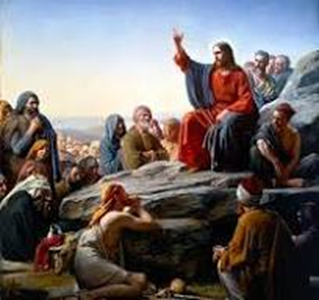
Is Jesus impressed with these early results? No. Jesus fully realizes that in a culture with little entertainment, these miracles and healings have become the biggest thing around. Matthew 5:1-2 tells us, “When Jesus saw the crowds, He went up on the mountain and sat down. His disciples came to Him, and He began to teach them…”

Jesus knows enough to realize that God the Father has blessed his early ministry. But now it’s time to begin teaching his followers and anyone else who shows up. The teachings Jesus shares on that hillside overlooking the Sea of Galilee are now known as the Sermon on the Mount. In that discourse, Jesus covers several important points.

Jesus begins by teaching the Beatitudes, those qualities that God calls blessed. These foundational truths are necessary for the disciples because Jesus isn’t worried about turning them into a bunch of miracle workers but rather into citizens of the Kingdom of God.

Matthew 5:3 “Blessed are the poor in spirit, for theirs is the kingdom of heaven.” Jesus first teaches that his followers are not to “get uppity,” that is to become proud of themselves in any fashion. While disciples are to value themselves as people whom God loves, they must realize that this does not make them more special than anybody else. George Whitefield and John Wesley were both at the forefront of revival in England in the 1700’s; however, they had strong theological differences. Whitefield was one of the most successful preachers of his day, preaching to as many as 20,000 people at a time in open fields. Tony Cooke tells us, “One of Whitfield’s followers (who obviously still held great animosity against Wesley) said to Whitfield, “We won’t see John Wesley in the heaven, will we?” Whitfield humbly replied “Yes, you’re right, we won’t see him in heaven. He will be so close to the Throne of God and we will be so far away, that we won’t be able to see him!” https://tonycooke.org/articles-by-tony-cooke/wesley-whitfield

4 “Blessed are those who mourn, for they will be comforted.”  Jesus already knows that his followers are going to suffer for their faith in him and wants to assure them that they can withstand any sorrow, knowing that God will comfort them.

5 “Blessed are the meek, for they will inherit the earth.” Followers of Jesus must not be push-overs; however, they also must continue to look to God for approval, not flaunting themselves as do the professional religious people. God can’t use someone with a bad attitude.

6 “Blessed are those who hunger and thirst for righteousness, for they will be filled.” No ministry can last if its proponents do not strive for righteousness, and Jesus’ followers must long for righteousness as much as they do for food and water to sustain their bodies.

7 “Blessed are the merciful, for they will be shown mercy.” Jesus wants his followers to be known for their mercy. Why? Because the professional religious people are some of the most intolerant, unmerciful, and judgmental people in existence. Later, Jesus will tell a story of a Pharisee who goes to the temple to pray and spends all his time praising himself. The Pharisee begins his prayer by saying, “God, I thank You that I am not as other men!” Those listening enjoy the story particularly because they have all witnessed something similar.

8 “Blessed are the pure in heart, for they will see God.” Jesus knows those who are listening and realizes that many of them are anything but pure in heart. At the same time, many of those same people are longing to become pure in heart and have no idea how to go about it. Here Jesus is not proposing an unreachable standard but is encouraging those who truly desire purity that indeed, purity is achievable and that God wants to help them.  

9 “Blessed are the peacemakers, for they will be called sons of God.”  Jesus wants his followers to be peacemakers and to be known for their ability to bring peace into conflict situations. Being a peacemaker is no easy task, for sometimes the two factions to whom you are trying to bring reconciliation choose to unite in their anger at you. Once you are eliminated, the two factions resume their fight. Peacemakers are sons of God because the mark of the Holy Spirit is peace, not conflict or confusion. We must ensure that we are bringing God’s peace to a situation and not simply imposing our ideas on others.

10 “Blessed are those who are persecuted because of righteousness, for theirs is the kingdom of heaven.”  Here Jesus is warning all listening that following him may result in persecution or even death. Richard Wurmbrand, a Romanian pastor who was tortured for his faith, suffered such beatings on the soles of his feet that later when speaking with friendly audiences, he generally sat down because standing was too painful. Korean friends have described North Korean authorities plowing over Christians with bull dozers to discourage others from following Jesus.

11 “Blessed are you when people insult you, persecute you, and falsely say all kinds of evil against you because of Me.” During one high school shooting in Colorado, the shooter queried a young woman as to whether she was a Christian. The young woman knew that to admit to following Christ would mean instant death; yet, she said so anyway and was shot immediately. Through the years, many Christians have endured slander and ridicule without breaking down. Jesus is warning his followers that being a disciple will be anything but a walk in the park.

12 “Rejoice and be glad, because great is your reward in heaven; for in the same way they persecuted the prophets before you.” Jesus is saying these things to Jews who remember the horrible fate of people like the prophet Isaiah who was murdered by wicked King Manasseh. Isaiah foretold more about the Messiah than any other prophet; yet, he suffered terribly. Jeremiah nearly died several times, once being thrown into a well full of muck from which he was rescued just before suffocating.

Anybody who has assumed that following Jesus is going to be lots of fun should be re-thinking that assumption by this point. Now Jesus is starting the process of turning a mixed group of men into a cohesive ministry unit. More than that, Jesus also wants to teach all those around him about the Kingdom as well.

What’s fascinating is that the crowd on the hillside listens raptly, and Jesus’ teaching stirs many hearts. These people have been spiritually hungry and the weekly recitations in the synagogues have failed to satisfy that hunger. Why are these words so compelling?

Many people choose to ignore the Holy Spirit, failing to realize that the third member of the Trinity is just as active as the other two. While Jesus is speaking, the Holy Spirit is convicting hearts. Those recording Jesus’ teachings are also being led by the Holy Spirit to record them precisely. Anyone coming to Jesus spiritually hungry is leaving satisfied, for the Holy Spirit never does anything half-way.

Those of us reading these words are hampered by never having witnessed Jesus speaking them. The film series The Chosen is remarkable for its truthful portrayal of Jesus; yet, even that series, well done as it is, simply falls short because it is only a video imagining what it must have been like to be with Jesus. But we can ask God to reveal Himself to us as we read His Word, and He will do so.

PRAYER: Father God, thank You for loving us and for caring for us. Lord, please open the eyes of our hearts so that we may truly see You and understand Your calling for us. In the mighty and precious Name of King Jesus. Amen.   
AUGUST 5, 2024 SO YOU WANT TO BE A DISCIPLE? #5 DON’T LET EARLY SUCCESS TURN YOUR HEAD

August 5, 2024

Matthew 4:23-25 “Jesus went throughout Galilee, teaching in their synagogues, preaching the gospel of the kingdom, and healing every disease and sickness among the people. News about Him spread all over Syria, and people brought to Him all who were ill with various diseases, those suffering acute pain, the demon-possessed, those having seizures, and the paralyzed—and He healed them. The large crowds that followed Him came from Galilee, the Decapolis, Jerusalem, Judea, and beyond the Jordan.”

Jesus has just started his ministry, teaching in synagogues and preaching. If we overlook that simple statement, we miss a great deal. Heads of synagogues don’t let any old person barge in and teach-what if they teach heresy? Obviously, at this point, Jesus has impressed a number of religious leaders and those listening are perking up. Much later in Jesus’ ministry, soldiers sent to arrest him refuse to do so, stating “No man has ever spoken like this before.”

Now the word about Jesus is spreading, and huge crowds are gathering wherever he goes. Some of these people are spiritually hungry, some of them are simply curious, and some of them are desperate for healing for themselves or for family members. The first time Jesus casts out a demon, the first time he heals epilepsy, the first time a stroke victim walks off waving his hands in the air, some of the crowd gasp in surprise while others run off to tell their neighbors. “Avram! Quick, take your son who keeps throwing himself into the fire and get over to that new preacher. People are getting healed and delivered!” “Hannah, get some men to help you carry your paralyzed husband to that carpenter who’s preaching down on the seashore! Remember Isaac, the cripple from the next village? That carpenter has laid hands on him and he is running around praising God!”

Before you know it, the crowd has ballooned to five times the size it was in the morning, and more people keep coming. Word of the miracles and healings begins spreading, carried by itinerant tradesmen and merchants at caravansaries. In a time when many people never leave their home towns except for attending the feasts in Jerusalem, people are streaming from everywhere, including the land beyond the Jordan River. Jesus is rapidly becoming what we in our time would call a mass media event with the news spread only by word of mouth.

At this point, Jesus might be excused if he decides to simply settle for a ministry of miracles and healings. Why not? Things are going swimmingly, and even the local religious authorities are praising him for the incisive teachings he is bringing in the synagogues. All Jesus has to do is to remain in the villages, going up to Jerusalem only for the feasts like all other Jewish believers, and he can have a long and happy life. But….

But Jesus has already faced the three major temptations regarding ministry out there in the wilderness-the temptation to be his own amateur providence, to tempt God’s watch-care, and to enjoy unparalleled earthly success-and has settled the matter in his heart. Jesus knows his main purpose in life is to be born as a man, to make disciples and teach, and to eventually die for the sins of the world. No matter how successful Jesus becomes, he keeps those purposes in mind.

Many years ago, a wise Bible teacher taught us that one of the keys in ministry is to “Keep the main thing the main thing,” that is, not to become distracted and to begin pursuing side-paths when you need to focus on your original calling. William Carey, one of the first missionaries to India, had an incredibly successful career as a minister and Bible translator; however, he also founded schools, was a social reformer and a cultural anthropologist. For part of his career, Carey supported himself by managing an indigo plant and later managed a large botanical garden. Despite all temptations to enrich himself, Carey persisted in using these various opportunities to spread the Gospel. Carey’s first wife suffered a complete nervous breakdown and required constant care. Somehow, Carey was able to combine seeing to his wife with all his other activities. Throughout Carey’s career, his focus remained on evangelism by any means possible.

Centuries before Jesus appears, the prophet Isaiah foretells the single-mindedness of the Messiah in Isaiah 50:7 “The Master, God, has given me a well-taught tongue, So I know how to encourage tired people. He wakes me up in the morning, Wakes me up, opens my ears to listen as one ready to take orders. The Master, God, opened my ears, and I didn’t go back to sleep, didn’t pull the covers back over my head. I followed orders, stood there and took it while they beat me, held steady while they pulled out my beard, Didn’t dodge their insults, faced them as they spit in my face. And the Master, God, stays right there and helps me, so I’m not disgraced. Therefore I set my face like flint, confident that I’ll never regret this. My champion is right here. Let’s take our stand together! Who dares bring suit against me? Let him try! Look! the Master, God, is right here. Who would dare call me guilty? Look! My accusers are a clothes bin of threadbare socks and shirts, fodder for moths! “ (The Message Translation)

Jesus does not allow early success to dissuade him from his main purposes but keeps moving steadily. If we are to be true Jesus-followers, we too must keep the main thing the main thing, not becoming legends in our own minds.

PRAYER: Father God, thank You for loving us and for caring for us. Lord, help us to follow hard after You all the days of our lives, not becoming distracted if we briefly enjoy earthly success. Thank You for calling each one of us to new opportunities to serve You. In the mighty and precious Name of King Jesus. Amen.  

AUGUST 4, 2024 SO YOU WANT TO BE A DISCIPLE?#4 DO YOU PICK YOUR HELP OR DOES GOD?

August 4, 2024

The First Disciples (Matthew 13:47-52; Mark 1:16-20; Luke 5:1-11; John 1:35-42)

Matthew 4:18-22 “As Jesus was walking beside the Sea of Galilee, He saw two brothers, Simon called Peter and his brother Andrew. They were casting a net into the sea, for they were fishermen. “Come, follow Me,” Jesus said, “and I will make you fishers of men.” And at once they left their nets and followed Him.

Going on from there, He saw two other brothers, James son of Zebedee and his brother John. They were in a boat with their father Zebedee, mending their nets. Jesus called them, and immediately they left the boat and their father and followed Him.”

Before Jesus ever moved to Capernaum, he spent a lot of time in prayer, asking his Heavenly Father for guidance. On the face of it, Capernaum didn’t seem like a profitable base for ministry; however, God assured him that it had to be Capernaum. Now Jesus has moved to Capernaum and is walking along the Sea of Galilee, watching the fishermen casting their nets. The fishermen are busy and have little interest in this stranger walking along the shore. Everybody has heard about this carpenter who has moved in from Nazareth, but nobody knows what he’s up to. So far he hasn’t opened a shop, and he just seems to walk around town. But those who have met him can’t stop talking about him. There’s something about this man that draws people to him, especially children and animals, any kind of animal.

Now Jesus stops to watch as Peter and Andrew repeatedly cast their net into the sea. Peter straightens up and looks into a face with the most loving expression he has ever seen. Seeing that Peter is standing still, Andrew also looks at Jesus and is immediately entranced. “Come, follow Me,” Jesus says, “and I will make you fishers of men.” Suddenly, nothing seems more appropriate to Peter and Andrew than dropping their nets, bringing the boat to shore, and leaving it to follow Jesus.

A little further down the beach, James and John are sitting with their father Zebedee, mending their nets. As Jesus, Peter, and Andrew walk by, Jesus calls out to James and John, “Follow Me, and I will make you fishers of men.” Amazed, Zebedee watches as his two sons carefully finish mending the holes on which they have been working, lay the nets down, and kiss him on the cheek before following Jesus. Their fishing careers are over, and they are walking into their future.

This story is so short and so simple that it almost seems ridiculous; yet, this is the way God sometimes moves in people’s lives. One moment, those people are going about their routine tasks, and in the next moment, their lives have changed forever. When Saul the ultimate Pharisee encountered Jesus on the road to Damascus, the glory of the risen Christ was so magnificent that Saul was struck blind for three days and had to be prayed for by a believe in Damascus.

One October Sunday in 1981, I walked into a double wide trailer in Mount Pleasant, South Carolina. I thought I was there simply to visit that mission congregation; however, God had selected me as their pianist. A few days later, I met the man who would become my husband, and God kept bringing both of us to more decision points where He provided quiet guidance. You know when God is calling you because suddenly there seems to be only one decision you can make, and you have peace about it.

Much has been written about Jesus’ actual appearance-was he swarthy? Was he short? Was he handsome? As a Jew, Jesus probably had dark hair and black eyes and an olive-skinned complexion. As a carpenter and a stone mason, Jesus would have been muscular, although not possessing the kind of physique that would win body building contests. None of that speculation is actually important. What’s really important is that the man Jesus was one of the most charismatic figures ever known. When Jesus called people, there was an instant connection. Later we will see this same thing happen with Matthew and the other disciples, and it is Matthew, the former tax collector, who is recording this story for us.

Why did Jesus choose fishermen for his first four disciples? Those fishermen were hard-working, successful, independent businessmen who were used to rough conditions and facing all kinds of problems. But more than those physical attributes, God the Father was advising Jesus all the while. “Jesus, why not walk down by the shore? Jesus, see those two men in that boat? Call to them. Jesus, see those two men mending nets? Call them as well. These men will be your first disciples. Just wait and see what I am going to do with them! You won’t believe it.”

What’s important about this story? When you are entering a ministry, you need to be careful about your helpers, praying and asking God for guidance. You also need to realize that God’s choice of helpers and yours might be radically different. God is always working in people’s lives and He wants to bring people out of themselves so they can fulfill His perfect will for their lives. Sometimes God gives people opportunities when we would rather leave them alone! God knows the potential each person has and He is always trying to prod that person into being better than they think they can be.

These verses tell the very beginning of the story of Peter and Andrew and James and John as disciples. At this point, nobody knows that Peter will become one of the respected elders of the church, eventually being crucified upside down, or that John will write one of the Gospels and some of the most glowing letters in the New Testament, plus experiencing a revelation that will be recorded for all time. Anyone looking at the group would simply see four guys from Capernaum plus a carpenter from Nazareth. These guys certainly don’t look as if they are going to change the world, but when God begins moving in their lives, they will.

Jesus is calling each one of us to be his disciple. No matter what your profession, your level of education, your social standing, your income, your physical attributes, your talents, Jesus is calling you just as he called those fishermen. How will you answer?

 PRAYER: Father God, thank You for loving us and for caring for us. Lord, many of us are afraid of Your call, not realizing that You want the very best for each of us. Help us to trust You and follow hard after You all the days of our lives. In the mighty and precious Name of King Jesus. Amen.
AUGUST 3, 2024 SO YOU WANT TO BE A DISCIPLE? #3 YOUR IDEA OF A LOCATION MIGHT NOT BE GOD’S IDEA

August 3, 2024

Jesus Begins His Ministry (Isaiah 9:1-7; Mark 1:14-15; Luke 4:14-15)

Matthew 4:12-17 “When Jesus heard that John had been imprisoned, He withdrew to Galilee. Leaving Nazareth, He went and lived in Capernaum, which is by the sea in the region of Zebulun and Naphtali, to fulfill what was spoken through the prophet Isaiah:

“Land of Zebulun and land of Naphtali, the Way of the Sea, beyond the Jordan, Galilee of the Gentiles— the people living in darkness have seen a great light; on those living in the land of the shadow of death, a light has dawned.”

From that time on Jesus began to preach, “Repent, for the kingdom of heaven is near.”

David Guzak in his Enduring Word Commentary has this to say about these verses:

a. When Jesus heard that John had been put in prison, He departed to Galilee: John 3:22 and 4:1-2 indicate that the first ministry Jesus did with His disciples was a baptizing ministry at the Jordan. Sometime after that and after the arrest of John the Baptist, Jesus went to Galilee to begin His itinerant ministry in that region.

i. John’s Gospel (John 1:19-2:12) records an early ministry in Galilee and in Judea before Jesus went to Galilee as mentioned here. This early Judean ministry included the earliest call of the disciples and the wedding at Cana (in Galilee), and the first cleansing of the temple followed by His interview with Nicodemus (in Judea). Then John tells us what happened when Jesus traveled north to Galilee through Samaria, and met a Samaritan woman at a well.

ii. It was the imprisonment of John that prompted this. “Galilee was the tetrarchy of Herod, who had imprisoned John. Into that region, our Lord went to continue the ministry of the man thus silenced…Thus it has ever been, and still is. Evil may silence a voice, but it cannot prevent the proclamation of the Word. If John is imprisoned, then Jesus takes up the message.” (Morgan)

b. He departed to Galilee: The region of Galilee was a fertile, progressive, highly populated region. According to figures from the Jewish historian Josephus, there were some 3 million people populating Galilee, an area smaller than the state of Connecticut.

i. In an area of about 60 by 30 miles, Josephus says that there were some 204 villages with none having less than 15,000 people. That gives a population of more than 3 million for the region.

ii. Galilee was predominately Gentile in its population, but with a large number of Jewish cities and citizens. Also, Galilee was known as an incredibly fertile region. Many successful farms took advantage of the good soil.

c. Leaving Nazareth, He came and dwelt in Capernaum: This was because the people rejected Jesus in His own hometown (Luke 4:16-30). It was significant that Jesus made His home in Capernaum and not in Nazareth.

i. Matthew may have been particularly interested in Capernaum because it was where he himself lived (Matthew 9:1-9). Peter also had a house in Capernaum (Matthew 8:14Mark 1:29 and 2:1).

ii. Yet leaving Nazareth, Jesus did not go to live and make His home in Jerusalem or Judea. Going to Jerusalem would seem to be smarter career planning for the Messiah, but Jesus dwelt in Capernaum. “This migration to Capernaum is not formally noted in the other Gospels, but Capernaum appears in all the synoptists as the main centre of Christ’s Galilean ministry.” (Bruce)

iii. “Here he dwelt in a house, either let or lent him; for of his own he had not where to rest his head, Matthew 8:20. Here he paid tribute as an inhabitant; and hither he resorted and retired himself, when he was tired.” (Trapp)

d. That it might be fulfilled which was spoken by Isaiah the prophet: As is his custom, Matthew sees Jesus’ ministry in Galilee as a fulfillment of prophecy. Light has come to this region, largely populated by Gentiles, and Isaiah 9:1-2 predicted this of the ministry of the Messiah.

i. “In despised Galilee, the place where people live in darkness (i.e., without the religious and cultic advantages of Jerusalem and Judea)…here the light has dawned.” (Carson)

ii. “Galilee of the Gentiles was now an even more appropriate description than in Isaiah’s day, as successive movements of population had given it a predominately Gentile population until a deliberate Judaizing policy was adopted by the Hasmonaean rulers, resulting in a thoroughly mixed population.” (France)

One of the songs in The Cotton Patch Gospel musical says of the place where the Messiah is born that “it’s a hell of a place to be heaven-sent.” That’s probably the way some people were thinking about Jesus basing in Capernaum. As far as Jewish religious leaders were concerned, the Messiah would certainly have the good taste and discernment to appear first in Jerusalem, rather than in a Gentile-dominated area. But Jesus was taking orders from his Heavenly Father, not from the high priest in Jerusalem. After centuries of suffering religious discrimination, the people in Galilee of the Gentiles were spiritually hungry and ready for the Gospel. Jesus began by preaching to anybody who would show up, and he preached on hillsides and at the seashore. To avoid being crushed by the crowds, Jesus frequently sat in a boat floating in the shallows. Jesus even preached to the fishermen mending their nets, to the women coming to buy the fish, and to anybody else who showed up.

When Jesus traveled, he preached in every village that would receive him and also dispatched his followers to preach in other villages. Had Jesus tried to begin his ministry in Jerusalem, he might have been crucified very quickly.

Notice also that Jesus did not begin preaching about the Kingdom of God until his cousin John was imprisoned. John’s ministry prepared the way for Jesus, and Jesus was willing to wait. Timing is critically important; Herod may have been distraught about being forced to behead John and may have let Jesus alone once Jesus came preaching a message similar to that of John’s.  

Timing and location are fundamental to a successful ministry. Anyone choosing to become a disciple of Jesus Christ has no right to dictate when and where he/she will work. In February 1992 we visited a tiny clinic in a remote village in northeastern Ghana. There was no electricity and only eleven workers. I was a fully-trained general and pediatric surgeon, and my husband was an EMT. We were prepared to visit and be polite, and then to tell the national church that had invited us, “Thanks, but no thanks.” But when we set foot on the clinic property, the Holy Spirit descended, wrapping us in a warm spiritual blanket. We KNEW we were called to come to that place. We came to that town in January 1993 and one year later, a tribal war broke out. Suddenly, that small clinic became the only source of medical care for nearly 100,000 people with nowhere else to go. We had to begin hospital-level work in a health center building. We had no idea what would happen, but God did.

“Little Is Much When  God Is In It” Kittie L. Suffield 1924

In the harvest field now ripened  

There is a work for all to do
Hark, the Master’s voice it’s calling

To the harvest, calling you

Chorus: Little is much when God is in it
Labor not for wealth or fame
There’s a crown, and you can win it
If you go in Jesus’ name.

Does the place you’re called to labor

Seem so small and little known?
Well, it is great if God is in it
And He will not forsake His own.

Are you laid aside from service

Body worn from toil and care?

You can still be in the battle

In the sacred place of prayer.

And when the conflict here has ended
And our race on Earth is run
He will say, “If you’ve been faithful
Welcome home, My child, well done”

Little is much when God is in it
Labor not for wealth or fame
There’s a crown, and you can win it
If you go in Jesus’ name.

PRAYER: Father God, thank You for loving us and for caring for us. Lord, help all who read these words to realize that You have selected their places of service and that as long as they are where you want them to be, they will be blessed. In the mighty and precious Name of King Jesus. Amen.

AUGUST 2, 2024 SO YOU WANT TO BE A DISCIPLE? #2 THE TEMPTATIONS OF MINISTRY “BEGIN AS YOU MEAN TO GO ON”

August 2, 2024

The Temptation of Jesus (Mark 1:12-13; Luke 4:1-13)

Matthew 4:1-11 “Then Jesus was led by the Spirit into the wilderness to be tempted by the devil. After fasting forty days and forty nights, He was hungry.

The tempter came to Him and said, “If You are the Son of God, tell these stones to become bread.”

But Jesus answered, “It is written: ‘Man shall not live on bread alone, but on every word that comes from the mouth of God.’”

Then the devil took Him to the holy city and set Him on the pinnacle of the temple. “If You are the Son of God,” he said, “throw Yourself down. For it is written: ‘He will command His angels concerning You, and they will lift You up in their hands, so that You will not strike Your foot against a stone.’ ”

Jesus replied, “It is also written: ‘Do not put the Lord your God to the test.’ ”

Again, the devil took Him to a very high mountain and showed Him all the kingdoms of the world and their glory. “All this I will give You,” he said, “if You will fall down and worship me.”

“Away from Me, Satan!” Jesus declared. “For it is written: ‘Worship the Lord your God and serve Him only.’ ”

Then the devil left Him, and angels came and ministered to Him.”

Why would God allow the Holy Spirit to lead Jesus out into the wilderness to be tempted at the beginning of his ministry? The British have a saying, “Begin as you mean to go on.” The way you start a project or a ministry determines the fashion in which you will proceed. Beginnings are foundational and must be handled carefully and with a great deal of prayer.

Jesus fasted for forty days and forty nights. While he would have to drink water, he might have eaten very little. Notice that the Scripture does not say that Jesus was thirsty. Perhaps Jesus copied his cousin John the Baptist and ate a few carob pods; however, this would scarcely have been sufficient to assuage hunger completely.
Why was it necessary for Jesus to fast before he was tempted? By fasting, Jesus was purifying himself and demonstrating reliance on God his Heavenly Father. Such preparation was absolutely necessary, for Satan was about to make Jesus offers he shouldn’t be able to refuse.
The first temptation was very practical: Satan tried to tempt Jesus to be his own amateur providence and turn stones into bread. Jesus had the perfect reply. “But Jesus answered, “It is written: ‘Man shall not live on bread alone, but on every word that comes from the mouth of God.’” Why did Jesus need to settle this point? After earning a living for years as a carpenter, Jesus was about to embark on a ministry that would last for an unknown period. How was Jesus to live? How would Jesus even get food to eat? How would Jesus care for those following him? Jesus had to affirm to Satan that he was going to rely on God and not on his own efforts.

The second temptation also was very practical. Satan wanted Jesus to test God to see if God would really protect him. “Then the devil took Him to the holy city and set Him on the pinnacle of the temple. “If You are the Son of God,” he said, “throw Yourself down. For it is written: ‘He will command His angels concerning You, and they will lift You up in their hands, so that You will not strike Your foot against a stone.’ ”
Jesus replied, “It is also written: ‘Do not put the Lord your God to the test.’ ” Jesus already knew that sooner or later; he must die for the sins of the world. Satan was trying to entice Jesus into forcing God to deliver him from physical danger. Had Jesus thrown himself off the temple, God the Fathe might have saved him, but he would still have failed the test because he would have failed to honor God and His perfect will.

“Again, the devil took Him to a very high mountain and showed Him all the kingdoms of the world and their glory. “All this I will give You,” he said, “if You will fall down and worship me.”
“Away from Me, Satan!” Jesus declared. “For it is written: ‘Worship the Lord your God and serve Him only.’ ” Here Satan was offering Jesus a deadly shortcut-complete earthly power and success without suffering. Ever since the Garden of Eden, Satan had ruled over earth, so he was making a genuine offer. All Jesus had to do was to give in to Satan and he could have all of earth; however, Satan would have all of Jesus. But Jesus had already spent his life worshiping God the Father. Why should Jesus worship his Heavenly Father’s arch-enemy? Everything in Jesus, tired and weak as he was, rebelled against this blasphemous idea! Here Jesus was telling Satan, “I don’t care if I die, I will never worship you!”

“Then the devil left Him, and angels came and ministered to Him.” The angels didn’t turn up until Satan had been defeated and had left. Those angels might have been standing in readiness, begging God to allow them to swoop in and distract Satan, only for God the Father to say, “No. You must allow Jesus to go through all of this on his own.”

What lessons for ministry can we learn from the story of Jesus’ temptations?

  1. First, realize that as long as you are a believer, whatever God calls you to do is ministry. One missionary friend who returned to America from Ghana began working at Houston Hobby Airport and found himself working along many Vietnamese immigrants. Our friend learned the Vietnamese language to be able to witness to his coworkers.
  2. Prepare spiritually. Jesus fasted for forty days and nights. While God might not call you to do something like that, you must pray and ask God for guidance before embarking on a new ministry. Once you have entered a new situation, you must pray even harder; however, these prayers can be “on the go” prayers, not requiring you kneel someplace. Kneeling is great and is very important, but you might not always be able to do so.
  3. Don’t be your own amateur providence but trust God. Don’t mishandle any power that God gives you. Notice this does not mean that you sit down, hoping that bread will fall from heaven. In 1990-1992 we lived in the Memphis area while preparing to return to Ghana to serve in a new location. Both my husband and I worked in minor emergency clinics and I worked in hospital ER’s. When we returned to America in 1996 so I could earn my Master’s degree in public health, my husband worked a variety of jobs to support us. My schooling was paid for partially by scholarships and partially by donations.
  4. Don’t test God’s protection. Yes, God may lead you into dangerous situations, but don’t court danger simply to see if God will deliver you. I’ve done some bone-headed things in my life and God has had to deliver me from my stupidity; however, I didn’t start out by intending to test God’s ability to save me.
  5. Sometimes opportunities may open that appear to offer “all the kingdoms of the world.” Watch out! Many years ago, I interviewed for a pediatric surgery position on a friend’s recommendation. The location was great and the pay and other aspects appeared highly attractive. But as we returned to New York City, where we were then living, God warned both my husband and me that this was a “velvet-lined trap.” Within a few months, my friend who had recommended the interview left his position in that practice because the senior partner wanted to use him as glorified slave labor. Had I accepted that position, I too could have wound up in trouble.

When you pray, stay humble, keep working, and allow God to guide you, you will wind up in the place of God’s choosing, the very best place for you.

PRAYER: Father God, thank You for loving us and for caring for us. Lord, many of us are confused and need guidance. We want to serve You but are not sure how or where. Lord, help us to pray and listen for Your still small voice, for You will surely guide us when we ask. In the mighty and precious Name of King Jesus. Amen.

AUGUST 1, 2024 SO YOU WANT TO BE A DISCIPLE#1 HOW DID JESUS PREPARE FOR MINISTRY?

August 1, 2024

We are about to embark on a new Bible study about becoming a Jesus follower, a disciple. The word disciple comes from a Latin word “discipulus,” or “learner,” that in turn comes from “discere,” which means “to learn.” Many times we might think that Jesus never had to learn anything, that he automatically knew everything there was to know about ministry. But Jesus was human, and therefore had to be trained just as he eventually trained his disciples.

Who trained Jesus? How else did Jesus prepare for ministry? Joseph and Mary began Jesus’ early training, just as they would for all their other children. Jesus undoubtedly attended a religious school at the local synagogue. The website christianpure.com makes the following points:

  • Though there’s no comprehensive account of Jesus’ early education, it’s widely accepted that he underwent some form of formal schooling.
  • Jesus’ role as a carpenter’s son suggests he had an education in non-religious areas such as reading, writing, and mathematics.
  • Jesus’ education likely encompassed religious aspects of Jewish history, the Law, and the Torah, as evidenced by his powerful knowledge of these subjects.
  • It’s probable that Jesus received education in Galilee synagogues, which housed schools called bet-sefers, and also from his earthly father, Joseph.
  • Jesus’ logical reasoning and adept teaching skills attest to his well-rounded education.
  • The New Testament implies that Jesus was educated even though it does not provide detailed accounts of his education.
  • Jesus had the ability to read Hebrew texts and interpret them in an advanced manner, as indicated by the incident in the book of Luke where he reads and interprets from the book of Isaiah (Luke 4:16-21). This shows that he had received formal education.
  • Many accounts in the gospels frequently use the title ‘Rabbi’ when referring to Jesus, indicating that he was respected as an educated teacher or scholar.
  • It is likely that Jesus received an education in a Galilean synagogue, learning from the local rabbis and studying the Torah, Jewish history, and other basic subjects. His father, Joseph, would also have contributed significantly in teaching him life skills and wisdom.
  • Jesus received both formal and informal education, intertwining religious tradition with practical life skills.
  • His foundational learning might have started with Joseph, his earthly father, enhancing his skills in reading, writing, and rudimentary mathematics integral to carpentry.
  • In the local ‘bet-sefer’ of a Galilean synagogue, Jesus likely embarked upon deep religious exploration, guided by rabbis.
  • Jesus’ teachings, evidence of his well-rounded education, encompassed more than religious knowledge, reflecting insights into human nature and societal dynamics.
  • The education Jesus received transcended territorial and intellectual borders, enriching the depth and breadth of wisdom he exhibited later in life.

Jesus was a bright boy running around in a small town where the favorite form of entertainment was talking about the neighbors. Nobody would pay attention to that little boy sitting in the corner and listening. Many of the parables Jesus later told probably had their origins in the lives of the citizens of Nazareth. Jesus’ listeners could identify with the people in the stories because everyone knew somebody who had lost a coin or who had struggled to rescue a lost sheep. And what farmer had not seen birds scooping up seeds that had fallen on rocky soil?

Jesus learned so much from his studies in the local synagogue that when his parents took him to Jerusalem at age twelve, the priests and scribes in the main temple were amazed at his discernment. (Luke 2:46-47) But Jesus was not a “bright brat.” Luke 2: 51 ”Then He went down with them and came to Nazareth, and was subject to them” (his parents.) Hebrews 5:8 tells us that “though he was a son, yet he learned obedience by the things which he suffered.”

Jesus paid attention and learned his entire life, and that attitude helped fit him for ministry. To become an effective teacher, one must first be a successful learner. The most effective teachers are those who maintain a sense of wonder and who are always ready to learn something new. Being a perpetual student also should lead to humility, causing one to realize that there is always far more to learn. This attitude of humility should then transmit to one’s students, encouraging them to think and to study as well. One of the chief differences between Jesus and the professional religious people was that the scribes and Pharisees were certain they knew it all and that nobody could teach them anything. Pride in scholarship led to disdain of working people who didn’t have time to devote to in-depth religious studies.

What can we learn from the way Jesus prepared for ministry?

  1. Never stop learning. You never know which tidbit of information will become useful at some point.
  2. There is nothing wrong with formal study, but be aware that some teachers are going to have their own agendas and viewpoints. Don’t take everything at face value but examine it and consider the implications.
  3. Learn as much as you can from those around you, particularly the elderly. There’s wisdom you won’t find in books.
  4. Don’t get so caught up in learning that you postpone ministry, for you can postpone it for the rest of your life.
  5. Begin early to ask God for wisdom and guidance. God can lead you to the right schools, the right teachers, the right books, and the right courses. Even if you get sidetracked, God can deliver you from yourself.

Anytime you begin a ministry, there are always temptations. Tomorrow we will see how Jesus faced those temptations successfully.

PRAYER: Father God, thank You for loving us and for caring for us. Lord, many of us are confused. We want to serve You but aren’t sure how to go about it. And we are afraid of doing the wrong thing. Help us to listen to You and to seek Your Will for our lives. In the mighty and precious Name of King Jesus. Amen.