Matthew 14:1-21 John the Baptist Beheaded
“At that time Herod the tetrarch heard the report about Jesus and said to his servants, “This is John the Baptist; he is risen from the dead, and therefore these powers are at work in him.” For Herod had laid hold of John and bound him, and put him in prison for the sake of Herodias, his brother Philip’s wife. Because John had said to him, “It is not lawful for you to have her.” And although he wanted to put him to death, he feared the multitude, because they counted him as a prophet.
But when Herod’s birthday was celebrated, the daughter of Herodias danced before them and pleased Herod. Therefore, he promised with an oath to give her whatever she might ask. So she, having been prompted by her mother, said, “Give me John the Baptist’s head here on a platter.”
And the king was sorry; nevertheless, because of the oaths and because of those who sat with him, he commanded it to be given to her. So he sent and had John beheaded in prison. And his head was brought on a platter and given to the girl, and she brought it to her mother. Then his disciples came and took away the body and buried it, and went and told Jesus.
Jesus knew it was coming. Herod Antipas, also called Herod the Tetrarch, the ruler of Galilee, was a son of Herod the Great who had ordered the death of all the babies of Bethlehem at the time of Jesus’ birth. (Herod the Great died shortly after this wicked order.) Jesus’ cousin John was never shy, so when Herod Antipas insisted on taking his brother Philip’s wife, Herodias, for himself, John naturally spoke out. Infuriated, Herod longed to find some excuse to put John to death, even though he realized that John was a true prophet. That excuse came during Herod’s birthday celebration.
Herodias arranged for her nubile daughter to dance before Herod as part of the birthday party. Drunk with wine and lust, Herod promised the girl to give her whatever she asked, and Herodias promptly saw a means of destroying this pestilential prophet who had dared to criticize her adultery. John was beheaded and his head brought before the entire party on a platter for the girl to give to her mother. John’s disciples collected his body and went to inform Jesus. Meanwhile, Herod shook off his drunkenness long enough to realize that he had committed a heinous crime against a holy man who had only spoken the truth. Herod was sorry, but it was too late. John was dead and Herod’s crime would become one more wicked act perpetrated by his family.
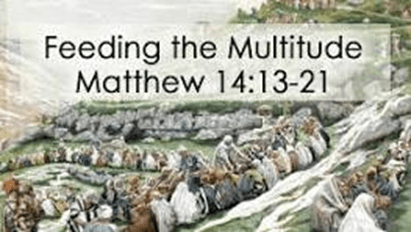
Feeding the Five Thousand
When Jesus heard it, He departed from there by boat to a deserted place by Himself. But when the multitudes heard it, they followed Him on foot from the cities. And when Jesus went out, He saw a great multitude; and He was moved with compassion for them, and healed their sick. When it was evening, His disciples came to Him, saying, “This is a deserted place, and the hour is already late. Send the multitudes away, that they may go into the villages and buy themselves food.”
But Jesus said to them, “They do not need to go away. You give them something to eat.”
And they said to Him, “We have here only five loaves and two fish.”
He said, “Bring them here to Me.” Then He commanded the multitudes to sit down on the grass. And He took the five loaves and the two fish, and looking up to heaven, He blessed and broke and gave the loaves to the disciples; and the disciples gave to the multitudes. So they all ate and were filled, and they took up twelve baskets full of the fragments that remained. Now those who had eaten were about five thousand men, besides women and children.
When Jesus received the news of John’s death, all he wanted to do was to withdraw to some remote and quiet place so he could grieve. John was not only Jesus’ cousin, but when Jesus’ mother Mary visited John’s mother Elizabeth, John had leaped in Elizabeth’s womb as he was filled with the Holy Spirit. John the Baptist had been fearless and faithful to the day of his death, only begging word from Jesus after he was imprisoned to make sure that Jesus really was the Messiah and that John’s labors had not been in vain. John was the one who had baptized Jesus and who had witnessed the Holy Spirit descending on Jesus in the form of a dove. John was the only one apart from Jesus who heard God the Father say, “This is my beloved Son., in whom I am well pleased.” Jesus and John may have met together many times to encourage each other. Now the one man who had never failed to believe in Jesus’ ministry was dead, and Jesus was hurting.
But even though Jesus and his disciples had withdrawn to a deserted and desolate area, the crowds who were watching followed them. We don’t know if Jesus was sitting in a cave or on a hillside. All we know is that when Jesus saw the crowds, he had compassion on them and began healing their sick. At the close of the day, Jesus even fed 5,000 men plus women and children, perhaps 12,000 altogether, after multiplying five loaves of bread and two fish.
Many times, we might read the account of the miraculous multiplication of food and focus on this miracle without realizing that a greater miracle had already taken place, namely, Jesus’ willingness to minister in the face of his own grief. The demands of ministry don’t wait for us to be in excellent shape physically, mentally, emotionally, or spiritually. Many times, we might have to minister when we are sick, weak, depressed, and wrung out.
Make no mistake, many times, ministry costs dearly. A friend once asked Oral Roberts about the sacrifices he had made for his highly successful ministry. Roberts said that among others, he had had to refuse to have a normal social life so that he could spend time in prayer and Bible study. Once we say “yes” to God as disciples, we become God’s property and He gets to direct us.
In the fall of 2011, we knew my father was dying and that it was only a matter of time. We left America in September with my father’s blessing, knowing that we would never see him again this side of eternity. I begged God to allow me to close my father’s eyes when he died, even though I realized that might be impossible. At noon on December 16th, I suddenly felt severe chest pain that lasted for 30 minutes and then left as swiftly as it had come. A few hours later, I received an email from one of my brothers informing me of Dad’s death. When I worked out the time, I realized that God had allowed me to feel the pain of Dad’s last heart attack.
Our village was remote and travel to the capital city took time, let alone arranging for plane fare back to the U.S. In addition, this event took place during the Christmas season, a time when most doctors in small district hospitals returned to their home villages, sometimes for several weeks. I was the only doctor for our hospital, and I knew people would be counting on me to handle surgical emergencies. My husband and I decided that it would honor my dad more if we were to remain at post than if we were to struggle to return to the U.S. for the funeral.
During our time in our current station, I have sometimes had to perform emergency surgeries when I was on IV antibiotics for typhoid. I have pulled cannulas out of my hand so that I could scrub my hands to operate. In 1995 when I was recovering from hepatitis, I was so weak that I had to have one of the workers pick me to the hospital on the back of a bicycle. Blessedly, nobody has ever demanded that I feed several thousand people; however, there have been times when God has had to multiply our drugs and supplies to care for our patients.
If ministry costs so much, why do it? Because the rewards are literally out of this world. Eric Liddle, the Olympic champion and missionary to China told someone that when he ran, he could feel God’s pleasure. When we are fulfilling our callings, we know we are pleasing God and things feel right. Liddle told an audience, “Many of us are missing something in life because we are after the second best, I put before you what I have found to be the best – one who is worthy of all our devotion – Jesus Christ. He is the Saviour for the young and the old. Lord, here I am.” God is faithful, and when you commit to Him, he will never leave you or forsake you. If you are called to minister when you are weak or sick or grieving, God will give you the strength to do His work, even in your weakness. Is ministry worth the cost? Absolutely!

PRAYER: Father God, thank You for loving us and for caring for us. Lord, help all who read these words to dedicate themselves to You, knowing that You have already bought their salvation through the blood of Jesus Christ. We ask this in the precious Name of King Jesus. Amen.
 Burunche's Blog
September 22, 2024 at 3:23 am
A Good Devotional!!
I have found that God gives us strength especially in the very difficult times!
God Bless you in your ministry and in your travels!!
Martin and Anne Gutzmer