Archive for September, 2024

SEPTEMBER 2, 2024 SO YOU WANT TO BE A DISCIPLE?#33 DO YOU HAVE COMPASSION ON THOSE WHO NEED HELP, OR ARE THEY MERELY AIDS TO BOOST YOUR REPUTATION?

September 2, 2024

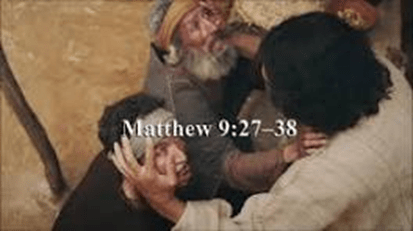
Matthew 9:27-38

Two Blind Men Healed

“When Jesus departed from there, two blind men followed Him, crying out and saying, “Son of David, have mercy on us!”

And when He had come into the house, the blind men came to Him. And Jesus said to them, “Do you believe that I am able to do this?”

They said to Him, “Yes, Lord.”

Then He touched their eyes, saying, “According to your faith let it be to you.” And their eyes were opened. And Jesus sternly warned them, saying, “See that no one knows it.” But when they had departed, they spread the news about Him in all that country.

A Mute Man Speaks

As they went out, behold, they brought to Him a man, mute and demon-possessed. And when the demon was cast out, the mute spoke. And the multitudes marveled, saying, “It was never seen like this in Israel!”

But the Pharisees said, “He casts out demons by the ruler of the demons.”

The Compassion of Jesus

Then Jesus went about all the cities and villages, teaching in their synagogues, preaching the gospel of the kingdom, and healing every sickness and every disease among the people. But when He saw the multitudes, He was moved with compassion for them, because they were weary and scattered, like sheep having no shepherd. Then He said to His disciples, “The harvest truly is plentiful, but the laborers are few. Therefore pray the Lord of the harvest to send out laborers into His harvest.”

Theres’ something funny about the way Jesus is ministering here: he’s refusing to advertise himself and even going so far as to order those being healed not to tell anybody. Of course, the crowds are busy spreading the news about Jesus as far and as rapidly as possible, but Jesus himself is refusing to keep score. By contrast, if any of us were to do even one such miracle, we would announce it on Facebook, Instagram, Twitter, and every WhatsApp platform going. If we have a blog, we will announce it on the blog and then do an email blast in addition. What’s the difference? “But when He saw the multitudes, He was moved with compassion for them, because they were weary and scattered, like sheep having no shepherd.”

Jesus is seeing people as individuals with specific needs. Lamentably, we frequently categorize people-“Needs healing,” “Needs deliverance,” “Needs financial success,” “Needs a husband/wife,” etc. We even report crusades in those terms. To Jesus, the crowds appear to be scattered and wandering aimlessly, like sheep without a shepherd to guide them. The long and complicated lists of religious rules have failed to help in the daily life of the people who supposed to be observing them.

Jesus also describes these people as weary. Why? These people want to experience God and have worn themselves out searching for God. But those who should be pointing the way to God are advertising themselves instead. Rather than ministering to people, these religious experts are treating people and their problems like commodities to be bought and sold.

Why does Jesus tell his disciples, “The harvest truly is plentiful, but the laborers are few. Therefore pray the Lord of the harvest to send out laborers into His harvest.” Every little village in Israel at this time has religious leaders; however, many of these villages are also coming under Greco-Roman influence, along with a pantheon of corrupt gods. These influences are even more noticeable in the big cities, where young men may even have operations to reverse their circumcisions so that they can exercise in the nude in the gymnasium and look like everybody else.

This story highlights two sides of Jesus’ ministry. On the one hand, Jesus heals and delivers three men individually, two from blindness and one from demon possession and epilepsy. On the other, Jesus ministers to huge groups of people, preaching and teaching and healing. But whether dealing with individuals or with crowds, Jesus continues to show compassion to all who come to him. Jesus’ approach never changes; he deals with people one at a time.

What makes Jesus’ approach different? Jesus prays frequently and sometimes for long periods of time. God the Father gives Jesus insight into the problems of those coming to him. Many times, physical problems are merely a manifestation of something spiritual. Jesus is praying for the whole person, not merely for the most obvious needs such as blindness or deafness. Jesus frequently orders those who have been healed not to tell anybody. Why? Jesus wants his Heavenly Father to get the credit and not him.

As disciples, how do we minister? Do we try to make sure God gets the credit and not us, or do we become legends in our own minds, blindly thinking that we are the ones making healing and deliverance happen? God may use us because people’s needs are so urgent; however, once those needs have been met, God can move on to use someone else, leaving us wondering why miracles aren’t happening any more. May we always be careful to give God the glory!

PRAYER: Father God, thank You for loving us and for caring for us. Lord, no matter how mightily You use us, help us to always give You the credit and the glory. In the mighty and precious Name of King Jesus. Amen.

SEPTEMBER 1, 2024 SO YOU WANT TO BE A DISCIPLE?#32 MINISTRY HAPPENS WHEN YOU LEAST EXPECT IT-BE READY!

September 1, 2024

Matthew 9:18-26 A Girl Restored to Life and a Woman Healed

“While He spoke these things to them, behold, a ruler came and worshiped Him, saying, “My daughter has just died, but come and lay Your hand on her and she will live.” So Jesus arose and followed him, and so did His disciples.

And suddenly, a woman who had a flow of blood for twelve years came from behind and touched the hem of His garment. For she said to herself, “If only I may touch His garment, I shall be made well.” But Jesus turned around, and when He saw her He said, “Be of good cheer, daughter; your faith has made you well.” And the woman was made well from that hour.

When Jesus came into the ruler’s house, and saw the flute players and the noisy crowd wailing, He said to them, “Make room, for the girl is not dead, but sleeping.” And they ridiculed Him. But when the crowd was put outside, He went in and took her by the hand, and the girl arose. And the report of this went out into all that land.”

Some accounts call the man Jairus, a ruler in the local synagogue. Everyone knew Jairus to be a devout man who loved God and his family, especially his little daughter, Rachel. Rachel was the light of the entire household, laughing, playing, singing, and loving. But during the night, Rachel suddenly became ill and that morning she breathed her last. Desperate, Jairus rushed to Jesus, seeking any help he could find, despite all the wild stories the Pharisees were circulating about the carpenter from Nazareth. As soon as Jairus explained the situation, Jesus began walking rapidly back  to Jairus’ house with the disciples trailing along behind him muttering, “The girl’s already dead! What can Jesus possibly do? Why waste our time this way? Doesn’t Jesus need to go off and preach somewhere?”

Call the woman Miriam. The vaginal bleeding had gone on for twelve years, rendering Miriam unclean and therefore unfit to mingle in society or to attend temple. But that morning as Jesus and his disciples rushed by on their way to Jairus’ house, Miriam veiled herself, mingling with the crowd. An old tradition taught that when Messiah came, all one had to do was to touch the tassels(tzitzit) of his prayer shawl (tallit) to receive healing. Miriam had never been so rude in a crowd before, but she was desperate for help and forced her way to the front. As Jesus stopped to allow a donkey cart to pass, Miriam crept to his feet and touched the tassels of his prayer shawl. Suddenly, Miriam felt a warmth go through her body, as if the sun had suddenly come out on a cloudy day. The gnawing pain in Miriam’s abdomen with which she had lived for twelve miserable years was gone and in its place Miriam felt whole.

Meanwhile, Jesus felt that power had gone out from him. Turning around, he looked down and saw Miriam cringing at his feet. Jesus reached out his hand, raising Miriam up and saying, “Be of good cheer, daughter; your faith has made you well. Go and show yourself to the priests.” By now, the disciples were really fuming! What did this woman mean by interrupting Jesus when he was on a desperate errand of mercy? What had happened? Was this lady really sick in the first place, or was she faking it? How dare a mere woman interrupt the Master? Jesus heard the disciples muttering but paid no attention.

Now the group reached Jairus’ house to find professional mourners and flute players already singing and playing dirges. Women were wailing and the noise and sadness were nearly unbearable. Ousting the curious from the girl’s room, Jesus said, “Make room, for the girl is not dead, but sleeping.” At that statement, the crowd began jeering; however, Jesus demanded they leave the room. Once the nay-sayers left, Jesus reached out his hand to Rachel, taking Rachel’s hand in his, and said, “Talitha koum.” (“Little girl, get up.”) Rachel sneezed once, took a deep breath, and then opened her eyes. Looking at her father, Rachel asked, “Is it morning already?” Jairus and his wife were speechless for joy and began hugging Rachel as hard as they could. (The phrase “Talitha Koum” occurs in Mark’s account, but it’s the same girl.)

Two situations, one was a life and death emergency while the other problem was a chronic one. The disciples were undoubtedly annoyed at Jesus for paying attention to Miriam and her bleeding. Here was one of the most important men in town begging for help. Why did Jesus bother with this miserable woman? Couldn’t he have taken care of her later?

There is a fine leisure in the fashion in which Jesus ministered. Jesus already knew what he would do for Jairus and he also knew that he was a vessel of God’s healing power. Spending a few moments with Miriam to confirm her healing would take nothing from the miracle he was about to perform for Jairus and his family. Both healings would be manifestations of God’s love and grace. Both healings would equally build up the faith of those seeking God. It was likely that Miriam was quite poor because she had spent all her resources trying for healing. Miriam would represent the lower end of the social scale while Jairus would represent the upper crust. Jesus knew that God wanted to demonstrate His unconditional love for all classes of people, not merely for the wealthy or religious leaders.

While we know what Jairus’ neighbors likely felt, what about Miriam’s neighbors? After spending twelve years as a social outcast, Miriam was now free to go out in public, to fetch water from the well, to chat with friends, and to attend the synagogue. Once a few ladies got to know about Miriam, they probably spread the word throughout town. Relatives who had shunned Miriam for years now resumed visiting her, eager to hear first-hand the story of her healing. All those people who saw Miriam and realized that her healing had been validated by the priests would flock to hear Jesus the next time they could.

For the disciples, the big lesson was that ministry opportunities don’t operate on a schedule. One pastor friend of ours told of a time when he was headed out of a hospital, only to be told that one of the community members had just died. The pastor had nearly reached his car when he began feeling that he had to return to the hospital and pray for that patient, even though the patient was dead. The pastor encountered the nursing staff in the elevator as they were moving the body to the hospital morgue. Laying hands on the patient, the pastor prayed. Nobody was more surprised than the pastor when the patient suddenly sat up and asked, ”Why am I in the elevator? What’s happening?”  

True disciples must minister just as Jesus did. This means that we must be ready to pray and to speak whether we feel like it or not. Disciples follow the master, whether or not it’s convenient. We must be available, for once we make ourselves available, God will use us.

PRAYER: Father God, thank You for loving us and for caring for us. Lord, help us to work on Your schedule and not on our own. In the mighty and precious Name of King Jesus. Amen.