Archive for October, 2024

OCTOBER 31, 2024 SO YOU WANT TO BE A DISCIPLE? #92 JESUS IS RETURNING! GET READY!

October 31, 2024

Matthew 24:29-51 The Coming of the Son of Man

“Immediately after the tribulation of those days the sun will be darkened, and the moon will not give its light; the stars will fall from heaven, and the powers of the heavens will be shaken. Then the sign of the Son of Man will appear in heaven, and then all the tribes of the earth will mourn, and they will see the Son of Man coming on the clouds of heaven with power and great glory. And He will send His angels with a great sound of a trumpet, and they will gather together His elect from the four winds, from one end of heaven to the other.”

The Parable of the Fig Tree

“Now learn this parable from the fig tree: When its branch has already become tender and puts forth leaves, you know that summer is near. So you also, when you see all these things, know that it is near—at the doors! Assuredly, I say to you, this generation will by no means pass away till all these things take place. Heaven and earth will pass away, but My words will by no means pass away.”

No One Knows the Day or Hour

“But of that day and hour no one knows, not even the angels of heaven, but My Father only. But as the days of Noah were, so also will the coming of the Son of Man be. For as in the days before the flood, they were eating and drinking, marrying and giving in marriage, until the day that Noah entered the ark, and did not know until the flood came and took them all away, so also will the coming of the Son of Man be. Then two men will be in the field: one will be taken and the other left. Two women will be grinding at the mill: one will be taken and the other left. Watch therefore, for you do not know what hour your Lord is coming. But know this, that if the master of the house had known what hour the thief would come, he would have watched and not allowed his house to be broken into. Therefore you also be ready, for the Son of Man is coming at an hour you do not expect.”

The Faithful Servant and the Evil Servant

“Who then is a faithful and wise servant, whom his master made ruler over his household, to give them food in due season? Blessed is that servant whom his master, when he comes, will find so doing. Assuredly, I say to you that he will make him ruler over all his goods. But if that evil servant says in his heart, ‘My master is delaying his coming,’ and begins to beat his fellow servants, and to eat and drink with the drunkards, the master of that servant will come on a day when he is not looking for him and at an hour that he is not aware of, and will cut him in two and appoint him his portion with the hypocrites. There shall be weeping and gnashing of teeth.”

Jesus is continuing to warn his disciples about the signs of his return, and those signs sound pretty frightening. Jesus affirms that when he comes back, nobody will be able to doubt what’s happening because there will be signs throughout the heavens and the earth. “Immediately after the tribulation of those days the sun will be darkened, and the moon will not give its light; the stars will fall from heaven, and the powers of the heavens will be shaken. Then the sign of the Son of Man will appear in heaven, and then all the tribes of the earth will mourn, and they will see the Son of Man coming on the clouds of heaven with power and great glory.”

Jesus compares the signs of his coming to the fig trees that put out both leaves and fruit as the summer approaches. These signs are going to be unmistakable. Jesus also states that his words will never pass away, that even the heavens and the earth will pass away before his words.

Jesus will return suddenly with no warning and will gather his faithful servants from their daily activities. “Therefore you also be ready, for the Son of Man is coming at an hour you do not expect.”

Finally, Jesus warns his disciples that they must always remain faithful. Recently, a householder has returned from a long trip, only to find that his steward has been abusing his fellow servants and drinking excessively. In the same way, Jesus will return at a day and hour when he is not expected. Disciples must therefore expect Jesus at any moment and continue to do his work.

When I was a child, we used to play hide and seek. The child who was “it” would cover their eyes and count to a certain number, then would uncover the eyes and cry out, “Ready or not, here I come!” In the same fashion, Jesus will return at a day and hour when we least expect him. Let all who claim to be disciples continue in the work Jesus has called us to do!

When He Comes-French E Oliver, 1921

There’s a king and captain high,
And He’s coming by and by,
And He’ll find me hoeing cotton when He comes.

You can hear His legions charging
In the regions of the sky,
And He’ll find me hoeing cotton when He comes.

There’s a Man they thrust aside,
Who was tortured till He died,
And He’ll find me hoeing cotton when He comes.

He was hated and rejected,
He was scorned and crucified,
And He’ll find me hoeing cotton when He comes.

When He comes! When he comes!
He’ll be crowned by saints and angels when He comes.

They’ll be shouting out Hosanna!
To the Man that men denied,
And I’ll kneel among my cotton when He comes.

PRAYER: Father God, thank You for loving us and caring for us. Lord, help us to be faithful disciples, studying Your Word and doing Your work until You call us to be in heaven with You forever. In the mighty and precious Name of King Jesus. Amen.

OCTOBER 30, 2024 SO YOU WANT TO BE A DISCIPLE? #91 BEING A DISCIPLE WHEN THINGS GET WORSE

October 30, 2024

Matthew 24: 3-28 The Signs of the Times and the End of the Age

“Now as He sat on the Mount of Olives, the disciples came to Him privately, saying, “Tell us, when will these things be? And what will be the sign of Your coming, and of the end of the age?”

And Jesus answered and said to them: “Take heed that no one deceives you. For many will come in My name, saying, ‘I am the Christ,’ and will deceive many. And you will hear of wars and rumors of wars. See that you are not troubled; for [a]all these things must come to pass, but the end is not yet. For nation will rise against nation, and kingdom against kingdom. And there will be famines, pestilences, and earthquakes in various places. All these are the beginning of sorrows.

“Then they will deliver you up to tribulation and kill you, and you will be hated by all nations for My name’s sake. And then many will be offended, will betray one another, and will hate one another. Then many false prophets will rise up and deceive many. And because lawlessness will abound, the love of many will grow cold. But he who endures to the end shall be saved. And this gospel of the kingdom will be preached in all the world as a witness to all the nations, and then the end will come.

The Great Tribulation

“Therefore, when you see the ‘abomination of desolation,’ spoken of by Daniel the prophet, standing in the holy place” (whoever reads, let him understand), “then let those who are in Judea flee to the mountains. Let him who is on the housetop not go down to take anything out of his house. And let him who is in the field not go back to get his clothes. But woe to those who are pregnant and to those who are nursing babies in those days! And pray that your flight may not be in winter or on the Sabbath. For then there will be great tribulation, such as has not been since the beginning of the world until this time, no, nor ever shall be. And unless those days were shortened, no flesh would be saved; but for the elect’s sake those days will be shortened.

“Then if anyone says to you, ‘Look, here is the Christ!’ or ‘There!’ do not believe it. For false christs and false prophets will rise and show great signs and wonders to deceive, if possible, even the elect. See, I have told you beforehand.

“Therefore, if they say to you, ‘Look, He is in the desert!’ do not go out; or ‘Look, He is in the inner rooms!’ do not believe it. For as the lightning comes from the east and flashes to the west, so also will the coming of the Son of Man be. For wherever the carcass is, there the eagles(vultures) will be gathered together.”

Jesus has just prophesied the destruction of the second temple, and now the disciples are anxious for details, raising questions that have plagued generations of disciples ever since. “Tell us, when will these things be? And what will be the sign of Your coming, and of the end of the age?” What’s frustrating is that Jesus doesn’t give a specific time line, nor does he give absolute answers. Why?

Later, after Jesus’ resurrection, the disciples are still trying to pin Jesus down. That’s when Jesus tells them, “It is not for you to know times or seasons which the Father has put in His own authority. But you shall receive power when the Holy Spirit has come upon you; and you shall be witnesses to Me in Jerusalem, and in all Judea and Samaria, and to the end of the earth.” (Acts 1:7-8)

Why hasn’t Jesus given us timelines? Only God the Heavenly Father really knows when the world will come to an end. Jesus is warning his disciples that things are going to deteriorate, and they do. By the time of Emperor Nero, Christians will be used as human torches to light Nero’s garden and will be thrown to wild beasts in the arena to entertain the masses. South Korean friends have described the fate of Christians in North Korea; one father was run over by bulldozers in front of his family for showing a Christian video privately in his home. Those turning from Islam to Christianity may be slaughtered by their own families. But each time a new atrocity occurs, those remaining faithful are encouraged that the cause of Christ is a faith worth dying for, not merely living for.

Why does Jesus warn the disciples about false prophets? As soon as Christianity begins to succeed as a faith, false prophets will appear. Paul in Romans 16:17-18 warns, “Now I urge you, brethren, note those who cause divisions and offenses, contrary to the doctrine which you learned, and avoid them. For those who are such do not serve our Lord Jesus Christ, but their own belly, and by smooth words and flattering speech deceive the hearts of the simple.”

1 Timothy 4:1-3 says, “Now the Spirit expressly says that in latter times some will depart from the faith, giving heed to deceiving spirits and doctrines of demons, speaking lies in hypocrisy, having their own conscience seared with a hot iron, forbidding to marry, and commanding to abstain from foods which God created to be received with thanksgiving by those who believe and know the truth.”

Cults and false prophets continue to abound. One of the best and most informative books is The Kingdom of the Cults by Walter Ralston Martin. Although this book first was published in 1965, it is now in its sixth edition and is well worth reading, both for the information and for the language, which is quite clear. There are also audio and YouTube versions for those who don’t like reading.

What about the horrors Jesus is foretelling? Although some people believe these prophecies were fulfilled when the Romans laid siege to Jerusalem, the complete fulfillment may still happen in the future. Jesus says that when he returns, nobody will be in doubt that it is he who has arrived. Jesus is likely quoting a pithy local proverb when he says, “For wherever the carcass is, there the eagles(vultures) will be gathered together.”

What do all these teachings mean for us as disciples? We know that Jesus will return, but we don’t know when; therefore, we need to be faithful and prepared. We must be willing to suffer for our faith if that becomes necessary, realizing that our example may encourage many others. Pastor Richard Wurmbrand was a leader in the anti-Communist movement in Rumania. Imprisoned and tortured, Wurmbrand remained faithful and lived to encourage many others. One of the best videos is Richard and Sarah Wurmbrand: The Underground Pastor and His Wife produced in 2020. https://www.youtube.com/watch?v=hyG_zXfwhSc

May God strengthen and encourage us, so that we will face any and all trials, knowing that God’s help is always available!

PRAYER: Father God, thank You for loving us and for caring for us. Lord, sometimes when we read predictions about suffering, we begin to fear that we will crumple under persecution. But You are the One who has helped believers, and You don’t play favorites; therefore, we can confidently expect that You will also help us and that You will be our strength. Thank You for Your promises! In the mighty and precious Name of King Jesus. Amen.

OCTOBER 29, 2024 SO YOU WANT TO BE A DISCIPLE? #90 WHAT IF YOUR MASTER SPEAKS HARD TRUTHS? WILL YOU BE ASHAMED?

October 29, 2024

Matthew 24:1-2 Jesus Predicts the Destruction of the Temple

“Then Jesus went out and departed from the temple, and His disciples came up to show Him the buildings of the temple. And Jesus said to them, “Do you not see all these things? Assuredly, I say to you, not one stone shall be left here upon another, that shall not be thrown down.”

Wikipedia gives this information: The Second Temple … was the reconstructed Temple in Jerusalem, in use between c. 516 BCE and its destruction in 70 CE. In its last phase it was enhanced by Herod the Great, the result being later called Herod’s Temple. Defining the Second Temple period, it stood as a pivotal symbol of Jewish identity and was central to Second Temple Judaism; it was the chief place of worship, ritual sacrifice (korban), and communal gathering for Jews. As such, it attracted Jewish pilgrims from distant lands during the Three Pilgrimage FestivalsPassoverShavuot, and Sukkot.

Construction on the Second Temple began in the aftermath of the Persian conquest of Babylon; the Second Temple’s predecessor, known as Solomon’s Temple, had been destroyed alongside the Kingdom of Judah as a whole by the Babylonian siege of Jerusalem around 587 BCE. After the Neo-Babylonian Empire was annexed by the Achaemenid Empire, the Persian king Cyrus the Great issued the so-called Edict of Cyrus, which is described in the Hebrew Bible as having authorized and encouraged the return to Zion—a biblical event in which the Jewish people returned to the former Kingdom of Judah…

The completion of the Second Temple at the time of the Persian king Darius I signified a period of renewed Jewish hope and religious revival. According to biblical sources, the Second Temple was originally a relatively modest structure built under the authority of the Persian-appointed Jewish governor Zerubbabel, the grandson of Jeconiah, the penultimate king of Judah.

In the 1st century BCE, the Second Temple was refurbished and expanded under the reign of Herod the Great, hence the alternative eponymous name for the structure. Herod’s transformation efforts resulted in a grand and imposing structure and courtyard, including the large edifices and façades shown in modern models, such as the Holyland Model of Jerusalem in the Israel Museum. The Temple Mount, where both Solomon’s Temple and the Second Temple stood, was also significantly expanded, doubling in size to become the ancient world’s largest religious sanctuary.”

Unless you know how large Herod’s temple in Jerusalem was, you might not understand why the disciples were giving Jesus a guided tour. Here are the dimensions: The façade of Herod’s Temple was 100 cubits by 100 cubits, which is about 172 feet by 52.5 meters. Herod’s Temple was 172 feet tall, which is one and a half times taller than the Dome of the Rock, which is 115 feet tall. Herod’s plan was to turn the entire Temple Mount into a giant square platform that was 1,600 feet wide by 900 feet broad by 9 stories high. However, the Temple Mount was never finished. The Temple Mount is a trapezium-shaped platform with a total area of approximately 150,000 square meters, or 37 acres.

Little wonder that the disciples are in awe of that temple and want to show it off. The original temple was built by Solomon and then later destroyed. No matter what failings Herod has, he has rebuilt the second temple into a monument to be proud of.

“And Jesus said to them, “Do you not see all these things? Assuredly, I say to you, not one stone shall be left here upon another, that shall not be thrown down.”  About this time, the disciples must have been thinking, “Awe, Jesus, why’d you have to go say that? Now we’re really going to be in trouble with the authorities!” Nothing is worse than a boss who’s a prophet, because you never know what he’s going to say publicly. Some of the disciples must have been looking around at one another, “Okay, who’s the wise guy who thought showing Jesus the temple was a great idea?”

It’s great being a disciple when your leader talks about love and forgiveness, but what happens if he comes out with something unpopular? In many respects, King Herod was a horrible man, but the engineering feats accomplished during his reign were amazing. Not only did Herod refurbish the temple but he also led the construction of the Port of Caesarea on the coast, as well as palaces at Masada and Jericho, and the Herodian in sight of Jerusalem.  

Why did Jesus prophesy about the coming destruction of the temple in Jerusalem? For many Jews, the temple had become such a source of pride that they were trusting in structures more than in God. As Messiah, Jesus was always fulfilling his roles as prophet, priest, and king. Here he was speaking prophetically. Wikipedia tells us, “In 70 CE, at the height of the First Jewish–Roman War, the Second Temple was destroyed by the Roman siege of Jerusalem, marking a cataclysmic and transformative point in Jewish history. The loss of the Second Temple prompted the development of Rabbinic Judaism, which remains the mainstream form of Jewish religious practices globally.”

The question for us as disciples is this: do we shy away from hard truths that Jesus taught and try to ignore them? If God calls on us to speak the truth in love, are we trying to avoid anything controversial because we want to remain popular and avoid criticism?

We live in a day when Biblical values are under attack. Looking back, we realize that things in America began to deteriorate when prayer was removed from schools and the churches only gave token opposition. While it’s tempting to criticize others, will we do any better? During the 19th century, James Russell Lowell was one of the leading opponents of slavery in the United States. Lowell wrote the following hymn, whose words remain valid today.

1 Once to every man and nation
Comes the moment to decide,
In the strife of truth with falsehood,
For the good or evil side;
Some great cause, God’s new Messiah,
Offering each the bloom or blight,
And the choice goes by forever
Twixt that darkness and that light.

2 Then to side with truth is noble,
When we share her wretched crust,
Ere her cause bring fame and profit,
And ’tis prosperous to be just;
Then it is the brave man chooses
While the coward stands aside,
Till the multitude make virtue
Of the faith they had denied.

3 By the light of burning martyrs,
Christ, Thy bleeding feet we track,
Toiling up new Calvaries ever
With the cross that turns not back;
New occasions teach new duties,
Time makes ancient good uncouth;
They must upward still and onward,
Who would keep abreast of truth.

4 Though the cause of evil prosper,
Yet ’tis truth alone is strong;
Though her portion be the scaffold,
And upon the throne be wrong:
Yet that scaffold sways the future,
And, behind the dim unknown,
Standeth God within the shadow
Keeping watch above His own.

PRAYER: Father God, thank You for loving us and for caring for us. Lord, help us to stand firm when You call us to speak out for righteousness’ sake. Help us not to waver, even in the face of opposition. In the mighty and precious Name of King Jesus. Amen.

OCTOBER 28, 2024 SO YOU WANT TO BE A DISCIPLE? #89 REJECT GOD AND DON’T REPENT AND GOD WILL REJECT YOU!

October 28, 2024

Matthew 23:29-39 Because Jerusalem has rejected the prophets, God will reject Jerusalem

“Woe to you, scribes and Pharisees, hypocrites! Because you build the tombs of the prophets and adorn the monuments of the righteous, and say, ‘If we had lived in the days of our fathers, we would not have been partakers with them in the blood of the prophets.’

“Therefore, you are witnesses against yourselves that you are sons of those who murdered the prophets. Fill up, then, the measure of your fathers’ guilt. Serpents, brood of vipers! How can you escape the condemnation of hell? Therefore, indeed, I send you prophets, wise men, and scribes: some of them you will kill and crucify, and some of them you will scourge in your synagogues and persecute from city to city, that on you may come all the righteous blood shed on the earth, from the blood of righteous Abel to the blood of Zechariah, son of Berechiah, whom you murdered between the temple and the altar. Assuredly, I say to you, all these things will come upon this generation.”

Jesus Laments over Jerusalem

“O Jerusalem, Jerusalem, the one who kills the prophets and stones those who are sent to her! How often I wanted to gather your children together, as a hen gathers her chicks under her wings, but you were not willing! See! Your house is left to you desolate; for I say to you, you shall see Me no more till you say, ‘Blessed is He who comes in the name of the Lord!’”

What must it have been like for Jesus to enter Jerusalem? Even as the crowd was shouting, “Hosanna to the Son of David! Blessed is he that comes in the Name of the Lord!” the very stones of Jerusalem must have been crying out because of the blood of martyred prophets and the blood of innocent victims slaughtered due to the idolatry of their neighbors. Even today, Jerusalem is a special city; however, its streets still cry out with silent voices.

Remember that before Jesus was born as a baby, he was reigning in heaven with his Heavenly Father and the Holy Spirit. During that time, Jesus would have been fully aware of all the glories and all the shame that occurred in Jerusalem. When the prophet Isaiah was being sawed in half at the order of wicked King Manasseh, Jesus was there. When Jeremiah was being lowered into a well full of muck that threatened to suffocate him, Jesus was there. And when Ebed-Melech, a royal servant, courageously went to King Zedekiah pleading to be allowed to save Jeremiah, Jesus was there helping turn a weak king’s heart to pity a righteous prophet. There were undoubtedly many more prophets whose stories remained untold who had been viciously slaughtered or stoned.

Now Jesus the Messiah has come with divine discernment. When Jesus looks at these religious rulers, he can immediately recite every bit of their lineages, including those wicked ancestors who killed the prophets. Now these current rulers are attempting a massive cover-up by building tombs for the prophets and disowning their ancestors. But all these efforts are useless, for Jesus knows all the details and realizes it’s all a show. The shedding of innocent blood brings curses on a land, and these men, their ancestors, and their successors have shed the blood of prophets and will continue to do so right up until the day the Romans take Jerusalem and reduce it to rubble. Jesus can already hear the cries of future martyrs rending the air, even as he knows that he is about to be crucified unjustly.

Given such information, most of us would simply be incensed and ready to take vengeance, but Jesus’ reaction is quite different. Although Jesus rebukes the religious leaders for their posturing and hypocrisy; nevertheless, he weeps over Jerusalem.

“O Jerusalem, Jerusalem, the one who kills the prophets and stones those who are sent to her! How often I wanted to gather your children together, as a hen gathers her chicks under her wings, but you were not willing! See! Your house is left to you desolate; for I say to you, you shall see Me no more till you say, ‘Blessed is He who comes in the name of the Lord!’”

Had the citizens of Jerusalem heeded the prophets and repented, God would never have allowed Jerusalem to be overrun by the Babylonians or by the Romans. But because the city as a whole has failed to recognize Jesus as the Messiah, once he ascends to heaven, they will never see him again until the day he returns.

The Messiah always fulfills three functions, prophet, priest, and king. Here Jesus is speaking prophetically, for he already can see what the Romans will do to Jerusalem in 70 A.D. and he is grieving over the coming destruction, not only physical destruction but also spiritual destruction.

What we will only know in eternity is the number of faithful who have survived all this warfare. God always has a remnant, people who love Him and fear Him. Will God reject us forever? When we repent and repudiate our disbelief, God will also forgive us. But here Jesus is grieving over Jerusalem because he knows that many of its inhabitants will actively and persistently reject him and persist in wickedness. 2 Peter 3:9 tells us, “The Lord is not slack concerning His promise, as some count slackness, but is longsuffering toward us, not willing that any should perish but that all should come to repentance.”  God would like nothing better than for all the inhabitants of Jerusalem to repent and turn to Him; however, He knows that they will not. Jesus also knows these things because God the Father has revealed them to him.

What can we as disciples learn from the sad example of Jerusalem? We should be vigilant to remain in close communication with the God whom we serve. We should not refuse correction or teaching when God sends prophets to us, even when their messages are unpleasant. We should always strive to please God, not because we are earning our way into heaven, but because Jesus has already died for our sins and we obey out of gratitude. May God help us so that we never grieve His Father Heart!

PRAYER: Father God, thank You for loving us and for caring for us. Lord, help us to follow hard after You all the days of our lives. Help us to listen to You so that we receive Your Word and apply it. In the mighty and precious Name of King Jesus. Amen.
OCTOBER 27, 2024 SO YOU WANT TO BE A DISCIPLE? #88 DON’T COPY YOUR ACCUSERS!

October 27, 2024

Jesus continues to confront the scribes and Pharisees Matthew 23:15-28

“Woe to you, scribes and Pharisees, hypocrites! For you travel land and sea to win one proselyte, and when he is won, you make him twice as much a son of hell as yourselves.

“Woe to you, blind guides, who say, ‘Whoever swears by the temple, it is nothing; but whoever swears by the gold of the temple, he is obliged to perform it.’ Fools and blind! For which is greater, the gold or the temple that sanctifies the gold? And, ‘Whoever swears by the altar, it is nothing; but whoever swears by the gift that is on it, he is obliged to perform it.’ Fools and blind! For which is greater, the gift or the altar that sanctifies the gift? Therefore, he who swears by the altar, swears by it and by all things on it. He who swears by the temple, swears by it and by Him who dwells in it. And he who swears by heaven, swears by the throne of God and by Him who sits on it.

“Woe to you, scribes and Pharisees, hypocrites! For you pay tithe of mint and anise and cummin, and have neglected the weightier matters of the law: justice and mercy and faith. These you ought to have done, without leaving the others undone. Blind guides, who strain out a gnat and swallow a camel!

“Woe to you, scribes and Pharisees, hypocrites! For you cleanse the outside of the cup and dish, but inside they are full of extortion and self-indulgence. Blind Pharisee, first cleanse the inside of the cup and dish, that the outside of them may be clean also.

“Woe to you, scribes and Pharisees, hypocrites! For you are like whitewashed tombs which indeed appear beautiful outwardly, but inside are full of dead men’s bones and all uncleanness. Even so you also outwardly appear righteous to men, but inside you are full of hypocrisy and lawlessness.”

Jesus is continuing to confront the Pharisees. Here are his points:

  1. The Pharisees will travel long distances to make one disciple, but these disciples will become more Pharisaical than the Pharisees, carrying hypocrisy to new lows.
  2. Therefore, he who swears by the altar, swears by it and by all things on it. He who swears by the temple, swears by it and by Him who dwells in it. And he who swears by heaven, swears by the throne of God and by Him who sits on it.”  The Pharisees are spiritually blind, teaching that swearing by the gold of the temple or the gifts on the altar are more important than the temple itself, thus ignoring the holiness of the temple and the fact that the temple makes the gifts and the gold holy and not vice versa.
  3. “Woe to you, scribes and Pharisees, hypocrites! For you pay tithe of mint and anise and cummin, and have neglected the weightier matters of the law: justice and mercy and faith. These you ought to have done, without leaving the others undone. Blind guides, who strain out a gnat and swallow a camel!“ The scribes and Pharisees have reduced the Law God has intended to bring forth justice and mercy and faith to a series of rules so ridiculous that they are even tithing the spices in their kitchen cabinets. Since it is easier to follow sets of rules than to become compassionate, these men are concentrating on the rules while gaining reputations as some of the stingiest and most vicious people in town. Even the tax collectors might be kinder.
  4. “Woe to you, scribes and Pharisees, hypocrites! For you cleanse the outside of the cup and dish, but inside they are full of extortion and self-indulgence. Blind Pharisee, first cleanse the inside of the cup and dish, that the outside of them may be clean also. “Woe to you, scribes and Pharisees, hypocrites! For you are like whitewashed tombs which indeed appear beautiful outwardly, but inside are full of dead men’s bones and all uncleanness. Even so you also outwardly appear righteous to men, but inside you are full of hypocrisy and lawlessness.”

These men who pride themselves on appearances have spared no expense to dress as handsomely as possible and to parade themselves before the common people; yet, all these efforts are meaningless since they have focused on externals while refusing to repent. As Jesus is teaching on the east steps of the temple, he can look out over the Kidron valley, where there are many whitewashed tombs. References to these “tombs full of dead men’s bones and all uncleanness” paints an unforgettable picture in the minds of Jesus’ listeners. For the rest of their days, these people will never look at a posturing Pharisee or scribe without remembering this vivid description.

Why is Jesus speaking out against the abuses perpetrated by the religious authorities? Lacking any other examples, people may believe that they must copy the behavior of the scribes and Pharisees to be serve God; meanwhile, most of these men are serving themselves rather than God. Even Jesus’ disciples might not be immune from learning bad practices from the Pharisees; after all, these men have grown up respecting scribes and Pharisees as being ultra-religious and therefore worth copying. Jesus knows his time is getting short and he must teach the disciples as much as possible as quickly as possible. If Jesus fails to combat these horrible beliefs, the disciples might be tempted to slide into them after he is gone.

How easy it is to succumb to a system of rules, regulations, and check lists! But God has never been impressed with check lists; instead, God looks at our hearts. Earlier, Jesus answered one of the lawyers questioning him by saying that the laws of the Kingdom of God can be simplified to “loving the Lord your God with all your heart, with all your soul, and with all your spirit and your neighbor as yourself.” There are an infinite number of ways in which we can show love for others, depending on their needs and circumstances. That’s why check lists don’t apply in the Kingdom of God.

As we strive to be disciples, let us remember that self-promotion and hypocrisy should have no place in our lives. Let us love others and serve them, for it is in so doing that we will prove to be true disciples.

PRAYER: Father God, thank You for loving us and for caring for us. Lord, help us to hard after You all the days of our lives, taking Jesus as our example and not someone else. Help us to be true-hearted and humble, serving those around us without thoughts of rewards. In the mighty and precious Name of King Jesus. Amen.

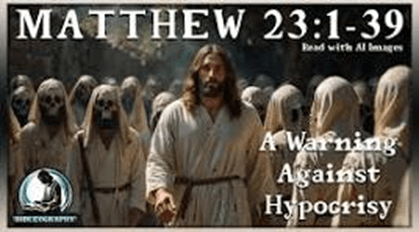
OCTOBER 26, 2024 SO YOU WANT TO BE A DISCIPLE? #87 MATTHEW 23:1-14 “DISCIPLE” DOESN’T MEAN “PUSHOVER!”

October 26, 2024

Matthew 23:1-14 Woe to the Scribes and Pharisees

“Then Jesus spoke to the multitudes and to His disciples, saying: “The scribes and the Pharisees sit in Moses’ seat. Therefore, whatever they tell you to observe, that observe and do, but do not do according to their works; for they say, and do not do. For they bind heavy burdens, hard to bear, and lay them on men’s shoulders; but they themselves will not move them with one of their fingers. But all their works they do to be seen by men. They make their phylacteries broad and enlarge the borders of their garments. They love the best places at feasts, the best seats in the synagogues, greetings in the marketplaces, and to be called by men, ‘Rabbi, Rabbi.’ But you, do not be called ‘Rabbi;’ for One is your Teacher, the Christ, and you are all brethren. Do not call anyone on earth your father; for One is your Father, He who is in heaven. And do not be called teachers; for One is your Teacher, the Christ. But he who is greatest among you shall be your servant. And whoever exalts himself will be humbled, and he who humbles himself will be exalted.

“But woe to you, scribes and Pharisees, hypocrites! For you shut up the kingdom of heaven against men; for you neither go in yourselves, nor do you allow those who are entering to go in. Woe to you, scribes and Pharisees, hypocrites! For you devour widows’ houses, and for a pretense make long prayers. Therefore, you will receive greater condemnation.”

Well, the gloves have come off and Jesus is finally speaking out against the practices of the scribes and Pharisees. Why now? These people have been pushing, questioning, accusing, and doing everything they can to humiliate Jesus; meanwhile, Jesus has simply been teaching about the Kingdom of God. Messiah has come and those who claim most loudly that they are waiting for him are rejecting him because God has sent him in a fashion that doesn’t meet their expectations. Jesus has given these judges every opportunity to change and to repent, but they have persisted. Now Jesus is going on the offensive, publishing their sins for all of Jerusalem to hear.

“Then Jesus spoke to the multitudes and to His disciples, saying: “The scribes and the Pharisees sit in Moses’ seat. Therefore whatever they tell you to observe, that observe and do, but do not do according to their works; for they say, and do not do.”

Notice that Jesus does not encourage the crowds to stop observing the Law of Moses, for there is nothing wrong in that Law. Jesus is telling the crowds that the scribes and Pharisees are hypocrites because they keep the letter of the Law but not the intentions of it. Through demands to observe minutiae that are no part of the original Law of Moses, the scribes and Pharisees have placed intolerable burdens on common believers.

“But he who is greatest among you shall be your servant. And whoever exalts himself will be humbled, and he who humbles himself will be exalted.” The last thing these men wish is to humble themselves; instead, their motto is “If you’ve got it, flaunt it!”

“But woe to you, scribes and Pharisees, hypocrites! For you shut up the kingdom of heaven against men; for you neither go in yourselves, nor do you allow those who are entering to go in. Woe to you, scribes and Pharisees, hypocrites! For you devour widows’ houses, and for a pretense make long prayers. Therefore, you will receive greater condemnation.”

At the same time, these same people who claim to be ultra-religious are complete hypocrites, praying long prayers, demanding the best seats at feasts and in the synagogues, and flashing big phylacteries and huge tassels on their garments-all to demonstrate just how religious they are. These same men love for people to call them Rabbi or Teacher, forgetting that God is the ultimate Teacher. These same men who are observing the letter of the Law have completely lost sight of the intention of that same Law, victimizing widows, and other disadvantaged people-the very people the Law seeks to protect. By setting such terrible examples, these men are turning people away from the God they claim to serve.

There is an old hymn that begins “Gentle Jesus, meek and mild…” Many times, we mistake gentleness and meekness for weakness and being a pushover. But strong people can be meek, simply restraining themselves from reacting to situations. Throughout his ministry, Jesus has steadfastly refused to call attention to himself or to promote himself because he has had no need to do so. But now Jesus is in Jerusalem, the city God has chosen as the site of the temple and the seat of religious hypocrisy. It’s time for Jesus to speak out.

Notice that in all the records of these confrontations between Jesus and the religious leaders, not once does Jesus descend into attacking individuals or deriding personalities. Jesus is criticizing the religious leaders because they have promised righteousness but have failed to deliver it.

As disciples of Jesus, we must be careful when confronting critics to avoid becoming vicious. We must remember that even when someone is attacking us or trying to tear us down, God still loves that person. Jesus Christ has died for the sins of the whole world, including those who are persecuting or opposing us. We must also be careful that we have all our facts straight before speaking out against someone. Nothing is more embarrassing or detrimental to the cause of Christ than a poorly informed disciple running off at the mouth without adequate information. Equally, nothing is more detrimental than a disciple who calls names or employs stereotypes. But Jesus wasn’t doing any part of this.

The problem for the scribes and Pharisees is that Jesus was accurately describing their shortcomings, and everyone in the crowd knew it. Jesus was speaking authoritatively as the Messiah, and the religious leaders had no defense. Tomorrow we will continue to study Jesus as he confronts his critics, but for today, remember that speaking the truth in love is not the same thing as being a pushover.

PRAYER: Father God, thank You for loving us and for caring for us. Lord, help us to follow hard after You all the days of our lives. Help us also to refute criticism accurately and adroitly, remembering that You love those critics just as much as You love us. In the mighty and precious Name of King Jesus. Amen.

OCTOBER 25, 2024 SO YOU WANT TO BE A DISCIPLE? #86 LOVINGLY CONFRONTING CRITICS

October 25, 2024

Matthew 22:34-40 The Scribes: Which Is the First Commandment of All?

“But when the Pharisees heard that He had silenced the Sadducees, they gathered together. Then one of them, a lawyer, asked Him a question, testing Him, and saying, “Teacher, which is the great commandment in the law?”

Jesus said to him, “‘You shall love the Lord your God with all your heart, with all your soul, and with all your mind.’ This is the first and great commandment. And the second is like it: ‘You shall love your neighbor as yourself.’ On these two commandments hang all the Law and the Prophets.”

Well, the Pharisees are chortling! Jesus has thoroughly embarrassed the Sadducees, reinforcing the position of the Pharisees on the validity of the resurrection in the process. Great! But can the Pharisees trip him up somehow? Shemuel, the lawyer, offers to interrogate Jesus and moves forward while his colleagues back him up. “Teacher, which is the great commandment in the law?” Shemuel asks, secure in his extensive knowledge of Mosaic and common law. Jesus gazes at Shemuel with a winsome loving smile.

“‘You shall love the Lord your God with all your heart, with all your soul, and with all your mind.’ This is the first and great commandment. And the second is like it: ‘You shall love your neighbor as yourself.’ On these two commandments hang all the Law and the Prophets.”  

Now Shemuel is flustered. What a simple answer! Surely Shemuel can pick these statements apart somehow; after all, he has a reputation as a fearsome investigator in the courts. But the longer Shemuel considers Jesus’ answer in light of all the laws he knows, the more Shemuel realizes that Jesus is correct. And then Jesus goes on the offensive.

Matthew 22:41-46 Jesus: How Can David Call His Descendant Lord?

“While the Pharisees were gathered together, Jesus asked them, saying, “What do you think about the Christ? Whose Son is He?”

They said to Him, “The Son of David.”

He said to them, “How then does David in the Spirit call Him ‘Lord,’ saying:

‘The Lord said to my Lord,
“Sit at My right hand,
Till I make Your enemies Your footstool”’?

If David then calls Him ‘Lord,’ how is He his Son?” And no one was able to answer Him a word, nor from that day on did anyone dare question Him anymore.”

The Pharisees are thoroughly confused! This morning was to be the great unveiling of Jesus the imposter; instead, the Pharisees strongly suspect that they are the ones looking foolish. Earlier Jesus has already stated that God is the God of the living, not of the dead. Now Jesus is adding that the Christ that David has referred to in his psalms is also referred to as the Son of David; yet, how can the Christ be a son when David calls him Lord?

There’s a law about holes: if you find yourself in a hole, stop digging! At this point, the Pharisees recognize that they are in a hole with no way out and quietly leave.

Notice something about Jesus’ answers: not once does Jesus mock those who are questioning him. Jesus treats these people and their questions with respect and dignity. Certainly, Jesus realizes his questioners are out to embarrass him; however, that doesn’t mean that Jesus has to embarrass them by reducing them to verbal rubble.

Many times we are tempted to answer viciously when someone is questioning our faith; yet, by doing so, we are abandoning the example set by Jesus. Notice that throughout all these exchanges documented in Matthew 22, Jesus never descends to name calling, nor does he vaunt himself over those whom he has actually defeated in verbal battle. The key for Jesus is love; Jesus loves these men who are trying to harass him and expose him as a fake. Jesus knows he is the Son of God and needs nobody to back him up on that. It’s possible that the love these men are feeling radiating from Jesus is as confusing as his wise answers to these tough questions.

If we are to be true disciples of Jesus, we must follow in his footsteps as far as criticism is concerned. We don’t have to worry about what to say, for Jesus promises that he will give us the right words at the right times. What we have to do is to refuse to become spiritual bullies. Treat our critics as sincere seekers who only want the truth. Leave the criticism to Jesus, for he is the only one who knows human hearts.

PRAYER: Father God, thank You for loving us and for caring for us. Lord, help us to do all things in love, respecting all those around us, including those who verbally attack us. In the mighty and precious Name of King Jesus. Amen.

OCTOBER 24, 2024 SO YOU WANT TO BE A DISCIPLE? #85 DISCIPLES REJOICE IN THE HOPE OF THE RESURRECTION

October 24, 2024

Matthew 22:23-33 The Sadducees: What About the Resurrection?

“The same day the Sadducees, who say there is no resurrection, came to Him and asked Him, saying: “Teacher, Moses said that if a man dies, having no children, his brother shall marry his wife and raise up offspring for his brother. Now there were with us seven brothers. The first died after he had married, and having no offspring, left his wife to his brother. Likewise, the second also, and the third, even to the seventh. Last of all the woman died also. Therefore, in the resurrection, whose wife of the seven will she be? For they all had her.”

Jesus answered and said to them, “You are mistaken, not knowing the Scriptures nor the power of God. For in the resurrection, they neither marry nor are given in marriage, but are like angels of God in heaven. But concerning the resurrection of the dead, have you not read what was spoken to you by God, saying, ‘I am the God of Abraham, the God of Isaac, and the God of Jacob’? God is not the God of the dead, but of the living.” And when the multitudes heard this, they were astonished at His teaching.”

Who were the Sadducees and how did they differ from the Pharisees? Study.com tells us these facts:  

The primary distinction between Pharisees and Sadducees was their disagreement about the resurrection of the dead and an afterlife. Sadducees were upper-class wealthy men mostly from Jerusalem who made up the Jewish aristocracy. Pharisees came from all economic classes but were distinguished by their rigid adherence to specific behavior prescriptions arising from their interpretation of the ambiguities in the Torah.

What did the Pharisees believe that the Sadducees did not?

Pharisees believed in the resurrection of the dead and an afterlife. The Sadducees did not believe in either of these. The Pharisees believed in a realm of spirit and angels. The Sadducees did not.

What do the Sadducees believe?

Sadducees believed that there was no resurrection of the dead, no afterlife, no spirit realm, no angels. Most Sadducees were priests of the Temple.

What did Pharisees believe?

Pharisees believed in the resurrection of the dead and the afterlife. They believed like all Jews that God created the world, chose Israel as his chosen people, and rewarded and punished them according to his law. They also felt that the Law of Moses contained ambiguities which they strove to fix by developing rules and regulations for every possible human action in order to adhere to the will of God as outlined in the Torah.

What did Jesus say about Pharisees?

Jesus at various times called Pharisees a brood of vipers, compared them to Satan and called them hypocrites. He also had Pharisees in his group of followers, praised them for following a righteous path.

So far, the Sadducees have been willing to allow the Pharisees to query Jesus while they have stood back and watched. But now the Sadducees decide to attack. The basis of the question from the Sadducees is the Mosaic command for a man to take his late brother’s wife as his wife so that she may bear children in the name of his late brother. While the Sadducees really don’t believe in the resurrection in the first place, they assume that by asking Jesus a ridiculous question, they can catch him. The Sadducees give a hypothetical example of seven brothers, all of whom die, and ask Jesus which man will be able to claim the woman as his wife in heaven. You can almost hear the Sadducees snickering as their representative questions Jesus. “Now we’ve got this ragged carpenter right where we want him! Let’s see him get out of this one!”

Too bad the Sadducees are about to be thoroughly embarrassed. This question doesn’t disturb Jesus in the slightest. “You are mistaken, not knowing the Scriptures nor the power of God. For in the resurrection, they neither marry nor are given in marriage, but are like angels of God in heaven. But concerning the resurrection of the dead, have you not read what was spoken to you by God, saying, ‘I am the God of Abraham, the God of Isaac, and the God of Jacob’? God is not the God of the dead, but of the living.” 

While the multitudes might be astonished, there also are many believers in the crowd who are thrilled at Jesus’ affirmation of the truth of the resurrection. While wealthy Sadducees may preen and claim that this life is all there is, those less fortunate are hoping and longing for resurrection and heaven.

Jesus is teaching about a resurrection that he is about to experience, for in a few days, Jesus will be crucified, will die, and be resurrected. That physical and spiritual resurrection will give incredible hope to all who are following him and who will follow him for the rest of the ages.

In one short statement, Jesus refutes the misbeliefs of the Sadducees and affirms the truth of the resurrection.

What’s so important about the resurrection? If this life is all there is, there is less incentive to live righteously and no hope for anything better. But if the resurrection is real, then disciples should live to please God and not themselves. But why live to please God? Because Jesus Christ has paid the sin-debt for each of us with his own blood. When we believe in Jesus and follow him, we are assured of forgiveness of our sins and eternal life in heaven when we die. Let all who claim Jesus as Savior and Lord rejoice in that hope!

PRAYER: Father God, thank You for loving us and for caring for us. Lord, help us to always rejoice in the hope of the resurrection and share that hope with those around us. In the mighty and precious Name of King Jesus. Amen.

OCTOBER 23, 2024 SO YOU WANT TO BE A DISCIPLE? #84 GOOD DISCIPLES STILL HONOR BAD GOVERNMENTS

October 23, 2024

Matthew 22:15-22 The Pharisees: Is It Lawful to Pay Taxes to Caesar?

“Then the Pharisees went and plotted how they might entangle Him in His talk. And they sent to Him their disciples with the Herodians, saying, “Teacher, we know that You are true, and teach the way of God in truth; nor do You care about anyone, for You do not regard the person of men. Tell us, therefore, what do You think? Is it lawful to pay taxes to Caesar, or not?”

But Jesus perceived their wickedness, and said, “Why do you test Me, you hypocrites? Show Me the tax money.”

So they brought Him a denarius.

And He said to them, “Whose image and inscription is this?”

They said to Him, “Caesar’s.”

And He said to them, “Render therefore to Caesar the things that are Caesar’s, and to God the things that are God’s.” When they had heard these words, they marveled, and left Him and went their way.”

By the time Jesus was born, the Romans had controlled Israel for 63 years, installing a puppet government but generally allowing religious freedom. (Encyclopedia Britannica describes these rulers as “local client kings.”) There was an uneasy alliance between the Jewish religious leaders and the rulers appointed by the Romans, for nobody wanted to destabilize what was at best a fragile situation. It was into this situation that Jesus was born. The last thing the canny religious authorities in Jerusalem wanted was some radical preaching any kind of rebellion that would threaten their position. The Romans were noted for taking revenge on anybody foolish enough to challenge them.

On this particular day, the scribes and Pharisees are clustering around Jesus and querying him for several reasons. Does this upstart carpenter from Galilee pose a threat to their carefully forged relationships with local rulers? Is this man fomenting rebellion? Is it possible to embarrass this man, tricking him into a seditious answer that will allow them to report him to the Romans, thereby inciting the Romans into getting rid of him themselves? And can the authorities trap this man into a religiously unacceptable statement?

As the group of scribes and Pharisees push their way through the crowd, Jesus is smiling. Jesus knows precisely why these men have come and their ambitions for his downfall. But this morning, these arrogant individuals are slated for yet another disappointment.

“And they sent to Him their disciples with the Herodians, saying, “Teacher, we know that You are true, and teach the way of God in truth; nor do You care about anyone, for You do not regard the person of men. Tell us, therefore, what do You think? Is it lawful to pay taxes to Caesar, or not?” Notice the big men are standing at the back of the crowd while their disciples are coming in with the Herodians, the supporters of Herod, the current “client king.”

“Surely!” these men think. “Surely, this time we have this man precisely where we want him! Go ahead, Jesus, you fool! Just make one statement out of line, and our disciples will whip up the crowd into a frenzy against you.” But these men are bound for disappointment.

“But Jesus perceived their wickedness, and said, “Why do you test Me, you hypocrites? Show Me the tax money.”

So they brought Him a denarius.

And He said to them, “Whose image and inscription is this?”

They said to Him, “Caesar’s.”

And He said to them, “Render therefore to Caesar the things that are Caesar’s, and to God the things that are God’s.” When they had heard these words, they marveled, and left Him and went their way.”

Not only has Jesus given a perfect answer, but even the Herodians have nothing further to say. Jesus has just encouraged the crowd to be law-abiding citizens and to pay their taxes. Instead of the humiliation these men have plotted, Jesus has said something that even the tax collectors might quote as they sit in their booths. You can practically imagine these frustrated religious authorities slinking off like some old-time villain in a melodrama, muttering, “Curses! Foiled again!”

What’s the lesson for us as modern disciples? We must be careful to know our mission from God. God has not appointed us to encourage a political rebellion but a spiritual one. When the Iron Curtain began to fall in Rumania, it was praying believers who brought that to pass, not gun-toting revolutionaries. As Christianity has spread throughout the world, it has been loving and servanthood that have won the day. Jesus overturned the world order of his day by dying on a cross, the most shameful death possible, not by organizing squadrons of fighters to confront Roman soldiers.

In some respects, fighting is easier than loving. If we are fighting, we can react, rather than acting. But being caught in actions/reactions does not win souls. Insofar as we can, we should support governments but pray for their change and encourage talented faithful believers to take part so that change will come from the inside.

PRAYER: Father God, thank You for loving us and for caring for us. Lord, guide us so that we pray fervently and wisely for the governments You want to see in power. Help us to remain courageous in the face of opposition but to also remain loving as well. In the mighty and precious Name of King Jesus. Amen.

OCTOBER 22, 2024 SO YOU WANT TO BE A DISCIPLE? #83 WHEN CONFRONTING CRITICS, CHECK YOUR OWN HEART!

October 22, 2024

Matthew 22:1-14 The Parable of the Wedding Feast

“And Jesus answered and spoke to them again by parables and said: “The kingdom of heaven is like a certain king who arranged a marriage for his son, and sent out his servants to call those who were invited to the wedding; and they were not willing to come. Again, he sent out other servants, saying, ‘Tell those who are invited, “See, I have prepared my dinner; my oxen and fatted cattle are killed, and all things are ready. Come to the wedding.”’ But they made light of it and went their ways, one to his own farm, another to his business. And the rest seized his servants, treated them spitefully, and killed them. But when the king heard about it, he was furious. And he sent out his armies, destroyed those murderers, and burned up their city. Then he said to his servants, ‘The wedding is ready, but those who were invited were not worthy. Therefore go into the highways, and as many as you find, invite to the wedding.’ So those servants went out into the highways and gathered together all whom they found, both bad and good. And the wedding hall was filled with guests.

“But when the king came in to see the guests, he saw a man there who did not have on a wedding garment. So he said to him, ‘Friend, how did you come in here without a wedding garment?’ And he was speechless. Then the king said to the servants, ‘Bind him hand and foot, take him away, and cast him into outer darkness; there will be weeping and gnashing of teeth.’

“For many are called, but few are chosen.”

Jesus is still telling stories aimed at the religious elite-why? It’s not just that Jesus is vicious and is trying to make these men appear as foolish as possible. Jesus knows his time is short and he is trying by any means possible to wake these men up to spiritual realities. As Messiah, Jesus has a trifold ministry-prophet, priest, and king. Prior to the crucifixion, Jesus functions mainly as a prophet and occasionally as a priest and king while that kingship is unarguably confirmed by his death and resurrection.

As a prophet, Jesus can clearly see the fate looming over Jerusalem and its inhabitants. For example, Jesus prophesies that the gorgeous temple built by Herod will be so thoroughly destroyed that there will not be one stone left standing on another. Jesus wants the religious leaders to change their minds and hearts while they still can, before the Romans level the city.

Every story Jesus tells works at several different levels. Look at the basics of this story. A wealthy ruler is celebrating the marriage of his son, a major social event in any culture. Most people would be thrilled to be invited to such an event, but not the prominent people the ruler invites. Not only do these people find all kinds of ridiculous excuses for refusing to come, but they even go so far as to kill some of the messengers. The murder of these messengers tells the king that these men have no regard for his authority or power, nor do they realize that their lives depend on the answers they give. When the invited guests scorn the invitation and slaughter the messengers, the ruler retaliates by annihilating them and their city.

Now the ruler invites everyone available to the banquet, both bad and good. As these last-minute guests arrive, each one of them is given lovely new wedding garments to wear, covering their old clothes and rendering them acceptable to take part in the banquet. Notice the wedding garments are distributed without any prior requirements. But one fellow evidently is so self-satisfied and certain that his clothing is acceptable that he refuses to don the brand-new garments the host provides. This man’s refusal to fully participate by exchanging his clothing for wedding clothes results in his being cast out into utter darkness and torment.  

Through this story, Jesus is pleading with the religious leaders to humble themselves and join the Kingdom of Heaven. Sadly, most of these people are like the one man who refuses to exchange his old clothes for brand new wedding clothes because he is so certain that his clothing is adequate. While those the religious leaders consider sinners are flocking into the Kingdom of Heaven, they are remaining outside sneering at the rabble who are pressing in, exchanging their robes of sin for robes of righteousness.

As Jesus tells this story, he may be looking at his disciples. After all, the disciples have been with him for three years and by now they might be feeling pretty cocky. Jesus has sent these men out to preach about the Kingdom of Heaven and has empowered them to heal the sick, raise the dead, and to cast out demons. This is very heady stuff for a bunch of fishermen and small businessmen. Not only is Jesus warning the scribes and Pharisees but he is also trying to warn his own followers as well.

Face it, folks, by ourselves, none of us is righteous enough to earn a spot in heaven. Without the cleansing blood of Jesus Christ, we are all like that wedding guest who refused to put on the wedding outfit provided by the host. Romans 3:23 tells us that “all have sinned and have fallen short of the glory of God.” Jesus had to die on that cross at Calvary for all of us, not merely for some of us. And those of us who claim to be disciples but who fail to appreciate our own sinful natures can find ourselves shut out of the Kingdom because we have trusted in our own righteousness rather than in the blood sacrifice of Jesus Christ for our sins.

As we bear witness to the eternal life Jesus has bought for us through his blood sacrifice, let us remember that God loves every one of our critics. Let us remember that none of us is righteous; each one of us needs the wedding garment that only God can provide. And let us check our own hearts, lest we find we have become religious hypocrites, prone to judging rather than to correcting in love.

PRAYER: Father God, thank You for loving us and for caring for us. Lord, help us to speak the truth in love and not in self-righteousness or bitterness. Search our hearts, Lord, and tell us where we are falling short so that we can confess our sins before attempting to guide anyone else. In the mighty and precious Name of King Jesus. Amen.