Luke 4:14-30 Jesus Begins His Galilean Ministry And Is Rejected in His Home Town
“Then Jesus returned in the power of the Spirit to Galilee, and news of Him went out through all the surrounding region. And He taught in their synagogues, being glorified by all.
Jesus Rejected at Nazareth
So He came to Nazareth, where He had been brought up. And as His custom was, He went into the synagogue on the Sabbath day, and stood up to read. And He was handed the book of the prophet Isaiah. And when He had opened the book, He found the place where it was written:
“The Spirit of the Lord is upon Me,
Because He has anointed Me
To preach the gospel to the poor;
He has sent Me to heal the brokenhearted,
To proclaim liberty to the captives
And recovery of sight to the blind,
To set at liberty those who are oppressed;
To proclaim the acceptable year of the Lord.”
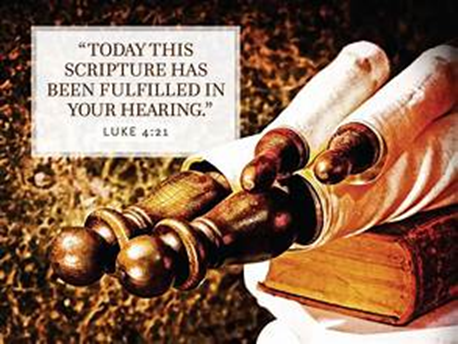
Then He closed the book, and gave it back to the attendant and sat down. And the eyes of all who were in the synagogue were fixed on Him. And He began to say to them, “Today this Scripture is fulfilled in your hearing.” So all bore witness to Him, and marveled at the gracious words which proceeded out of His mouth. And they said, “Is this not Joseph’s son?”
He said to them, “You will surely say this proverb to Me, ‘Physician, heal yourself! Whatever we have heard done in Capernaum, do also here in Your country.’” Then He said, “Assuredly, I say to you, no prophet is accepted in his own country. But I tell you truly, many widows were in Israel in the days of Elijah, when the heaven was shut up three years and six months, and there was a great famine throughout all the land; but to none of them was Elijah sent except to Zarephath, in the region of Sidon, to a woman who was a widow. And many lepers were in Israel in the time of Elisha the prophet, and none of them was cleansed except Naaman the Syrian.”
So all those in the synagogue, when they heard these things, were filled with wrath, and rose up and thrust Him out of the city; and they led Him to the brow of the hill on which their city was built, that they might throw Him down over the cliff. Then passing through the midst of them, He went His way.”
Ah, there’s nothing so sweet as coming back to your home town to be with friends and family…or is there? After surviving temptation by Satan, Jesus has begun traveling throughout the Galilee, preaching and teaching in the synagogues and “being glorified by all.” WOW! Great stuff! So when Jesus returns to Nazareth, his friends and family have high expectations. After all, Jesus has performed miracles in other places, so what might he do in Nazareth? When Jesus enters the synagogue that Sabbath, crowds follow him, eager to watch some great miracle.
Jesus makes a good start by reading the Haftorah for the day, Isaiah 61:1-2. “The Spirit of the Lord is upon Me, Because He has anointed Me To preach the gospel to the poor; He has sent Me to heal the brokenhearted, To proclaim liberty to the captives And recovery of sight to the blind, To set at liberty those who are oppressed; To proclaim the acceptable year of the Lord.” Those watching fail to realize that Isaiah has written this prophecy specifically about Jesus, but Jesus knows and assures the crowd that “Today this Scripture is fulfilled in your hearing.” While some of the crowd are very impressed, there are others who are grumbling to themselves. “Wait a minute! This is Jesus, Joseph’s son! This guy is a carpenter, so why is he applying a Messianic prophecy to himself? We grew up with this guy. We played with him in the streets. There’s no mystery about Jesus.” The faith quotient in the crowd is plummeting, and Jesus can feel it.
Jesus knows exactly what these men are thinking and openly quotes a common proverb, “Physician, heal thyself.” Jesus has already performed miracles in Capernaum, and the home town crowd now expects that he’ll do even greater stuff in Nazareth. Expectations are rapidly turning to demands as these men wait eagerly to see what will happen next.
But Jesus doesn’t work to fulfill anybody’s expectations; he only does the will of his Heavenly Father. Jesus proceeds to inform the crowd that God chooses times and places and follows up by saying that no prophet is accepted in his home country. Jesus continues, reminding them that during the terrible famine, Elijah went to a widow in Zarephath, not to a widow in Israel, and that Elisha healed Naaman, a Syrian, of his leprosy, not a leper from Israel.
The crowds are furious! Never mind that Jesus has accurately discerned their lack of faith and their lust for signs and wonders, he has failed to perform on command and they are outraged! Some of the biggest guys in the crowd seize Jesus, dragging him out of the synagogue and up the street to the top of a high cliff, intending to throw him off the edge. But Jesus’ time to die is three years in the future, and somehow Jesus simply walks through the crowd and out of town.
Why doesn’t Jesus satisfy the home town crowd and perform a few simple miracles to justify his ministry? Surely, somewhere on the edge of town, there must be one or two lepers who need healing. Jesus might simply wave his hand over a leper and people can watch fingers and toes grow back, facial features be reconstructed, etc. The answer is simple: Jesus has come to preach, teach, and heal, but not to put on shows. For all we know, as Jesus leaves town, he might heal the lepers hanging around the outskirts, for lepers are not allowed to mingle with healthy people. It’s not that Jesus lacks compassion but that his sense of mission is too strong for him to cheapen ministry by turning it into a performance.
There is a second aspect of this story: it illustrates how rapidly public acclaim can turn to public damnation. The crowd becomes incensed when Jesus refuses to perform on cue. This lightning-fast reversal of public acclaim foreshadows the events of Palm Sunday and Good Friday. On Palm Sunday Jesus will enter to shouts of “Hosanna to the Son of David!” Five days later, the same people will be screaming, “Crucify him!”
We don’t know what God the Father tells Jesus that evening when Jesus goes to Him in prayer, but it’s quite possible that God the Father warns Jesus that this is what will eventually happen. The take-home lesson for us is simple: Do what is right and refuse to believe public opinion, for people are fickle and easily swayed. We must always listen to God and not to men, for men can change in an instant.
PRAYER: Father God, thank You for loving us and for caring for us. Lord, help us to always listen to You and not to people. Help us to remember that You are the One who calls us to work for You and we are not to cheapen ministry by turning it into a circus act. In the mighty and precious Name of King Jesus. Amen.
 Burunche's Blog
Leave a comment