Luke 8:1-15 The Parable of the Sower
“After this, Jesus traveled about from one town and village to another, proclaiming the good news of the kingdom of God. The Twelve were with him, and also some women who had been cured of evil spirits and diseases: Mary (called Magdalene) from whom seven demons had come out; Joanna the wife of Chuza, the manager of Herod’s household; Susanna; and many others. These women were helping to support them out of their own means.
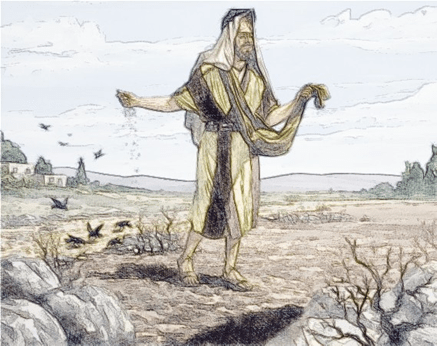
While a large crowd was gathering and people were coming to Jesus from town after town, he told this parable: “A farmer went out to sow his seed. As he was scattering the seed, some fell along the path; it was trampled on, and the birds ate it up. Some fell on rocky ground, and when it came up, the plants withered because they had no moisture. Other seed fell among thorns, which grew up with it and choked the plants. Still other seed fell on good soil. It came up and yielded a crop, a hundred times more than was sown.”
When he said this, he called out, “Whoever has ears to hear, let them hear.”
His disciples asked him what this parable meant. He said, “The knowledge of the secrets of the kingdom of God has been given to you, but to others I speak in parables, so that, “‘though seeing, they may not see; though hearing, they may not understand.’ (Isaiah 6:9)
“This is the meaning of the parable: The seed is the word of God. Those along the path are the ones who hear, and then the devil comes and takes away the word from their hearts, so that they may not believe and be saved. Those on the rocky ground are the ones who receive the word with joy when they hear it, but they have no root. They believe for a while, but in the time of testing they fall away. The seed that fell among thorns stands for those who hear, but as they go on their way they are choked by life’s worries, riches, and pleasures, and they do not mature. But the seed on good soil stands for those with a noble and good heart, who hear the word, retain it, and by persevering produce a crop.”
No matter where Jesus is or what he is teaching, he is always looking toward Calvary and he is always preparing his disciples. Here Luke mentions the women who traveled with Jesus and supported his work.
“The Twelve were with him, and also some women who had been cured of evil spirits and diseases: Mary (called Magdalene) from whom seven demons had come out; Joanna the wife of Chuza, the manager of Herod’s household; Susanna; and many others. These women were helping to support them out of their own means.”
Presumably, each of these women has been healed in some fashion and is now contributing to Jesus’ ministry out of gratitude. Some of these ladies are probably fetching wood and water wherever Jesus and the disciples lodge. Some of these women may have come from upper class families while others might have been businesswomen in their own rights. Much later, some of these women will stand at the foot of the cross on Calvary while Mary Magdalene will be one of the first people to see Jesus after he has arisen from the dead. While the disciples are listening, these women are listening as well, and will eventually spread the Gospel quietly and effectively.
Farms in Jesus’ day are not huge, for there are few places where the soil is not punctuated by rocky outcroppings. Farmers scatter seed and hope for the best; however, there are lots of problems. Seed that falls along paths through fields will be trampled and eaten by birds. Seed falling on rocks may spring up briefly; however, rocks provide no moisture, and the seedling cannot penetrate the rock to form strong root systems. There are plenty of thorn bushes scattered throughout the land, and these bushes grow much faster than the farmer’s crop. Farmers can only hope that somewhere, somehow, some seed will fall in good soil.
While the disciples demand an explanation of this parable, the women likely already understand it perfectly. These ladies have raised many children, and they can tell you all kinds of stories. There are the kids who listen and immediately go off to do whatever they are planning to do anyway. There are the kids who obey until swayed by the influence of bad friends. There are other kids who refuse to become mature adults and try to perpetually depend on their families. And then there are the kids who become fully functioning mature adults and live to give their parents joy.
There’s no need to add to Jesus’ explanation, for it is perfect. The question for us is this: What kind of soil do we have in our hearts and minds? Or, if you prefer the analogy of raising children, what kind of kid are you? Do you feel you already know everything and don’t need anybody to teach you anything? Perhaps you committed your life to Christ years ago, but you haven’t grown as a believer. There’s a story about an old man who got gloriously saved when he was young and who wrote out a testimony about his salvation; however, this man never matured as a Christian. Whenever someone asked this man about his relationship to Jesus, he would haul out his written testimony. But one day when the man asked his wife to fetch the testimony, his wife came back to tell him, “The mice have eaten your testimony.” Have the mice eaten your testimony?
How deep are your spiritual roots? In some parts of the world, Christians are dying for their faith. Are your roots that deep? Or are you allowing the stresses and strains of life to distract you, choking your faith?
How can we make sure that our hearts remain receptive to all God has to teach us? PRAY!!! Ask God to give you a teachable heart and a receptive spirit. When faced with a perplexing situation, you can ask God to help you die to your own imaginations for the way things should work. And continue to read God’s Word, studying it and asking God to show you what He wants you to learn today. When I was about nine years old, I realized that if I read 3 pages a day in my Bible, I could go through the Bible in a year. For decades, I have read part of the Old Testament, a chapter from Psalms, a chapter from Proverbs, something from the prophets, something from the Gospels, and something from the epistles on a daily basis. I have no idea how many times I have read the Bible through, but it might be as many as one hundred or more. There are also certain passages I read daily, notably, Deuteronomy 6, 1 Corinthians 13, and Galatians 6:1-10. I am not giving these details to boast but to assure you that no matter how many times I read a piece of Scripture, there is always something new to be gained from it.
There are all kinds of Bible reading plans out there. If you don’t find any of them helpful, I encourage you to read one of the Psalms and the appropriate chapter from Proverbs daily. (You can break Psalm 119 into 20-verse segments if you wish. That’s normally what I do.) If you want to read the Gospels, begin with the Book of John, for it tells you more about the nature of Jesus than do any of the other Gospels. You can also pray the prayer from Psalm 119:18 “Open my eyes that I may see wonderful things in your law.”
PRAYER: Father God, thank You for loving us and for caring for us. Lord, open our eyes that we may see wonderful things in Your law. And give us teachable hearts and spirits, so that Your Gospel will fall on good soil and yield a peaceable crop of righteousness in our hearts, minds, and lives. In the mighty and precious Name of King Jesus. Amen.
 Burunche's Blog
Leave a comment