John 21:1-14 Jesus and the Miraculous Catch of Fish
“Afterward Jesus appeared again to his disciples, by the Sea of Galilee. It happened this way: Simon Peter, Thomas (also known as Didymus), Nathanael from Cana in Galilee, the sons of Zebedee, and two other disciples were together. “I’m going out to fish,” Simon Peter told them, and they said, “We’ll go with you.” So they went out and got into the boat, but that night they caught nothing.
Early in the morning, Jesus stood on the shore, but the disciples did not realize that it was Jesus.
He called out to them, “Friends, haven’t you any fish?”
“No,” they answered.
He said, “Throw your net on the right side of the boat and you will find some.” When they did, they were unable to haul the net in because of the large number of fish.
Then the disciple whom Jesus loved said to Peter, “It is the Lord!” As soon as Simon Peter heard him say, “It is the Lord,” he wrapped his outer garment around him (for he had taken it off) and jumped into the water. The other disciples followed in the boat, towing the net full of fish, for they were not far from shore, about a hundred yards. When they landed, they saw a fire of burning coals there with fish on it, and some bread.
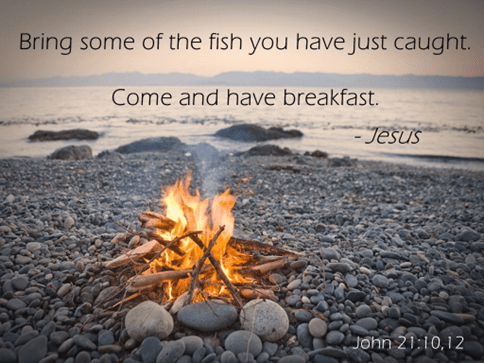
Jesus said to them, “Bring some of the fish you have just caught.” So Simon Peter climbed back into the boat and dragged the net ashore. It was full of large fish, 153, but even with so many the net was not torn. Jesus said to them, “Come and have breakfast.” None of the disciples dared ask him, “Who are you?” They knew it was the Lord. Jesus came, took the bread and gave it to them, and did the same with the fish. This was now the third time Jesus appeared to his disciples after he was raised from the dead.”
When Jesus appeared to Mary Magdalene at the Garden tomb, he told her to inform the disciples that he was going ahead of them to Galilee. The disciples show up in Galilee, and since most of them are fishermen, they naturally think about heading out on the lake. But after spending the entire night, the nets are empty and the disciples are frustrated. Then the disciples hear a shout from the shore. “Friends, haven’t you any fish?”
“No,” they answered.
He said, “Throw your net on the right side of the boat and you will find some.” When they did, they were unable to haul the net in because of the large number of fish.”
Although John is writing this Gospel, he routinely refers to himself as “the disciple whom Jesus loved.” Now the penny drops for John and he cries out, “It’s the Lord!” Suddenly, Peter remembers the first time he has seen a similar miracle-the day Jesus borrowed his boat as a makeshift pulpit and then ordered him to go fishing in the middle of the day. Peter immediately wraps his outer garment around him, hops out of the boat, and splashes to the shore to greet Jesus. Meanwhile, the other disciples also hop out of the boat and drag the bulging net and the boat full of fish to shore because the water is very shallow. Jesus grills some of the fish and feeds the disciples with fish and bread.
John 21:15-25 Jesus Reinstates Peter
“When they had finished eating, Jesus said to Simon Peter, “Simon son of John, do you love me more than these?”
“Yes, Lord,” he said, “you know that I love you.”
Jesus said, “Feed my lambs.”
Again Jesus said, “Simon son of John, do you love me?”
He answered, “Yes, Lord, you know that I love you.”
Jesus said, “Take care of my sheep.”
The third time he said to him, “Simon son of John, do you love me?”
Peter was hurt because Jesus asked him the third time, “Do you love me?” He said, “Lord, you know all things; you know that I love you.”
Jesus said, “Feed my sheep. Very truly I tell you, when you were younger you dressed yourself and went where you wanted; but when you are old you will stretch out your hands, and someone else will dress you and lead you where you do not want to go.” Jesus said this to indicate the kind of death by which Peter would glorify God. Then he said to him, “Follow me!”
Peter turned and saw that the disciple whom Jesus loved was following them. (This was the one who had leaned back against Jesus at the supper and had said, “Lord, who is going to betray you?”) When Peter saw him, he asked, “Lord, what about him?”
Jesus answered, “If I want him to remain alive until I return, what is that to you? You must follow me.” Because of this, the rumor spread among the believers that this disciple would not die. But Jesus did not say that he would not die; he only said, “If I want him to remain alive until I return, what is that to you?”
This is the disciple who testifies to these things and who wrote them down. We know that his testimony is true.
Jesus did many other things as well. If every one of them were written down, I suppose that even the whole world would not have room for the books that would be written.”
Although Peter has seen Jesus along with the other disciples, this morning is the first time Jesus and Peter have met privately since Peter denied Jesus three times as Jesus was being interrogated. Peter is understandably nervous; what if Jesus completely rejects him as a disciple? Even though Peter was previously one of the leaders in the group of disciples, now he figures the best he can hope for is for Jesus not to refuse for him to continue to belong to that group.
Three times, Jesus asks Peter if Peter loves him. Why three times? Remember that Peter denied Jesus three times; now Jesus gives Peter the chance to reverse that betrayal. David Guzik points out: “Jesus asked the question twice using the word agapas, which in its Biblical usage often speaks of an all giving, uncaused, unselfish love. Peter answered Jesus using the word philio, which in Biblical usage sometimes has in mind a more reciprocal love, a friendly affection. Some translations express Peter’s answer as, “I am your friend…. The third time Jesus slightly changed His question. He asked Peter if he did in fact have a brotherly love, a friendly devotion to Jesus (phileis).”
“Peter in his first two answers uses a less exalted word, and one implying a consciousness of his own weakness, but a persuasion and deep feeling of personal love. Then in the third question, the Lord adopts the word of Peter’s answer, the closer to press the meaning of it home to him.” (Alford)
Finally, Jesus re-commissions Peter to tend his sheep and feed his lambs. In addition, Jesus also prophesies over Peter regarding the manner of Peter’s eventual death. Peter, wishing to deflect attention away from himself, points to John and asks, “What about him?” Jesus replies, “Don’t worry about John; even if I choose for him to live until I return, what is that to you?”
Not only does Jesus take the opportunity to feed the disciples one more time, but he also re-commissions Peter, encouraging him and informing him about his future career as a church leader.
At this point, Peter must be feeling incredible. From depression over his failures and betrayal, now Jesus has restored and recommissioned Peter. Peter now realizes that he will have to depend on Jesus and not on himself for the rest of his life, but Jesus loves him and is giving him a new assignment. No matter how bad things get, from now on, Peter will never look back.
Many of us have been in Peter’s place; we have done the very thing we swore we would never do. When we should have supported a friend, we have deserted instead. But how will we make it through the rest of our lives? That’s where Jesus’ forgiveness and encouragement become fundamental. We might not be able to trust ourselves, but we can trust the Man who has already survived death, hell, and the grave.
PRAYER: Father God, thank You for loving us and for caring for us. Lord, we have messed up! We feel as if our situations are irretrievable. But You are the God of second, third, and fourth chances. You can redeem our failures. Please change us into Your image and help us to follow hard after You all the days of our lives. In the mighty and precious Name of King Jesus. Amen.
 Burunche's Blog
Leave a comment