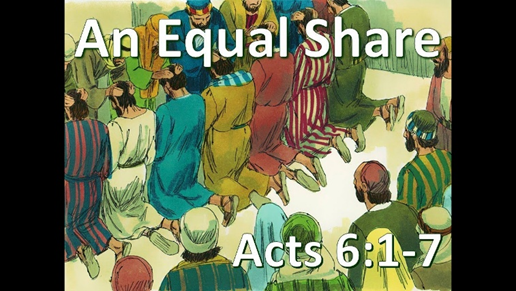
Acts 6:1-7 Seven Chosen to Serve
“Now in those days, when the number of the disciples was multiplying, there arose a complaint against the Hebrews by the Hellenists, because their widows were neglected in the daily distribution. Then the twelve summoned the multitude of the disciples and said, “It is not desirable that we should leave the word of God and serve tables. Therefore, brethren, seek out from among you seven men of good reputation, full of the Holy Spirit and wisdom, whom we may appoint over this business; but we will give ourselves continually to prayer and to the ministry of the word.”
And the saying pleased the whole multitude. And they chose Stephen, a man full of faith and the Holy Spirit, and Philip, Prochorus, Nicanor, Timon, Parmenas, and Nicolas, a proselyte from Antioch, whom they set before the apostles; and when they had prayed, they laid hands on them. Then the word of God spread, and the number of the disciples multiplied greatly in Jerusalem, and a great many of the priests were obedient to the faith.”
While the Jesus followers are sharing everything in common, sometimes the sharing appears to be lopsided, with the Hebrew widows getting more resources than the widows from other ethnic groups, particularly the Greeks. Certainly, the twelve disciples have no intention of being unfair; however, they are overburdened as church membership explodes, and those tasked with the distribution fail to understand their roles completely. It’s also natural that Hebrews who understand the language of the Hebrew widows might accidentally favor those with whom they can communicate more freely. There are undoubtedly hundreds of different ethnic groups in Jerusalem, and communication with some widows is undoubtedly challenging.
As a doctor working in rural northern Ghana, I can attest to the problems of communication in minor tribal languages. Many days, we might go through six or more tribal languages in our consulting room. Some of our Fulani ladies only speak Fulfulde, and we are frequently reduced to hand gestures to ask questions such as cough, vomiting, diarrhea, etc. In such circumstances, it is easy to overlook crying needs. (Incidentally, I have provided all kinds of entertainment for my nursing staff with my graphic demonstrations of vomiting and diarrhea! And no, I am not posting any Tiktok videos!)
“Then the twelve summoned the multitude of the disciples and said, “It is not desirable that we should leave the word of God and serve tables. Therefore, brethren, seek out from among you seven men of good reputation, full of the Holy Spirit and wisdom, whom we may appoint over this business; but we will give ourselves continually to prayer and to the ministry of the word.”
The twelve disciples are being very smart. First, they consult “the multitude of disciples.” Proverbs 24:6 tells us, “For by counsel you will wage your own war, and in a multitude of counselors there is safety.” By consulting a number of people from different backgrounds, the twelve are ensuring that they won’t make a mistake when they select seven men to handle the equitable distribution of resources to widows. The twelve also demonstrate wisdom by realizing that they can’t handle all responsibilities, so they need to delegate. In addition, the twelve clearly understand that their business is to “give ourselves continually to prayer and to the ministry of the word.” While we can pray while working, ministering the word requires long periods of silence so that God can speak to us, an impossibility if one is handling relief supplies.
One famous Christian writer has spoken about the need to eliminate distractions and concentrate on God’s calling for our lives. The disciples are giving a graphic demonstration of those principles.
“And they chose Stephen, a man full of faith and the Holy Spirit, and Philip, Prochorus, Nicanor, Timon, Parmenas, and Nicolas, a proselyte from Antioch, whom they set before the apostles; and when they had prayed, they laid hands on them.” Looking at these names, it is obvious that some of these men are Greeks, a fact that will placate the Hellenists. Also notice that these men were only appointed after prayer and dedication; they weren’t simply handed assignments and ordered to go out and work.
“Then the word of God spread, and the number of the disciples multiplied greatly in Jerusalem, and a great many of the priests were obedient to the faith.” The word of God is spreading because the disciples are praying and ministering the word as well as making other disciples, who are also praying and ministering the word. The last observation is fascinating. Evidently, there are large numbers of Jewish priests who have been sincerely awaiting the Messiah. These men have realized that their Messiah has come and are now following Jesus. Why are the numbers of disciples multiplying? People are seeing that the good news of Jesus’ death and resurrection and his payment for sin-debt is real, and that those following Jesus’ teachings are making an enormous difference in people’s lives.
Jesus told his disciples early on that men would see their good works and glorify the Father who is in heaven. Now that promise is being fulfilled in Jerusalem and lives are being transformed. Are we allowing Jesus’ teachings to transform our own lives, or do we view them as nice platitudes with little application for us? May God speak to our hearts so that we will become true Jesus followers!
PRAYER: Father God, thank You for loving us and for caring for us. Lord, please help us to follow hard after You all the days of our lives. In the mighty and precious Name of King Jesus. Amen.
 Burunche's Blog
Leave a comment