
Acts 10:1-7 Cornelius Sends for Peter
“At Caesarea there was a man named Cornelius, a centurion in what was called the Italian Regiment. He and all his household were devout and God-fearing. He gave generously to the people and prayed to God regularly. One day at about the ninth hour, he had a clear vision of an angel of God who came to him and said, “Cornelius!”
Cornelius stared at him in fear and asked, “What is it, Lord?”
The angel answered, “Your prayers and gifts to the poor have ascended as a memorial offering before God. Now send men to Joppa to call for a man named Simon who is called Peter. He is staying with Simon the tanner, whose house is by the sea.”
When the angel who spoke to him had gone, Cornelius called two of his servants and a devout soldier from among his attendants. He explained what had happened and sent them to Joppa.”
Many Roman commanders stationed in various parts of the Roman Empire are suffering from isolation and poor living conditions. But Cornelius, a centurion in the Italian Regiment, has settled in Caesarea, Herod’s magnificent artificial port on the Mediterranean Sea. Cornelius and his entire household are devout and God-fearing. Rather than embracing traditional Roman gods or the worship of the god Mithras, a cult popular among Roman soldiers from the 1st-4th century AD, Cornelius and his household are worshiping Yaweh and praying regularly. Cornelius is praying about 3 PM when an angel appears, instructing him to send for Simon Peter, who is staying with a believer named Simon the tanner in Joppa, just up the coast from Caesarea.
Cornelius immediately sends a three-man delegation to Peter. Meanwhile, God is about to shock Peter, shaking him out of his preconceptions.
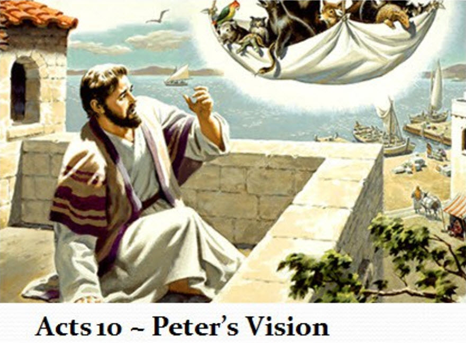
Acts 10:9-16 Peter’s Vision (Leviticus 11:1–47; Deuteronomy 14:1–21)
“The next day at about the sixth hour, as the men were approaching the city on their journey, Peter went up on the roof to pray. He became hungry and wanted something to eat, but while the meal was being prepared, he fell into a trance.
He saw heaven open and something like a large sheet being let down to earth by its four corners. It contained all kinds of four-footed animals and reptiles of the earth, as well as birds of the air. Then a voice said to him: “Get up, Peter, kill and eat!”
“No, Lord!” Peter answered. “I have never eaten anything impure or unclean.”
The voice spoke to him a second time: “Do not call anything impure that God has made clean.”
This happened three times, and all at once the sheet was taken back up into heaven.”
While Peter is a Jesus follower, he is also a practicing Jew and follows the Jewish dietary laws. So when Peter has a vision of all kinds of unclean animals, birds, and even snakes coming down in a sheet while he is ordered to “Kill and eat,” Peter is horrified. No, Lord!” Peter answered. “I have never eaten anything impure or unclean.”
“The voice spoke to him a second time: “Do not call anything impure that God has made clean.” This happened three times, and all at once the sheet was taken back up into heaven.”
Why does the event take place three times? Three is a number associated with divinity. God wants Peter to realize that this vision is serious and not simply due to Peter’s blood sugar dropping due to hunger.
Acts 10:17-23 Peter Called to Caesarea
“While Peter was puzzling over the meaning of the vision, the men sent by Cornelius found Simon’s house and approached the gate. They called out to ask if Simon called Peter was staying there.
As Peter continued to reflect on the vision, the Spirit said to him, “Behold, three men are looking for you. So get up! Go downstairs and accompany them without hesitation, because I have sent them.”
So Peter went down to the men and said, “Here am I, the one you are looking for. Why have you come?”
“Cornelius the centurion has sent us,” they said. “He is a righteous and God-fearing man with a good reputation among the whole Jewish nation. A holy angel instructed him to request your presence in his home so he could hear a message from you.”
So Peter invited them in as his guests. And the next day he got ready and went with them, accompanied by some of the brothers from Joppa.”
While Peter is still struggling to understand this amazing vision, Cornelius’ emissaries come to the gate. “As Peter continued to reflect on the vision, the Spirit said to him, “Behold, three men are looking for you. So get up! Go downstairs and accompany them without hesitation, because I have sent them.” Notice, God isn’t giving Peter any chance for second thoughts. Peter has just seen the vision, and now the Roman delegation has arrived. Next day, the group return to Caesarea.
At this point, Peter is probably in his late thirties or early forties and has been an observant Jew for his entire life. One of the fundamental parts of Jewish life is the dietary laws first laid down by Moses. When God orders Peter to violate these laws, it takes Peter time to realize that the Gospel is meant for the gentiles as well as for the Jews. Here is a summary of the laws with which Peter has grown up:
Food Laws in the Bible https://www.myjewishlearning.com/article/food-laws-in-the-bible/
Meat
“Meat was restricted by dietary laws. “You may eat any animal that has a split hoof completely divided and that chews the cud” (Leviticus 11:3). The key word is “and,” for Leviticus 11 continues to describe the animals that have one or another attribute, but not both at the same time, e.g., the camel, coney, rabbit, and pig. Of them, it says, “You must not eat their meat or touch their carcasses” (Leviticus 11:4-8). This leaves the sheep, goat, ox, steer, and wild game, e.g., gazelle, deer, roebuck, wild goat, wild ox, and chamois. Even ritually fit animals, however, were subject to certain regulations and methods of preparation.
Meat was usually boiled, but was also roasted as prescribed for the paschal lamb at Passover, or cooked in a stew. At no time could a kid be boiled in its mother’s milk (Exodus 23:19; 34:26; Deuteronomy 14:21). The regulation was later extended to include the prohibition against even eating meat and milk products together at the same meal. Archaeology has proved it to have been a ban on a pagan practice. Findings at Ugarit [an ancient city whose ruins are located on the Syrian coast] have shown that it was the custom there to boil a kid in its mother’s milk as a lucky charm.
Fowl
Certain kinds of fowl were forbidden, including birds of prey (eagle, osprey, hawk, falcon, owl); those that feed on carrion (vulture, buzzard, raven); certain waterbirds (pelican, stork, heron, swan, sea gull); and other birds (ostrich, bat, lapwing). Poultry (goose, chicken, duck), pigeon and doves, and wild birds not on the above list were permitted (Leviticus 11:13-19; Deuteronomy 14:12-18). Only the eggs of clean fowl could be eaten.
Fish
Fish could be eaten if it had fins and scales. This excluded all shellfish and fish that had fins but no scales, e.g., shark, catfish, and eels (Leviticus 11:9-12; Deuteronomy 14:9-10).
Insects and creeping things
Certain insects were acceptable as food, including the locust, katydid, cricket, and grasshopper. “All other flying insects that have four feet shall be an abomination to you” (Leviticus 11:20-24). Creeping things that crawl upon the earth are considered unclean, including worms, caterpillars, snakes, snails, lizards, chameleon, and moles (Leviticus 11:30,41-43).
According to Mosaic law, if any of the unclean creeping things dies and falls into a clay water pot, the water is to be considered unclean, and a source of contamination. The clay pot must be broken and if the carcass of a creeping thing touches the oven, it must be broken as well (Leviticus 11:33-35).
Excerpted from the entry “Food” in the Almanac of the Bible, edited by Geoffrey Wigoder, Shalom M. Paul, and Benedict T. Viviano, published by Prentice-Hall. Most of the distinctions described here remain in practice among those who observe Jewish dietary laws, but the identification of insects that may be eaten was retained only in some Middle Eastern communities (notably in Yemen) and is practiced only rarely in our time.”
There’s a story about a missionary working in South America who found he had to work with members of a different denomination at some point. “But God!” this man complained, “These people don’t believe the way I do!” “Well,” replied the Lord, “I don’t always believe the same way you do either, but I still work with you!” Putting it bluntly, God doesn’t care about our prejudices; He’s far more interested in our sharing His love with those around us. May God help us, so that we will be as sensitive to the Holy Spirit as Peter is in this story!
PRAYER: Father God, thank You for loving us and caring for us. Lord, help us to be obedient to Your Holy Spirit, rather than to our prejudices. In the mighty and precious Name of King Jesus. Amen.
 Burunche's Blog
Leave a comment