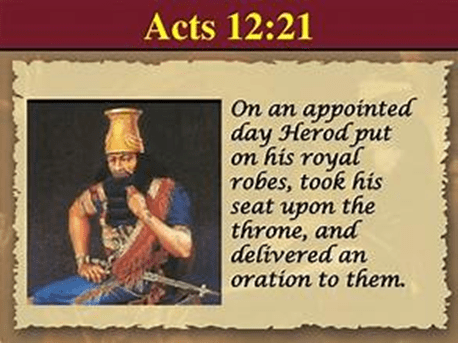
Acts 12:20- 24 Herod’s Violent Death
“Now Herod had been very angry with the people of Tyre and Sidon; but they came to him with one accord, and having made Blastus the king’s personal aide their friend, they asked for peace, because their country was supplied with food by the king’s country.
So, on a set day Herod, arrayed in royal apparel, sat on his throne and gave an oration to them. And the people kept shouting, “The voice of a god and not of a man!” Then immediately an angel of the Lord struck him, because he did not give glory to God. And he was eaten by worms and died.
But the word of God grew and multiplied.”
Those who must deal with Herod on a regular basis feel he is a megalomaniac with an ego that won’t quit. Certainly, there is no simple means of dealing with this man, for if you flatter too little, you might lose influence. On the other hand, no amount of effusive flattery appears to be too much for Herod. The more grandiose the praise, the more Herod revels in it.
After Peter has escaped Herod’s jail, despite the four squads of Roman soldiers Herod has sent to guard him, Herod huffs off to his magnificent port of Caesarea on the coast. Caesarea is a true triumph of engineering, for it is a self-cleaning port designed to avoid the silting problem that has plagued so many other ports around the Mediterranean Sea. The kingdom of Tyre is built on a peninsula that juts out into the sea; while Tyre is a major trading city, it depends on Herod’s lands for its food. While Sidon is a coastal city, it too gets its food from further inland.
We don’t know what the citizens of Tyre and Sidon have done to offend Herod; however, they are sensible to the need to make peace with him. After all, no peace with Herod means no food! Through Herod’s personal aid, Blastus, these people invite Herod to visit them. Acting on the theory that no amount of flattery is too much for Herod, these people listen raptly to Herod’s oration and then cry out, “The voice of a god and not of a man!” Herod stands there in the sunlight, preening himself. Surely, this must be one of the finest moments of Herod’s entire career…or is it?
The Bible records that suddenly an angel strikes Herod and that he is eaten by worms and dies. The ancient Jewish historian Josephus gives this description: “He put on a garment made wholly of silver, and of a contexture truly wonderful, and came into the theatre early in the morning; at which time the silver of his garment, being illuminated by the fresh reflection of the sun’s rays upon it, shone out after a surprising manner, and was so resplendent as to spread a horror over those that looked intently upon him; and presently his flatterers cried out, one from one place, and another from another (though not for his good), that he was a god…A severe pain also arose in his belly, and began in a most violent manner… when he had been quite worn out by the pain in his belly for five days, he departed this life.” (Antiquities, XIX.8.2)
Did Herod suffer a perforated peptic ulcer or an intestinal perforation from typhoid or some other illness? Whatever has happened must be quite sudden. A perforated peptic ulcer would certainly fit the description, and dying within five days would be a strong possibility with such a perforation. The agony from unrestricted amounts of gastric juice pouring into one’s abdomen cannot be overstated.
Was it necessary for Herod to die in this fashion? NO! Through the years, God gave Herod all kinds of opportunities to repent and to worship Him. But Herod persisted in worshiping himself and paid a horrific price for doing so.
We read this account and think smugly, “Well, I would never do anything like that.” But is that true, or are we “legends in our own minds?” While we might not parade in front of a crowd dressed in silver clothing, how do we handle ourselves in public or on social media? Are we truly worshiping God in everything we do, or do we confine worship to one hour on Sunday morning? And if we confine worship to that small a time period, is it really worship in the first place? Do we acknowledge God as our Redeemer and our Creator, or do we think we are “self-made people?”
Eventually, even righteous Job repented, telling God, “I have heard of You by the hearing of the ear, but now my eye sees You. Therefore, I abhor myself, and repent in dust and ashes.”
When Jesus was speaking to the Samaritan woman at the well, he told her, “God is Spirit, and those who worship Him must worship in spirit and truth.” (John 4:24) May God help us, so that we will worship Him and nobody else and that we will worship in spirit and truth.
PRAYER: Father God, thank You for loving us and for caring for us. Lord, help us to truly worship You and nobody and nothing else. In the mighty and precious Name of King Jesus. Amen.
 Burunche's Blog
Leave a comment