Archive for May, 2025

MAY 21, 2025 FOLLOWING JESUS IN A POST-ASCENSION WORLD #27 WHY DOES GOD ALLOW SOME BELIEVERS TO SUFFER AND DIE FOR THEIR FAITH WHILE DELIVERING OTHERS?

May 21, 2025

Acts 12:1-4 Herod’s Violence to the Church

“Now about that time Herod the king stretched out his hand to harass some from the church. Then he killed James the brother of John with the sword. And because he saw that it pleased the Jews, he proceeded further to seize Peter also. Now it was during the Days of Unleavened Bread. So, when he had arrested him, he put him in prison, and delivered him to four squads of soldiers to keep him, intending to bring him before the people after Passover.

Acts 12:5-19 Peter Freed from Prison

“Peter was therefore kept in prison, but constant prayer was offered to God for him by the church. And when Herod was about to bring him out, that night Peter was sleeping, bound with two chains between two soldiers; and the guards before the door were keeping the prison. Now behold, an angel of the Lord stood by him, and a light shone in the prison; and he struck Peter on the side and raised him up, saying, “Arise quickly!” And his chains fell off his hands. Then the angel said to him, “Gird yourself and tie on your sandals;” and so he did. And he said to him, “Put on your garment and follow me.” So, he went out and followed him, and did not know that what was done by the angel was real, but thought he was seeing a vision. When they were past the first and the second guard posts, they came to the iron gate that leads to the city, which opened to them of its own accord; and they went out and went down one street, and immediately the angel departed from him.

And when Peter had come to himself, he said, “Now I know for certain that the Lord has sent His angel, and has delivered me from the hand of Herod and from all the expectation of the Jewish people.”

So, when he had considered this, he came to the house of Mary, the mother of John whose surname was Mark, where many were gathered together praying. And as Peter knocked at the door of the gate, a girl named Rhoda came to answer. When she recognized Peter’s voice, because of her gladness she did not open the gate, but ran in and announced that Peter stood before the gate. But they said to her, “You are beside yourself!” Yet she kept insisting that it was so. So, they said, “It is his angel.”

Now Peter continued knocking; and when they opened the door and saw him, they were astonished. But motioning to them with his hand to keep silent, he declared to them how the Lord had brought him out of the prison. And he said, “Go, tell these things to James and to the brethren.” And he departed and went to another place.

Then, as soon as it was day, there was no small stir among the soldiers about what had become of Peter. But when Herod had searched for him and not found him, he examined the guards and commanded that they should be put to death. And he (Herod) went down from Judea to Caesarea, and stayed there.”

Herod doesn’t believe in God, but he does believe in maintaining good relationships with Jewish leaders. First, Herod kills James, the brother of John. James has followed Jesus ever since the day that Jesus walked on that sea shore and called both James and John to follow him. Now James is paying for his faithfulness with his life. Next, Herod seizes Peter and even has him guarded with four squads of soldiers. It’s possible Herod intends to kill Peter as well; however, it’s Passover time, so Herod keeps Peter in jail until the end of the celebrations.

But God has other designs for Peter and miraculously delivers Peter from that prison guarded by all those soldiers.

“And when Herod was about to bring him out, that night Peter was sleeping, bound with two chains between two soldiers; and the guards before the door were keeping the prison. Now behold, an angel of the Lord stood by him, and a light shone in the prison; and he struck Peter on the side and raised him up, saying, “Arise quickly!” And his chains fell off his hands. Then the angel said to him, “Gird yourself and tie on your sandals;” and so he did. And he said to him, “Put on your garment and follow me.” So, he went out and followed him, and did not know that what was done by the angel was real, but thought he was seeing a vision. When they were past the first and the second guard posts, they came to the iron gate that leads to the city, which opened to them of its own accord; and they went out and went down one street, and immediately the angel departed from him.”

Tonight is Peter’s last night in jail, for tomorrow Herod intends to haul Peter out and kill him in some ghastly fashion, making him an example to frighten Christians. Peter is sleeping, bound with two chains between two soldiers, with more guards standing before the door of the prison. God sends an angel who frees Peter from his chains and leads him out of the prison, right past all those guards. Peter shows himself to those praying for him, who at first refuse to believe that their prayers have actually been answered. “It’s really me,” says Peter, and then leaves to hide in a safe place. Meanwhile, when Herod learns Peter has somehow escaped, he puts those soldiers guarding Peter to death, and then leaves Jerusalem for Caesarea.

James is a good man, so why does God allow Herod to slaughter James but delivers Peter from prison with all those armed guards? Evidently, James has fulfilled his purposes in the fledgling church, while Peter will remain for many more years before finally also being martyred in Rome. God’s purposes are sure; however, His ways are not to be traced. I have just finished re-reading the Book of Job, which describes the sufferings of a righteous man. Job’s only failing is that he questions God; however, God makes it clear to Job’s friends that Job is righteous while they, despite all their lectures, are not. God allows Job to suffer, but ultimately restores to Job far more than Job lost in the first place.

During our missionary careers, the projects on which we have worked have endured many kinds of upheavals. It is frustrating in the extreme to read accounts of fellow missionaries working in other projects where the facilities are far nicer, drugs and consumables are readily available, and personnel problems appear to be at a minimum. One mission group with which we work requests that we complete a monthly questionnaire. This questionnaire includes such questions as “Are you following your plans for family recreation?” “When is your next scheduled time away from your station?” “Are you discipling others?” Answering these questions honestly can pose a major challenge. We are constantly reminded of that old saying that “When you’re up to your rear end in alligators, it’s difficult to remember that your original objective was to drain the swamp.” Somehow, we perpetually find ourselves assailed by alligators, and we are hard-pressed to survive, let alone attempt to do anything else.

Queen Esther would probably have been quite happy, had she been able to settle down with some nice young man and quietly raise a family. Instead, because of Esther’s beauty, she was sent to the royal palace and eventually made a queen. Then Esther’s uncle Mordecai got wind of a heinous plot to wipe out all the Jews in the entire Persian kingdom. Mordecai sent a message to Esther. “Do not think in your heart that you will escape in the king’s palace any more than all the other Jews. For if you remain completely silent at this time, relief and deliverance will arise for the Jews from another place, but you and your father’s house will perish. Yet who knows whether you have come to the kingdom for such a time as this?” (Esther 4:13-14)

J. R. R. Tolkein aptly describes such situations in his book The Fellowship of the Ring. “I wish it need not have happened in my time,” said Frodo.
“So do I,” said Gandalf, “and so do all who live to see such times. But that is not for them to decide. All we have to decide is what to do with the time that is given us.”

The words of an old hymn point the way.

Once to every man and nation, comes the moment to decide,
in the strife of truth with falsehood, for the good or evil side;
some great cause, some great decision, offering each the bloom or blight,
and the choice goes by forever, ‘twixt that darkness and that light.

Then to side with truth is noble, when we share her wretched crust,
ere her cause bring fame and profit, and ’tis prosperous to be just;
then it is the brave man chooses while the coward stands aside,
till the multitude make virtue of the faith they had denied.

By the light of burning martyrs, Christ, thy bleeding feet we track,
toiling up new Calvaries ever with the cross that turns not back;
new occasions teach new duties, ancient values test our youth;
they must upward still and onward, who would keep abreast of truth.

Though the cause of evil prosper, yet the truth alone is strong;
though her portion be the scaffold, and upon the throne be wrong;
yet that scaffold sways the future, and behind the dim unknown,
standeth God within the shadow, keeping watch above his own.”

May God help us, so that whether we face the fate of James or Peter, we will continue to be faithful!

PRAYER: Father God, thank You for loving us and for caring for us. Lord, help us to trust You, no matter what is happening in our situations, knowing that You are able to deliver or to give courage to endure. In the mighty and precious Name of King Jesus. Amen.

MAY 20, 2025 FOLLOWING JESUS IN A POST-ASCENSION WORLD #26 THE GOSPEL BEGINS SPREADING LIKE A VIRUS!

May 20, 2025

Acts 11:19-26 Barnabas and Saul at Antioch

“Now those who were scattered after the persecution that arose over Stephen traveled as far as Phoenicia, Cyprus, and Antioch, preaching the word to no one but the Jews only. But some of them were men from Cyprus and Cyrene, who, when they had come to Antioch, spoke to the Hellenists, preaching the Lord Jesus. And the hand of the Lord was with them, and a great number believed and turned to the Lord.

Then news of these things came to the ears of the church in Jerusalem, and they sent out Barnabas to go as far as Antioch. When he came and had seen the grace of God, he was glad, and encouraged them all that with purpose of heart they should continue with the Lord. For he was a good man, full of the Holy Spirit and of faith. And a great many people were added to the Lord.

Then Barnabas departed for Tarsus to seek Saul. And when he had found him, he brought him to Antioch. So it was that for a whole year they assembled with the church and taught a great many people. And the disciples were first called Christians in Antioch.”

Acts 11:27-30 Relief to Judea

“And in these days prophets came from Jerusalem to Antioch. Then one of them, named Agabus, stood up and showed by the Spirit that there was going to be a great famine throughout all the world, which also happened in the days of Claudius Caesar. Then the disciples, each according to his ability, determined to send relief to the brethren dwelling in Judea. This they also did, and sent it to the elders by the hands of Barnabas and Saul.”

“Now those who were scattered after the persecution that arose over Stephen traveled as far as Phoenicia, Cyprus, and Antioch, preaching the word to no one but the Jews only. But some of them were men from Cyprus and Cyrene, who, when they had come to Antioch, spoke to the Hellenists, preaching the Lord Jesus. And the hand of the Lord was with them, and a great number believed and turned to the Lord.”

When Stephen was stoned, believers scattered everywhere in the known world, including Phoenicia, Cyprus, and Antioch. Although the Jewish believers began by preaching only to Jews, there were other believers from Cyprus and Cyrene who felt no such restrictions and preached to everybody, including the Greeks.

When church leaders in Jerusalem heard about these conversions, they immediately dispatched Barnabas, a Jewish believer from Cyprus, to investigate these reports. Also nicknamed as “Son of Encouragement,” Barnabas is thrilled by the numbers of new believers and encourages them. But Barnabas also remembers Saul of Tarsus, that fiery Jewish scholar who is currently at Tarsus. Saul is a fine linguist and apologist, and Barnabas knows that he will be a big help at Antioch. Barnabas himself is no mean scholar; however, he is humble enough to realize that Saul’s scholarship far outstrips his. Saul and Barnabas spend an entire year in Antioch teaching new converts. The term “Christian” is first applied to believers in Antioch.

One of the amazing things about Barnabas is his humility. Barnabas is a scholar with a great deal of experience in the Christian faith, and he has been teaching and preaching extensively. Yet, Barnabas has no qualms about going to Tarsus and bringing Saul back to Antioch to teach as well. Certainly, Barnabas realizes that Saul has more learning than he does, and that Saul will undoubtedly outshine him. But Barnabas is far more concerned about the Kingdom of God being advanced than about personalities. How many of us, if put in the same position, would demonstrate this same degree of humility and willingness to involve someone else more talented than we are?

“And in these days prophets came from Jerusalem to Antioch. Then one of them, named Agabus, stood up and showed by the Spirit that there was going to be a great famine throughout all the world, which also happened in the days of Claudius Caesar. Then the disciples, each according to his ability, determined to send relief to the brethren dwelling in Judea. This they also did, and sent it to the elders by the hands of Barnabas and Saul.”

There are several things about this small story. First, when prophets come from Jerusalem to Antioch, people believe them, to the extent that when the disciples in Antioch take up a collection, people give willingly. Next, the disciples in Antioch select Barnabas and Saul to carry the collection to Jerusalem. Obviously, Saul and Barnabas have established themselves as highly responsible and accountable; otherwise, those in Antioch would send their contributions with someone else. Finally, these contributions also mark the first time that converts outside Jerusalem send relief to church headquarters, sharing resources with church leaders. Church members are beginning to realize that they belong to a larger fellowship and not merely to something confined to their immediate area.

There’s a horrible story about a selfish old man who prayed, “God bless me and my wife, my son and his wife, us four, no more. Amen.” One of the fundamental laws of the Kingdom of God is that the measure you give out is the measure you will receive. We have no idea whether the believers in Antioch were any richer than those in Jerusalem. Given the fact that many of these people had had to flee to Antioch, they might have had very little. Yet these people were willing to share their resources with others. May God help us, so that we will also be willing to share without worrying about our own poverty.

PRAYER:  Father God, thank You for loving us and for caring for us. Lord, help us to be humble enough to recognize when others have more talents to contribute than we do. Also help us to be generous, knowing that You bless those who bless others. In the mighty and precious Name of King Jesus. Amen.
MAY 19, 2025 FOLLOWING JESUS IN A POST-ASCENSION WORLD #25 PETER GETS CALLED ON THE CARPET FOR MINISTERING TO UNTOUCHABLES

May 19, 2025

Acts 11:1-18 Peter’s Report at Jerusalem

“The apostles and brothers throughout Judea soon heard that the Gentiles also had received the word of God. So when Peter went up to Jerusalem, the circumcised believers took issue with him and said, “You visited uncircumcised men and ate with them.”

But Peter began and explained to them the whole sequence of events: “I was in the city of Joppa praying, and in a trance, I saw a vision of something like a large sheet being let down from heaven by its four corners, and it came right down to me. I looked at it closely and saw four-footed animals of the earth, wild beasts, reptiles, and birds of the air. Then I heard a voice saying to me, ‘Get up, Peter, kill and eat.’

‘No, Lord,’ I said, ‘for nothing impure or unclean has ever entered my mouth.’

But the voice spoke from heaven a second time, ‘Do not call anything impure that God has made clean.’

This happened three times, and everything was drawn back up into heaven.

Just then three men sent to me from Caesarea stopped at the house where I was staying. The Spirit told me to accompany them without hesitation. These six brothers also went with me, and we entered the man’s home. He told us how he had seen an angel standing in his house and saying, ‘Send to Joppa for Simon who is called Peter. He will convey to you a message by which you and all your household will be saved.’

As I began to speak, the Holy Spirit fell upon them, just as He had fallen upon us at the beginning. Then I remembered the word of the Lord, as He used to say, ‘John baptized with water, but you will be baptized with the Holy Spirit.’ So if God gave them the same gift He gave us who believed in the Lord Jesus Christ, who was I to hinder the work of God?”

When they heard this, their objections were put to rest, and they glorified God, saying, “So then, God has granted even the Gentiles repentance unto life.”

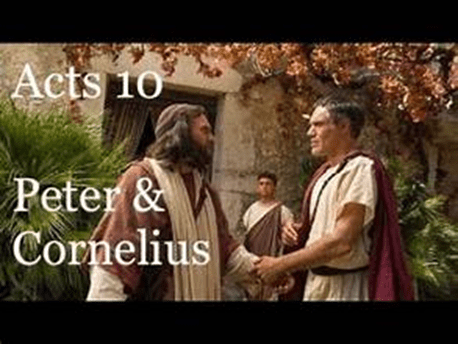
“You visited uncircumcised men and ate with them.” Well, Peter has really put his foot in it now! The circumcised Jewish believers are furious. Peter has dared to enter the house of a Roman centurion, has eaten with the household, and has even preached to them. What is Peter thinking? What sacrilege!……or is it?

Now we begin to see that the vision God has sent Peter is also for the rest of the circumcised Jewish believers. Obviously, these men have no idea of what God wants to do but think that Jesus has been sent simply to save Jews. Only as Peter describes his vision and his visit to the home of Cornelius do these men begin to soften. Then Peter continues to describe the scene as the Holy Spirit sovereignly descends, baptizing all of those present at Cornelius’ place. “So if God gave them the same gift He gave us who believed in the Lord Jesus Christ, who was I to hinder the work of God?”

Peter’s critics are astounded. “When they heard this, their objections were put to rest, and they glorified God, saying, “So then, God has granted even the Gentiles repentance unto life.”

Isaiah 55:9 tells us, “For as the heavens are higher than the earth, so are My ways higher than your ways and My thoughts than your thoughts.” God wants everyone in the entire world to be saved by believing in Jesus Christ. Jesus himself has told Nicodemus that “God so loved the world that He gave His only begotten Son, that whoever believes in him should not perish but have eternal life.” (John 3:16)

These disciples have no idea what God has in store for them. In the next few years, some of these men will find themselves traveling to far parts of the Roman Empire, with Thomas eventually suffering martyrdom in India. Persecution by the Romans will also scatter believers throughout the Roman Empire, and they will spread Christianity as they go. That fiery new convert Saul will rename himself Paul and will wind up arguing with philosophers in Athens, as well as planting churches in Macedonia and other strange places.

There is a saying that if you want to hear God laugh, just tell Him your plans. God is always doing new things, always creating, revising, improving, people and situations. We must remain close to God if we are to see what He wants us to do. And sometimes we falter. Later, we will see that Peter retreats from his bold stance in an effort to placate the circumcised Jews, only for Paul to rebuke him. Peter will ultimately remain true, and will eventually suffer crucifixion in Rome, demanding to be crucified head-down because he feels unworthy to die in the same manner as Jesus. But before that happens, Peter will lead the church into exciting new pathways, all because of a vision he has seen while staying with his friend in Joppa.

May God help us, so that we remain flexible and willing to change to fit His plans and not our own.

PRAYER: Father God, thank You for loving us and for caring for us. Lord, help us to follow hard after You all the days of our lives, even when You lead us into situations that turn our prejudices on their heads. In the mighty and precious Name of King Jesus. Amen.

MAY 18, 2025 FOLLOWING JESUS IN A POST-ASCENSION WORLD #24 PETER HAS TO DO A SPIRITUAL 180 WHEN THE HOLY SPIRIT DESCENDS!

May 18, 2025

Acts 10:24-33 Peter Visits Cornelius

“The following day he arrived in Caesarea, where Cornelius was expecting them and had called together his relatives and close friends. As Peter was about to enter, Cornelius met him and fell at his feet to worship him. But Peter helped him up. “Stand up,” he said, “I am only a man myself.”

As Peter talked with him, he went inside and found many people gathered together. He said to them, “You know how unlawful it is for a Jew to associate with a foreigner or visit him. But God has shown me that I should not call any man impure or unclean. So when I was invited, I came without objection. I ask, then, why have you sent for me?”

Cornelius answered: “Four days ago I was in my house praying at this, the ninth hour. Suddenly a man in radiant clothing stood before me and said, ‘Cornelius, your prayer has been heard, and your gifts to the poor have been remembered before God. Therefore send to Joppa for Simon, who is called Peter. He is a guest in the home of Simon the tanner, by the sea.’

So I sent for you immediately, and you were kind enough to come. Now then, we are all here in the presence of God to listen to everything the Lord has instructed you to tell us.”

Acts 10:34-43 Good News for the Gentiles

“Then Peter began to speak: “I now truly understand that God does not show favoritism, but welcomes those from every nation who fear Him and do what is right. He has sent this message to the people of Israel, proclaiming the gospel of peace through Jesus Christ, who is Lord of all.

You yourselves know what has happened throughout Judea, beginning in Galilee with the baptism that John proclaimed: how God anointed Jesus of Nazareth with the Holy Spirit and with power, and how Jesus went around doing good and healing all who were oppressed by the devil, because God was with Him.

We are witnesses of all that He did, both in the land of the Jews and in Jerusalem. And although they put Him to death by hanging Him on a tree, God raised Him up on the third day and caused Him to be seen—not by all the people, but by the witnesses God had chosen beforehand, by us who ate and drank with Him after He rose from the dead. And He commanded us to preach to the people and to testify that He is the One appointed by God to judge the living and the dead. All the prophets testify about Him that everyone who believes in Him receives forgiveness of sins through His name.”

Acts 10:44-48 The Gentiles Receive the Holy Spirit (Acts 19:1–7)

While Peter was still speaking these words, the Holy Spirit fell upon all who heard his message. All the circumcised believers who had accompanied Peter were astounded that the gift of the Holy Spirit had been poured out even on the Gentiles. For they heard them speaking in tongues and exalting God.

Then Peter said, “Can anyone withhold the water to baptize these people? They have received the Holy Spirit just as we have!” So he ordered that they be baptized in the name of Jesus Christ. Then they asked him to stay for a few days.”

Well, Peter has arrived in Caesarea; however, he’s not exactly enthusiastic about this whole process, even though Cornelius has gathered all his friends and relatives to meet Peter. Some circumcised Jewish believer friends have accompanied Peter, and they are also behaving standoffish. Peter’s introductory remarks are quite cold. “You know how unlawful it is for a Jew to associate with a foreigner or visit him. But God has shown me that I should not call any man impure or unclean. So, when I was invited, I came without objection. I ask, then, why have you sent for me?”

Despite Peter’s cool attitude, Cornelius gives a gracious answer, describing his vision and ending by saying, “Now then, we are all here in the presence of God to listen to everything the Lord has instructed you to tell us.”

“Then Peter began to speak: “I now truly understand that God does not show favoritism, but welcomes those from every nation who fear Him and do what is right. He has sent this message to the people of Israel, proclaiming the gospel of peace through Jesus Christ, who is Lord of all.” Peter goes on to tell this fascinated audience about the ministry, death, and resurrection of Jesus Christ. But what happens next is something nobody there will ever forget.

“While Peter was still speaking these words, the Holy Spirit fell upon all who heard his message. All the circumcised believers who had accompanied Peter were astounded that the gift of the Holy Spirit had been poured out even on the Gentiles. For they heard them speaking in tongues and exalting God.” God doesn’t give Peter a chance to hesitate or deliberate about laying hands on these eager new converts, for the Holy Spirit descends while Peter is still speaking. With no alternatives, Peter proceeds to conduct water baptism for all these new Jesus followers.

God has an incredible sense of humor! First, God sends Peter a vision of a sheet with all kinds of creatures no good practicing Jew will ever eat, telling Peter to “kill and eat.” God knows He has to shake up Peter’s strong prejudices against gentiles. Next, God sends Peter, not just to gentiles, but to ROMAN gentiles. The Jews have a special antipathy towards the Romans, for generally the Romans are arrogant, rude, and obnoxious bullies. Many Romans pursue all kinds of weird cults, are sexually promiscuous, and eat foods no observant Jew will ever touch. The Jews might be a defeated race, but they feel they are morally superior to

 the Romans. Now God is shaking up everything Peter thinks he knows, forcing Peter to realize that when Jesus has ordered the disciples to “go into all the world,” he truly means it. To seal the deal, the Holy Spirit descends on all of Cornelius’ family, friends, and household while Peter is still speaking. God is not giving Peter the slightest bit of wiggle room.

While we might read this story and be amused at the way God outsmarts Peter, instead, we should be examining our own hearts. Are there people whom we think are beyond redemption? Youth With A Mission has had a major ministry to prostitutes and drug addicts in Amsterdam for decades. Teen Challenge has successfully ministered to those with drug and alcohol addictions, leading them to new lives in Christ. Prison Fellowship has ministered so successfully around the world that many prisons have closed or have become models of hope.

We need to know two things: 1. We are all sinners at the foot of the Cross, deserving nothing but eternal damnation without the Blood of Jesus 2. No living person is beyond salvation, no matter what he or she has done. Corey Ten Boom tells the story of a time shortly after World War II when she had just spoken passionately on forgiveness. As Corey was shaking hands with audience members afterwards, she cam face to face with one of the former guards at the concentration camp where she and her sister had been imprisoned and where her sister had died. Now this man had gotten gloriously saved and had become a practicing Christian. Corey said that reaching out and shaking that man’s hand was one of the hardest things God ever asked her to do. But when Corey took that man’s hand, suddenly both she and her former captor were in tears, and God healed hurts in both their hearts.

May God help us, so that we will faithfully witness to all those around us, leaving our preconceived notions and cherished prejudices behind.

PRAYER: Father God, thank You for loving us and for caring for us. Lord, help us to follow You and not our prejudices. Help us to obey even as Peter did. In the mighty and precious Name of King Jesus. Amen.
MAY 17, 2025 FOLLOWING JESUS IN A POST-ASCENSION WORLD #23 GOD DOESN’T CARE ABOUT YOUR PREJUDICES!

May 17, 2025

Acts 10:1-7 Cornelius Sends for Peter

“At Caesarea there was a man named Cornelius, a centurion in what was called the Italian Regiment. He and all his household were devout and God-fearing. He gave generously to the people and prayed to God regularly. One day at about the ninth hour, he had a clear vision of an angel of God who came to him and said, “Cornelius!”

Cornelius stared at him in fear and asked, “What is it, Lord?”

The angel answered, “Your prayers and gifts to the poor have ascended as a memorial offering before God. Now send men to Joppa to call for a man named Simon who is called Peter. He is staying with Simon the tanner, whose house is by the sea.”

When the angel who spoke to him had gone, Cornelius called two of his servants and a devout soldier from among his attendants. He explained what had happened and sent them to Joppa.”

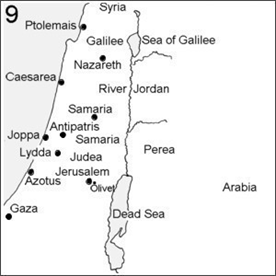
Many Roman commanders stationed in various parts of the Roman Empire are suffering from isolation and poor living conditions. But Cornelius, a centurion in the Italian Regiment, has settled in Caesarea, Herod’s magnificent artificial port on the Mediterranean Sea. Cornelius and his entire household are devout and God-fearing. Rather than embracing traditional Roman gods or the worship of the god Mithras, a cult popular among Roman soldiers from the 1st-4th century AD, Cornelius and his household are worshiping Yaweh and praying regularly. Cornelius is praying about 3 PM when an angel appears, instructing him to send for Simon Peter, who is staying with a believer named Simon the tanner in Joppa, just up the coast from Caesarea.

Cornelius immediately sends a three-man delegation to Peter. Meanwhile, God is about to shock Peter, shaking him out of his preconceptions.


Acts 10:9-16 Peter’s Vision (Leviticus 11:1–47; Deuteronomy 14:1–21)

“The next day at about the sixth hour, as the men were approaching the city on their journey, Peter went up on the roof to pray. He became hungry and wanted something to eat, but while the meal was being prepared, he fell into a trance.

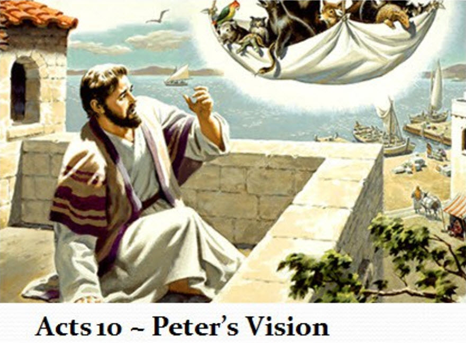
He saw heaven open and something like a large sheet being let down to earth by its four corners. It contained all kinds of four-footed animals and reptiles of the earth, as well as birds of the air. Then a voice said to him: “Get up, Peter, kill and eat!”

“No, Lord!” Peter answered. “I have never eaten anything impure or unclean.”

The voice spoke to him a second time: “Do not call anything impure that God has made clean.”

This happened three times, and all at once the sheet was taken back up into heaven.”

While Peter is a Jesus follower, he is also a practicing Jew and follows the Jewish dietary laws. So when Peter has a vision of all kinds of unclean animals, birds, and even snakes coming down in a sheet while he is ordered to “Kill and eat,” Peter is horrified. No, Lord!” Peter answered. “I have never eaten anything impure or unclean.”

“The voice spoke to him a second time: “Do not call anything impure that God has made clean.” This happened three times, and all at once the sheet was taken back up into heaven.”

Why does the event take place three times? Three is a number associated with divinity. God wants Peter to realize that this vision is serious and not simply due to Peter’s blood sugar dropping due to hunger.

Acts 10:17-23 Peter Called to Caesarea

“While Peter was puzzling over the meaning of the vision, the men sent by Cornelius found Simon’s house and approached the gate. They called out to ask if Simon called Peter was staying there.

As Peter continued to reflect on the vision, the Spirit said to him, “Behold, three men are looking for you.  So get up! Go downstairs and accompany them without hesitation, because I have sent them.”

So Peter went down to the men and said, “Here am I, the one you are looking for. Why have you come?”

“Cornelius the centurion has sent us,” they said. “He is a righteous and God-fearing man with a good reputation among the whole Jewish nation. A holy angel instructed him to request your presence in his home so he could hear a message from you.”

So Peter invited them in as his guests. And the next day he got ready and went with them, accompanied by some of the brothers from Joppa.”

While Peter is still struggling to understand this amazing vision, Cornelius’ emissaries come to the gate. “As Peter continued to reflect on the vision, the Spirit said to him, “Behold, three men are looking for you.  So get up! Go downstairs and accompany them without hesitation, because I have sent them.”  Notice, God isn’t giving Peter any chance for second thoughts. Peter has just seen the vision, and now the Roman delegation has arrived. Next day, the group return to Caesarea.

At this point, Peter is probably in his late thirties or early forties and has been an observant Jew for his entire life. One of the fundamental parts of Jewish life is the dietary laws first laid down by Moses. When God orders Peter to violate these laws, it takes Peter time to realize that the Gospel is meant for the gentiles as well as for the Jews. Here is a summary of the laws with which Peter has grown up:

Food Laws in the Bible https://www.myjewishlearning.com/article/food-laws-in-the-bible/

 Meat

“Meat was restricted by dietary laws. “You may eat any animal that has a split hoof completely divided and that chews the cud” (Leviticus 11:3). The key word is “and,” for Leviticus 11 continues to describe the animals that have one or another attribute, but not both at the same time, e.g., the camel, coney, rabbit, and pig. Of them, it says, “You must not eat their meat or touch their carcasses” (Leviticus 11:4-8). This leaves the sheep, goat, ox, steer, and wild game, e.g., gazelle, deer, roebuck, wild goat, wild ox, and chamois. Even ritually fit animals, however, were subject to certain regulations and methods of preparation.

Meat was usually boiled, but was also roasted as prescribed for the paschal lamb at Passover, or cooked in a stew. At no time could a kid be boiled in its mother’s milk (Exodus 23:19; 34:26; Deuteronomy 14:21). The regulation was later extended to include the prohibition against even eating meat and milk products together at the same meal. Archaeology has proved it to have been a ban on a pagan practice. Findings at Ugarit [an ancient city whose ruins are located on the Syrian coast] have shown that it was the custom there to boil a kid in its mother’s milk as a lucky charm.

Fowl

Certain kinds of fowl were forbidden, including birds of prey (eagle, osprey, hawk, falcon, owl); those that feed on carrion (vulture, buzzard, raven); certain waterbirds (pelican, stork, heron, swan, sea gull); and other birds (ostrich, bat, lapwing). Poultry (goose, chicken, duck), pigeon and doves, and wild birds not on the above list were permitted (Leviticus 11:13-19Deuteronomy 14:12-18). Only the eggs of clean fowl could be eaten.

Fish

Fish could be eaten if it had fins and scales. This excluded all shellfish and fish that had fins but no scales, e.g., shark, catfish, and eels (Leviticus 11:9-12Deuteronomy 14:9-10).

Insects and creeping things

Certain insects were acceptable as food, including the locust, katydid, cricket, and grasshopper. “All other flying insects that have four feet shall be an abomination to you” (Leviticus 11:20-24). Creeping things that crawl upon the earth are considered unclean, including worms, caterpillars, snakes, snails, lizards, chameleon, and moles (Leviticus 11:30,41-43).

According to Mosaic law, if any of the unclean creeping things dies and falls into a clay water pot, the water is to be considered unclean, and a source of contamination. The clay pot must be broken and if the carcass of a creeping thing touches the oven, it must be broken as well (Leviticus 11:33-35).

Excerpted from the entry “Food” in the Almanac of the Bible, edited by Geoffrey Wigoder, Shalom M. Paul, and Benedict T. Viviano, published by Prentice-Hall. Most of the distinctions described here remain in practice among those who observe Jewish dietary laws, but the identification of insects that may be eaten was retained only in some Middle Eastern communities (notably in Yemen) and is practiced only rarely in our time.”

There’s a story about a missionary working in South America who found he had to work with members of a different denomination at some point. “But God!” this man complained, “These people don’t believe the way I do!” “Well,” replied the Lord, “I don’t always believe the same way you do either, but I still work with you!” Putting it bluntly, God doesn’t care about our prejudices; He’s far more interested in our sharing His love with those around us. May God help us, so that we will be as sensitive to the Holy Spirit as Peter is in this story!

PRAYER: Father God, thank You for loving us and caring for us. Lord, help us to be obedient to Your Holy Spirit, rather than to our prejudices. In the mighty and precious Name of King Jesus. Amen.


MAY 16, 2025 FOLLOWING JESUS IN A POST-ASCENSION WORLD #22 SOMETIMES GOD CHOOSES TO HEAL MIRACULOUSLY

May 16, 2025

Acts 9:31 The Church Prospers

“Then the churches throughout all Judea, Galilee, and Samaria had peace and were edified. And walking in the fear of the Lord and in the comfort of the Holy Spirit, they were multiplied.”

Acts 9:32-35 Aeneas Healed

“Now it came to pass, as Peter went through all parts of the country, that he also came down to the saints who dwelt in Lydda. There he found a certain man named Aeneas, who had been bedridden eight years and was paralyzed. And Peter said to him, “Aeneas, Jesus the Christ heals you. Arise and make your bed.” Then he arose immediately. So all who dwelt at Lydda and Sharon saw him and turned to the Lord.”

Acts 9:36-43 Dorcas Restored to Life

“At Joppa there was a certain disciple named Tabitha, which is translated Dorcas. This woman was full of good works and charitable deeds which she did. But it happened in those days that she became sick and died. When they had washed her, they laid her in an upper room. And since Lydda was near Joppa, and the disciples had heard that Peter was there, they sent two men to him, imploring him not to delay in coming to them. Then Peter arose and went with them. When he had come, they brought him to the upper room. And all the widows stood by him weeping, showing the tunics and garments which Dorcas had made while she was with them. But Peter put them all out, and knelt down and prayed. And turning to the body he said, “Tabitha, arise.” And she opened her eyes, and when she saw Peter she sat up. Then he gave her his hand and lifted her up; and when he had called the saints and widows, he presented her alive. And it became known throughout all Joppa, and many believed on the Lord. So it was that he stayed many days in Joppa with Simon, a tanner.”

With Saul safely on his way to Tarsus, the church is enjoying a short interval of peace. Peter travels through the country to Joppa, a port on the Mediterranean Sea and to Lydda, a town close to Joppa. While Peter is in Lydda, he learns that Aeneas, an elderly man, has been paralyzed for eight years, likely with a stroke.

“And Peter said to him, “Aeneas, Jesus the Christ heals you. Arise and make your bed.” Then he arose immediately. So all who dwelt at Lydda and Sharon saw him and turned to the Lord.” Aeneas was a well-known personality in Lydda, and all the neighbors in Lydda and the neighboring town of Sharon are so impressed that they convert to following Jesus. But this miracle is only a warm-up for what is about to take place in Joppa.

At Joppa there was a certain disciple named Tabitha, which is translated Dorcas. This woman was full of good works and charitable deeds which she did. But it happened in those days that she became sick and died.” Tabitha was one of those ladies who never met a hungry person whom she failed to feed or someone shivering for lack of clothing for whom she did not sew garments. As one of the most beloved women in the community, Tabitha’s death was a huge blow to the poor whom she had been helping.

“But Peter put them all out, and knelt down and prayed. And turning to the body he said, “Tabitha, arise. And she opened her eyes, and when she saw Peter she sat up. Then he gave her his hand and lifted her up; and when he had called the saints and widows, he presented her alive. And it became known throughout all Joppa, and many believed on the Lord.” This is the second miraculous healing in which Peter has been involved in the Joppa area.

We read these accounts and wonder why God doesn’t do these things today. But we have a missionary friend in South America who teaches his congregations to pray for people, and even small children have acted as agents for miraculous healings from the Holy Spirit. We must begin praying before anything else can happen.

Another aspect of the situation: God wants Peter to remain in Joppa, for God is about to give Peter a revelation that will shake up the entire church. And God is preparing Peter to receive that revelation, for when Aeneas is healed and Tabitha rises from the dead, Peter is as astounded as anybody else. Even though Peter is praying in faith, miraculous results are always astounding and faith-building.

May God help us, so that we too will step out in faith and trust God for the results.

PRAYER: Father God, thank You for loving us and for caring for us. Lord, we believe but help our unbelief! Help us to trust You where we cannot see, realizing that you are far more willing to work than we are to ask. In the mighty and precious Name of King Jesus. Amen.

MAY 15, 2025 FOLLOWING JESUS IN A POST-ASCENSION WORLD #21 ARE NEW BELIEVERS IRRITATING YOU OR INSPIRING YOU?

May 15, 2025

Acts 9: 20-22 Saul Preaches at Damascus

“Saul promptly began to proclaim Jesus in the synagogues, declaring, “He is the Son of God.”

All who heard him were astounded and asked, “Isn’t this the man who wreaked havoc in Jerusalem on those who call on this name? And hasn’t he come here to take them as prisoners to the chief priests?”

But Saul was empowered all the more, and he confounded the Jews living in Damascus by proving that Jesus is the Christ.

Acts 9:23-25 The Escape from Damascus

“After many days had passed, the Jews conspired to kill him, but Saul learned of their plot. Day and night they watched the city gates in order to kill him. One night, however, his disciples took him and lowered him in a basket through a window in the wall.”

Acts 9:26-30 Saul in Jerusalem

“When Saul arrived in Jerusalem, he tried to join the disciples, but they were all afraid of him, not believing that he was a disciple. Then Barnabas brought him to the apostles and described how Saul had seen the Lord, who spoke to him on the road to Damascus, and how Saul had spoken boldly in that city in the name of Jesus.

So Saul stayed with them, moving about freely in Jerusalem and speaking boldly in the name of the Lord. He talked and debated with the Grecian Jews, but they tried to kill him. When the brothers learned of this, they took him down to Caesarea and sent him off to Tarsus.”

What do you do with an evil sinner whom God has transformed gloriously into a vibrant and outspoken saint? Although the believers in Damascus have rejoiced at the news of Saul’s conversion, Saul is now giving them almost as many problems as he was before he converted! Saul is one of these guys who NEVER shies away from an argument or a confrontation. As a brilliant scholar, Saul is well versed in the traditional Jewish methods of debating over religious points. Previously, Saul was intent on punishing anyone daring to promulgate the Christian heresy; now Saul has become its greatest proponent. And Saul has a talent for showing up in the most public places and humiliating anyone who tries to disprove him. The news of Saul’s encounter with Jesus on the road to Damascus has also spread throughout the city, leaving people in awe. Many of the common people fear Saul; after all, if God has really chosen this man, do they want to fight God?

“But Saul was empowered all the more, and he confounded the Jews living in Damascus by proving that Jesus is the Christ.” Hitherto, the Jewish scholars in Damascus have been basking in public acclaim and have paraded themselves as experts. Now Saul appears and destroys all the well-constructed arguments on which these leaders have built their reputations. The Jewish religious leaders are not only confounded, but also infuriated. How can Saul be eliminated? While spies watch the gates, Saul remains in someone’s home. One night, those who have already become Saul’s disciples open a window on the city wall and lower him in a basket.

Saul makes his way to Jerusalem, where he attempts to join other believers. But all these people remember about Saul is how he watched the cloaks of those who stoned Stephen. This guy is bad news, so why mess with him? Has this man really changed, or is this a ruse to entice believers to come out of hiding so that he can arrest them? Only when Barnabas intervenes and describes Saul’s conversion do church leaders begin to trust Saul. But now there’s another problem, the same one that cropped up in Damascus. Bluntly speaking, SAUL WON’T STOP TALKING!

While many believers in Jerusalem have been trying to keep a low profile in hopes of avoiding persecution, Saul revels in confrontation. When Saul confronts the Grecian Jews (likely in their own language) and refutes all their arguments, these men become so infuriated that they too are prepared to kill Saul. With no other choices left, church leaders send Saul to the port of Caesarea on the coast and get him on a ship for Tarsus, his home town. It’s quite possible that believers in Jerusalem might even take up a collection to pay Saul’s fare, just to get him out of town.

Who is right, church leaders in Jerusalem, or Saul? The church leaders are trying to have a nice quiet ministry, worshiping, praying for people, carrying out charitable works, and witnessing where they will not attract undue attention. Why does God send Saul to Jerusalem? Bluntly speaking, things are becoming too comfortable in Jerusalem, and God wants to shake things up. You can’t worship someone who has died a violent, shameful death and has then risen from the dead without having to speak radically.

Jesus has never avoided controversy in his preaching and this is not the time for his followers to start. Before Jesus ascended, he told his disciples, “All authority has been given to Me in heaven and on earth. Go therefore and make disciples of all the nations, baptizing them in the name of the Father and of the Son and of the Holy Spirit, teaching them to observe all things that I have commanded you; and lo, I am with you always, even to the end of the age.” (Matthew 28:18-20) “But you shall receive power when the Holy Spirit has come upon you; and you shall be witnesses to Me in Jerusalem, and in all Judea and Samaria, and to the end of the earth.” (Acts 1:8)

Nowhere in Jesus’ instructions does he order his followers to hide and to avoid confrontation. Jesus is the one who drove the money changers and sellers of animals out of the temple in Jerusalem. Now God is using this fiery new convert, Saul, to shake up a group that is already becoming complacent and perhaps looking inward too much.

Encountering people like Saul can be very upsetting! We may feel that our lives are well-ordered and our ministries progressing well, only to have some new convert who’s on fire for the Lord embarrass us with their zeal. Our response to such people will indicate our personal zeal for the Lord. If we truly love the Lord, we will be inspired; however, if our passions have become cold, we will feel irritated or even threatened. Eventually, the church leaders in Jerusalem put Saul on a ship back to his home town so that he will stop drawing unwanted attention to the church in Jerusalem.

What is our response when we encounter someone whose zeal is glowing while ours is faltering? Are we inspired or irritated? Do we try to catch some of the fire or do we try to get them to go somewhere else to bother people? When speaking to the Church at Ephesus, Jesus warns them, “To the angel of the church of Ephesus write, ‘These things says He who holds the seven stars in His right hand, who walks in the midst of the seven golden lampstands: “I know your works, your labor, your patience, and that you cannot bear those who are evil. And you have tested those who say they are apostles and are not, and have found them liars; and you have persevered and have patience, and have labored for My name’s sake and have not become weary. Nevertheless, I have this against you, that you have left your first love. Remember therefore from where you have fallen; repent and do the first works, or else I will come to you quickly and remove your lampstand from its place—unless you repent.” (Revelation 2:1-5)

May God help us so that we will be inspired and not merely agitated! May our love for God grow exponentially so that God will not have to reprove us for leaving our first love!

PRAYER: Father God, thank You for loving us and for caring for us. Lord, help us to be inspired by new believers and not irritated. Help us to encourage new believers and not to stifle them. In the mighty and precious Name of King Jesus. Amen.

MAY 14, 2025 FOLLOWING JESUS IN A POST-ASCENSION WORLD #20 GOD CAN TURN HORRIBLE SINNERS INTO GREAT SAINTS!

May 14, 2025

Acts 9: 1-9 The Road to Damascus (Acts 22:1–21; Acts 26:1–23)

“Meanwhile, Saul was still breathing out murderous threats against the disciples of the Lord. He approached the high priest and requested letters to the synagogues in Damascus, so that if he found any men or women belonging to the Way, he could bring them as prisoners to Jerusalem.

As Saul drew near to Damascus on his journey, suddenly a light from heaven flashed around him. He fell to the ground and heard a voice say to him, “Saul, Saul, why do you persecute Me?”

“Who are You, Lord?” Saul asked.

“I am Jesus, whom you are persecuting,” He replied. “It is hard for you to kick against the goads. Now get up and go into the city, and you will be told what you must do.”

The men traveling with Saul stood there speechless. They heard the voice but did not see anyone. Saul got up from the ground, but when he opened his eyes, he could not see a thing. b So they led him by the hand into Damascus. For three days he was without sight, and he did not eat or drink anything.

Acts 9:10-19 Ananias Baptizes Saul

In Damascus there was a disciple named Ananias. The Lord spoke to him in a vision, “Ananias!”

“Here I am, Lord,” he answered.

“Get up!” the Lord told him. “Go to the house of Judas on Straight Street and ask for a man from Tarsus named Saul, for he is praying. In a vision he has seen a man named Ananias come and place his hands on him to restore his sight.”

But Ananias answered, “Lord, many people have told me about this man and all the harm he has done to Your saints in Jerusalem. And now he is here with authority from the chief priests to arrest all who call on Your name.”

“Go!” said the Lord. “This man is My chosen instrument to carry My name before the Gentiles and their kings, and before the people of Israel. I will show him how much he must suffer for My name.”

So Ananias went to the house, and when he arrived, he placed his hands on Saul. “Brother Saul,” he said, “the Lord Jesus, who appeared to you on the road as you were coming here, has sent me so that you may see again and be filled with the Holy Spirit.”

At that instant, something like scales fell from Saul’s eyes, and his sight was restored. He got up and was baptized, and after taking some food, he regained his strength. And he spent several days with the disciples in Damascus.”

That morning, Saul could scarcely wait to get to Damascus. After all Saul’s successes in dragging Jesus followers off to prison in other places, Saul was certain that he would break up the nest of heretics hiding in Damascus and drag them back in chains to Jerusalem. Nothing was going to stop Saul…except the Holy Spirit.

“As Saul drew near to Damascus on his journey, suddenly a light from heaven flashed around him. He fell to the ground and heard a voice say to him, “Saul, Saul, why do you persecute Me?”

“Who are You, Lord?” Saul asked.

“I am Jesus, whom you are persecuting,” He replied. “It is hard for you to kick against the goads. Now get up and go into the city, and you will be told what you must do.”

Saul has been struck blind, and those with him are shaking in their sandals. Although Saul’s companions haven’t seen the blindingly bright light, they have heard the voice of thunder and they will be thrilled to deliver Saul to someone else so they can distance themselves. Obviously, Saul has angered God, and these men don’t want to become targets of God’s wrath. Meanwhile, Saul is blind and confused but spiritually stunned. Is Jesus Christ really the Messiah? Has Saul been wrong all along? If Jesus is truly the Messiah, how and why has Saul missed all the signs? After all, Saul has studied the Messianic prophecies intensively since his youth. But Jesus has spoken to Saul in tones of thunder, and Saul knows that he has had an encounter with the Holy One. Little wonder then, that Saul goes on a complete fast for three days and nights without eating or drinking. Saul needs divine answers and this is the only way he knows to get them.

If Saul’s companions are shaken, that’s nothing compared to the response of a believer named Ananias. All the believers in Damascus know that Saul is on his way to arrest them and drag them back to Jerusalem. Now God speaks to Ananias in a vision, ordering him to go lay hands on Saul so that he can receive his sight. Ananias is terrified! “God, what are You thinking of? This man is prepared to kill us all! How can You possibly demand that I go minister to our worst enemy?”  

But God isn’t interested in Ananias’ arguments. “Go!” said the Lord. “This man is My chosen instrument to carry My name before the Gentiles and their kings, and before the people of Israel. I will show him how much he must suffer for My name.”  Imagine Ananias, trudging along the streets of Damascus, getting slower the closer he comes to the house where Saul is waiting.

“So Ananias went to the house, and when he arrived, he placed his hands on Saul. “Brother Saul,” he said, “the Lord Jesus, who appeared to you on the road as you were coming here, has sent me so that you may see again and be filled with the Holy Spirit.”  Ananias is obedient, lays hands on Saul, and Saul regains his sight and is simultaneously filled with the Holy Spirit. Does Saul embrace Ananias? We don’t know. We only know that Ananias disappears back into anonymity, his main task completed, while Saul enjoys a meal and begins learning about Jesus from the believers in Damascus.

Generally, people focus on Saul and his miraculous transformation. But without Ananias and his act of obedience, nothing would have happened. Saul might have remained as a blind Jewish scholar for the rest of his life. Most of the New Testament would never have been written. The people to whom Saul would preach would never have heard the good news of Jesus Christ.

Throughout the history of the church, there are small people who quietly do great things. Nobody remembers D. L. Moody’s Sunday School teacher, but it was that man who sought out Moody in the shoe store where he was working and led him to the Lord in the back room. Moody became one of the greatest evangelists of the late nineteenth century, spreading the Gospel both in America and in Great Britain, and founding Bible schools that have since trained hundreds of thousands of vibrant witnesses to Jesus.

There are countless lessons to be learned from this story, but let’s learn from the example of Ananias. We might be small people, but God can use us to do great things when we will listen to Him. Let us listen to Him and obey.

PRAYER: Father God, thank You for loving us and caring for us. Lord, help us to listen and be obedient, no matter what You ask us to do. In the mighty and precious Name of King Jesus. Amen.  

MAY 13, 2025 FOLLOWING JESUS IN A POST-ASCENSION WORLD #19 THE HOLY SPIRIT CAN MOVE YOU WHEREVER HE NEEDS YOU

May 13, 2025

Acts 8: 26-39 Christ Is Preached to an Ethiopian

“Now an angel of the Lord spoke to Philip, saying, “Arise and go toward the south along the road which goes down from Jerusalem to Gaza.” This is desert. So he arose and went. And behold, a man of Ethiopia, a eunuch of great authority under Candace the queen of the Ethiopians, who had charge of all her treasury, and had come to Jerusalem to worship was returning. And sitting in his chariot, he was reading Isaiah the prophet. Then the Spirit said to Philip, “Go near and overtake this chariot.”

So Philip ran to him, and heard him reading the prophet Isaiah, and said, “Do you understand what you are reading?”

And he said, “How can I, unless someone guides me?” And he asked Philip to come up and sit with him. The place in the Scripture which he read was this:

“He was led as a sheep to the slaughter; and as a lamb before its shearer is silent,
So He opened not His mouth. In His humiliation His justice was taken away, and who will declare His generation? For His life is taken from the earth.”

So the eunuch answered Philip and said, “I ask you, of whom does the prophet say this, of himself or of some other man?” Then Philip opened his mouth, and beginning at this Scripture, preached Jesus to him. Now as they went down the road, they came to some water. And the eunuch said, “See, here is water. What hinders me from being baptized?”

Then Philip said, “If you believe with all your heart, you may.”

And he answered and said, “I believe that Jesus Christ is the Son of God.”

So he commanded the chariot to stand still. And both Philip and the eunuch went down into the water, and he baptized him. Now when they came up out of the water, the Spirit of the Lord caught Philip away, so that the eunuch saw him no more; and he went on his way rejoicing. But Philip was found at Azotus. And passing through, he preached in all the cities till he came to Caesarea.”

 This particular day, Philip has no intention of going anywhere. He is in Jerusalem, and that is fine. But God has other ideas, for He knows that the Treasurer under the Ethiopian Queen Candace is desperately seeking Him and has even traveled all the way to Jerusalem to worship. Now this man is returning to Ethiopia, and God wants to meet him on the way.

Why does God send an angel to give Philip orders? The Jesus followers are under intense persecution that has become worse ever since the stoning of Stephen. Many of the disciples are hiding, and if God does not send an angel, Philip might find an excuse not to go. Given no choice, Philip leaves Jerusalem and follows the Gaza road, overtaking the Ethiopian. Even then, the Holy Spirit has to nudge Philip before he approaches the chariot. You can imagine Philip’s dialogue with the Lord. “God, You want me to go WHERE? To do WHAT?”

Once Philip greets the Ethiopian, he realizes the man is reading one of the Messianic prophecies from Isaiah. God uses that prophecy as an entry point for Philip to tell this man about Jesus. The Ethiopian is so thrilled that as soon as they pass a pool of water, he immediately requests to be baptized.

“Now as they went down the road, they came to some water. And the eunuch said, “See, here is water. What hinders me from being baptized?”

Then Philip said, “If you believe with all your heart, you may.”

And he answered and said, “I believe that Jesus Christ is the Son of God.”

Obviously, this man’s heart has already been prepared to receive the Gospel. But what about that convenient pool of water along a desert road? Does God provide that pool just so the Ethiopian can be baptized? Does the pool remain after the baptism? We don’t know.

Philip baptizes the Ethiopian and the Holy Spirit immediately picks up Philip and transports him to Azotus, or Ashdod, one of the major cities of the Philistines. From Azotus, Philip preaches his way up the coast all the way up to the Roman port of Caesarea. All those in cities and towns along the coast hear the good news of Jesus Christ. Since all of these places are trading centers, Philip’s ministry potentially can spread throughout the known world as ships from these places travel everywhere.

Meanwhile, the Ethiopian eunuch is going on his way rejoicing that God has heard his prayers and that he now knows about Jesus Christ. Many scholars believe that this man’s witness is part of the foundation for what becomes the Coptic Church in Ethiopia. Saint Matthew and Saint Bartholomew also travel to Ethiopia and preach the Gospel; however, it is likely this man’s testimony that prepares the way for Matthew and Bartholomew. As Treasurer to the Queen, this man is obviously competent, brilliant, and well-versed in a number of different languages. When Philip catches up to the eunuch, the eunuch is reading a scroll from the Book of Isaiah, presumably in Arabic or Hebrew.

As an official of the Queen’s court, this man may speak many different languages. One of our late friends in Saboba spoke twelve different tribal languages plus English, and many of our friends speak at least five different tribal languages. As a gifted linguist and believer, this man is now prepared to witness to everyone who visits the court. The potential for evangelism is enormous.

Never underestimate God! Through Philip’s obedience, the Ethiopian court and everyone visiting it will now hear the Gospel. At the same time, all the cities and towns along the coast will also hear. All of these wonderful things begin with Philip’s obedience. If Philip had failed to obey the angel, the Ethiopian would have returned to Candace’s court unchanged, and none of the cities along the coast would have heard the Gospel. Philip himself would have been diminished for failing to obey the Lord.

We read this account but fail to consider the tiny things God might be asking us to do. There is a story about David and Svea Flood, two early Swedish missionaries to what is now DRC. The only person Svea was able to lead to the Lord before she died was the little boy who sold them chickens and eggs. Svea died, and David gave their infant daughter to other missionaries while he returned to Sweden in despair. But that little boy led 600 people in his village to the Lord and eventually became the head of the Assemblies of God Church in Zaire, now DRC. That little girl was later able to travel to Africa and to visit her mother’s grave and travel to Sweden and lead her father back to the Lord. Today, if God moves you to speak to someone, don’t hesitate! You never know what wonderful things God will do.

PRAYER: Father God, thank You for loving us and for caring for us. Lord, help us to always be obedient, even when we don’t understand Your reasons. In the mighty and precious Name of King Jesus. Amen.

MAY 12, 2025 FOLLOWING JESUS IN A POST-ASCENSION WORLD #18 STEPHEN DIES AND THE CHURCH EXPLODES IN GROWTH!

May 12, 2025

When Simon saw the power of the Holy Spirit at work he offered money to Peter. ‘Give me this ability to put my hands on people so they receive the Holy Spirit,’ he begged. – Slide 9

John 12:24 “Most assuredly I say to you, unless a grain of wheat falls into the ground and dies, it remains alone, but if it dies, it produces much grain.” (Jesus’ words to his disciples on Palm Sunday.)

Acts 8:1-3 Saul Persecutes the Church

“And Saul was there, giving approval to Stephen’s death.

On that day (the day of Stephen’s death) a great persecution broke out against the church in Jerusalem, and all except the apostles were scattered throughout Judea and Samaria. God-fearing men buried Stephen and mourned deeply over him. But Saul began to destroy the church. Going from house to house, he dragged off men and women and put them in prison.

Acts 8:4-8 Philip in Samaria

Those who had been scattered preached the word wherever they went. Philip went down to a city in Samaria and proclaimed the Christ to them. The crowds gave their undivided attention to Philip’s message and to the signs they saw him perform. With loud shrieks, unclean spirits came out of many who were possessed, and many of the paralyzed and lame were healed. So there was great joy in that city.

Acts 8:9-25 Simon the Sorcerer (Deuteronomy 18:9–14)

Prior to that time, a man named Simon had practiced sorcery in the city and astounded the people of Samaria. He claimed to be someone great, and all the people, from the least to the greatest, heeded his words and said, “This man is the divine power called the Great Power.” They paid close attention to him because he had astounded them for a long time with his sorcery.

But when they believed Philip as he preached the gospel of the kingdom of God and the name of Jesus Christ, they were baptized, both men and women. Even Simon himself believed and was baptized. He followed Philip closely and was astounded by the great signs and miracles he observed.

When the apostles in Jerusalem heard that Samaria had received the word of God, they sent Peter and John to them. On their arrival, they prayed for them to receive the Holy Spirit. For the Holy Spirit had not yet fallen upon any of them; they had simply been baptized into the name of the Lord Jesus. Then Peter and John laid their hands on them, and they received the Holy Spirit.

When Simon saw that the Spirit was given through the laying on of the apostles’ hands, he offered them money. “Give me this power as well,” he said, “so that everyone on whom I lay my hands may receive the Holy Spirit.”

But Peter replied, “May your silver perish with you, because you thought you could buy the gift of God with money! You have no part or share in our ministry, because your heart is not right before God. Repent, therefore, of your wickedness, and pray to the Lord. Perhaps He will forgive you for the intent of your heart. For I see that you are poisoned by bitterness and captive to iniquity.”

Then Simon answered, “Pray to the Lord for me, so that nothing you have said may happen to me.”

And after Peter and John had testified and spoken the word of the Lord, they returned to Jerusalem, preaching the gospel in many of the Samaritan villages.”

“But Saul began to destroy the church. Going from house to house, he dragged off men and women and put them in prison.” The Holy Spirit is always up to something new. Emboldened by having slaughtered Stephen, the Jewish religious leaders institute a fierce persecution. Saul, that pupil of Gamaliel, is heading the attacks, doing everything he can to wipe out these heretics. In the face of such opposition, the Jesus followers who have previously clustered in Jerusalem have no choice but to leave for other parts of Judea and-gasp!- Samaria!

For centuries there has been enmity between the Jews and the Samaritans. The people of Samaria are a mixed race descended from groups of people imported by the Assyrians to work the land. When the Samaritans first settled in what had been the Northern Kingdom, they were practicing their original idolatrous religions and faced fierce attacks by lions. Only when Jewish priests were brought to teach them about Yaweh did the lion attacks cease. But the Samaritans combined worship of Yaweh with their idolatry, creating a syncretistic religion. The Samaritans also opposed the rebuilding of Jerusalem and the temple under Nehemiah. It’s likely that early Jewish believers have negatively influenced believers from other ethnic groups against the Samaritans. But right now, there’s relative safety in Samaria, so believers are flocking to Samaria, sharing their faith as they do so. It’s ironic that even though Jesus has ordered his disciples to preach the Gospel in Jerusalem, Judea, and Samaria, it has taken persecution to force believers out to Samaria.

Under Philip’s preaching, revival has broken out in Samaria, and signs and wonders abound. By now, Peter and John have joined Philip and have been laying hands on the new believers who have undergone water baptism so they receive the baptism of the Holy Spirit. Even a local sorcerer has gotten saved; however, there’s a problem. This guy thinks the Holy Spirit is for sale. OOOH! Bad idea! Peter swiftly rebukes this man.

“May your silver perish with you, because you thought you could buy the gift of God with money! You have no part or share in our ministry, because your heart is not right before God. Repent, therefore, of your wickedness, and pray to the Lord. Perhaps He will forgive you for the intent of your heart. For I see that you are poisoned by bitterness and captive to iniquity.”

Then Simon answered, “Pray to the Lord for me, so that nothing you have said may happen to me.”

Simon the sorcerer has a problem. His heart has been stirred, but he has not allowed himself to be completely changed. Years of serving demons have left a stain on Simon’s soul that cannot be erased by a few prayers and water baptism. When Simon thinks he might have the chance to become more powerful spiritually, his immediate response is to offer money; after all, he’s been paid handsomely for all the miracles he’s performed previously.

We might read this account of Peter’s confrontation with Simon and assume that we would NEVER behave like Simon, but is that true? Possession of spiritual power is an enormous temptation to most of us. One of our Ghanaian friends recently shared a local proverb that says that if you want to know a man’s character, give him power and money, and see how he behaves. We can begin an activity with the highest of motives, only to descend into becoming petty tyrants who viciously attack anyone we think is opposing us. God blesses many of us with modest incomes because we might be tempted to misuse resources or to manipulate people were we to have more money. May God help us, so that we remain true to Him, no matter what!

PRAYER: Father God, thank You for loving us and for caring for us. Lord, please help us to remain true to You and to share our faith wherever You send us. In the mighty and precious Name of King Jesus. Amen.