Acts 16:25-34 The Philippian Jailer Saved
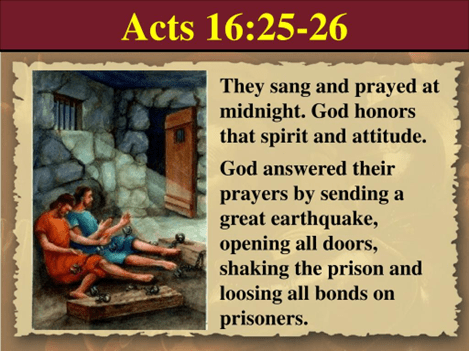
“But at midnight Paul and Silas were praying and singing hymns to God, and the prisoners were listening to them. Suddenly there was a great earthquake, so that the foundations of the prison were shaken; and immediately all the doors were opened and everyone’s chains were loosed. And the keeper of the prison, awaking from sleep and seeing the prison doors open, supposing the prisoners had fled, drew his sword and was about to kill himself. But Paul called with a loud voice, saying, “Do yourself no harm, for we are all here.”
Then he called for a light, ran in, and fell down trembling before Paul and Silas. And he brought them out and said, “Sirs, what must I do to be saved?”
So, they said, “Believe on the Lord Jesus Christ, and you will be saved, you and your household.” Then they spoke the word of the Lord to him and to all who were in his house. And he took them the same hour of the night and washed their stripes. And immediately he and all his family were baptized. Now when he had brought them into his house, he set food before them; and he rejoiced, having believed in God with all his household.”
It’s midnight in the inky depths of a Roman prison. Two Christian prisoners are sitting in stocks, their hands and feet encased so they can scarcely move. If either one of them wants to itch his nose, he can’t. Although there are many men in the prison, it’s so dark they can’t see one another; only their breathing gives their presence away. But what are these two men doing? Rather than complaining, these guys are singing praises to God while the other prisoners listen raptly. Suddenly, a tremendous earthquake shakes the prison, shattering the stocks and causing all the prisoners’ chains to fall apart. When another shock hits, the prison doors fly open as well. The prisoners are so amazed that they can only stand there; meanwhile, the jailer rushes to the prison, certain that all the prisoners have escaped and that he might as well kill himself before the Romans do it for him.
“But Paul called with a loud voice, saying, “Do yourself no harm, for we are all here.”
Then he called for a light, ran in, and fell down trembling before Paul and Silas. And he brought them out and said, “Sirs, what must I do to be saved?” The jailor is a man of experience, but he has never witnessed anybody like Paul and Silas. Immediately recognizing the presence of servants of a holy God, the jailor accepts Jesus as Savior along with all of his family. The jailor leads Paul and Silas to his own home, where he washes their wounds and feeds them. Then Paul and Silas baptize the jailor and his family, and everyone rests well for the remainder of the night.
Acts 16:35-40 Paul Refuses to Depart Secretly
“And when it was day, the magistrates sent the officers, saying, “Let those men go.”
So, the keeper of the prison reported these words to Paul, saying, “The magistrates have sent to let you go. Now therefore depart, and go in peace.”
But Paul said to them, “They have beaten us openly, uncondemned Romans, and have thrown us into prison. And now do they put us out secretly? No indeed! Let them come themselves and get us out.” And the officers told these words to the magistrates, and they were afraid when they heard that they were Romans. Then they came and pleaded with them and brought them out, and asked them to depart from the city. So, they went out of the prison and entered the house of Lydia; and when they had seen the brethren, they encouraged them and departed.”
It’s always a good idea to get your facts straight before acting dramatically. After tearing the clothes off Paul and Silas and beating them publicly, throwing them in the deepest part of the prison to suffer in the stocks all night without food or water, now the city officials are having second thoughts and are hoping to get these trouble makers to leave town quietly. Big mistake! Now Paul confronts these men.
“And when it was day, the magistrates sent the officers, saying, “Let those men go.”
So, the keeper of the prison reported these words to Paul, saying, “The magistrates have sent to let you go. Now therefore depart, and go in peace.”
But Paul said to them, “They have beaten us openly, uncondemned Romans, and have thrown us into prison. And now do they put us out secretly? No indeed! Let them come themselves and get us out.” After this major embarrassment, Paul and Silas return to Lydia’s home, greet the people there and then leave town.
An article from Bible hub delineates the advantages of Roman citizenship: “Roman citizenship in the first century A.D. was a privileged status that conferred a variety of legal rights and protections. This status is significant in the context of the New Testament, as it provides insight into the Apostle Paul’s interactions with Roman authorities and his missionary journeys.
Legal Rights of Roman Citizens-Roman citizens enjoyed several legal rights that distinguished them from non-citizens. These rights included the ability to vote, marry legally, and engage in commerce. More importantly, Roman citizens were entitled to a fair trial and were protected from certain forms of punishment. For instance, they could not be subjected to torture or crucifixion, a method of execution reserved for non-citizens and slaves. Roman citizens also had the right to appeal to the Emperor in legal matters, a privilege that Paul exercised during his ministry.
Paul’s Roman Citizenship-The Apostle Paul, originally known as Saul of Tarsus, was a Roman citizen by birth. This status is mentioned explicitly in the Book of Acts, where it plays a crucial role in his ministry and legal encounters. In Acts 22:25-29 , Paul reveals his citizenship to a Roman centurion to avoid being flogged: “But as they stretched him out to strap him down, Paul said to the centurion standing there, ‘Is it lawful for you to flog a Roman citizen without a trial?’ On hearing this, the centurion went and reported it to the commander. ‘What are you going to do?’ he said. ‘This man is a Roman citizen.’ The commander went to Paul and asked, ‘Tell me, are you a Roman citizen?’ ‘Yes,’ he answered. ‘I paid a high price for my citizenship,’ said the commander. ‘But I was born a citizen,’ Paul replied.”
Paul’s citizenship provided him with protection and facilitated his missionary work. In Acts 16:37-39 , after being unjustly imprisoned in Philippi, Paul asserts his rights: “But Paul said to the officers, ‘They beat us publicly without a trial, even though we are Roman citizens, and they threw us into prison. And now do they want to send us away secretly? Certainly not! Let them come themselves and escort us out.’ The officers reported this to the magistrates, who were afraid when they heard that Paul and Silas were Roman citizens. They came to appease them and escorted them out, requesting them to leave the city.”
Implications for the Early Church-Roman citizenship had significant implications for the spread of Christianity. It allowed Paul and other early Christians to travel more freely across the Roman Empire, which was crucial for the dissemination of the Gospel. The legal protections afforded to citizens also provided a measure of safety and legitimacy in a time when Christians often faced persecution.
The Apostle Paul’s strategic use of his Roman citizenship exemplifies the early Church’s navigation of the complex socio-political landscape of the Roman Empire. His ability to invoke his rights not only protected him but also advanced the mission of spreading the message of Christ to both Jews and Gentiles.” https://biblehub.com/topical/r/roman_citizenship_and_legal_rights.htm
This story has everything-miracles, salvation, and a highly satisfying story of puffed-up officials getting their just deserts. God sends Paul and Silas to jail for the sake of the prisoners and the jailor and his family. Next God uses the details of Paul and Silas’ citizenship to free them with no further repercussions.
How can we apply these principles to our own lives? No matter how hard we try, we can expect to encounter opposition when we are working for God. But no matter where we wind up, God is still there and He is still working. Until we reach heaven, we will never know how many of Paul and Silas’ fellow prisoners also accepted Jesus that night, but those men may also have entered the Kingdom of Heaven along with the jailor and his family. What marks Paul and Silas is that they never lost sight of God’s call on their lives and they continued to serve him, even when restrained in stocks in the depths of a reeking prison. May God help us so that we will go and do likewise!
PRAYER: Father God, thank You for loving us and caring for us. Lord, help us to serve You, no matter how trying our circumstances might be. In the mighty and precious Name of King Jesus. Amen.
 Burunche's Blog
Leave a comment