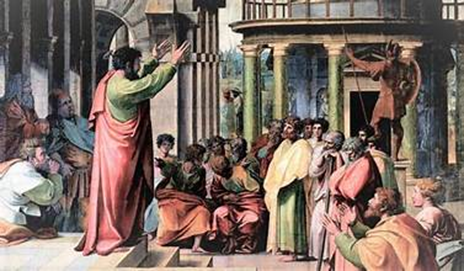
Acts 17:16-21 The Philosophers at Athens
“Now while Paul waited for them at Athens, his spirit was provoked within him when he saw that the city was given over to idols. Therefore, he reasoned in the synagogue with the Jews and with the Gentile worshipers, and in the marketplace daily with those who happened to be there. Then certain Epicurean and Stoic philosophers encountered him. And some said, “What does this babbler want to say?” Others said, “He seems to be a proclaimer of foreign gods,” because he preached to them Jesus and the resurrection.
And they took him and brought him to the Areopagus, saying, “May we know what this new doctrine is of which you speak? For you are bringing some strange things to our ears. Therefore, we want to know what these things mean.” For all the Athenians and the foreigners who were there spent their time in nothing else but either to tell or to hear some new thing.”
After being run out of Thessalonica and Berea, Paul has now arrived in Athens, one of the intellectual centers of this time. As a serious scholar, Paul has heard about Athens for years and has longed to see it. But reality is failing to match expectations, for Paul finds Athens to be a city drenched in idolatry, its philosophers suffering a mental disconnect from reality as they attempt to justify their allegiance to these morally inferior deities. Athens is covered up with altars of every kind dedicated to every deity ever dreamt of.
Well! Paul is rubbing his hands in anticipation as he begins preaching about Jesus in synagogues to Jewish and Gentile believers and in the market place to anybody who will listen. It doesn’t take long before local intellectuals hear about Paul; in fact, Paul’s reputation gained at Thessalonica and Berea may have even preceded him. Epicurean and Stoic philosophers are fascinated and want to hear more.
Who are these Epicurean philosophers? David Guzik in his Enduring Word Bible Commentary tells us, “The Epicureans pursued pleasure as the chief purpose in life, and valued most of all the pleasure of a peaceful life, free from pain, disturbing passions and superstitious fears (including the fear of death). They did not deny the existence of gods, but believed that they had nothing to do with man.” The Epicureans feel that some god might have gotten the world going, but now the gods have left for parts unknown. Their ideal is to float through life with as little suffering as possible. Years ago, Bette Midler popularized a song that said, “God is watching us from a distance.” Today, large numbers of people throughout the world are behaving like Epicureans, whether or not they realize it.
Epicureanism is a highly selfish philosophy, with its proponents continually looking inward to ensure that they are as comfortable as possible. Don’t look for help from one of these guys, because unless he shares your problems with you, he won’t care. Epicureans aren’t looking for a holy, pure, righteous God to worship because in effect, they feel they are in charge of their own lives. An Epicurean might buy the idea of a god of love, as long as that god promises the Epicurean comfort and peace. Selling an Epicurean on the concept of sin is a tough proposition. And without the knowledge of sin and the conviction of sin, how can anyone value the need for a Savior?
Who are the Stoics? Again, Guzik tells us, “The Stoics were pantheists who put great emphasis on moral sincerity and a high sense of duty. They cultivated a spirit of proud dignity, and believed that suicide was better than a life lived with less dignity. The Stoics believed that everything was god, and god was in everything. So they believed that all things, good or evil, were from “god,” and so nothing should be resisted, and they believed there was no particular direction or destiny for mankind.”
Imagine being an Epicurean or a Stoic philosopher lacking any belief in a holy God who loves mankind and cares about men’s lives. Suddenly, you are confronted by this fiery Jewish preacher speaking fluent Greek and telling of a supreme God who loves men and wants to redeem them from their sins by the ultimate blood sacrifice of his Son Jesus Christ. Such teaching is setting all your cherished beliefs on their ears, and you can’t decide whether to be fascinated or furious. The best thing to do with this troublesome fellow is to bring him to the Areopagus on Mars Hill, where your fellow intellectuals can interrogate him thoroughly. But even at the Areopagus, things don’t go quite as the philosophers have intended.

Why has God sent Paul to Athens? Just look at Paul’s Curriculum Vitae. Paul is from Tarsus, the chief city and capital of the Roman Province of Cilicia located in the eastern part of Asia Minor. Tarsus is known for its wealth and schools of learning. Not only does Paul have a strong academic background from his home city, but he is also a pupil of Gamaliel, one of the foremost Jewish teachers of this day. Paul is undoubtedly an excellent linguist, handling Aramaic, Hebrew, Latin, Greek, Coptic and possibly several other languages in addition. Some sources claim Paul might speak as many as 14 different languages, an invaluable help when confronting philosophers in a cosmopolitan city such as Athens. As a polyglot, Paul can quote proverbs in these languages with devastating effect.
Despite its decline as a world political power, of all the major cities at this time, Athens remains one of the centers of philosophy and learning. Athens has a large population of learned men with sufficient means to spend much of their time in discussion and debate. Why are these men anxious to hear new things?
Whether or not the Athenians realize it, they are spiritually hungry. Study Roman and Greek mythology and you swiftly realize that the Roman and Greek deities are anything but pure, holy, or righteous. Whether or not these men realize it, they long for a religion that will bring holiness.

The famous eighteenth century American preacher Jonathan Edwards (1793-1758) has said that “Holiness appeared to me to be of a sweet, pleasant, charming, serene, calm nature; which brought an inexpressible purity, brightness, peacefulness, and ravishment to the soul.”
Even though these supercilious intellectuals are trying as hard as possible to hold Paul at arm’s length, they are about to have an encounter with a man speaking by the power of the Holy Spirit. Athens will never be the same again!
PRAYER: Father God, thank You for loving us and for caring for us. Lord, empower us so that when we speak, people hear You and not us. Help us to love You and to worthily magnify You, no matter where we are or what we are doing. In the mighty and precious Name of King Jesus. Amen.
 Burunche's Blog
Leave a comment