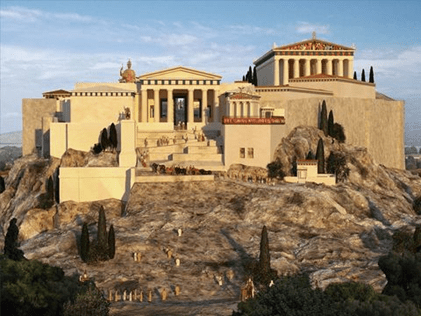
Acts 17:22-34 Addressing the Areopagus “Then Paul stood in the midst of the Areopagus and said, “Men of Athens, I perceive that in all things you are very religious; for as I was passing through and considering the objects of your worship, I even found an altar with this inscription: TO THE UNKNOWN GOD.
Therefore, the One whom you worship without knowing, Him I proclaim to you: God, who made the world and everything in it, since He is Lord of heaven and earth, does not dwell in temples made with hands. Nor is He worshiped with men’s hands, as though He needed anything, since He gives to all life, breath, and all things. And He has made from one blood every nation of men to dwell on all the face of the earth, and has determined their preappointed times and the boundaries of their dwellings, so that they should seek the Lord, in the hope that they might grope for Him and find Him, though He is not far from each one of us; for in Him we live and move and have our being, as also some of your own poets have said, ‘For we are also His offspring.’ Therefore, since we are the offspring of God, we ought not to think that the Divine Nature is like gold or silver or stone, something shaped by art and man’s devising. Truly, these times of ignorance God overlooked, but now commands all men everywhere to repent, because He has appointed a day on which He will judge the world in righteousness by the Man whom He has ordained. He has given assurance of this to all by raising Him from the dead.”
And when they heard of the resurrection of the dead, some mocked, while others said, “We will hear you again on this matter.” So Paul departed from among them. However, some men joined him and believed, among them Dionysius the Areopagite, a woman named Damaris, and others with them.”
Ever since Paul first uttered these words in the Areopagus on Mars Hill in Athens, people have studied this discourse for the way God leads Paul to catch the attention of these jaded Athenian philosophers.
“Men of Athens, I perceive that in all things you are very religious; for as I was passing through and considering the objects of your worship, I even found an altar with this inscription: TO THE UNKNOWN GOD.” Paul begins by complimenting the Athenians on their persistent search for God. Paul does not begin by criticizing the Athenians for polytheism, idolatry, or a host of other bad practices, for Paul realizes that he is speaking to people who are searching for holiness without realizing it. The Athenians have filled their city with altars to various deities in hopes that one of them is the correct one; in fact, there’s even an altar to an unknown God.
Where did these altars entitled “To The Unknown God” come from? Guzik tells us, “Athens was filled with statues dedicated TO THE UNKNOWN GOD. Six hundred years before Paul, a terrible plague came on the city and a man name Epimenides had an idea. He let loose a flock of sheep through the town, and wherever they lay down, they sacrificed that sheep to the god that had the nearest shrine or temple. If a sheep lay down near no shrine or temple, they sacrificed the sheep TO THE UNKNOWN GOD.”
“Therefore, the One whom you worship without knowing, Him I proclaim to you: God, who made the world and everything in it, since He is Lord of heaven and earth, does not dwell in temples made with hands. Nor is He worshiped with men’s hands, as though He needed anything, since He gives to all life, breath, and all things.” Paul builds on practices the Athenians are already observing. Rather than telling the Athenians that they are wrong, Paul simply explains that he is an ambassador for the Unknown God whom the Athenians have honored for centuries. Paul presents himself as someone bringing incredibly good news.
“And He has made from one blood every nation of men to dwell on all the face of the earth, and has determined their preappointed times and the boundaries of their dwellings, so that they should seek the Lord, in the hope that they might grope for Him and find Him, though He is not far from each one of us; for in Him we live and move and have our being, as also some of your own poets have said, ‘For we are also His offspring.’” Here Paul is acknowledging the multicultural aspects of Athens and encouraging his listeners. But what is the source of this quote?
“For in Him we live and move and have our being” is actually a quote from Epimenides of Crete, the same man who sent all those sheep wandering through Athens, causing Athenians to erect altars to an unknown God. By quoting Epimenides, Paul aligns himself with Athenian culture and Athenian tradition, indicating that even centuries earlier, the ancestors of these people were searching for God without knowing Him.
’” Therefore, since we are the offspring of God, we ought not to think that the Divine Nature is like gold or silver or stone, something shaped by art and man’s devising. Truly, these times of ignorance God overlooked, but now commands all men everywhere to repent, because He has appointed a day on which He will judge the world in righteousness by the Man whom He has ordained. He has given assurance of this to all by raising Him from the dead.”
“And when they heard of the resurrection of the dead, some mocked, while others said, “We will hear you again on this matter.” So Paul departed from among them. However, some men joined him and believed, among them Dionysius the Areopagite, a woman named Damaris, and others with them.”
Until now, many of the Athenians are listening with interest but not particularly concerned. After all, there are new speakers appearing daily and Paul is interesting but scarcely revolutionary. But when Paul mentions Jesus being raised from the dead, suddenly the complexion of the situation changes completely. Those scoffers who have no interest in being changed but only in being entertained swiftly dismiss Paul as a crazy babbler. But there are others in the crowd who listen and believe and follow Paul to hear more.
Steve Jobs has been quoted as having said, “If you want to be popular, sell ice cream.” Whenever we speak the truth about Jesus, there will always be those who mock or ignore while others will grasp the teachings and believe. Even when pastors preach Holy Spirit-inspired messages to their congregations, some people will remain unmoved because their hearts are hard. But we must remember something a pastor friend used to say repeatedly, “We are only in advertising. God is in management.” We are responsible for proclaiming the truth about Jesus Christ as the Way of salvation. God is the only One who can move in people’s hearts. May God help us so that we remain faithful, persistent, and loyal to the One who has shed His blood for our sins!
PRAYER: Father God, thank You for loving us and for caring for us. Lord, help us to follow hard after You, refusing to become discouraged at those who scoff or mock. In the mighty and precious Name of King Jesus. Amen.
 Burunche's Blog
Leave a comment