Acts 19:21-41 The Riot at Ephesus
“When these things were accomplished, Paul purposed in the Spirit, when he had passed through Macedonia and Achaia, to go to Jerusalem, saying, “After I have been there, I must also see Rome.” So he sent into Macedonia two of those who ministered to him, Timothy and Erastus, but he himself stayed in Asia for a time.
And about that time there arose a great commotion about the Way. For a certain man named Demetrius, a silversmith, who made silver shrines of Diana, brought no small profit to the craftsmen. He called them together with the workers of similar occupation, and said: “Men, you know that we have our prosperity by this trade. Moreover, you see and hear that not only at Ephesus, but throughout almost all Asia, this Paul has persuaded and turned away many people, saying that they are not gods which are made with hands. So not only is this trade of ours in danger of falling into disrepute, but also the temple of the great goddess Diana may be despised and her magnificence destroyed, whom all Asia and the world worship.”
Now when they heard this, they were full of wrath and cried out, saying, “Great is Diana of the Ephesians!” So the whole city was filled with confusion, and rushed into the theater with one accord, having seized Gaius and Aristarchus, Macedonians, Paul’s travel companions. And when Paul wanted to go in to the people, the disciples would not allow him. Then some of the officials of Asia, who were his friends, sent to him pleading that he would not venture into the theater. Some therefore cried one thing and some another, for the assembly was confused, and most of them did not know why they had come together. And they drew Alexander out of the multitude, the Jews putting him forward. And Alexander motioned with his hand, and wanted to make his defense to the people. But when they found out that he was a Jew, all with one voice cried out for about two hours, “Great is Diana of the Ephesians!”
And when the city clerk had quieted the crowd, he said: “Men of Ephesus, what man is there who does not know that the city of the Ephesians is temple guardian of the great goddess Diana, and of the image which fell down from Zeus? Therefore, since these things cannot be denied, you ought to be quiet and do nothing rashly. For you have brought these men here who are neither robbers of temples nor blasphemers of your goddess. Therefore, if Demetrius and his fellow craftsmen have a case against anyone, the courts are open and there are proconsuls. Let them bring charges against one another. But if you have any other inquiry to make, it shall be determined in the lawful assembly. For we are in danger of being called in question for today’s uproar, there being no reason which we may give to account for this disorderly gathering.” And when he had said these things, he dismissed the assembly.”
Things have been going quite well with the ministry, and Paul is beginning to plan to visit Jerusalem and Rome. Paul is still in Ephesus, but he sends Timothy and Erastus back to Macedonia to encourage believers there. But problems are about to erupt.
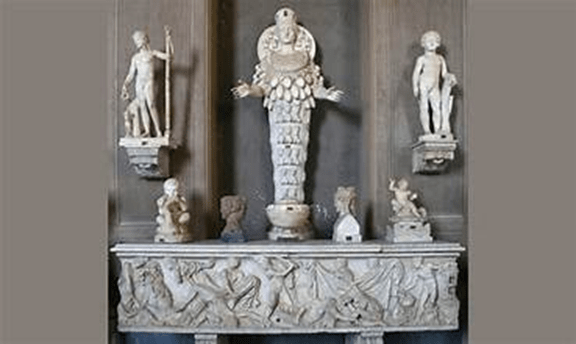
Ephesus is the seat of worship for the goddess Diana, also known as Artemis. Who is this Diana/Artemis whose towering temple dominates the city of Ephesus? Wikipedia tells us, “In ancient Greek religion and mythology, Artemis (/ˈɑːrtɪmɪs/; Ancient Greek: Ἄρτεμις) is the goddess of the hunt, the wilderness, wild animals, transitions, nature, vegetation, childbirth, care of children, and chastity… patron and protector of young children, especially young girls. Artemis was worshipped as one of the primary goddesses of childbirth and midwifery along with Eileithyia and Hera. She was also a patron of healing and disease, particularly among women and children, and believed to send both good health and illness upon women and children.”
David Guzik in his Enduring Word Bible Commentary tells us this about Ephesus:” This tremendous temple to Diana (also known as Artemis) in Ephesus was regarded as one of the seven wonders of the ancient world. It was supported by 127 pillars, each 60 feet high, and was decorated with great sculptures. It was lost to history until it was discovered in 1869, and its main altar was unearthed in 1965.
i. “The epicenter of Artemis worship was a black meteorite that either resembled or had been fashioned into a grotesque image of a woman. The lower part was wrapped like a mummy…the idol was covered with breasts, symbolizing fertility.” (Hughes)
ii. “The Temple of Artemis was also a major treasury and bank of the ancient world, where merchants, kings, and even cities made deposits, and where their money could be kept safe under the protection of deity.” (Longenecker) https://enduringword.com/bible-commentary/acts-19/
Throughout human history, women have always searched for some kind of divine assistance that would ensure fertility, safe pregnancies, easy child births, and healthy children. Lacking any knowledge of the One True Living God, it’s no wonder that Diana/Artemis would be a highly popular deity. Women likely beg their husbands who are doing business in Ephesus to bring back a small shrine. But worship of Diana also confers financial benefits as well. Evidently, the temple of Diana is functioning as a huge international bank with deposits under the divine protection of the goddess.
The city fathers of Ephesus have every incentive to make sure that nothing disturbs devotion to Diana in any form. Clearly, Christianity might pose a threat, for worshipers of Jesus have no need to worship Diana in addition. When Demetrius, one of the chief silver smiths, realizes the threat, he immediately organizes a mob scene. Many people flock into the local theater with no idea of what’s going on, only to find themselves caught up in a crowd chanting, “Great is Diana, of the Ephesians!”
But the city clerk is a brave man with a cool head. Addressing the crowd, the city clerk points out the fact that Demetrius’ accusations are baseless, that the courts are open to hear complaints, and that the Ephesians are in danger of attracting undue attention from their Roman rulers. Letting off steam is one thing; however, the Romans take a very dim view of rabble rousers of any stripe. If the crowd does not disperse swiftly and quietly, the local Roman legion might appear, and the situation might become very dangerous to all those in the theater. The city clerk dismisses the crowd.
Why are these rioters willing to listen to the city clerk and even obey him? The city clerk is obviously a man of great authority and power because after two hours of screaming themselves hoarse, the Ephesians come to their senses and leave the scene as quietly as possible.
The Encyclopedia of the Bible gives this information: “The town clerk, or grammateus, occupied a position of considerable importance in city administration. His initial duties consisted of keeping the records of the city, taking the minutes of the council and assembly, caring for official correspondence, receiving the edicts of emperors and governors, plus a great mass of miscellaneous documents, then filing and publishing these, as required. He publicly read decrees, put up temporary notices for the people to read, and those of permanent importance were inscribed on stone. This clerk of the Greek towns served a number of boards, and was the normal officer of the council; and, as indicated, was charged with many details of the administration of the city, in addition to supervising its archives. His work load was therefore heavy; hence he normally had a staff of assistants.
By the Antonine age, the grammateus had attained considerable importance in city leadership, and became a dominant political figure, who filled the highest magistracy the Roman colony had to offer. He enrolled new citizens in some towns, and occasionally the priesthood was combined with his office. Since his work necessitated such broad and specialized knowledge, the office was sometimes held for a long period of time, and exercised great influence in city affairs. He might also on occasion be a member of the Asiarchs, who seem to have been elected officers of importance, and who were drawn from the ranks of the wealthy and influential.
At Ephesus the town clerk was president of the assembly and probably of Roman aristocracy. He was frequently named on the coins and inscriptions of the city. Roman records show that he annually distributed money from the public treasury (evidently to the poor and needy), on the occasion of Antoninus’ birthday. This was authorized by both the council and the assembly (the town clerk had charge of the endowment for doles to be given to the citizens). Another record shows his distribution to the councilors of money presented by Vibius Salutaris.”
Religious fervor, greed, political intrigue-the mess at Ephesus has it all. But in the midst of the chaos, God sends a wise man to calm the crowds and bring sense to the situation. And the church in Ephesus continues to grow. It’s even possible that the controversy stirred up by Demetrius attracts even more people to consider the claims of Christianity. God can redeem any situation to His glory.
PRAYER: Father God, thank You for loving us and for caring for us. Lord, help us to trust You, even when things appear to be falling apart, knowing that You can bring glory out of chaos. In the mighty and precious Name of King Jesus. Amen.
 Burunche's Blog
Leave a comment