Acts 23:1-11 Paul before the Sanhedrin
“Paul looked directly at the Sanhedrin and said, “Brothers, I have conducted myself before God in all good conscience to this day.”
At this, the high priest Ananias ordered those standing near Paul to strike him on the mouth.
Then Paul said to him, “God will strike you, you whitewashed wall! You sit here to judge me according to the law, yet you yourself violate the law by commanding that I be struck.”
But those standing nearby said, “How dare you insult the high priest of God!”
“Brothers,” Paul replied, “I was not aware that he was the high priest, for it is written: ‘Do not speak evil about the ruler of your people.’”
Then Paul, knowing that some of them were Sadducees and others Pharisees, called out in the Sanhedrin, “Brothers, I am a Pharisee, the son of a Pharisee. It is because of my hope in the resurrection of the dead that I am on trial.”
As soon as he had said this, a dispute broke out between the Pharisees and Sadducees, and the assembly was divided. For the Sadducees say that there is neither a resurrection, nor angels, nor spirits, but the Pharisees acknowledge them all.
A great clamor arose, and some scribes from the party of the Pharisees got up and contended sharply, “We find nothing wrong with this man. What if a spirit or an angel has spoken to him?” The dispute grew so violent that the commander was afraid they would tear Paul to pieces. He ordered the soldiers to go down and remove him by force and bring him into the barracks.
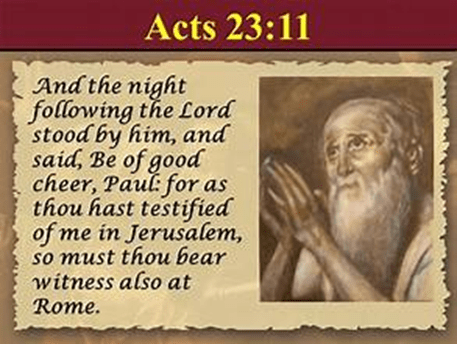
The following night the Lord stood near Paul and said, “Take courage! As you have testified about Me in Jerusalem, so also you must testify in Rome.”
Having spent the night in bonds, Paul is now brought before the Sanhedrin, the body of Jewish religious rulers in Jerusalem. When Paul begins by making stating that he has conducted himself in all good conscience before God, the high priest immediately orders someone to strike Paul. Knowing full well that this is the high priest, Paul rebukes him for demanding an illegal action. This response leaves the audience aghast, for nobody has dared to say such things to Ananias, the high priest. When an onlooker informs Paul that this is the high priest speaking, Paul immediately quotes Scripture as a form of apology. But two things are going on here: Paul has succeeded in demonstrating that the high priest is demanding an illegal action and Paul is also demonstrating that he has a large knowledge of Scripture.
As a Pharisee and a former pupil of Gamaliel, Paul knows most of the members of the Sanhedrin quite well. Many of these men may be longing for the coming of the Messiah but their honest spiritual hunger has been quenched by filling the void with religiosity.
“Then Paul, knowing that some of them were Sadducees and others Pharisees, called out in the Sanhedrin, “Brothers, I am a Pharisee, the son of a Pharisee. It is because of my hope in the resurrection of the dead that I am on trial.”
As soon as he had said this, a dispute broke out between the Pharisees and Sadducees, and the assembly was divided. For the Sadducees say that there is neither a resurrection, nor angels, nor spirits, but the Pharisees acknowledge them all.”
Paul might be from Tarsus, but he’s spent enough time studying in Jerusalem to know all the ins and outs of the controversies between the Pharisees and the Sadducees. As soon as Paul introduces his hope in the resurrection of the dead, the Sanhedrin erupts into a fire storm of controversy, with Sadducees defending themselves loudly while Pharisees begin to defend Paul. The arguments become so heated that the commander removes Paul from the scene before his accusers can tear him to pieces. That night, Paul has another vision of Jesus in which Jesus tells Paul that he will go to Rome and testify about Jesus there as well.
We all love miracle stories in which saints or angels or Jesus appear to give messages to a blessed person. Why does Jesus appear to Paul after this grueling confrontation with the Sanhedrin? Prior to Paul’s conversion, he was one of the leading lights of the Sanhedrin. Many of those hurling accusations at Paul are doing so out of spite or disappointment that Paul has betrayed them by becoming a Christian. For Paul, this encounter must be incredibly painful, for many of these men are former friends and colleagues. Paul has entered upon this meeting with high hopes of somehow convincing these men of the reality of Jesus Christ’s resurrection; however, it is now obvious that these men have hardened their hearts and won’t listen to anything or anybody. Paul might remember a story that Jesus told about a rich man and a beggar at his gate. The rich man died and went to hell, while the beggar died and went to heaven. When the rich man begged Father Abraham to send Lazarus, the beggar, back to warn the rich man’s brothers, Abraham told the rich man that his brothers had Moses and the prophets. If the rich man’s brothers refused to believe Moses and the prophets, neither would they believe it if someone arose from the dead. Now Paul realizes the truth of that story.
The Romans are bemused by all this furor, but the one thing they desire above all else is peace. While Paul is in prison enjoying a vision of Jesus, the Roman commander is probably staying up late, trying to figure out how to handle this well-spoken Roman citizen who has obviously run afoul of local religious leaders. This might be a small country, but these people are very troublesome!
What might we learn from Paul’s tactics in this meeting? Once Paul realizes that witnessing to these men is hopeless, he concentrates on dividing the group so that they will argue among themselves and he can escape. Jesus warned his disciples not to cast pearls before swine, and obviously, these men are swinish in their lack of spiritual understanding. There’s no point in forcing the argument any further, for nothing will be gained. Sometimes, we must realize that arguments are useless and a strategic retreat is the wisest tactic. May God help us, so that we will know when to speak out and when to quietly move back!
PRAYER: Heavenly Father, thank You for loving us and caring for us. Lord, help us to be wise as serpents and innocent as doves when dealing with critics. Give us the right words so that we will say only what You want us to say and the proper body language so that we will convey Your messages and none other. In the mighty and precious Name of King Jesus. Amen.
 Burunche's Blog
Leave a comment