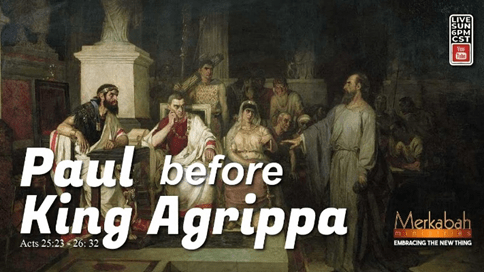
Acts 26:1-11 Paul’s Early Life
“Then Agrippa said to Paul, “You are permitted to speak for yourself.”
So Paul stretched out his hand and answered for himself: “I think myself happy, King Agrippa, because today I shall answer for myself before you concerning all the things of which I am accused by the Jews, especially because you are expert in all customs and questions which have to do with the Jews. Therefore, I beg you to hear me patiently.
“My manner of life from my youth, which was spent from the beginning among my own nation at Jerusalem, all the Jews know. They knew me from the first, if they were willing to testify, that according to the strictest sect of our religion I lived a Pharisee. And now I stand and am judged for the hope of the promise made by God to our fathers. To this promise our twelve tribes, earnestly serving God night and day, hope to attain. For this hope’s sake, King Agrippa, I am accused by the Jews. Why should it be thought incredible by you that God raises the dead?
“Indeed, I myself thought I must do many things contrary to the name of Jesus of Nazareth. This I also did in Jerusalem, and many of the saints I shut up in prison, having received authority from the chief priests; and when they were put to death, I cast my vote against them. And I punished them often in every synagogue and compelled them to blaspheme; and being exceedingly enraged against them, I persecuted them even to foreign cities.”
Paul is testifying before King Agrippa, Porcius Festus, and a host of other lesser dignitaries. In an age when we are absorbed in social media, it’s difficult to remember that Paul’s age was one in which people discussed ideas and concepts freely. Well educated people were expected to be conversant with some of the most famous Greek philosophers, as well as popular Roman writers of the day. Both Agrippa and Festus undoubtedly frequented gatherings where all kinds of issues such as the resurrection of the dead were debated. Paul has caught the interest of his audience.
Acts 26:12-18 Paul Recounts His Conversion
“While thus occupied, as I journeyed to Damascus with authority and commission from the chief priests, at midday, O king, along the road I saw a light from heaven, brighter than the sun, shining around me and those who journeyed with me. And when we all had fallen to the ground, I heard a voice speaking to me and saying in the Hebrew language, ‘Saul, Saul, why are you persecuting Me? It is hard for you to kick against the goads.’ So I said, ‘Who are You, Lord?’ And He said, ‘I am Jesus, whom you are persecuting. But rise and stand on your feet; for I have appeared to you for this purpose, to make you a minister and a witness both of the things which you have seen and of the things which I will yet reveal to you. I will deliver you from the Jewish people, as well as from the Gentiles, to whom I now send you, to open their eyes, in order to turn them from darkness to light, and from the power of Satan to God, that they may receive forgiveness of sins and an inheritance among those who are sanctified by faith in Me.’
Acts 26:19-23 Paul’s Post-Conversion Life
“Therefore, King Agrippa, I was not disobedient to the heavenly vision, but declared first to those in Damascus and in Jerusalem, and throughout all the region of Judea, and then to the Gentiles, that they should repent, turn to God, and do works befitting repentance. For these reasons the Jews seized me in the temple and tried to kill me. Therefore, having obtained help from God, to this day I stand, witnessing both to small and great, saying no other things than those which the prophets and Moses said would come— that the Christ would suffer, that He would be the first to rise from the dead, and would proclaim light to the Jewish people and to the Gentiles.”
Paul knows that this part of his testimony will be difficult for his listeners to accept; however, throughout the Greco-Roman world, there are all kinds of myths about spirits speaking to humans. Now Paul is telling his story as plainly as possible in hopes that his hearers will become fascinated and choose to consider the claims of Christ for themselves.
Acts 26:24-32 Agrippa Parries Paul’s Challenge
Now as he thus made his defense, Festus said with a loud voice, “Paul, you are beside yourself! Much learning is driving you mad!”
But he said, “I am not mad, most noble Festus, but speak the words of truth and reason. For the king, before whom I also speak freely, knows these things; for I am convinced that none of these things escapes his attention, since this thing was not done in a corner. King Agrippa, do you believe the prophets? I know that you do believe.”
Then Agrippa said to Paul, “You almost persuade me to become a Christian.”
And Paul said, “I would to God that not only you, but also all who hear me today, might become both almost and altogether such as I am, except for these chains.”
When he had said these things, the king stood up, as well as the governor and Bernice and those who sat with them; and when they had gone aside, they talked among themselves, saying, “This man is doing nothing deserving of death or chains.”
Then Agrippa said to Festus, “This man might have been set free if he had not appealed to Caesar.”
Paul makes an enormous impression on all who listen to him that morning. But the saddest phrase in the entire piece is Agrippa’s statement. When Paul asks Agrippa if Agrippa believes the prophets, Agrippa counters, “You almost persuade me to become a Christian.” The operative word here is “almost.” Agrippa recognizes truth when he hears it, and he realizes that Paul’s testimony is true. The appeal of the Gospel is very real; however, Agrippa backs off at the last minute. Why doesn’t Agrippa commit himself? Agrippa is from a Greek background but is doing his best to maintain his Roman position in a challenging political climate. Committing to Christ would be career suicide for Agrippa, and he is too fond of the power and grandeur of his appointment to give it up, even when he hears truth preached. Surely, surely there will be another means for Agrippa to encounter God without having to make such sacrifices. So Agrippa continues without committing himself and eventually flees Jerusalem in 66 AD when he sides with the Romans. Paul’s defense at Caesarea takes place about 6 years earlier.
Paul knows that Agrippa knows the Scriptures and Paul bends every bit of his talent as a speaker to convince Agrippa to trust in Jesus Christ. But Agrippa is too consumed with earthly glory to choose heavenly glory instead.
Agrippa and Festus agree that Paul is innocent. But God wants Paul in Rome and God is using these circumstances to get him there. Were Agrippa to convert to Christianity, God would use other means to get Paul to Rome; however, this time, God is using the political ambitions of these two rulers. As we observed yesterday, God continues to work out His purposes if we will only trust Him.
PRAYER: Father God, thank You for loving us and for caring for us. Lord, Your purposes are sure and Your will is perfect. Help us to trust even when events appear chaotic, for You are working in the midst of the chaos. In the mighty and precious Name of King Jesus. Amen.
 Burunche's Blog
Leave a comment