Archive for June, 2025

JUNE 21, 2025 FOLLOWING JESUS IN A POST-ASCENSION WORLD #58 “ALMOST PERSUADED” IS WORTHLESS!

June 21, 2025

Acts 26:1-11 Paul’s Early Life

“Then Agrippa said to Paul, “You are permitted to speak for yourself.”

So Paul stretched out his hand and answered for himself: “I think myself happy, King Agrippa, because today I shall answer for myself before you concerning all the things of which I am accused by the Jews, especially because you are expert in all customs and questions which have to do with the Jews. Therefore, I beg you to hear me patiently.

“My manner of life from my youth, which was spent from the beginning among my own nation at Jerusalem, all the Jews know. They knew me from the first, if they were willing to testify, that according to the strictest sect of our religion I lived a Pharisee. And now I stand and am judged for the hope of the promise made by God to our fathers. To this promise our twelve tribes, earnestly serving God night and day, hope to attain. For this hope’s sake, King Agrippa, I am accused by the Jews. Why should it be thought incredible by you that God raises the dead?

“Indeed, I myself thought I must do many things contrary to the name of Jesus of Nazareth. This I also did in Jerusalem, and many of the saints I shut up in prison, having received authority from the chief priests; and when they were put to death, I cast my vote against them. And I punished them often in every synagogue and compelled them to blaspheme; and being exceedingly enraged against them, I persecuted them even to foreign cities.”

Paul is testifying before King Agrippa, Porcius Festus, and a host of other lesser dignitaries. In an age when we are absorbed in social media, it’s difficult to remember that Paul’s age was one in which people discussed ideas and concepts freely. Well educated people were expected to be conversant with some of the most famous Greek philosophers, as well as popular Roman writers of the day. Both Agrippa and Festus undoubtedly frequented gatherings where all kinds of issues such as the resurrection of the dead were debated. Paul has caught the interest of his audience.

Acts 26:12-18 Paul Recounts His Conversion

“While thus occupied, as I journeyed to Damascus with authority and commission from the chief priests, at midday, O king, along the road I saw a light from heaven, brighter than the sun, shining around me and those who journeyed with me. And when we all had fallen to the ground, I heard a voice speaking to me and saying in the Hebrew language, ‘Saul, Saul, why are you persecuting Me? It is hard for you to kick against the goads.’ So I said, ‘Who are You, Lord?’ And He said, ‘I am Jesus, whom you are persecuting. But rise and stand on your feet; for I have appeared to you for this purpose, to make you a minister and a witness both of the things which you have seen and of the things which I will yet reveal to you. I will deliver you from the Jewish people, as well as from the Gentiles, to whom I now send you, to open their eyes, in order to turn them from darkness to light, and from the power of Satan to God, that they may receive forgiveness of sins and an inheritance among those who are sanctified by faith in Me.’

Acts 26:19-23 Paul’s Post-Conversion Life

“Therefore, King Agrippa, I was not disobedient to the heavenly vision, but declared first to those in Damascus and in Jerusalem, and throughout all the region of Judea, and then to the Gentiles, that they should repent, turn to God, and do works befitting repentance. For these reasons the Jews seized me in the temple and tried to kill me. Therefore, having obtained help from God, to this day I stand, witnessing both to small and great, saying no other things than those which the prophets and Moses said would come— that the Christ would suffer, that He would be the first to rise from the dead, and would proclaim light to the Jewish people and to the Gentiles.”

Paul knows that this part of his testimony will be difficult for his listeners to accept; however, throughout the Greco-Roman world, there are all kinds of myths about spirits speaking to humans. Now Paul is telling his story as plainly as possible in hopes that his hearers will become fascinated and choose to consider the claims of Christ for themselves.

Acts 26:24-32 Agrippa Parries Paul’s Challenge

Now as he thus made his defense, Festus said with a loud voice, “Paul, you are beside yourself! Much learning is driving you mad!”

But he said, “I am not mad, most noble Festus, but speak the words of truth and reason. For the king, before whom I also speak freely, knows these things; for I am convinced that none of these things escapes his attention, since this thing was not done in a corner. King Agrippa, do you believe the prophets? I know that you do believe.”

Then Agrippa said to Paul, “You almost persuade me to become a Christian.”

And Paul said, “I would to God that not only you, but also all who hear me today, might become both almost and altogether such as I am, except for these chains.”

When he had said these things, the king stood up, as well as the governor and Bernice and those who sat with them; and when they had gone aside, they talked among themselves, saying, “This man is doing nothing deserving of death or chains.”

Then Agrippa said to Festus, “This man might have been set free if he had not appealed to Caesar.”

Paul makes an enormous impression on all who listen to him that morning. But the saddest phrase in the entire piece is Agrippa’s statement. When Paul asks Agrippa if Agrippa believes the prophets, Agrippa counters, “You almost persuade me to become a Christian.” The operative word here is “almost.” Agrippa recognizes truth when he hears it, and he realizes that Paul’s testimony is true. The appeal of the Gospel is very real; however, Agrippa backs off at the last minute. Why doesn’t Agrippa commit himself? Agrippa is from a Greek background but is doing his best to maintain his Roman position in a challenging political climate. Committing to Christ would be career suicide for Agrippa, and he is too fond of the power and grandeur of his appointment to give it up, even when he hears truth preached. Surely, surely there will be another means for Agrippa to encounter God without having to make such sacrifices. So Agrippa continues without committing himself and eventually flees Jerusalem in 66 AD when he sides with the Romans. Paul’s defense at Caesarea takes place about 6 years earlier.

Paul knows that Agrippa knows the Scriptures and Paul bends every bit of his talent as a speaker to convince Agrippa to trust in Jesus Christ. But Agrippa is too consumed with earthly glory to choose heavenly glory instead.

Agrippa and Festus agree that Paul is innocent. But God wants Paul in Rome and God is using these circumstances to get him there. Were Agrippa to convert to Christianity, God would use other means to get Paul to Rome; however, this time, God is using the political ambitions of these two rulers. As we observed yesterday, God continues to work out His purposes if we will only trust Him.

PRAYER: Father God, thank You for loving us and for caring for us. Lord, Your purposes are sure and Your will is perfect. Help us to trust even when events appear chaotic, for You are working in the midst of the chaos. In the mighty and precious Name of King Jesus. Amen.

JUNE 20, 2025 FOLLOWING JESUS IN A POST-ASCENSION WORLD #57 GOD IS ALWAYS UP TO MORE THAN WE CAN POSSIBLY IMAGINE!

June 20, 2025

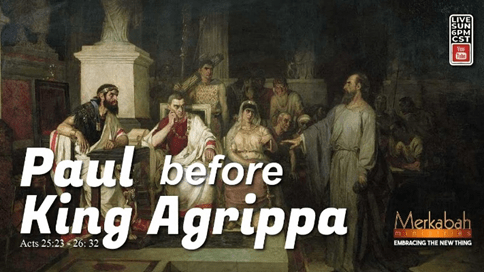
Acts 25:13-27 Paul Before Agrippa

“And after some days King Agrippa and Bernice came to Caesarea to greet Festus. When they had been there many days, Festus laid Paul’s case before the king, saying: “There is a certain man left a prisoner by Felix, about whom the chief priests and the elders of the Jews informed me, when I was in Jerusalem, asking for a judgment against him. To them I answered, ‘It is not the custom of the Romans to deliver any man to destruction before the accused meets the accusers face to face, and has opportunity to answer for himself concerning the charge against him.’ Therefore, when they had come together, without any delay, the next day I sat on the judgment seat and commanded the man to be brought in. When the accusers stood up, they brought no accusation against him of such things as I supposed, but had some questions against him about their own religion and about a certain Jesus, who had died, whom Paul affirmed to be alive. And because I was uncertain of such questions, I asked whether he was willing to go to Jerusalem and there be judged concerning these matters. But when Paul appealed to be reserved for the decision of Augustus, I commanded him to be kept till I could send him to Caesar.”

Then Agrippa said to Festus, “I also would like to hear the man myself.”

“Tomorrow,” he said, “you shall hear him.”

So the next day, when Agrippa and Bernice had come with great pomp, and had entered the auditorium with the commanders and the prominent men of the city, at Festus’ command Paul was brought in. And Festus said: “King Agrippa and all the men who are here present with us, you see this man about whom the whole assembly of the Jews petitioned me, both at Jerusalem and here, crying out that he was not fit to live any longer. But when I found that he had committed nothing deserving of death, and that he himself had appealed to Augustus, I decided to send him. I have nothing certain to write to my lord concerning him. Therefore, I have brought him out before you, and especially before you, King Agrippa, so that after the examination has taken place I may have something to write. For it seems to me unreasonable to send a prisoner and not to specify the charges against him.”

There were two King Herod Agrippas mentioned in Acts. Herod Agrippa I persecuted Christians, killing James and imprisoning Peter. Later Agrippa I traveled to Caesarea where he addressed a crowd from his throne. The people shouted, “The voice of a god, and not of a man!” (Acts 12:22). Agrippa, filled with pride, accepted the praise, and “immediately an angel of the Lord struck him down, because he did not give God the glory, and he was eaten by worms and breathed his last” (Acts 12:23)

The son of Agrippa I was King Herod Agrippa II, also known as Julius Marcus Agrippa; he was the brother of Bernice and Drusilla and heard Paul’s defense of the gospel in Acts 26. Agrippa II had quite a lot of power in Jewish religious affairs, for he had been given custodianship of the temple and the authority to appoint the high priest. Agrippa II was much more humble and open than his father had been. https://www.compellingtruth.org/Herod-Agrippa.html

Here, Porcius Festus, the new procurator, cleverly transfers some of the burden of Paul’s matters to Agrippa II by engaging him to examine Paul. And Festus truly is bewildered, for it’s no small matter to refer a case to Rome for judgement. If Festus is not careful, he will gain a reputation for incompetence with the judges in Rome complaining that he is referring problems he should handle back in his own territory. There are many hungry politicians out there who would love to displace Agrippa so they can take over his plum appointment. Involving Agrippa II allows Festus to claim that he has exhausted all measures prior to sending Paul to Rome.  

All the time Festus is trying to manipulate Agrippa, God is chuckling. This trial before Agrippa and Festus will give Paul a golden opportunity for a detailed re-telling of his encounter with the risen Jesus Christ. Who knows how many others sitting in that gathering might come to a saving knowledge of Jesus from hearing Paul’s testimony?

God never wastes any situation. While we assume God is working to accomplish one purpose, meanwhile, God has ten or twenty other purposes He’s working out at the same time. An old hymn by Arthur Campbell Ainger describes this well.

1 God is working this purpose out,
as year succeeds to year;
God is working this purpose out,
and the time is drawing near;
nearer and nearer draws the time,
the time that shall surely be:
when the earth shall be filled with the glory of God
as the waters cover the sea.

2 From utmost east to utmost west,
where human feet have trod,
by the mouth of many messengers
goes forth the voice of God:
“Give ear to me, ye continents,
ye isles, give ear to me,
that the earth may be filled with the glory of God
as the waters cover the sea.”

3 Let us go forth in the strength of God,
with the banner of Christ unfurled,
that the light of the glorious gospel of truth
may shine throughout the world.
Let us all fight with sorrow and sin
to set the captives free,
that the earth may be filled with the glory of God
as the waters cover the sea.

4 All we can do is nothing worth
unless God blesses the deed.
Vainly we hope for the harvest-tide
till God gives life to the seed.
Yet nearer and nearer draws the time,
the time that shall surely be,
when the earth shall be filled with the glory of God
as the waters cover the sea.

PRAYER: Father God, thank You for loving us and for caring for us. Lord, help us to trust where we cannot see and to remember that when Your hand is upon our lives, You will always work things out for Your praise and Your glory. In the mighty and precious Name of King Jesus. Amen.

JUNE 19, 2025 FOLLOWING JESUS IN A POST-ASCENSION WORLD #56 GOD CAN USE ANYONE TO ACCOMPLISH HIS PURPOSES!

June 19, 2025

Acts 25:1-12 Paul Appeals to Caesar

“Now when Festus had come to the province, after three days he went up from Caesarea to Jerusalem. Then the high priest and the chief men of the Jews informed him against Paul; and they petitioned him, asking a favor against him, that he would summon him to Jerusalem—while they lay in ambush along the road to kill him. But Festus answered that Paul should be kept at Caesarea, and that he himself was going there shortly. “Therefore,” he said, “let those who have authority among you go down with me and accuse this man, to see if there is any fault in him.”

And when he had remained among them more than ten days, he went down to Caesarea. And the next day, sitting on the judgment seat, he commanded Paul to be brought. When he had come, the Jews who had come down from Jerusalem stood about and laid many serious complaints against Paul, which they could not prove, while he answered for himself, “Neither against the law of the Jews, nor against the temple, nor against Caesar have I offended in anything at all.”

But Festus, wanting to do the Jews a favor, answered Paul and said, “Are you willing to go up to Jerusalem and there be judged before me concerning these things?”

So Paul said, “I stand at Caesar’s judgment seat, where I ought to be judged. To the Jews I have done no wrong, as you very well know. For if I am an offender, or have committed anything deserving of death, I do not object to dying; but if there is nothing in these things of which these men accuse me, no one can deliver me to them. I appeal to Caesar.”

Then Festus, when he had conferred with the council, answered, “You have appealed to Caesar? To Caesar you shall go!”

Porcius Festus is the 5th procurator of Judea from about 59 to 62, succeeding Antonius Felix. Although Festus has just come into office, he is already aware that keeping Jewish religious authorities happy will be a major challenge. As a means of compromise, Festus insists that the Jewish leaders come to Caesarea. When the high priest and his associates come to Caesarea, they are unable to prove any of the charges they have made against Paul.  

When the high priest and his minions demand that Paul should be returned to Jerusalem, Festus asks Paul if he is willing to return to Jerusalem. Paul already knows that earlier, 40 zealots were prepared to seize him and slaughter him. The road between Caesarea and Jerusalem is long with lots of places where a convoy might be attacked, Paul seized, and murdered. And Jesus has already appeared to Paul, instructing him that as Paul has testified for Jesus in Jerusalem, so Paul will also testify for Jesus in Rome. Sensibly, Paul argues, “I stand at Caesar’s judgment seat, where I ought to be judged. To the Jews I have done no wrong, as you very well know. For if I am an offender, or have committed anything deserving of death, I do not object to dying; but if there is nothing in these things of which these men accuse me, no one can deliver me to them. I appeal to Caesar.” Festus is relieved; now he can pass this burden onto someone else. But what is the basis for Paul’s appeal to Caesar?

“About two decades before the birth of Christ, Rome passed a law, the lex de ui publica, which forbade any magistrate to kill, scourge, chain, torture, or even sentence a Roman citizen who had announced his intention to appeal, or prevent him from going to Rome to lodge his appeal there within a fixed time. Assuming (for a moment) that Paul’s case did come to trial, it is very unlikely that the case was heard by Caesar Nero. The Emperor, according to Tacitus, had been quite firm in the matter of rendering judgments: “‘He would not’ [Nero] said, ‘be judge in all cases…’.” Up until a.d. 62 or 63 he made no exceptions, and only a few after that time, up until the burning of Rome. Appeals cases were apparently assigned to various officials….Festus was reluctant to give a decision on the matter, and Paul seeing that a trial in Jerusalem held virtually no hope of justice, Paul therefore made his petition (I appeal to Caesar) that is to be judged by the highest court of the empire. In Rome Paul would be tried by an imperial representative and be subject to Roman law.” https://hermeneutics.stackexchange.com/questions/49788/what-were-the-legal-consequences-of-i-appeal-to-caesar-in-acts-2511

Wikipedia tells us this about Porcius Festus: “Festus inherited the problems of his predecessor in regard to the Roman practice of creating civic privileges for Jews.[4] Another issue that bedeviled his administration was the controversy between Herod Agrippa II and the priests in Jerusalem regarding the wall erected at the temple to break the view of the new wing of Agrippa’s palace.[5] During his administration, Jewish hostility to Rome was greatly inflamed by the civic privileges issue. Feelings were aroused which played an important part in the closely following Jewish War of AD 66.

The Acts of the Apostles narrates that the Apostle Paul had his final hearing before Festus (Acts 24:27). In Acts 25:9-12, Festus sought to induce Paul to go to Jerusalem for trial; Paul appealed to the Emperor. The appeal resulted in Paul being sent to Rome for judgment by the Emperor himself although Festus had difficulty in detailing charges against him (Acts 2526).

Once more, we see God using unrighteous acts of men to accomplish His perfect Will. God wants Paul to go to Rome; very good. So, God is going to use the Roman government to transport Paul to its capital. In the process, God uses two different relatively weak Roman rulers to accomplish this.

God can use all kinds of circumstances to accomplish His perfect Will. We were already preparing to travel to the U.S. in August 2006 when I injured my left hip in a fall from my bicycle on a dark night. Because I needed to be on crutches for three months, we extended our stay in America. While I was still on crutches, we learned that my husband had prostate cancer, so he underwent operation, and we extended our stay further. While my husband was recovering, we traveled to his home area to celebrate several birthdays and anniversaries. Sadly, we found my husband’s twin brother dead in the house on their mutual 65th birthday; however, as the two medically trained family members, it was far better for us to be the ones to find him rather than other relatives. My husband’s younger brother developed such anxiety attacks at the tragic news that he was hospitalized and could not attend the funeral. My husband and I helped facilitate funeral arrangements that included our early departure afterwards due to a blizzard.

Today, do you find yourself in confusing circumstances? Pastor David Yonggi Cho’s advice to one American evangelist still applies: “I pray and I obey.” Keep praying and obeying what God has already shown you to do. As you obey, God will open the way, even if it’s only one step at a time. But be prepared for God to use circumstances in a fashion you have never anticipated. God is a God of infinite variety!

PRAYER: Father God, thank You for loving us and for caring for us. Lord, help us to trust where we cannot see and to remember that You are always working, even when our circumstances appear confusing. Help us to pray and obey. In the mighty and precious Name of King Jesus. Amen.

JUNE 18, 2025 FOLLOWING JESUS IN A POST-ASCENSION WORLD #55 SOMETIMES GOD GIVES US ENFORCED VACATIONS!

June 18, 2025

Acts 24:22-27 Felix Procrastinates

“But when Felix heard these things, having more accurate knowledge of the Way, he adjourned the proceedings and said, “When Lysias the commander comes down, I will make a decision on your case.” So he commanded the centurion to keep Paul and to let him have liberty, and told him not to forbid any of his friends to provide for or visit him.” When is a prisoner not a prisoner? When he has liberty and his friends can visit him and bring him anything he needs or wants. Obviously, Felix has not been impressed by Tertullus, the fancy orator hired by the high priest. One hopes for Tertullus’ sake that he has collected his speaking fee ahead of time; otherwise, he might find himself unpaid. (The high priest might not speak fluent Latin, but he’s undoubtedly a canny businessman who pays for results, not attempts.)

So Paul continues to stay in Caesarea, presumably in a well-ventilated room with guards who have come to enjoy his company. Given all Paul’s travels, he is probably a very engaging companion, one who can speak knowledgably about nearly any part of the Roman Empire at that point. And all the time Paul remains in Caesarea, he continues to quietly witness to his guards and to anybody else who visits him. Who knows how many converts Paul is making while he stays in Caesarea!

“And after some days, when Felix came with his wife Drusilla, who was Jewish, he sent for Paul and heard him concerning the faith in Christ. Now as he reasoned about righteousness, self-control, and the judgment to come, Felix was afraid and answered, “Go away for now; when I have a convenient time I will call for you.” Meanwhile he also hoped that money would be given him by Paul, that he might release him. Therefore, he sent for him more often and conversed with him.” Hmm! Sounds as if Felix is coming under conviction. Drusilla, Felix’s wife, is Jewish and she might even become a Christian during the time Paul is in Caesarea. Since Drusilla is only a female, she doesn’t come in for much attention in this story. And Felix continues to keep Paul in hopes that someone will reward him (Felix) generously, at which point, he will find a convenient excuse for releasing Paul.

The tragedy of Felix’s life is that he has the opportunity to listen to one of the greatest evangelists of all time, and he stops his ears and his heart. Eventually, Felix will go on to Rome, where he will narrowly escape punishment for using a dispute between the Jews and the Syrians of Caesarea as a pretext to slay and plunder the inhabitants.

“But after two years Porcius Festus succeeded Felix; and Felix, wanting to do the Jews a favor, left Paul bound.” For Felix, the decision is simple: Paul’s friends have refused to pay bribes, so let Porcius Festus deal with these troublesome Jews and their complicated theological wranglings. Paul remains technically in prison but at liberty and his friends continue to visit and provide for him.

Why is God allowing Paul to remain a prisoner at Caesarea? Paul has been traveling a great deal. Now that Paul is staying in one of the most healthful parts of the Roman Empire, he has leisure in which to visit with people, eat regular meals, and catch up on his sleep. Prior to the Day of Pentecost when Paul entered the temple in Jerusalem, he was bending every effort to make it to Jerusalem on time. Now, all Paul can do is to wait and rest and build up his strength.

One of the most helpful pieces of advice we have ever received from veteran missionaries is this: God wants us to be human BEINGS, not human DOINGS. So many times, we devise agendas and then beat ourselves bloody about the head and shoulders to stay on course, to fulfill our plans. But are those plans always God’s plans, or are they our idea of what we think we must do to please God? Psalm 46:10 tells us, “Be still, and know that I am God; I will be exalted among the nations, I will be exalted in the earth!”

Today, may God help all of us so that we will “be still and know” that He is God and that our times are in His hands!

PRAYER: Father God, thank You for loving us and for caring for us. Lord, help us to rest when You give us time to do so, realizing that You know our limitations better than we do. In the mighty and precious Name of King Jesus. Amen.  

JUNE 17, 2025 FOLLOWING JESUS IN A POST-ASCENSION WORLD #54 HOW DO YOU HANDLE FALSE ACCUSATIONS?

June 17, 2025

Acts 24:1-9 Accused of Sedition

“Now after five days Ananias the high priest came down with the elders and a certain orator named Tertullus. These gave evidence to the governor against Paul.

And when he was called upon, Tertullus began his accusation, saying: “Seeing that through you we enjoy great peace, and prosperity is being brought to this nation by your foresight, we accept it always and in all places, most noble Felix, with all thankfulness. Nevertheless, not to be tedious to you any further, I beg you to hear, by your courtesy, a few words from us. For we have found this man a plague, a creator of dissension among all the Jews throughout the world, and a ringleader of the sect of the Nazarenes. He even tried to profane the temple, and we seized him, and wanted to judge him according to our law. But the commander Lysias came by and with great violence took him out of our hands, commanding his accusers to come to you. By examining him yourself you may ascertain all these things of which we accuse him.” And the Jews also assented, maintaining that these things were so.”

Hmph! The first thing to note is the delay of five days between the time Paul is taken to Caesarea and the arrival of the high priest and his minions. Note that they have engaged the services of a lawyer or orator Tertullus to speak on their behalf. Tertullus may be a Hellenistic Jew who makes a good living from defending those lacking either Latin or Greek. The Jewish religious leaders are crafty enough to realize that they need help from someone accustomed to making formal speeches in Latin.

Doctor Luke has punctiliously recorded Tertullus’ speech, and it follows the approved form used in such occasions. First, Tertullus flatters Felix as an author of peace and prosperity; in fact, nobody knowing Felix would honestly describe him in this fashion! Felix was quite corrupt and had no scruples about arranging for the murder of anyone opposing him. Wikipedia tells us this about Felix:

“Felix was the younger brother of Greek freedman Marcus Antonius Pallas who served as a secretary of the treasury during the reign of Emperor Claudius. According to Tacitus, Pallas and Felix descended from the Greek Kings of Arcadia.[

Felix became the procurator by the petition of his brother. Felix’s cruelty and his accessibility to bribes (see Book of Acts 24:26) led to a great increase of crime in Judaea. The period of his rule was marked by internal feuds and disturbances, which he put down with severity.[4]

In 58, Felix hired assassins to murder Jonathan the High Priest, shortly after Jonathan took office.[5] Jonathan had often criticized Felix about governing Jewish affairs, and he threatened to report to Caesar if Felix did not do well. Felix persuaded Doras, one of Jonathan’s most trusted friends and a citizen of Jerusalem, to hire robbers to kill Jonathan by promising to give him a large sum of money. Doras arranged for some hired men to mingle with the worshippers in the Temple in Jerusalem with daggers hidden under their garments. These assassins killed Jonathan during a Jewish festival and were never caught.[5]

The Apostle Paul was arrested in Jerusalem and rescued from a plot against his life, and Claudius Lysias transferred him to Caesarea, where he stood trial before Felix. Felix and his wife Drusilla heard Paul’s discourse and sent for him to talk with him. However, Felix’s actual desire was to receive a bribe from Paul, which Paul refused to do (Acts 24:24–26). Felix was succeeded as procurator after detaining Paul for two years, but he left him imprisoned as a favor to the Jews (Acts 24:27).

Upon returning to Rome, Felix was accused of using a dispute between the Jews and the Syrians of Caesarea as a pretext to slay and plunder the inhabitants, but he escaped unpunished through the intercession of his brother Pallas, who had great influence with Emperor Nero.[4] Porcius Festus succeeded him as procurator of Judea.

After flattering Felix, Tertullus pushes the claims of the high priest that the Jewish leaders “simply” wanted to judge Paul according to their laws but that the nasty Roman commander, Lysias, has interfered by “violently” removing Paul from the hands of the Jews and referring him to Felix for judgement. While Tertullus is likely expressing the true feelings of the Jewish leaders, he would be better off had he not criticized the Roman commander. Protection of Roman citizens is a priority throughout the Empire, and Felix is well aware of the actual circumstances surrounding Paul’s imprisonment and transfer to Caesarea. There remains the fact that previously, the Jewish leaders have behaved in a very high-handed manner to the Romans. Felix is from an ancient Greek royal family and knows this gives him high status.

Acts 24:10-21 The Defense Before Felix

“Then Paul, after the governor had nodded to him to speak, answered: “Inasmuch as I know that you have been for many years a judge of this nation, I do the more cheerfully answer for myself, because you may ascertain that it is no more than twelve days since I went up to Jerusalem to worship. And they neither found me in the temple disputing with anyone nor inciting the crowd, either in the synagogues or in the city. Nor can they prove the things of which they now accuse me. But this I confess to you, that according to the Way which they call a sect, so I worship the God of my fathers, believing all things which are written in the Law and in the Prophets. I have hope in God, which they themselves also accept, that there will be a resurrection of the dead, both of the just and the unjust. This being so, I myself always strive to have a conscience without offense toward God and men.”

“Now after many years I came to bring alms and offerings to my nation, in the midst of which some Jews from Asia found me purified in the temple, neither with a mob nor with tumult. They ought to have been here before you to object if they had anything against me. Or else let those who are here themselves say if they found any wrongdoing in me while I stood before the council, unless it is for this one statement which I cried out, standing among them, ‘Concerning the resurrection of the dead I am being judged by you this day.’”

As a highly educated man, Paul is conversant with many of the Greek and Roman myths regarding death and resurrection. Even in ancient times, some people believed that there was no such thing as an afterlife; dying ended everything. Others believed that there was an afterlife while still others believed that virtuous people would live on after death while others would go to some netherworld.

Paul makes swift work of the ridiculous accusations against him, knowing full well that these men cannot possibly prove anything. Even the Jews from Asia who raised the first complaint jumped to a wrong conclusion by assuming that Paul had brought an uncircumcised man into the temple. Paul focuses on the actual problem: the reality of resurrection from the dead.

Many times, we might find ourselves falsely accused and forced to testify before leaders whom we know to be untrustworthy or corrupt. But Jesus has promised his followers, “Behold, I send you out as sheep in the midst of wolves. Therefore, be wise as serpents and harmless as doves. But beware of men, for they will deliver you up to councils and scourge you in their synagogues. You will be brought before governors and kings for My sake, as a testimony to them and to the Gentiles. But when they deliver you up, do not worry about how or what you should speak. For it will be given to you in that hour what you should speak; for it is not you who speak, but the Spirit of your Father who speaks in you.” (Matthew 10:16-20)

Today, you might be facing false accusations from those wishing to destroy your reputation. Do not fear or worry. God is the One who promotes and God is the One who can give you the right words. Trust in the One who inspired Paul to inspire you also.

PRAYER: Father God, thank You for loving us and caring for us. Lord, help us to trust You when we are faced with interrogation, so that we will say only what You want us to, nothing more, nothing less, and nothing else. In the mighty and precious Name of King Jesus. Amen.

JUNE 16. 2025 FOLLOWING JESUS IN A POST-ASCENSION WORLD #53 WHEN GOD DELIVERS MIRACULOUSLY

June 16, 2025

Acts 23:12-22 The Plot Against Paul And when it was day, some of the Jews banded together and bound themselves under an oath, saying that they would neither eat nor drink till they had killed Paul. Now there were more than forty who had formed this conspiracy. They came to the chief priests and elders, and said, “We have bound ourselves under a great oath that we will eat nothing until we have killed Paul. Now you, therefore, together with the council, suggest to the commander that he be brought down to you tomorrow, as though you were going to make further inquiries concerning him; but we are ready to kill him before he comes near.”

So when Paul’s sister’s son heard of their ambush, he went and entered the barracks and told Paul. Then Paul called one of the centurions to him and said, “Take this young man to the commander, for he has something to tell him.” So he took him and brought him to the commander and said, “Paul the prisoner called me to him and asked me to bring this young man to you. He has something to say to you.”

Then the commander took him by the hand, went aside, and asked privately, “What is it that you have to tell me?”

And he said, “The Jews have agreed to ask that you bring Paul down to the council tomorrow, as though they were going to inquire more fully about him. But do not yield to them, for more than forty of them lie in wait for him, men who have bound themselves by an oath that they will neither eat nor drink till they have killed him; and now they are ready, waiting for the promise from you.”

So the commander let the young man depart, and commanded him, “Tell no one that you have revealed these things to me.”

Paul has a bright nephew in Jerusalem. While Paul is confronting the Sanhedrin, this young man is quietly hanging around listening for any plans to hurt Paul. The morning after Paul’s confrontation with the Sanhedrin, more than forty Jewish zealots band together, taking strong oaths that they will neither eat nor drink anything until they have murdered Paul. This group sends word to the Jewish leaders that they should manipulate the Romans to bring Paul back for further examination. At that time, these men will fall upon Paul and kill him. When Paul hears of the plot, he reports it to one of the centurions, who immediately sends Paul’s nephew to the commander.

Even though Paul is a prisoner, he has evidently impressed the Roman centurions as well as the commander. Paul speaks fluent Greek and likely also speaks fluent Latin, something that would put the Romans at ease. There’s nothing simple about trying to keep order among a people with whom you struggle to communicate. As a scholar, Paul might be able to quote a few of the famous Roman writers, something else that would impress the Romans. And Paul is used to meeting and chatting with people from all kinds of ethnic groups and all levels of society. The Jewish religious leaders, secure in their status, have quite possibly given the Romans the feeling that they are somehow socially superior, never a good idea, considering the fact that Jerusalem is under Roman rule. This report of a plot against Paul gives the Roman commander a wonderful opportunity to pass this problem on to someone else.

Acts 23:23- 35 Sent to Felix

“And he called for two centurions, saying, “Prepare two hundred soldiers, seventy horsemen, and two hundred spearmen to go to Caesarea at the third hour of the night; and provide mounts to set Paul on, and bring him safely to Felix the governor.” He wrote a letter in the following manner:

Claudius Lysias,

To the most excellent governor Felix:

Greetings.

This man was seized by the Jews and was about to be killed by them. Coming with the troops I rescued him, having learned that he was a Roman. And when I wanted to know the reason they accused him, I brought him before their council. I found out that he was accused concerning questions of their law, but had nothing charged against him deserving of death or chains. And when it was told me that the Jews lay in wait for the man, I sent him immediately to you, and also commanded his accusers to state before you the charges against him.

Farewell.”

“Then the soldiers, as they were commanded, took Paul and brought him by night to Antipatris. The next day they left the horsemen to go on with him, and returned to the barracks. When they came to Caesarea and had delivered the letter to the governor, they also presented Paul to him. And when the governor had read it, he asked what province he was from. And when he understood that he was from Cilicia, he said, “I will hear you when your accusers also have come.” And he commanded him to be kept in Herod’s Praetorium.”

Well! The Roman commander in Jerusalem is doing his best to impress his superiors that he will protect Roman citizens at any cost. The commander organizes 200 soldiers, 200 spearmen, and seventy horsemen, plus mounts for Paul and whoever is traveling with him. This armed group leaves Jerusalem by night, traveling toward the port of Caesarea. So much for that carefully contrived plot. The commander also sends a very carefully worded letter to Felix, the governor, acknowledging Felix’s authority as well as hinting that the Jewish religious leaders will eventually make an appearance.

The story of Paul’s narrow escape from forty would-be assassins illustrates the way God can deliver His people. Because Paul has made such a good impression on the commander and because of his Roman citizenship, the commander sends 400 soldiers plus seventy horsemen, an incredible number of defenders. God has given Paul favor, and Paul’s life is spared.

Sometimes we might feel that God doesn’t care about us or that He has even forgotten us. But this story of Paul’s escape illustrates the fact that God can and will deliver miraculously. J. Hudson Taylor, founder of the China Inland Mission, used to say that “God’s work, done God’s way, will never lack God’s supply.” Sometimes we may wonder if this is true, but God doesn’t play favorites. What God has done for Paul, God can do for any of us if the situation demands it.

PRAYER: Father God, thank You for loving us and for caring for us. Lord, help us to trust Your provision and Your protection. In the mighty and precious Name of King Jesus. Amen.
JUNE 15, 2025 FOLLOWING JESUS IN A POST-ASCENSION WORLD #52 WHEN YOU’RE UNDER FIRE, HOW DO YOU HANDLE YOURSELF?

June 15, 2025

Acts 23:1-11 Paul before the Sanhedrin

“Paul looked directly at the Sanhedrin and said, “Brothers, I have conducted myself before God in all good conscience to this day.”

At this, the high priest Ananias ordered those standing near Paul to strike him on the mouth.

Then Paul said to him, “God will strike you, you whitewashed wall! You sit here to judge me according to the law, yet you yourself violate the law by commanding that I be struck.”

But those standing nearby said, “How dare you insult the high priest of God!”

“Brothers,” Paul replied, “I was not aware that he was the high priest, for it is written: ‘Do not speak evil about the ruler of your people.’”

Then Paul, knowing that some of them were Sadducees and others Pharisees, called out in the Sanhedrin, “Brothers, I am a Pharisee, the son of a Pharisee. It is because of my hope in the resurrection of the dead that I am on trial.”

As soon as he had said this, a dispute broke out between the Pharisees and Sadducees, and the assembly was divided. For the Sadducees say that there is neither a resurrection, nor angels, nor spirits, but the Pharisees acknowledge them all.

A great clamor arose, and some scribes from the party of the Pharisees got up and contended sharply, “We find nothing wrong with this man. What if a spirit or an angel has spoken to him?” The dispute grew so violent that the commander was afraid they would tear Paul to pieces. He ordered the soldiers to go down and remove him by force and bring him into the barracks.

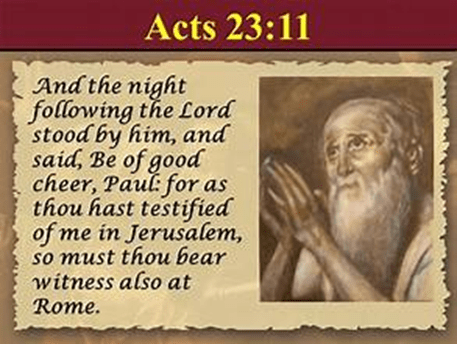
The following night the Lord stood near Paul and said, “Take courage! As you have testified about Me in Jerusalem, so also you must testify in Rome.”

Having spent the night in bonds, Paul is now brought before the Sanhedrin, the body of Jewish religious rulers in Jerusalem. When Paul begins by making stating that he has conducted himself in all good conscience before God, the high priest immediately orders someone to strike Paul. Knowing full well that this is the high priest, Paul rebukes him for demanding an illegal action. This response leaves the audience aghast, for nobody has dared to say such things to Ananias, the high priest. When an onlooker informs Paul that this is the high priest speaking, Paul immediately quotes Scripture as a form of apology. But two things are going on here: Paul has succeeded in demonstrating that the high priest is demanding an illegal action and Paul is also demonstrating that he has a large knowledge of Scripture.

As a Pharisee and a former pupil of Gamaliel, Paul knows most of the members of the Sanhedrin quite well. Many of these men may be longing for the coming of the Messiah but their honest spiritual hunger has been quenched by filling the void with religiosity.  

Then Paul, knowing that some of them were Sadducees and others Pharisees, called out in the Sanhedrin, “Brothers, I am a Pharisee, the son of a Pharisee. It is because of my hope in the resurrection of the dead that I am on trial.”

As soon as he had said this, a dispute broke out between the Pharisees and Sadducees, and the assembly was divided. For the Sadducees say that there is neither a resurrection, nor angels, nor spirits, but the Pharisees acknowledge them all.”

Paul might be from Tarsus, but he’s spent enough time studying in Jerusalem to know all the ins and outs of the controversies between the Pharisees and the Sadducees. As soon as Paul introduces his hope in the resurrection of the dead, the Sanhedrin erupts into a fire storm of controversy, with Sadducees defending themselves loudly while Pharisees begin to defend Paul. The arguments become so heated that the commander removes Paul from the scene before his accusers can tear him to pieces. That night, Paul has another vision of Jesus in which Jesus tells Paul that he will go to Rome and testify about Jesus there as well.

We all love miracle stories in which saints or angels or Jesus appear to give messages to a blessed person. Why does Jesus appear to Paul after this grueling confrontation with the Sanhedrin? Prior to Paul’s conversion, he was one of the leading lights of the Sanhedrin. Many of those hurling accusations at Paul are doing so out of spite or disappointment that Paul has betrayed them by becoming a Christian. For Paul, this encounter must be incredibly painful, for many of these men are former friends and colleagues. Paul has entered upon this meeting with high hopes of somehow convincing these men of the reality of Jesus Christ’s resurrection; however, it is now obvious that these men have hardened their hearts and won’t listen to anything or anybody. Paul might remember a story that Jesus told about a rich man and a beggar at his gate. The rich man died and went to hell, while the beggar died and went to heaven. When the rich man begged Father Abraham to send Lazarus, the beggar, back to warn the rich man’s brothers, Abraham told the rich man that his brothers had Moses and the prophets. If the rich man’s brothers refused to believe Moses and the prophets, neither would they believe it if someone arose from the dead. Now Paul realizes the truth of that story.

The Romans are bemused by all this furor, but the one thing they desire above all else is peace. While Paul is in prison enjoying a vision of Jesus, the Roman commander is probably staying up late, trying to figure out how to handle this well-spoken Roman citizen who has obviously run afoul of local religious leaders. This might be a small country, but these people are very troublesome!

What might we learn from Paul’s tactics in this meeting? Once Paul realizes that witnessing to these men is hopeless, he concentrates on dividing the group so that they will argue among themselves and he can escape. Jesus warned his disciples not to cast pearls before swine, and obviously, these men are swinish in their lack of spiritual understanding. There’s no point in forcing the argument any further, for nothing will be gained. Sometimes, we must realize that arguments are useless and a strategic retreat is the wisest tactic. May God help us, so that we will know when to speak out and when to quietly move back!

PRAYER: Heavenly Father, thank You for loving us and caring for us. Lord, help us to be wise as serpents and innocent as doves when dealing with critics. Give us the right words so that we will say only what You want us to say and the proper body language so that we will convey Your messages and none other. In the mighty and precious Name of King Jesus. Amen.

JUNE 14, 2025 FOLLOWING JESUS IN A POST-ASCENSION WORLD #51 PAUL’S ROMAN CITIZENSHIP SAVES HIM ONCE MORE

June 14, 2025

Acts 22:22-30 Paul’s Roman Citizenship

“And they listened to him until this word, and then they raised their voices and said, “Away with such a fellow from the earth, for he is not fit to live!” Then, as they cried out and tore off their clothes and threw dust into the air, the commander ordered him to be brought into the barracks, and said that he should be examined under scourging, so that he might know why they shouted so against him. And as they bound him with thongs, Paul said to the centurion who stood by, “Is it lawful for you to scourge a man who is a Roman, and uncondemned?”

“When the centurion heard that, he went and told the commander, saying, “Take care what you do, for this man is a Roman.”

Then the commander came and said to him, “Tell me, are you a Roman?”

He said, “Yes.”

The commander answered, “With a large sum I obtained this citizenship.”

And Paul said, “But I was born a citizen.”

Then immediately those who were about to examine him withdrew from him; and the commander was also afraid after he found out that he was a Roman, and because he had bound him.

The Sanhedrin Divided

The next day, because he wanted to know for certain why he was accused by the Jews, he released him from his bonds, and commanded the chief priests and all their council to appear, and brought Paul down and set him before them.”

Paul tells the truth, only to have the mob rise up screaming for his blood again. Now the mob is tearing their clothes, throwing dust in the air, and generally going crazy. The Roman soldiers drag Paul back into the barracks for further questioning. The soldiers are binding Paul with thongs when he quietly asks them, “Is it lawful for you to scourge a man who is a Roman, and uncondemned?”

“When the centurion heard that, he went and told the commander, saying, “Take care what you do, for this man is a Roman.”

Then the commander came and said to him, “Tell me, are you a Roman?”

He said, “Yes.”

The commander answered, “With a large sum I obtained this citizenship.”

And Paul said, “But I was born a citizen.”

Once more, Paul’s Roman citizenship saves him from being abused. Evidently, the commander is from some outlying province and has had to purchase his Roman citizenship at great cost while Paul has been borne a citizen. The commander does keep Paul bound in some fashion and arranges for the Sanhedrin to meet Paul on the following day.

How much is citizenship worth? When my husband’s US passport was stolen as we came through the airport in Accra in 1992, a US passport would then fetch $10,000 on the black market. Getting passports and renewing passports can be tricky and time-consuming. But there’s one form of citizenship open to all of us: through the sacrifices Jesus Christ has made for us on the cross at Calvary, we can all become citizens of heaven if we will turn away from our sins, confess them, and believe in Jesus Christ.

No matter what country issues a passport, that document will still have to be renewed at intervals. But when we become citizens of heaven, we don’t need to worry. As long as we are faithful to follow Jesus, our citizenship is secure. God has promised that He will never leave us or forsake us, and we can trust God’s promises.

May God help all who read these words to accept God’s free gift of eternal salvation through Jesus Christ and to become citizens of heaven.

PRAYER: Father God, thank You for loving us and for caring for us. Lord, we confess that we are sinners and that nothing we can do is good enough to make up for our sins or to earn our way into heaven. Please forgive our sins. Thank You for sending Jesus Christ to die for our sins so that his blood sacrifice cancels out all our wrong-doing. Thank You that because of Jesus’ sacrifice, we can become citizens of heaven. We accept Your promise and ask You to help us to be faithful to You for the rest of our lives. In the mighty and precious Name of King Jesus. Amen.
JUNE 13, 2025 FOLLOWING JESUS IN A POST-ASCENSION WORLD #50 SOMETIMES THE TRUTH CAN GET YOU INTO TROUBLE!

June 13, 2025

Acts 22:1-21 Paul’s Defense at Jerusalem

“Brethren and fathers, hear my defense before you now.” And when they heard that he spoke to them in the Hebrew language, they kept all the more silent.

Then he said: “I am indeed a Jew, born in Tarsus of Cilicia, but brought up in this city at the feet of Gamaliel, taught according to the strictness of our fathers’ law, and was zealous toward God as you all are today. I persecuted this Way to the death, binding and delivering into prisons both men and women, as also the high priest bears me witness, and all the council of the elders, from whom I also received letters to the brethren, and went to Damascus to bring in chains even those who were there to Jerusalem to be punished.”

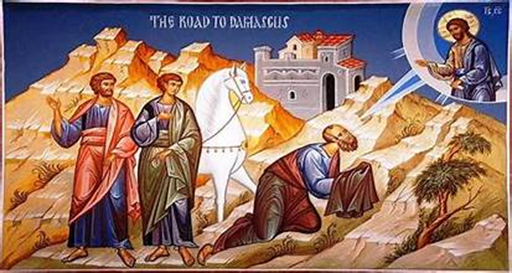
“Now it happened, as I journeyed and came near Damascus at about noon, suddenly a great light from heaven shone around me. And I fell to the ground and heard a voice saying to me, ‘Saul, Saul, why are you persecuting Me?’ So I answered, ‘Who are You, Lord?’ And He said to me, ‘I am Jesus of Nazareth, whom you are persecuting.’”

“And those who were with me indeed saw the light and were afraid, but they did not hear the voice of Him who spoke to me. So I said, ‘What shall I do, Lord?’ And the Lord said to me, ‘Arise and go into Damascus, and there you will be told all things which are appointed for you to do.’ And since I could not see for the glory of that light, being led by the hand of those who were with me, I came into Damascus.”

“Then a certain Ananias, a devout man according to the law, having a good testimony with all the Jews who dwelt there, came to me; and he stood and said to me, ‘Brother Saul, receive your sight.’ And at that same hour I looked up at him. Then he said, ‘The God of our fathers has chosen you that you should know His will, and see the Just One, and hear the voice of His mouth. For you will be His witness to all men of what you have seen and heard. And now why are you waiting? Arise and be baptized, and wash away your sins, calling on the name of the Lord.’”

“Now it happened, when I returned to Jerusalem and was praying in the temple, that I was in a trance and saw Him saying to me, ‘Make haste and get out of Jerusalem quickly, for they will not receive your testimony concerning Me.’ So I said, ‘Lord, they know that in every synagogue I imprisoned and beat those who believe on You. And when the blood of Your martyr Stephen was shed, I also was standing by consenting to his death, and guarding the clothes of those who were killing him.’ Then He said to me, ‘Depart, for I will send you far from here to the Gentiles.’”

Paul is nothing if not brave. Here Paul is, having had to be carried bodily by Roman soldiers into the praetorium to avoid being torn apart by a hostile mob. Now Paul is addressing this furious group in Hebrew, shocking them into silence. Paul gives a brief account of his radical change of heart from persecutor of Christians to a preacher and teacher.

“Now it happened, when I returned to Jerusalem and was praying in the temple, that I was in a trance and saw Him saying to me, ‘Make haste and get out of Jerusalem quickly, for they will not receive your testimony concerning Me… Then He said to me, ‘Depart, for I will send you far from here to the Gentiles.’”

The crowd seems to be cooling off until Paul reports that God has sent him to the Gentiles. This statement is all it takes for the crowd to begin screaming for Paul’s blood.’’

Paul knows the emotions of the crowd, so why does he bother describing his encounter with Jesus? Paul is trying to be as honest as possible, and he wants to make sure that none of the religious authorities fail to hear his testimony. Paul still hopes that some of his former colleagues might have a change of heart if only they will listen to his testimony. But this is also Paul’s last attempt to make these men understand. If Jewish religious leaders refuse to listen, Paul feels he has done everything he can and is now completely free to go to the Gentiles.

When facing opposition, do we tell the whole truth or try to shade things a little to make them more palatable? We must be honest, we have no choice; we know we must tell the truth, even though we anticipate a bad reception. Here Paul gives a clear account of his divine encounter with the risen Jesus Christ, but he’s addressing a hostile audience.

Our responsibility is to tell the truth. The reaction of our audience is their choice, not ours. Once we deliver God’s message, we must trust Him to take care of us and our audience. May God help us so that we will be brave under fire.

PRAYER: Father God, thank You for loving us and caring for us. Lord, help us to be faithful to You, even when we face fierce opposition. In the mighty and precious Name of King Jesus. Amen.
JUNE 12, 2025 FOLLOWING JESUS IN A POST-ASCENSION WORLD #49 COMPROMISES DON’T ALWAYS WORK!

June 12, 2025

Acts 21:26-36 Arrested in the Temple

“Then Paul took the men, and the next day, having been purified with them, entered the temple to announce the expiration of the days of purification, at which time an offering should be made for each one of them.”

Remember those church leaders in Jerusalem who are still trying to compromise with the believers who are ultra-observant Jews? These men have virtually ordered Paul to undergo purification and to pay the ritual offering demanded for four men who have completed a vow and who are also undergoing purification with Paul. Sounds simple, right? But when Paul enters the temple with these men, hell is literally going to break loose!

“Now when the seven days were almost ended, the Jews from Asia, seeing him in the temple, stirred up the whole crowd and laid hands on him, crying out, “Men of Israel, help! This is the man who teaches all men everywhere against the people, the law, and this place; and furthermore, he also brought Greeks into the temple and has defiled this holy place.” (For they had previously seen Trophimus the Ephesian with him in the city, whom they supposed that Paul had brought into the temple.)

Remember, Jerusalem is a cosmopolitan city, and Jews from all over the known world are gathering for the Feast of Pentecost. These Jews from Asia might not actually know much of anything about Paul; however, they’ve gotten hold of a bunch of vicious lies and are more than ready to persecute Paul. Perhaps some of these men have previously debated with Paul and lost while he was evangelizing in Asia. Now is their golden opportunity for revenge, and for proving that they can be more orthodox than those Jews in Jerusalem. Truth has nothing to do with this situation. Their minds are made up; don’t confuse them with the facts!

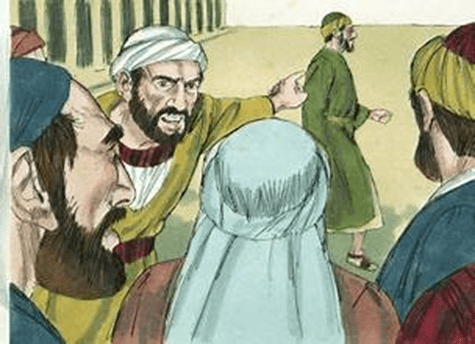
“And all the city was disturbed; and the people ran together, seized Paul, and dragged him out of the temple; and immediately the doors were shut. Now as they were seeking to kill him, news came to the commander of the that all Jerusalem was in an uproar. He immediately took soldiers and centurions, and ran down to them. And when they saw the commander and the soldiers, they stopped beating Paul. Then the commander came near and took him, and commanded him to be bound with two chains; and he asked who he was and what he had done. And some among the multitude cried one thing and some another.

So when he could not ascertain the truth because of the tumult, he commanded him to be taken into the barracks. When he reached the stairs, he had to be carried by the soldiers because of the violence of the mob. For the multitude of the people followed after, crying out, “Away with him!”

It’s never difficult to assemble a mob in Jerusalem, and this time is no exception. Some of these men truly believe they are honorable Jews punishing a heretic. Others in the crowd might simply be hangers-on in the market place, ready for any kind of excitement. Still others might be getting some money to shout more loudly.

When the Roman commander gets word of the mob action, he organizes swiftly, taking armed soldier and centurions and running to where the mob is beating Paul. As Paul is suffering, does he remember standing by while Stephen was being stoned? The mob has become so violent that the Romans bind Paul with chains and physically carry him into their barracks where nobody else dare penetrate. Even so, those attacking Paul follow the soldiers all the way to the barracks, screaming for Paul’s blood.

Acts 21:37-40 Addressing the Jerusalem Mob

Then as Paul was about to be led into the barracks, he said to the commander, “May I speak to you?”

He replied, “Can you speak Greek? Are you not the Egyptian who some time ago stirred up a rebellion and led the four thousand assassins out into the wilderness?”

But Paul said, “I am a Jew from Tarsus, in Cilicia, a citizen of no mean city; and I implore you, permit me to speak to the people.”

So when he had given him permission, Paul stood on the stairs and motioned with his hand to the people. And when there was a great silence, he spoke to them in the Hebrew language, saying, “Brethren and fathers, hear my defense before you now.” And when they heard that he spoke to them in the Hebrew language, they kept all the more silent.”

The Romans have confused Paul with some Egyptian who has previously led a rebellion involving four thousand men. Many of the Jews in Jerusalem don’t really know Paul but they are certain he must be some heretic from Asia, since it’s the Asian Jews who have raised an outcry. Evidently, Paul addresses the Roman commander in fluent Greek, immediately getting his attention. This commander likely speaks excellent Latin, Greek, and possibly a few more languages as well, depending on where he has previously been stationed. When Paul informs the commander that he is a Jew from Tarsus in Cilicia, the commander immediately realizes that Paul must be a Roman citizen. Now the commander is concerned, for Roman citizens are not to be bound with chains without a fair trial. Who knows what political connections Paul might have? And unlike the mob, Paul addresses the commander courteously, using the form of address appropriate for the commander’s rank and position.

Being stationed in Jerusalem to keep peace among the Jews is no plum assignment for a Roman commander. These people are forever picking fights over theology and then demanding the Romans settle the matter for them. Some Romans follow the Roman traditional religions while many soldiers follow the cult of Mithraeus or sacrifice to the god Mars, the Roman god of war. Most Romans have little or no understanding of traditional Judaism, nor do they really care about the Jewish God. Throughout the Roman Empire, there are all kinds of local deities. The key thing is to demonstrate sufficient respect that local people will not riot while maintaining one’s own belief systems.

Most commanders long for the day they can return to Italia, perhaps to some desirable property in the peaceful Italian countryside. But this man Paul is a Roman citizen from Tarsus in the province of Cilicia and he seems like a decent fellow. The commander is inclined to investigate Paul further; besides, many of these Jewish religious leaders have made no pretense of their scorn for the Romans. Why satisfy these men who have behaved so arrogantly?

When we are in trouble, we must remember that God is the One who orchestrates our circumstances. Here, it is the hated Romans who rescue Paul from the ultra-religious Jews. The Roman commander might be fascinated by Paul, for Paul is obviously well-educated, well-spoken, and does not appear to be a threat to anybody. By now, the commander has undoubtedly gotten a full report of the incident in the temple and realizes that this mob scene has little to do with truth and everything to do with someone jumping to conclusions. Psalm 37:23-24 tells us, “The steps of a good man are ordered by the Lord, and He delights in his way. Though he fall, he shall not be utterly cast down; for the Lord upholds him with His hand.” Even though this mob in Jerusalem is screaming for Paul’s blood, God is using them to bring Paul into Roman custody. God wants Paul in Rome and the Romans are going to transport him there.

Sometimes we might find ourselves embroiled in all kinds of controversy that is not of our making. Someone in our situation has made major mistakes and is now attempting to divert attention from themselves by accusing us of things we have never thought of, let alone done. As long as our consciences are clear, we can relax, knowing that God is the One who will orchestrate everything. Lies might have long legs; however, the legs of truth are longer and stronger. May God help us to trust in His mercy and grace, so that we remain calm when unjustly accused!

PRAYER: Father God, thank You for loving us and for caring for us. Lord, deliver us from the need to justify ourselves! You are the One who justifies. You are the One who promotes. Help us to trust in You, even when we cannot see. In the mighty and precious Name of King Jesus. Amen.