Archive for July, 2025

JULY 21, 2025 WHEN TRAGEDY STRIKES, HOW DO WE RESPOND? #4 DEALING WITH PEOPLE STUCK IN HORRIBLE SITUATIONS

July 21, 2025

Job 3 Job’s First Speech

“At last Job spoke, and he cursed the day of his birth. He said: “Let the day of my birth be erased, and the night I was conceived. Let that day be turned to darkness. Let it be lost even to God on high, and let no light shine on it. Let the darkness and utter gloom claim that day for its own. Let a black cloud overshadow it, and let the darkness terrify it. Let that night be blotted off the calendar, never again to be counted among the days of the year, never again to appear among the months.

Let that night be childless. Let it have no joy. Let those who are experts at cursing—whose cursing could rouse Leviathan—curse that day. Let its morning stars remain dark. Let it hope for light, but in vain; may it never see the morning light. Curse that day for failing to shut my mother’s womb, for letting me be born to see all this trouble. “Why wasn’t I born dead? Why didn’t I die as I came from the womb? Why was I laid on my mother’s lap? Why did she nurse me at her breasts?

Had I died at birth, I would now be at peace. I would be asleep and at rest. I would rest with the world’s kings and prime ministers, whose great buildings now lie in ruins. I would rest with princes, rich in gold, whose palaces were filled with silver. Why wasn’t I buried like a stillborn child, like a baby who never lives to see the light? For in death the wicked cause no trouble, and the weary are at rest. Even captives are at ease in death, with no guards to curse them. Rich and poor are both there, and the slave is free from his master.

“Oh, why give light to those in misery, and life to those who are bitter? They long for death, and it won’t come. They search for death more eagerly than for hidden treasure. They’re filled with joy when they finally die, and rejoice when they find the grave.

Why is life given to those with no future, those God has surrounded with difficulties? I cannot eat for sighing; my groans pour out like water. What I always feared has happened to me. What I dreaded has come true. I have no peace, no quietness. I have no rest; only trouble comes.”

Nobody can blame Job for wishing for relief from this suffering; the poor guy is miserable. Now Job is wishing that he had never been born or that he would have died at birth. Again, Job’s losses are so staggering that his grief is understandable. But what is most interesting is Job’s final statement. “What I always feared has happened to me. What I dreaded has come true.” All this time, even though Job has been enjoying a wealthy lifestyle, he has been living in fear, but fear of what? Evidently, Job has feared losing everything, including his family, his wealth, and his standing in the community. Yes, Job is a man of faith; however, he has also been making those sacrifices in hopes of protecting his children and his way of life.

Notice something:  Even though Job wishes he had never been born, he is not threatening to kill himself.  Job is committed to continuing to live, even though he is miserable. Job is a man in search of the God who has been leading him and keeping him all his life. Even though Job is in despair, he isn’t giving up.

We have friends who for the last eight months have endured sufferings rivaling those of Job. When Pastor Rus led a small group on a short-term mission to Guatemala, he expected to be there a few weeks at the most and then to return to the small town where he pastors a church. But while in a remote mountain village, Rus suddenly developed severe pancreatitis and had to be carried down the mountain and then sent to a big city hospital where he remained for several weeks. Thousands of people were praying for our friend, for there were times when his life was at risk due to repeated infections. Eventually, Rus was transferred to an excellent hospital in his home area; however, he continued to suffer repeated infections and all kinds of other problems for several more months. There were undoubtedly times when Rus might have wished that the misery and pain would simply stop. Rus’s wife was forced to become his advocate, arguing with health care workers and reporting problems as they became evident.

Blessedly, Pastor Rus’s story has a very glorious ending, for Rus has made a miraculous recovery. Not only has Rus returned home but he is also gradually returning to ministry a little at a time. Both Rus and his wife give all glory to God for answering the prayers of those who continued to storm heaven, refusing to give up.

Throughout the world there are millions of people suffering from chronic diseases that make them miserable. How can we help such people? First, Pray! Pray! Pray! God can give relief or the courage to continue to move forward. Second, ask God to show small things you can do to help-doing shopping, doing laundry, running kids to activities, cleaning house, driving the sufferer to medical appointments-the list of possibilities is virtually endless. And don’t overlook the value of simple text messages or short encouraging phone calls.

May God help us to be sensitive to the needs of others and to help and not hinder.

PRAYER: Father God, thank You for loving us and caring for us. Lord, inspire us so that we will find new ways to help those around us. In the mighty and precious Name of King Jesus. Amen.
JULY 20, 2025 WHEN TRAGEDY STRIKES, HOW DO WE RESPOND #3 HOW CAN WE HELP SOMEONE WHO IS GRIEVING? SHOW UP!

July 20, 2025

 Job 2 Job’s Second Test

“One day the members of the heavenly court came again to present themselves before the Lord, and the Accuser, Satan, came with them. “Where have you come from?” the Lord asked Satan.

Satan answered the Lord, “I have been patrolling the earth, watching everything that’s going on.”

Then the Lord asked Satan, “Have you noticed my servant Job? He is the finest man in all the earth. He is blameless—a man of complete integrity. He fears God and stays away from evil. And he has maintained his integrity, even though you urged me to harm him without cause.”

Satan replied to the Lord, “Skin for skin! A man will give up everything he has to save his life. But reach out and take away his health, and he will surely curse you to your face!”

“All right, do with him as you please,” the Lord said to Satan. “But spare his life.” So Satan left the Lord’s presence, and he struck Job with terrible boils from head to foot.

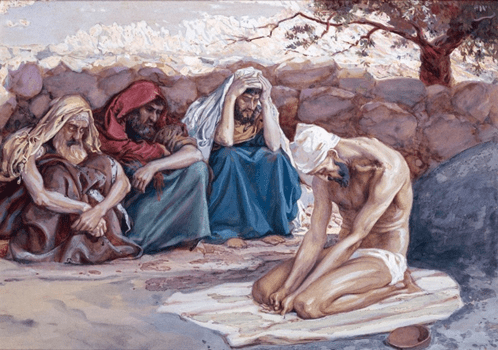
Job scraped his skin with a piece of broken pottery as he sat among the ashes. His wife said to him, “Are you still trying to maintain your integrity? Curse God and die.”

But Job replied, “You talk like a foolish woman. Should we accept only good things from the hand of God and never anything bad?” So in all this, Job said nothing wrong.”

Ever have shingles? Shingles is a viral rash caused by the same virus that causes chicken pox. Those suffering from shingles will tell you that the pain is itching, stinging, burning, and among the worst pains they have ever experienced. Sometimes shingles rashes can produce large blisters, inciting the sufferers to dig at themselves as they try to gain any kind of relief possible. While we don’t know if Job is suffering from shingles, this description certainly fits. Now Job is applying ashes and scraping at his sores with a broken piece of pottery, probably bleeding from the sores and mixing blood with ashes.

Sadly, Job’s wife is not a woman of faith. Mrs. Job likely married her husband when he was a prominent businessman. Now this lady’s children are dead, the family has lost most of its wealth as well as most of its servants, and her husband is suffering from a loathsome disease. As far as Madam Job is concerned, she would be happy if her husband would just go ahead and die; at least she would get sympathy as a widow and she might be able to re-marry. But Job continues to trust God and tells his wife, “You talk like a foolish woman. Should we accept only good things from the hand of God and never anything bad?” So in all this, Job said nothing wrong.”

Job’s Three Friends Share His Anguish

“When three of Job’s friends heard of the tragedy he had suffered, they got together and traveled from their homes to comfort and console him. Their names were Eliphaz the Temanite, Bildad the Shuhite, and Zophar the Naamathite. When they saw Job from a distance, they scarcely recognized him. Wailing loudly, they tore their robes and threw dust into the air over their heads to show their grief. Then they sat on the ground with him for seven days and nights. No one said a word to Job, for they saw that his suffering was too great for words.”

If you’ve ever read the Book of Job before, you might have found yourself thoroughly irritated with Job’s friends and the arrogant nature of the advice they give him later; however, look at their initial response. These three men tear their clothing, ruining it, and throw dust into the air over their heads. Next these men sit on the ground with Job seven days and nights without saying anything.

Compare the response of Job’s three friends to the responses we generally give to someone else’s grief. First, none of us are about to tear any of our clothing, let alone throw dust on our heads. We might send text messages or emails or show up at the house of the grieving family with food. These men sit for a full week on the ground without saying anything. What an amazing response! By spending this time quietly sitting with Job, these men are witnesses that they feel his pain and are grieving with him. It’s likely that 99.99% of us when given the opportunity will furnish all kinds of unwanted and/or unnecessary advice, much of it starting with foolish statements such as “I know how you feel.” Rubbish! Grief is an individual matter and none of us knows precisely how someone else feels.  

Although none of these men is Jewish as far as we know, the ritual of Shiva that Job and his friends are going through is one commonly practiced by Jews since Bible times. Here is what Wikipedia says about Shiva.  “Shiva is the week-long mourning period in Judaism for first-degree relatives. The ritual is referred to as “sitting shiva” in English. The shiva period lasts for seven days following the burial. Following the initial period of despair and lamentation immediately after the death, shiva embraces a time when individuals discuss their loss and accept the comfort of others.[1]

Its observance is a requirement for the parents, siblings, spouses, and children of the person who has died. At the funeral, mourners wear an outer garment that is torn before the procession in a ritual known as keriah. In some traditions, mourners wear a black ribbon that is cut in place of an everyday garment.[2][3] The torn article is worn throughout the entirety of shiva. Typically, the seven days begin immediately after the deceased has been buried. Following burial, mourners[4] assume the halakhic status of avel (Hebrew: אבל, ‘mourner’). This state lasts for the entire duration of shiva.

It is necessary for the burial spot to be entirely covered with earth in order for shiva to commence. During the period of shiva, mourners remain at home. Friends and family visit those in mourning in order to give their condolences and provide comfort. The process, dating back to biblical times, formalizes the natural way an individual confronts and overcomes grief. Shiva allows for the individual to express their sorrow, discuss the loss of a loved one, and slowly reenter society.[

Job’s friends make a good beginning by just being with him in his anguish and not offering quick solutions. Too bad they don’t continue in this vein. As we go through the Book of Job, let’s remember that these men are friends and also remember that we too can wound people in the name of friendship.

PRAYER: Father God, thank You for loving us and caring for us. Lord, help us to be sensitive to the griefs of others and to encourage rather than discourage them. In the mighty and precious Name of King Jesus. Amen.

JULY 19, 2025 WHEN TRAGEDY STRIKES, HOW DO WE RESPOND #2 HOW DO YOU FACE LOSS OF WEALTH OR FAMILY?

July 19, 2025

Job 1 Prologue

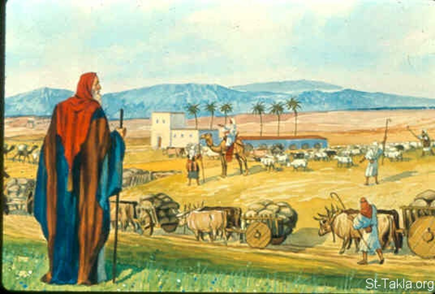
“There once was a man named Job who lived in the land of Uz. He was blameless—a man of complete integrity. He feared God and stayed away from evil. He had seven sons and three daughters. He owned 7,000 sheep, 3,000 camels, 500 teams of oxen, and 500 female donkeys. He also had many servants. He was, in fact, the richest person in that entire area.

Job’s sons would take turns preparing feasts in their homes, and they would also invite their three sisters to celebrate with them. When these celebrations ended—sometimes after several days—Job would purify his children. He would get up early in the morning and offer a burnt offering for each of them. For Job said to himself, “Perhaps my children have sinned and have cursed God in their hearts.” This was Job’s regular practice.”

Personally, I vote with Pastor Swindoll, that Job himself is telling this story. Does Job keep a diary during his suffering? We don’t know. We do know that Job belongs to a culture and an era that values memorization of large amounts of material, so perhaps Job memorizes everything and writes it down later. But if this is Job telling his own story, he would definitely know all the details of his family and his wealth, and he would be fully aware of the steps he was taking to try to purify his children. But there’s a problem.

Can we purify someone else, even a beloved child? Each one of us must stand before God individually and answer to God for ourselves. All that we can do is to try to teach our children the way to God and set an example by our actions. Certainly, Job is setting an example; however, are Job’s kids relaxing, assuming that they can coast along on their father’s holiness? Sadly, that doesn’t work. And although most young people secretly believe they’re immortal, young people can die in disasters.

Job’s First Test

“One day the members of the heavenly court came to present themselves before the Lord, and the Accuser, Satan, came with them. “Where have you come from?” the Lord asked Satan.

Satan answered the Lord, “I have been patrolling the earth, watching everything that’s going on.”

Then the Lord asked Satan, “Have you noticed my servant Job? He is the finest man in all the earth. He is blameless—a man of complete integrity. He fears God and stays away from evil.”

Satan replied to the Lord, “Yes, but Job has good reason to fear God. You have always put a wall of protection around him and his home and his property. You have made him prosper in everything he does. Look how rich he is! But reach out and take away everything he has, and he will surely curse you to your face!”

“All right, you may test him,” the Lord said to Satan. “Do whatever you want with everything he possesses, but don’t harm him physically.” So Satan left the Lord’s presence.

One day when Job’s sons and daughters were feasting at the oldest brother’s house, a messenger arrived at Job’s home with this news: “Your oxen were plowing, with the donkeys feeding beside them, when the Sabeans raided us. They stole all the animals and killed all the farmhands. I am the only one who escaped to tell you.”

While he was still speaking, another messenger arrived with this news: “The fire of God has fallen from heaven and burned up your sheep and all the shepherds. I am the only one who escaped to tell you.”

While he was still speaking, a third messenger arrived with this news: “Three bands of Chaldean raiders have stolen your camels and killed your servants. I am the only one who escaped to tell you.”

While he was still speaking, another messenger arrived with this news: “Your sons and daughters were feasting in their oldest brother’s home. Suddenly, a powerful wind swept in from the wilderness and hit the house on all sides. The house collapsed, and all your children are dead. I am the only one who escaped to tell you.”

Job stood up and tore his robe in grief. Then he shaved his head and fell to the ground to worship. He said, “I came naked from my mother’s womb, and I will be naked when I leave.
The Lord gave me what I had, and the Lord has taken it away. Praise the name of the Lord!” In all of this, Job did not sin by blaming God.”

WOOF! In a few brief hours Job loses most of his servants and all of his camels, oxen, donkeys, and sheep through marauding bands and lightning strikes. Now Job learns that all his children have died when the house they were in collapsed during a tornado. When Job got up that morning, he was happy, healthy, and wealthy. Now he is destitute and grieving over the loss of his seven sons and three daughters, not to mention the servants who have also died. If Job is an animal lover, he might also be grieving over the loss of those animals. How much grief can one man stand?

Fortunately for Job, social media did not exist at this time; otherwise, Job’s suffering might have been far worse. News pundits would have been trying to interview everyone in the household-“Exclusive! Job’s servant reveal that his animals were grazing in an endangered area!” “Were these deaths really necessary? An analysis of the house where Job’s children died.” “I alone escaped! The harrowing details given by one of Job’s most trusted servants.” “Rich man but poor decisions-Did Job sufficiently protect his property?”

In the wake of the flooding in various parts of Texas, people in other parts of the world have reveled in criticizing everything and everybody, including the poor weather forecasters, who did their best under horrible circumstances. At least in Job’s day, people were willing to accept tragedies as just that, tragedies. These days, blaming and shaming has become the name of the game. It is eerily reminiscent of practices in remote villages in Ghana where as soon as someone dies, sooth sayers begin trying to ascertain which old lady in the village has performed witchcraft to kill that person.

Job responds beautifully; he tears his robe in grief, shaves his head, and then falls to the ground and worships God. “The Lord gave me what I had, and the Lord has taken it away. Praise the name of the Lord!” One of our village friends had a bright son in university. The young man was not only a diligent student but also a fine Christian and a leader in his local church. The morning after this young man suddenly died from liver failure due to Hepatitis B, this man’s father, a strong Christian, quoted Job’s words.

Repeatedly, I have argued with God when young patients have died. And repeatedly, God has reminded me that the day each of these patients was born, He already knew the day they would die. Isaiah 55:8-9 tells us, “My thoughts are nothing like your thoughts,” says the Lord.
  “And my ways are far beyond anything you could imagine. For just as the heavens are higher than the earth, so my ways are higher than your ways and my thoughts higher than your thoughts.”
One of our pastor friends who has gone to be with Jesus used to remind us that God is in management and that we are only in advertising.

How do we face unspeakable tragedies? In the end, we must either bless God or curse Him. The families of little girls who were swept away from their camp by the Texas floods are choosing to bless God and to establish foundations that will bless others. Let us follow their example!

PRAYER: Father God, thank You for loving us and caring for us. Lord, help us to trust Your sovereignty, even when tragedy strikes and to be grateful for all the years of blessings. In the mighty and precious Name of King Jesus. Amen.
JULY 18, 2025 WHEN TRAGEDY STRIKES, HOW DO WE RESPOND #1 INTRODUCTION TO THE BOOK OF JOB

July 18, 2025

Well, you never know what God is going to do! After completing the Pilgrim Psalms, I thought God wanted me to write about the fruits of the Spirit. But floods are raging in Texas, Oklahoma, Iowa, Illinois, and North Carolina. A huge fire has destroyed National Park Service Headquarters and several other buildings at the Grand Canyon. Photos of those lost in the Texas floods are dominating many news feeds. While we are demanding to know where God is in all these disasters, it’s time to take another look at the Book of Job. Pastor Chuck Swindoll in his Insight for Living teaching gives us this introduction to this complicated but important book. https://www.insight.org/resources/bible/the-wisdom-books/job

Who wrote the book?

The author of the book of Job is unknown. Several suggestions have been put forth as plausible authors: Job himself, who could have best recalled his own words; Elihu, the fourth friend who spoke toward the end of the story; various biblical writers and leaders; or many editors who compiled the material over the years. While there is no definitive answer, it was most likely an eyewitness who recorded the detailed and lengthy conversations found in the book. In Old Testament times, authors sometimes referred to themselves in the third person, so Job’s authorship is a strong possibility.

Who was Job? This wealthy landowner and father is one of the best-known biblical heroes. But we know little more than that he was stripped of everything, without warning, and that his faith was severely tested.

Where are we?

Though the text does not directly identify its setting, internal clues indicate that Job lived during the time of the patriarchs, approximately 2100 to 1900 BC. According to Job 42:16, Job lived an additional 140 years after his tragedies occurred, perhaps to around 210 years total. His long lifespan generally corresponds to that of Terah (Abraham’s father), Abraham, Isaac, and Jacob. Also, Job’s wealth was measured in livestock (Job 1:342:12), as was Abraham’s (Genesis 12:16). Like the patriarchs, Job used God’s unique title “El Shaddai” (God Almighty). The book of Job does not mention the Mosaic Law; indeed, Job’s daughters were equal heirs with his sons, and Job himself, though not a priest, offered sacrifices—things not possible under the Law (Leviticus 4:10Numbers 27:8). Though we cannot be certain, Job may have lived during the time of Jacob or shortly thereafter.

Job lived in the land of Uz (Job 1:1), but no one really knows where Uz was located. Scholars believe it was outside of Canaan, near the desert because “the customs, vocabulary, and references to geography and natural history relate to northern Arabia.”

Why is Job so important?

The Israelites categorized Job within their wisdom literature. The book includes language from ancient legal proceedings, laments, and unique terms not found elsewhere in the Bible. In addition, the majority of Job is written in parallel lines which are indicative of poetry.

The book delves into issues near to the heart of every human who experiences suffering. The prologue provides a fascinating peek into the back story—why God allowed Satan to afflict Job with such pain and turmoil. Then, through a series of dialogues and monologues arranged in a pattern of threes, human wisdom attempts to explain the unexplainable, until finally God Himself speaks.

The final chapters of Job record God’s masterful defense of His majesty and unique “otherness”—of God’s eternal transcendence above creation—in contrast with Job’s humble and ignorant mortality. “Where were you when I laid the foundation of the earth? / Tell Me, if you have understanding” (Job 38:4).

What’s the big idea?

Job’s plight of undeserved suffering compels us to ask the age-old question, “Why do bad things happen to good people?” The answer given to Job may or may not satisfy the reader. God allows pain for good reason, but He may never reveal those reasons.

Job did not reject God, but Job did challenge and accuse Him. The Almighty quieted Job decisively when He finally thundered His own perspective on the situation. God did not answer Job’s question of “Why?”—He instead overwhelmed Job and his friends with the truth of His majesty and sovereignty. Job came away with a deeper sense of God’s power and splendor, trusting Him more:

“I have heard of You by the hearing of the ear;
But now my eye sees You;
Therefore I retract,
And I repent in dust and ashes.” (
Job 42:5–6

How do I apply this?

Pain inevitably afflicts each one of us. Suffering is unavoidable in this life. Will your relationship with God be enough when trials come? Will you trust Him through your suffering? Read Job 38–42. Spend time with the Almighty. Pray for a stronger faith in the powerful Creator described in those chapters. Pray for a right perspective of Him so that you might see your situation through His eyes.

Instead of asking where God is in the midst of your pain, the book of Job affirms God’s control and asks us, “Where are we in our pain? Are we trusting our Creator, even though we cannot understand our circumstances?”

Job is neither a simple book nor an easy one, but there are lessons we need to learn from it. So, come to the Land of Uz, where we are about to meet a very wealthy landowner, even a prince, named Job.

PRAYER: Father God, thank You for loving us and for caring for us. Lord, help us to learn as much as we can from the Book of Job, knowing that there will always be more for us to gain as we continue with You. We ask this in the mighty Name of King Jesus. Amen.

JULY 17, 2025 WE’RE ALL PILGRIMS HEADED SOMEWHERE #15 WHAT’S KEEPING YOU UP AT NIGHT?

July 17, 2025

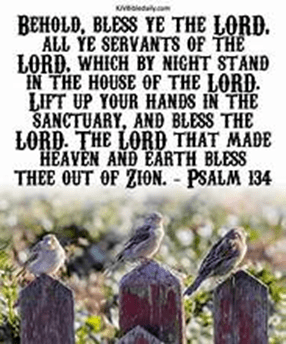
Psalm 134 Praise to God in His Temple

A song for pilgrims ascending to Jerusalem.

“Oh, praise the Lord, all you servants of the Lord, you who serve at night in the house of the Lord.
Lift your hands toward the sanctuary, and praise the Lord.

May the Lord, who made heaven and earth, bless you from Jerusalem.”

Consider the priests on duty at the temple in Jerusalem. Obviously, these men were organized into shifts, including priests to offer prayers, singers, musicians, etc. Now think about what it was like in the temple during the daytime.

During the day, the temple would be packed with worshipers praying, making offerings and sacrifices, and meeting and greeting one another.Anyone working the day shift could look forward to an interesting and stimulating time. But what about night in the temple?

Once the evening prayers and sacrifices had been offered, things would be very quiet. There were lights that were to be kept burning at all times, and night workers would be responsible for ensuring that these lights were supplied with purest oil, that the wicks were properly trimmed, and that everything was in its place. But none of these duties would take very long, so what were the temple workers to do for the rest of the night? This psalm tells us that they were to “praise the Lord,” and that they were to “lift their hands toward the sanctuary and praise the Lord.”

We might imagine that even though music would have been softer than in the daytime, musicians would still have been playing, singers singing, and those assigned to special prayer would be praying.

There are several important things about this psalm. First, worship is to continue even when there’s no audience. These days, much of what passes for worship in many churches has actually become performance. Sadly, many lead singers behave as if they are auditioning for Christian music videos, not leading people into the throne room of God.  

Next, worship and prayer at night are particularly important. During the daytime, many of us are so distracted that even when we repeat prayers, we may be doing it by rote rather than by heart. But at night when things are quiet, it’s much easier to pray effectively and also much easier to hear the Holy Spirit. While the Holy Spirit may come as a rushing wind on occasion, it’s far more common for the Holy Spirit to speak very softly. Daytime events can make it impossible to hear the Holy Spirit. Remember that prayer is a two-way conversation, not a recitation. If all we are doing is dumping our problems and grievances on God without listening for His answers, we have accomplished nothing.

Yet another reason for nighttime prayer and worship is the spiritual danger many people find themselves in at night. When we are tired, Satan can appeal to our fatigue to lead us into self-pity, a useless endeavor that precludes hearing from God. Those wishing to hurt us may try to attack us in dreams. There have been many occasions when God has awakened me and ordered me to pray for people. Sometimes I eventually get feedback but many times, I do not. No matter. God is the One handing out prayer assignments. My job is to obey, not to argue.

When I can’t sleep, I do my devotional reading for the next day, assuming that I might be called out for a medical emergency at the time I would normally be doing devotions.

How can we hear from God at night? The prayer Eli told the boy Samuel to pray gives us the answer. “Speak, Lord, for your servant is listening.” We can also ask God to help quiet our hearts and minds so that we will hear His still small voice speaking in our minds.

Very few believers ever hear God speaking in an audible voice. I was once in a Bible study where several believers were testifying, saying, “God told me…..” After several of these testimonies, one sweet lady broke down and wept, saying, “You keep saying ‘God told me’ but God never tells me anything!” Sadly, this lady was legally blind and yet bravely took two different city buses to and from work each day. Obviously, God had to be guiding her, but she misunderstood our enthusiasm to mean that God was speaking to the rest of us audibly. It took quite a bit of time that night to let this lady see that she was receiving just as much guidance from God as the rest of us were.

There’s a meme that says, “If you can’t sleep, don’t count sheep. Talk to the Shepherd.” Find a quiet place. Spend time with God and ask Him to speak to you. Even if you don’t feel as if God has said anything to you, you will still find you have peace and you can go to sleep.

Psalm 4:8 tells us, “In peace I will lie down and sleep,
    for you alone, O Lord, will keep me safe.”
Come bless the Lord, lifting up your hands in worship. And then go to sleep, knowing that the Shepherd is keeping watch.

PRAYER Father God, thank You for loving us and caring for us. Lord, many of us feel helpless, confused, conflicted and exhausted. Please speak to the hearts of all who read these words, comforting them and letting them know that You are with them and that You will never leave them or forsake them. In the mighty and precious Name of King Jesus. Amen.

JULY 16, 2025 WE’RE ALL PILGRIMS HEADED SOMEWHERE #14 “GENTLEMEN, EITHER WE MUST ALL HANG TOGETHER OR WE WILL ALL HANG SEPARATELY!”

July 16, 2025

Psalm 133 Brotherly Fellowship and Unity

A song for pilgrims ascending to Jerusalem. A psalm of David.

“How wonderful and pleasant it is when brothers live together in harmony!
For harmony is as precious as the anointing oil that was poured over Aaron’s head, that ran down his beard and onto the border of his robe.
Harmony is as refreshing as the dew from Mount Hermon that falls on the mountains of Zion.”
And there the Lord has pronounced his blessing, even life everlasting.”

It was 1776 and in Philadelphia, representatives of the thirteen colonies were arguing over the Declaration of Independence. Finally, Benjamin Franklin, fed up with his fellow delegates told the assembly, “Gentlemen, either we must all hang together or we will all hang separately!” Faced with the reality possibility of dying at the hands of the British, delegates eventually signed, pledging “our lives, our fortunes, and our sacred honor.” Who were these individuals? What happened to the 56 men who signed the Declaration of Independence? What kind of men were they? Here is the information from https://ultimateflags.com/blog/56-men-pledge-our-lives-our-fortunes-and-our-sacred-honor/

The men were lawyers, jurists, merchants, farmers, large plantation owners; men of means, well educated. But they signed the Declaration of Independence knowing full well what they were putting at risk. They were British subjects at the time, and knew that the penalty for treason was death by hanging.

They were not wild-eyed, rabble-rousers, but mostly soft-spoken men of means and education. They had security, but valued liberty more. Each one surely had more to lose from revolution than he had to gain by it. But they stood tall, and unwavering and pledged:  

“For the support of this declaration, with firm reliance on the protection of the divine providence, we mutually pledge to each other, our lives, our fortunes, and our sacred honor.”

Here are the fates of the signers:

Nine fought and died from wounds or hardships during the war. Five were captured by the British, charged with treason, and were tortured before they died. Twelve had their homes ransacked and burned. Two lost their sons serving in the Revolutionary Army. Another had two sons captured. Several lost wives, sons, or entire families. One lost his 13 children. Two wives were brutally treated. All were at one time or another the victims of manhunts and driven from their homes. Seventeen lost everything they owned. Yet not one of them defected or went back on his pledged word.

Of note is the New Jersey Signer, Abraham Clark. He had two sons serving in the Revolutionary Army . They were captured and sent to the infamous British prison boat known as the hell ship “Jersey” in New York Harbor where 11,000 Americans were to die.

The sons received extra brutal treatment because of their father. One was in solitary and given no food. With the war almost over and won, no one could have blamed Abraham Clark if he had accepted the British offer of sparing his sons’ lives if he would recant and come out for the King and Parliament. Certainly, with utter despair and anguish in his heart and soul, his answer was “No.” The 56 signers of the Declaration of Independence proved by their every deed that they made no idle boast when they composed` that magnificent pledge. They ultimately gave us a free and independent America whose liberties should never be taken for granted.”

Galatians 5:22-23 tells us, “But the Holy Spirit produces this kind of fruit in our lives: love, joy, peace, patience, kindness, goodness, faithfulness,gentleness, and self-control. There is no law against these things!” No organization or corporation can function properly when members or workers are fighting and arguing. As soon as one faction begins speaking out, other factions will also begin complaining. Before long, petty grievances that have lain dormant for years are suddenly being aired.

The same thing can happen in families. As a physician, I must be extremely careful in the way I handle families losing a loved one. Any failure to communicate properly may result in some family members forming factions against others. I once cared for an elderly chief with a life-threatening condition who was recovering. But a struggle erupted between the traditionalists who believed the man was dying and were demanding he return to the village to die there and the educated members who realized the man might recover and who wanted him to remain in the hospital. Negotiating this situation strained every bit of my poor talents as a diplomat!

For harmony is as precious as the anointing oil that was poured over Aaron’s head, that ran down his beard and onto the border of his robe.” The anointing oil was made from very precious ingredients and its recipe guarded so closely that anybody foolish enough to duplicate the recipe could be put to death. That anointing oil carried a wonderful fragrance that penetrated every part of Aaron’s body as well as his garments. For the rest of his days, Aaron would carry that fragrance with him. When we are people of peace, we carry the fragrance of peace with us, and others will sense that peace as well.

Harmony is as refreshing as the dew from Mount Hermon that falls on the mountains of Zion.” Dew falls on Mount Hermon and then forms streams that flow down the mountainside and then come together to form the River Jordan. In a country where water is very precious, such dew will refresh and encourage all fortunate enough to experience it.

When we encounter people of peace, we find ourselves refreshed and relaxed. May God help us so that we ourselves will become people of peace!

PRAYER: Father God, thank You for loving us and caring for us. Lord, help us to become people of peace and to seek peace and pursue it. In the mighty and precious Name of King Jesus. Amen.
JULY 15, 2025 WE’RE ALL PILGRIMS HEADED SOMEWHERE #13 GOD IS WITH US!

July 15, 2025

Psalm 132 God’s Sovereign Plans for His People

A song for pilgrims ascending to Jerusalem.

“Lord, remember David and all that he suffered. He made a solemn promise to the Lord. He vowed to the Mighty One of Israel, “I will not go home; I will not let myself rest. I will not let my eyes sleep nor close my eyelids in slumber until I find a place to build a house for the Lord, a sanctuary for the Mighty One of Israel.”

“We heard that the Ark was in Ephrathah; then we found it in the distant countryside of Jaar. Let us go to the sanctuary of the Lord; let us worship at the footstool of his throne.

Arise, O Lord, and enter your resting place, along with the Ark, the symbol of your power. May your priests be clothed in godliness; may your loyal servants sing for joy.
For the sake of your servant David, do not reject the king you have anointed. The Lord swore an oath to David with a promise he will never take back: “I will place one of your descendants on your throne. If your descendants obey the terms of my covenant and the laws that I teach them, then your royal line will continue forever and ever.”

“For the Lord has chosen Jerusalem; he has desired it for his home. “This is my resting place forever,” he said. “I will live here, for this is the home I desired. I will bless this city and make it prosperous; I will satisfy its poor with food. I will clothe its priests with godliness; its faithful servants will sing for joy. Here I will increase the power of David; my anointed one will be a light for my people. I will clothe his enemies with shame, but he will be a glorious king.”

“Lord, remember David and all that he suffered. He made a solemn promise to the Lord. He vowed to the Mighty One of Israel, “I will not go home; I will not let myself rest. I will not let my eyes sleep nor close my eyelids in slumber until I find a place to build a house for the Lord, a sanctuary for the Mighty One of Israel.” If you remember the story of the Ark of the Covenant, the Israelites insisted on taking it into battle, only for the Philistines to defeat the Israelites and capture the Ark. But capturing is not the same as keeping, and after several incidents of divine wrath, including bubonic plague, the Philistines return the Ark to Israel on a cart pulled by milk cows who cry for their calves, even as they head to Israel. The Ark winds up being kept by a family in Kiriath Jearim and later by a man named Obed Edom until David studies God’s commandments and then arranges for the Ark to be brought into Jerusalem carried by priests as Moses has commanded.

“We heard that the Ark was in Ephrathah; then we found it in the distant countryside of Jaar. Let us go to the sanctuary of the Lord; let us worship at the footstool of his throne.”  

1 Chronicles 16 describes King David bringing the Ark to Jerusalem, with singing, dancing, and blowing of trumpets. One of the songs David wrote for the musicians to sing was this: “Arise, O Lord, and enter your resting place, along with the Ark, the symbol of your power. May your priests be clothed in godliness; may your loyal servants sing for joy.”

“For the sake of your servant David, do not reject the king you have anointed. The Lord swore an oath to David with a promise he will never take back: “I will place one of your descendants on your throne. If your descendants obey the terms of my covenant and the laws that I teach them, then your royal line will continue forever and ever.” When Jesus Christ came as Messiah, being borne in the lineage of David, these verses literally came true.

“For the Lord has chosen Jerusalem; he has desired it for his home. “This is my resting place forever,” he said. “I will live here, for this is the home I desired. I will bless this city and make it prosperous; I will satisfy its poor with food. I will clothe its priests with godliness; its faithful servants will sing for joy. Here I will increase the power of David; my anointed one will be a light for my people. I will clothe his enemies with shame, but he will be a glorious king.” Was this psalm written during David’s reign or after the Israelites returned from Babylon? We don’t know; all we know is that God has definitely chosen Jerusalem as a holy city.

You might read this psalm and ask, “So what? What does this psalm have to do with me?” First, God knows all our suffering, our fears, our trials, and our failures. But praise God, He has not forgotten us, nor is He indifferent to all our trials. Second, David has set all of us an example, for David began making promises to God back when King Saul was still chasing David all over Israel. David didn’t wait until he was safe before he began serving God; David began as a teenager herding sheep. Third, David completely fulfilled his promises to God, regardless of the cost to himself.

Why does this psalm rate as a psalm of pilgrimage? Pilgrims are focused, traveling to Jerusalem, working toward a goal. No matter what time we are born in, we are all pilgrims headed somewhere. If God has called us to set out on pilgrimage, He will protect us and help us to complete our pilgrimage. When John Wesley, founder of the Methodist Church, was dying, he is quoted as having said, “The best of all is, God is with us.” And He is.

PRAYER: Father God, thank You for loving us and caring for us. Lord, help us to trust that You are leading us and guiding us. Help us to follow hard after You all the days of our lives. In the mighty and precious Name of King Jesus. Amen.

JULY 14, 2025 WE’RE ALL PILGRIMS HEADED SOMEWHERE #12 ARE YOU A WEANED CHILD OR ARE YOU STILL CRYING FOR MILK?

July 14, 2025

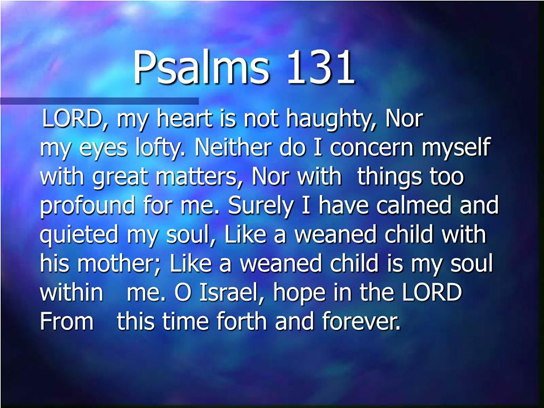
Psalm 131 Surrender as a child to the Lord

A song for pilgrims ascending to Jerusalem. A psalm of David.

“Lord, my heart is not proud; my eyes are not haughty. I don’t concern myself with matters too great or too awesome for me to grasp.
Instead, I have calmed and quieted myself, like a weaned child who no longer cries for its mother’s milk. Yes, like a weaned child is my soul within me.

O Israel, put your hope in the Lord—now and always.”

“Lord, my heart is not proud; my eyes are not haughty. I don’t concern myself with matters too great or too awesome for me to grasp.” These verses might be daunting for some people addicted to social media to handle. Past generations emphasized keeping one’s opinions private; however, now people are likely to spout off on Facebook, Instagram, TikTok, YouTube, and any other social media they can find. Never mind whether or not the information these people are spreading is valid; the idea is to publicize as much as possible as quickly as possible. These same people are likely to assess their own value based on the number of followers they have garnered.

While following news coverage on the recent flooding in Texas, I have noticed conspiracy theory proponents blaming all sorts of groups for this flooding. But responsible meteorologists have testified that local weather authorities did warn about flash floods. The scope of these floods simply exceeded all predictions. When warnings were sent out to people’s phones, many disregarded the warnings, assuming that authorities were becoming excited for nothing. There were also those who assumed that because they had weathered previous floods without incident, they would survive this one as well. Sadly, many of those people paid with their lives for their complacency. Then there were others whose only warning came when flood waters inundated their cabins or RV’s. In the face of such overwhelming tragedy, blaming and shaming has no place. Far better to realize that matters about this flood are far greater and more awesome than we can grasp.

“Instead, I have calmed and quieted myself, like a weaned child who no longer cries for its mother’s milk. Yes, like a weaned child is my soul within me.” Ask any mother how difficult it can be to wean a child off breast feeding. Here in Ghana, breast feeding is encouraged until the age of two, although mothers begin home foods at six months. During the weaning process, there are plenty of times when mothers must turn a deaf ear to their children’s cries, knowing that these children must become independent. But in times of stress, many three-or four-year-olds instinctively reach for their mothers’ breasts for comfort, confident that those mothers will soothe and protect them.

A weaned child knows that mother remains as a source of comfort, for the mother-child bond is one that lasts a lifetime. Agatha Christie has been quoted as saying, “A mother’s love for her child is like nothing else in this world. It knows no law, no pity. It dares all things and crushes down remorselessly all that stands in its path.” No matter a child’s age, a mother will still want to comfort them. God is the One who has given mothers this passion for their children; His passion for us is far far greater.

When we are new believers, we demand as much of God’s attention as possible. As we grow in our faith, we continue to be aware of God’s presence; however, we no longer need dramatic proofs of His Love. This does not mean that God will not do miracles for older believers but that older believers no longer require miracles to bolster their faith. The longer we walk with God, the more we see of His great provision and watch-care, so the more our faith grows.

“O Israel, put your hope in the Lord—now and always.”  Nations who put their hope in the Lord will never be disappointed. The problem is that most nations trust in something else-money, power, military might. Even in America where “In God we trust” is on all the money, many people are only giving lip service to that idea.

During the recent Texas floods, some survivors admitted that when they received alerts about flooding on their phones, they disregarded the messages, assuming that authorities were over-reacting. National governments might also feel the same way about warnings to hope in God, feeling that their might, their wealth, and their power are sufficient for any challenge. But natural disasters can humble the most arrogant of men and God, the Creator of the Universe, remains unimpressed by those who think they can make it on their own.

Don’t make the same mistake those people who disregarded those flood alerts made! God wants each of us to turn to Him, repent of our sins, and follow Him for the rest of our lives. When we hope in the Lord, we are trusting the only One who can deliver us from every evil so we can be with Him in heaven. “O Israel, put your hopes in the Lord!”

PRAYER: Father God, thank You for loving us and caring for us. Lord, thank You, that You are a God of hope. You have promised in Romans 15:13 that if we trust in You, you will fill us with joy and peace as we trust in You and that we will overflow with hope. Forgive our sins and help us to hope in You. In the mighty and precious Name of King Jesus. Amen.

JULY 13, 2025 WE’RE ALL PILGRIMS HEADED SOMEWHERE #11 WHEN YOU’RE FEELING LOWER THAN A DITCH DIGGER’S BOOTS, THIS PSALM IS FOR YOU!

July 13, 2025

Psalm 130 A Plea for God’s Help

A song for pilgrims ascending to Jerusalem. “From the depths of despair, O Lord, I call for your help. Hear my cry, O Lord. Pay attention to my prayer.

Lord, if you kept a record of our sins, who, O Lord, could ever survive? But you offer forgiveness, that we might learn to fear you.

I am counting on the Lord; yes, I am counting on him. I have put my hope in his word. I long for the Lord more than sentries long for the dawn, yes, more than sentries long for the dawn.

O Israel, hope in the Lord; for with the Lord there is unfailing love. His redemption overflows. He himself will redeem Israel from every kind of sin.”

“From the depths of despair, O Lord, I call for your help. Hear my cry, O Lord. Pay attention to my prayer.” There are times when we find ourselves in situations that seem hopeless. No matter which way we turn, we see no way out of the mess we’re in. There’s nobody who can help us and there might not even be anyone who knows where we are or the mess we are in. That’s the situation in which Aron Lee Ralston found himself.

On April 26, 2003, during a solo descent of Bluejohn Canyon in southeastern Utah, he dislodged a boulder, pinning his right wrist to the side of the canyon wall. After five days, he had to break his decomposing forearm, amputate it with a dull pocket knife to break free, make his way through the rest of the canyon, rappel down a 65-foot (20 m) drop, and hike 7 miles (11 km) to safety. Ralston was found by hikers, who gave him water, dressed his wound, and called emergency services.

While we might not find ourselves in such dire straits physically, emotional crises, financial crises, and losses of family and friends can hit any of us. Currently, I have been viewing videos of the flooding in the Texas Hill Country. Watching these scenes of devastation, I can scarcely wrap my mind around the pain these people are feeling. As emergency workers, volunteers, and family members speak of the tragic losses, I find myself praying, begging God to comfort, to encourage, to strengthen and to heal all those involved. Truly, only God can properly heal these people.

Lord, if you kept a record of our sins, who, O Lord, could ever survive? But you offer forgiveness, that we might learn to fear you.” People are great for keeping score of every little hurt and insult. But God is amazing. Micah 7:18-19 tells us, “Who is a God like you, who pardons sin and forgives the transgression of the remnant of his inheritance? You do not stay angry forever but delight to show mercy. You will again have compassion on us; you will tread our sins underfoot and hurl all our iniquities into the depths of the sea.” Psalm 103:11-12 tells us, “For as high as the heavens are above the earth, so great is his love for those who fear him; as far as the east is from the west, so far has he removed our transgressions from us.”

I am counting on the Lord; yes, I am counting on him. I have put my hope in his word. I long for the Lord more than sentries long for the dawn, yes, more than sentries long for the dawn.”  Consider the old-time watchmen on the walls of ancient cities. These men had to remain awake and attentive all night long; little wonder then, that these men would long for sunrise so that they could go off duty and go home to sleep. When you’re in a mess, all you want is hope and relief. The longer you continue with no change in your problems, the more desperate you are for help. The great thing about God is that God hears us, God sees us, and God will not abandon us.

“O Israel, hope in the Lord; for with the Lord there is unfailing love. His redemption overflows. He himself will redeem Israel from every kind of sin.” Because of God’s unfailing love, we can be redeemed from every kind of sin. When we repent, God will forgive us.

1 John 1:8-9 says, “If we claim to be without sin, we deceive ourselves and the truth is not in us.If we confess our sins, he is faithful and just and will forgive us our sins and purify us from all unrighteousness.” God’s promises are sure and He never fails. Today, give your mess to the Lord and let Him sort it out. But make sure that there is no sin that you need to confess. There’s no point in trying to cover up sin, for God already knows what you have done. Simply follow John’s advice: confess and receive forgiveness!

PRAYER: Father God, thank You for loving us and caring for us. Lord, we confess that we have failed to do Your will. Please forgive our sins and help us to change so that we will glorify You in our lives. Thank You for redeeming us and for giving us hope. In the mighty and precious Name of King Jesus. Amen.

JULY 12, 2025 WE’RE ALL PILGRIMS HEADED SOMEWHERE #10 WHEN GOD DELIVERS YOU, PASS THE BLESSING ON TO OTHERS

July 12, 2025

Psalm 129 A Cry for Help to the Lord

A song for pilgrims ascending to Jerusalem.

“From my earliest youth my enemies have persecuted me. Let all Israel repeat this: From my earliest youth my enemies have persecuted me, but they have never defeated me.
My back is covered with cuts, as if a farmer had plowed long furrows.

But the Lord is good; he has cut me free from the ropes of the ungodly.

May all who hate Jerusalem be turned back in shameful defeat. May they be as useless as grass on a rooftop, turning yellow when only half grown, ignored by the harvester, despised by the binder. And may those who pass by refuse to give them this blessing: “The Lord bless you; we bless you in the Lord’s name.”

“From my earliest youth my enemies have persecuted me. Let all Israel repeat this: From my earliest youth my enemies have persecuted me, but they have never defeated me. My back is covered with cuts, as if a farmer had plowed long furrows. But the Lord is good; he has cut me free from the ropes of the ungodly.”

In case you have thought that ancient pilgrims had it easy, this psalm should convince you otherwise. This writer has faced opposition his entire life and he wants you to know about it! Here in Ghana, there’s a common slogan painted on small buses, “Kae me bre!” “Remember my suffering!” This psalmist wants you to know that he has SUFFERED!!!

I came of age as a general surgeon in the 1970’s when female surgeons were far less common than they are now. I can testify that I have endured prejudice, gas lighting, and all kinds of verbal and emotional abuse in my quest to become a competent surgeon. There were times when I felt as if I had visible cleat marks on my back. During those times, this psalm became one of my favorites, one I would read repeatedly for comfort.  

It’s not difficult to find yourself in the same position as this psalmist. Work hard, behave with honesty and integrity, and you too will find enemies on the attack. When you try to do everything right, your enemies still leave you with long deep furrows on your back. But there’s hope.

But the Lord is good; he has cut me free from the ropes of the ungodly.” Here is the secret ofthe psalmist’s salvation. Each time enemies think they have captured this man, God sets him free. God is all-powerful and all-seeing; God never becomes fed up with delivering us from those who would destroy us. Even when we find ourselves caught in cleverly designed traps, God already has made ways of escape for us.

May all who hate Jerusalem be turned back in shameful defeat. May they be as useless as grass on a rooftop, turning yellow when only half grown, ignored by the harvester, despised by the binder.” These verses give us a fascinating glimpse into ancient Israeli culture. What good is grass on a flat house top? This grass is “volunteer, “springing up by itself but unfit for any good use. Of course, this grass will turn yellow, drying out in the relentless sun. And what harvester or binder would bother with such grass? So all enemies will be turned back in shameful defeat, worthless as dried up grass on a housetop.

“And may those who pass by refuse to give them this blessing: “The Lord bless you; we bless you in the Lord’s name.” Evidently, in ancient Israel, when travelers would pass those harvesting a crop, they would automatically pronounce blessings on the crops and the workers. “The Lord bless you; we bless you in the Lord’s name.”  Children would grow up listening to their parents blessing the neighbors in the fashion, so blessings would spread throughout an entire area. How wonderful! I grew up on a farm, but I don’t recall ever hearing anyone blessing us in this fashion.

But do we need to merely regard this blessing as a fascinating cultural insight? What if we were to bless workers each time we see them working? Again, here in Ghana, most tribal languages have a phrase meaning “How’s work?” Those raised to regard traditional courtesies will greet workers in this fashion wherever they see them. We have learned several of these phrases and those we greet in this fashion are always charmed and flattered when we acknowledge their work in their own language.

God knows the way you have suffered, but God also is the Healer. Trust God to deliver you from enemies, and while you’re waiting for deliverance, bless all those around you. Who knows? God might use you to deliver someone else.

PRAYER: Father God, thank You for loving us and caring for us. Lord, help us to trust Your deliverance and to remain faithful, even when things are difficult. And help us to be a blessing to all those around us. In the mighty and precious Name of King Jesus. Amen.