Again, I am relying heavily on David Guzik’s marvelous Enduring Word commentary. If you want to dig deeper, check out the full text at https://enduringword.com/bible-commentary/daniel-8/
Daniel 8:1-27 Daniel’s Vision of a Ram and Goat
During the third year of King Belshazzar’s reign, I, Daniel, saw another vision, following the one that had already appeared to me. In this vision I was at the fortress of Susa, in the province of Elam, standing beside the Ulai River. (This vision takes place about 550 B.C. during the reign of Nebuchadnezzar’s grandson, Belshazzar.)
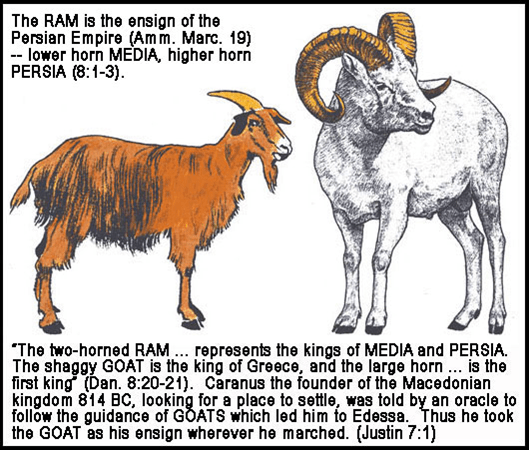
As I looked up, I saw a ram with two long horns standing beside the river. One of the horns was longer than the other, even though it had grown later than the other one. The ram butted everything out of his way to the west, to the north, and to the south, and no one could stand against him or help his victims. He did as he pleased and became very great.
While I was watching, suddenly a male goat appeared from the west, crossing the land so swiftly that he didn’t even touch the ground. This goat, which had one very large horn between its eyes, headed toward the two-horned ram that I had seen standing beside the river, rushing at him in a rage. The goat charged furiously at the ram and struck him, breaking off both his horns. Now the ram was helpless, and the goat knocked him down and trampled him. No one could rescue the ram from the goat’s power.
Guzik tells us, “This vision happened while Babylon was securely in power. Though the vision will deal with the emergence and destiny of the Greek Empire, the Greek Empire was not much of anything at the time the prophecy came to Daniel.”
The ram was the national emblem of Persia, and rams were stamped on Persian coins as well as on the headdress of Persian emperors. The two horns represent the Medes and the Persians, with the Persians emerging later but being stronger. The Medo-Persian Empire made conquests to the north (Scythians), south (Egyptians), and west (Greeks) but none to the east.
The male goat represents Greece. Guzik tells us, “From ancient history we know this wasn’t a strange symbol. The goat was a common representation of the Greek Empire. “Newton very properly observes that, two hundred years before the time of Daniel, they were called, the goats’ people.” (Clarke)”
Across the surface of the whole earth, without touching the ground: This prophetic description of the male goat was proved to be accurate regarding the Greek Empire.
· The Greek Empire rose from the west of previous empires.
· The Greek Empire rose with great speed (suddenly… without touching the ground).
· The Greek Empire had a notable ruler, Alexander the Great (a notable horn).
· The Greek Empire had a famous war with the Medo-Persian Empire (I saw him confronting the ram).
· The Greek Empire and the Medo-Persian Empire greatly hated each other (with furious power… moved with rage). Some of the greatest, fiercest battles of ancient history were fought between the Greeks and the Persians.
· The Greek Empire conquered the Medo-Persian Empire (no one that could deliver the ram from his hand).
· The reign of the notable leader of the Greek Empire was suddenly cut short (the large horn was broken).
· After the end of Alexander the Great’s reign, the Greek Empire was divided among four rulers (in place of it four notable ones came up).
· The four rulers of the Greek Empire after Alexander ruled their own dominions, not the entire empire together (came up toward the four winds of heaven).
i. Alexander did not divide the empire among his four generals himself. His four leading generals divided it among themselves by force after his death. The four generals were:
· Cassander, ruling over Greece and its region.
· Lysimachus, ruling over Asia Minor.
· Seleucus, ruling over Syria and Israel’s land.
· Ptolemy, ruling over Egypt.
c. The male goat grew very great: The greatness of Alexander’s Empire was not only in its vast dominion but also in its cultural power. Alexander the Great was determined to spread Greek civilization, culture, and language across every land he conquered.
i. As God guided history, He used Alexander’s passion to spread Greek culture to prepare the world for the Gospel of Jesus Christ. Because of Alexander’s influence, koine (common) Greek became the common language of the civilized world – and the language of the New Testament.”
Tomorrow we will continue with the explanation of this vision, but look at how God has arranged world events so that at the right time, the world will be speaking Greek as a common language. Many times, we look at world events and feel as if nothing can possibly help us; yet, God is still on the throne and He is still in control. May God help us to trust Him, even in the midst of chaos.
PRAYER: Father God, thank You for loving us and caring for us. Lord, help us to remember that You know the end from the beginning and that You order events to accomplish Your perfect will. In the mighty and precious Name of King Jesus. Amen.
 Burunche's Blog
Leave a comment