The Value of Diligence
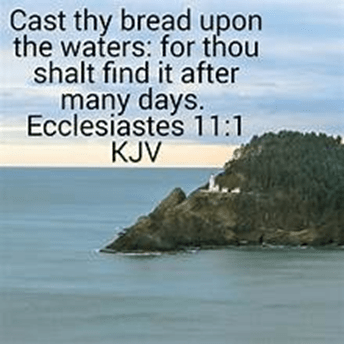
11:1-8 Cast your bread upon the waters, for you will find it after many days. Give a serving to seven, and also to eight, for you do not know what evil will be on the earth. If the clouds are full of rain, they empty themselves upon the earth; and if a tree falls to the south or the north, in the place where the tree falls, there it shall lie.
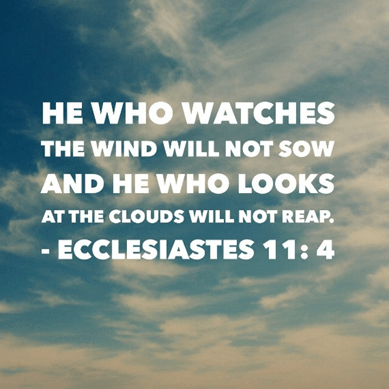
He who observes the wind will not sow, and he who regards the clouds will not reap. As you do not know what is the way of the wind, or how the bones grow in the womb of her who is with child, so you do not know the works of God who makes everything.
In the morning sow your seed, and in the evening do not withhold your hand; for you do not know which will prosper, either this or that, or whether both alike will be good. Truly the light is sweet, and it is pleasant for the eyes to behold the sun; but if a man lives many years and rejoices in them all, yet let him remember the days of darkness, for they will be many. All that is coming is vanity.
Seek God in Early Life
9-10 Rejoice, O young man, in your youth, and let your heart cheer you in the days of your youth; walk in the ways of your heart, and in the sight of your eyes; but know that for all these God will bring you into judgment. Therefore remove sorrow from your heart, and put away evil from your flesh, for childhood and youth are vanity.
This chapter of Ecclesiastes is one of my favorites for several reasons. First, the admonition to be generous: Cast your bread upon the waters. At first, this seems weird; why throw good bread out into a stream indiscriminately? But this is really an admonition to be generous, giving with no thought of getting anything in return.We live in a small northeastern Ghanaian village, working in a mission hospital that serves very poor people. Our patients and their families have very little money, and we frequently must assist in buying medicines, paying blood donors when no relative is available, and even feeding families while they are in hospital. But it’s also quite common for us to receive guinea fowls, guinea fowl eggs, and tubers of yam months or even years after having cared for someone, once the grateful family is able to organize a donation. It’s quite true that you can’t out-give God, and God has all kinds of ways of providing.
The law of the Kingdom of God is simple and Jesus enunciated it clearly: “Give, and it will be given to you. A good measure, pressed down, shaken together, and running over will be poured into your lap. For with the measure you use, it will be measured back to you.” (Luke 6:38) Rain falls on the earth whether anybody applauds it or not; rain falls because God has set natural events in motion and that is the nature of rain. In the same way, we are to be generous whether or not anyone is noticing.
“He who observes the wind will not sow, and he who regards the clouds will not reap.” I grew up on an Illinois farm at a time when much of the work was done by hand. We were still caring for beef cattle, pigs, and chickens, and milking cows by hand. Our work had to go on no matter how bad the weather was. If an ancient farmer demanded a sunny day with no wind before he would sow crops, he would never reap a harvest, for such days are rare. You must determine God’s calling on your life and then do your best to fulfill it without waiting for conditions to become perfect. If you demand perfect conditions, you will waste your entire life.
Just as none of us can control the wind, none of us can control the development of a child in the womb. God is the One who makes all things possible.
“Truly the light is sweet, and it is pleasant for the eyes to behold the sun; but if a man lives many years and rejoices in them all, yet let him remember the days of darkness, for they will be many. All that is coming is vanity.” At first, this statement seems horrible as it speaks of “the days of darkness.” Days of darkness will come to all of us-losses, sickness, betrayals, disappointments. The important thing is to trust God in both the light and the darkness.
The key to happiness is to seek God early in your youth and to serve Him faithfully all the days of your life. The Westminster Shorter Catechism tells us that the chief end of man is to “glorify God and to enjoy Him forever.” This week, they buried one of our close personal friends who had served God faithfully for 84 years. At the funeral service, countless people came forward with testimonies of this man’s kindness, compassion, and good works. Our friend’s children “rose up to call him blessed.” Our friend remained faithful to God despite daunting health challenges that might have discouraged a lessor individual.
Happiness has little to do with circumstances, for the Apostle Paul wrote the Book of Philippians, one of the happiest chapters of the Bible, while in prison. Roman prisons were anything but luxurious; yet, Paul says, “Rejoice in the Lord always. I will say it again: Rejoice! Let your gentleness be apparent to all. The Lord is near. Be anxious for nothing, but in everything, by prayer and petition, with thanksgiving, present your requests to God. And the peace of God, which surpasses all understanding, will guard your hearts and your minds in Christ Jesus.” (Philippians 4:4-7)
Be generous! Be faithful! Trust God and find your happiness in Him! These are the lessons from this sparkling chapter. May God help us so that we will internalize these lessons and make them part of our lives.
PRAYER: Father God, thank You for loving us and caring for us. Lord, help us to be generous, faithful, trusting, and rejoicing in You. In the mighty and precious Name of King Jesus. Amen.
 Burunche's Blog
Leave a comment