10 1-2 God responded. He said, “Shape two slabs of stone similar to the first ones. Climb the mountain and meet me. Also make yourself a wooden chest. I will engrave the stone slabs with the words that were on the first ones, the ones you smashed. Then you will put them in the Chest.”
3-5 So I made a chest out of acacia wood, shaped two slabs of stone, just like the first ones, and climbed the mountain with the two slabs in my arms. He engraved the stone slabs the same as he had the first ones, the Ten Words that he addressed to you on the mountain out of the fire on the day of the assembly. Then God gave them to me. I turned around and came down the mountain. I put the stone slabs in the Chest that I made and they’ve been there ever since, just as God commanded me.
Moses is concluding the story of how he smashed the first set of the Ten Commandments and then had to fashion a second set himself. The Chest mentioned here is the Ark of the Covenant. Moses is careful to note that God is the One who has engraved those commandments on the stone-why? The Israelites are stubborn and rebellious and are quite capable of accusing Moses of thinking up the commandments himself. Moses wants to make sure his people realize it is God who has commanded them and not him.
6-7 The People of Israel went from the wells of the Jaakanites to Moserah. Aaron died there and was buried. His son Eleazar succeeded him as priest. From there they went to Gudgodah, and then to Jotbathah, a land of streams of water.
8-9 That’s when God set apart the tribe of Levi to carry God’s Covenant Chest, to be on duty in the Presence of God, to serve him, and to bless in his name, as they continue to do today. And that’s why Levites don’t have a piece of inherited land as their kinsmen do. God is their inheritance, as God, your God, promised them.
10 I stayed there on the mountain forty days and nights, just as I did the first time. And God listened to me, just as he did the first time: God decided not to destroy you.
11 God told me, “Now get going. Lead your people as they resume the journey to take possession of the land that I promised their ancestors that I’d give to them.”
Moses reminds the Israelites that Aaron has already died for his sins of creating the golden calf and for rebelling when Moses struck the rock rather than speaking to it. (Question: did Aaron encourage Moses to strike the rock, disregarding God’s specific instructions? Aaron appears to have been a rather weak individual, going in for drama. Perhaps this is why Aaron died before Moses did.)
12-13 So now Israel, what do you think God expects from you? Just this: Live in his presence in holy reverence, follow the road he sets out for you, love him, serve God, your God, with everything you have in you, obey the commandments and regulations of God that I’m commanding you today—live a good life.
14-18 Look around you: Everything you see is God’s—the heavens above and beyond, the Earth, and everything on it. But it was your ancestors who God fell in love with; he picked their children—that’s you!—out of all the other peoples. That’s where we are right now. So cut away the thick calluses from your heart and stop being so willfully hardheaded. God, your God, is the God of all gods, he’s the Master of all masters, a God immense and powerful and awesome. He doesn’t play favorites, takes no bribes, makes sure orphans and widows are treated fairly, takes loving care of foreigners by seeing that they get food and clothing.
Throughout their wanderings, God keeps reminding the Israelites that He has chosen them and therefore they must follow His commandments. Here God lays out exactly what He wants the Israelites to do: Live in his presence in holy reverence, follow the road he sets out for you, love him, serve God, your God, with everything you have in you, obey the commandments and regulations of God that I’m commanding you today—live a good life… So cut away the thick calluses from your heart and stop being so willfully hardheaded.
God wants the Israelites to follow His example by dealing honestly and caring for widows, orphans, and foreigners: He doesn’t play favorites, takes no bribes, makes sure orphans and widows are treated fairly, takes loving care of foreigners by seeing that they get food and clothing. God’s people are to be as compassionate as He is.
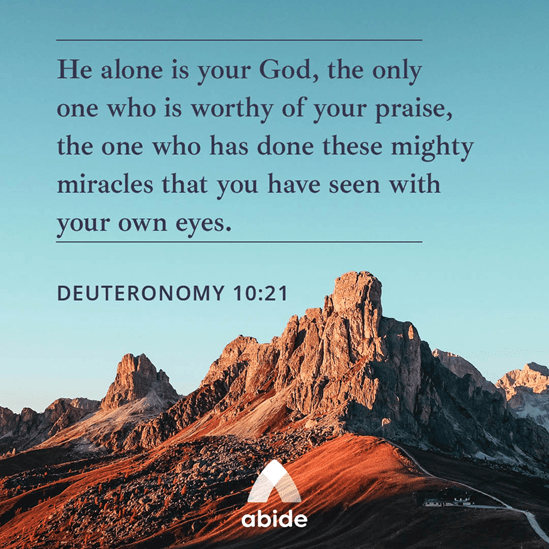
19-21 You must treat foreigners with the same loving care—remember, you were once foreigners in Egypt. Reverently respect God, your God, serve him, hold tight to him, back up your promises with the authority of his name. He’s your praise! He’s your God! He did all these tremendous, these staggering things that you saw with your own eyes. 22 When your ancestors entered Egypt, they numbered a mere seventy souls. And now look at you—you look more like the stars in the night skies in number. And your God did it.
Repeatedly, God reminds the Israelites that they were once foreigners in Egypt and that they suffered as a result. It was the status of the Israelites as foreigners and their inferior social status as shepherds and cattle herders that gave the Egyptians the excuse to enslave them. (Remember, Joseph even warned his family about the Egyptian attitudes towards shepherds.)
God also reminds His people that when Jacob and his family entered Egypt, there were only seventy of them. Now the Israelites number at least 2.4 million-more like the stars in the night skies.
Why is God so insistent about the Israelites caring for foreigners? Throughout history, foreigners have always been a favorite targe of despotic rulers, corrupt judges, dishonest merchants, and cheaters of all kinds. God hates thieves and those who take advantage of others unfamiliar with a culture. God wants the Israelites to remember what it felt like when they sought permission to pass through various nations, offering to pay for their food and water, only for these nations to refuse them passage.
Today the issue of illegal immigrants in America has become a hot one. How should we live out God’s commands to help foreigners? Those whose lives are least impacted have been the most vocal in offering all kinds of help, some of it not even available to American citizens. But ask those who live along the Mexican border, and the picture appears far different. Families who have lived peacefully for years have suffered theft, fire outbreaks, and have even had their lives threatened. These citizens live in constant fear. There are no easy answers to these questions, especially when families are fleeing due to threats from the cartels. For those aware of the facts, the situation demands as much prayer as possible.
Here in Ghana, we have Fulani cattle herders, and many cattle owners employ Fulanis to care for their herds. But as in any ethnic group, there are virtuous people and wicked people. Some Fulanis are law-abiding citizens while others have become armed robbers. Sometimes armed robbers will dress as Fulanis in an attempt to cloak their true identities. The ensuing confusion results in an entire ethnic group being wrongly blamed.
God is a God of compassion. Are we people of compassion? May God help us so that we will have hearts like His!
PRAYER: Father God, thank You for loving us and caring for us. Lord, please let our hearts hurt with the things that hurt Your Heart. In the mighty and precious Name of King Jesus. Amen.
 Burunche's Blog
Leave a comment