Archive for October, 2025

OCTOBER 11, 2025 “BUT GOD, DO I REALLY HAVE TO OBEY YOU? WHY? #5 PAY ATTENTION OR ELSE!

October 11, 2025

Deuteronomy 4:1-23

4 1-2 Now listen, Israel, listen carefully to the rules and regulations that I am teaching you to follow so that you may live and enter and take possession of the land that God, the God-of-Your-Fathers, is giving to you. Don’t add a word to what I command you, and don’t remove a word from it. Keep the commands of God, your God, that I am commanding you.

3-4 You saw with your own eyes what God did at Baal Peor, how God destroyed from among you every man who joined in the Baal Peor orgies. But you, the ones who held tight to God, your God, are alive and well, every one of you, today.

5-6 Pay attention: I’m teaching you the rules and regulations that God commanded me, so that you may live by them in the land you are entering to take up ownership. Keep them. Practice them. You’ll become wise and understanding. When people hear and see what’s going on, they’ll say, “What a great nation! So wise, so understanding! We’ve never seen anything like it.”

7-8 Yes. What other great nation has gods that are intimate with them the way God, our God, is with us, always ready to listen to us? And what other great nation has rules and regulations as good and fair as this Revelation that I’m setting before you today?

Just make sure you stay alert. Keep close watch over yourselves. Don’t forget anything of what you’ve seen. Don’t let your heart wander off. Stay vigilant as long as you live. Teach what you’ve seen and heard to your children and grandchildren.

10 That day when you stood before God, your God, at Horeb, God said to me, “Assemble the people in my presence to listen to my words so that they will learn to fear me in holy fear for as long as they live on the land, and then they will teach these same words to their children.”

11-13 You gathered. You stood in the shadow of the mountain. The mountain was ablaze with fire, blazing high into the very heart of Heaven. You stood in deep darkness and thick clouds. God spoke to you out of the fire. You heard the sound of words but you saw nothing—no form, only a voice. He announced his covenant, the Ten Words, by which he commanded you to live. Then he wrote them down on two slabs of stone.

14 And God commanded me at that time to teach you the rules and regulations that you are to live by in the land which you are crossing over the Jordan to possess.

15-20 You saw no form on the day God spoke to you at Horeb from out of the fire. Remember that. Carefully guard yourselves so that you don’t turn corrupt and make a form, carving a figure that looks male or female, or looks like a prowling animal or a flying bird or a slithering snake or a fish in a stream. And also carefully guard yourselves so that you don’t look up into the skies and see the sun and moon and stars, all the constellations of the skies, and be seduced into worshiping and serving them. God set them out for everybody’s benefit, everywhere. But you—God took you right out of the iron furnace, out of Egypt, to become the people of his inheritance—and that’s what you are this very day.

21-22 But God was angry with me because of you and the things you said. He swore that I’d never cross the Jordan, never get to enter the good land that God, your God, is giving you as an inheritance. This means that I am going to die here. I’m not crossing the Jordan. But you will cross; you’ll possess the good land.”

Poor Moses! After a forty-year sojourn in the wilderness rather than a swift victorious entry into Canaan, he knows he has lost the opportunity forever. But Moses is a man of amazing faith and spiritual maturity and he is still operating under God’s orders. Now Moses is seriously warning the Israelites to remain faithful and not to divert into idolatry. Actions have consequences, and Moses does everything possible to warn the Israelites and to delineate the horrors that will overtake them should they worship idols.

“Now listen, Israel, listen carefully to the rules and regulations that I am teaching you to follow so that you may live and enter and take possession of the land that God, the God-of-Your-Fathers, is giving to you. Don’t add a word to what I command you, and don’t remove a word from it.” The title of these studies is “BUT GOD, DO I REALLY HAVE TO OBEY YOU? WHY?” Throughout this chapter, Moses alternates between reminding the Israelites of the times they have failed to follow God faithfully and warning them of the consequences if they mess up.

Moses reminds his listeners, “You saw with your own eyes what God did at Baal Peor, how God destroyed from among you every man who joined in the Baal Peor orgies. But you, the ones who held tight to God, your God, are alive and well, every one of you, today.”

Moses has no illusions; he realizes that many of the Israelites are secretly keeping household gods and sneaking off to worship the moon and the stars. Moses also knows that God knows even more details about Israelite idolatry than he does. Desperately, Moses tries to remind the Israelites of the majesty and power of God, but all the time Moses is issuing these warnings, he is worried that the Israelites won’t take God seriously.

What can we learn from this passage? Actions do have consequences and God doesn’t play games. As a prophet, Moses senses that many of the Israelites are going to degenerate into idolatry. Moses knows that God is holy and must be respected, worshiped, and obeyed. No amount of empty promises will satisfy the One True Living God.

The entire Book of Deuteronomy is so inspiring and yet heart-breaking: inspiring because it encapsulates magnificent promises but heart-breaking because we know how tragically Israel will fail as they fall increasingly farther away from God. May we remain faithful to God, no matter what happens to us.

PRAYER:  Father God, thank You for loving us and caring for us. Lord, help us to follow hard after You all the days of our lives. Help us to remain true, no matter what influences are pressing on us. In the mighty and precious Name of King Jesus. Amen.   
OCTOBER 10, 2025 “BUT GOD, DO I REALLY HAVE TO OBEY YOU? WHY? #4 SOMETIMES GOD SAYS, “NO!!!”

October 10, 2025

Deuteronomy 3

3 Then we turned north and took the road to Bashan. Og king of Bashan, he and all his people, came out to meet us in battle at Edrei.

2 God said to me, “Don’t be afraid of him; I’m turning him over to you, along with his whole army and his land. Treat him the way you treated Sihon king of the Amorites who ruled from Heshbon.”

3-7 So God, our God, also handed Og king of Bashan over to us—Og and all his people—and we utterly crushed them. Again, no survivors. At the same time we took all his cities. There wasn’t one of the sixty cities that we didn’t take—the whole region of Argob, Og’s kingdom in Bashan. All these cities were fortress cities with high walls and barred gates. There were also numerous unwalled villages. We totally destroyed them—a holy destruction. It was the same treatment we gave to Sihon king of Heshbon, a holy destruction of every city, man, woman, and child. But all the livestock and plunder from the cities we took for ourselves.

8-10 Throughout that time we took the land from under the control of the two kings of the Amorites who ruled the country east of the Jordan, all the way from the Brook Arnon to Mount Hermon. (Sirion is the name given Hermon by the Sidonians; the Amorites call it Senir.) We took all the towns of the plateau, everything in Gilead, everything in Bashan, as far as Salecah and Edrei, the border towns of Bashan, Og’s kingdom.

11 Og king of Bashan was the last remaining Rephaite. His bed, made of iron, was over thirteen feet long and six wide. You can still see it on display in Rabbah of the People of Ammon.

* * *

Hmmm. So Og, King of Bashan, was a giant with a bed 13 feet long and 6 feet wide. No wonder God had to get rid of all those cowardly soldiers who quailed at the idea of facing giants! Now the Israelites have conquered the lush land of Gilead, and the Reubenites and the half-tribe of Manasseh have claimed this land for their own because they have so much livestock.

12 Of the land that we possessed at that time, I gave the Reubenites and the Gadites the territory north of Aroer along the Brook Arnon and half the hill country of Gilead with its towns.

13 I gave the half-tribe of Manasseh the rest of Gilead and all of Bashan, Og’s kingdom—all the region of Argob, which takes in all of Bashan. This used to be known as the Land of the Rephaites.

14 Jair, a son of Manasseh, got the region of Argob to the borders of the Geshurites and Maacathites. He named the Bashan villages after himself, Havvoth Jair (Jair’s Tent-Villages). They’re still called that.

15 I gave Gilead to Makir.

16-17 I gave the Reubenites and Gadites the land from Gilead down to the Brook Arnon, whose middle was the boundary, and as far as the Jabbok River, the boundary line of the People of Ammon. The western boundary was the Jordan River in the Arabah all the way from the Kinnereth (the Sea of Galilee) to the Sea of the Arabah (the Salt Sea or Dead Sea) at the base of the slopes of Mount Pisgah on the east.

* * *

18-20 I commanded you at that time, “God, your God, has given you this land to possess. Your men, fit and armed for the fight, are to cross the river in advance of their brothers, the People of Israel. Only your wives, children, and livestock (I know you have much livestock) may go ahead and settle down in the towns I have already given you until God secures living space for your brothers as he has for you and they have taken possession of the country west of the Jordan that God, your God, is giving them. After that, each man may return to the land I’ve given you here.”

* * *

21-22 I commanded Joshua at that time, “You’ve seen with your own two eyes everything God, your God, has done to these two kings. God is going to do the same thing to all the kingdoms over there across the river where you’re headed. Don’t be afraid of them. God, your God—he’s fighting for you.”

23-25 At that same time, I begged God: “God, my Master, you let me in on the beginnings, you let me see your greatness, you let me see your might—what god in Heaven or Earth can do anything like what you’ve done! Please, let me in also on the endings, let me cross the river and see the good land over the Jordan, the lush hills, the Lebanon mountains.”

26-27 But God was still angry with me because of you. He wouldn’t listen. He said, “Enough of that. Not another word from you on this. Climb to the top of Mount Pisgah and look around: look west, north, south, east. Take in the land with your own eyes. Take a good look because you’re not going to cross this Jordan.

28 “Then command Joshua: Give him courage. Give him strength. Single-handed he will lead this people across the river. Single-handed he’ll cause them to inherit the land at which you can only look.”

29 That’s why we have stayed in this valley near Beth Peor.”

Why is God being so mean to Moses? Moses has faithfully led the Israelites for forty years and has even met God. But Moses is paying heavily for losing his temper. The story is told in Numbers 20:1-12. Once more, the Israelites were whining for water and accusing Moses and Aaron. God ordered Moses to speak to the rock so that water would come forth; however, Moses struck the rock with his rod twice, saying “Listen, rebels! Do we have to bring water out of this rock for you?” God brought water out of the rock, but Moses’ failure to honor God and His holiness cost him the chance to enter the Promised Land. When Moses begs God once more for the chance to enter Canaan, God still refuses, ordering him to deputize Joshua to lead the people and then to ascend Mount Pisgah and die there.

Many times, people confuse God with Santa Claus, assuming that if they whine enough, God will change His “no” to “yes.” But in Numbers 23, God tells a pagan king, “God is not man, one given to lies, and not a son of man changing his mind.”

The story of God’s refusal to allow Moses to enter the Promised Land should serve as a warning to all of us. Moses is a towering figure; if Moses can mess up, so can the rest of us. God is to be worshiped and respected. Attempts at manipulation only demonstrate how little we know of God’s holiness. May God help us so that we will properly respect and adore him!

PRAYER: Father God, thank You for loving us and caring for us. Lord, help us to truly worship You and honor You in everything we say and do. In the mighty and precious Name of King Jesus. Amen.

OCTOBER 9, 2025 “BUT GOD, DO I REALLY HAVE TO OBEY YOU? WHY? #3 ARE YOU GOING IN CIRCLES?

October 9, 2025

Deuteronomy 2 The Message

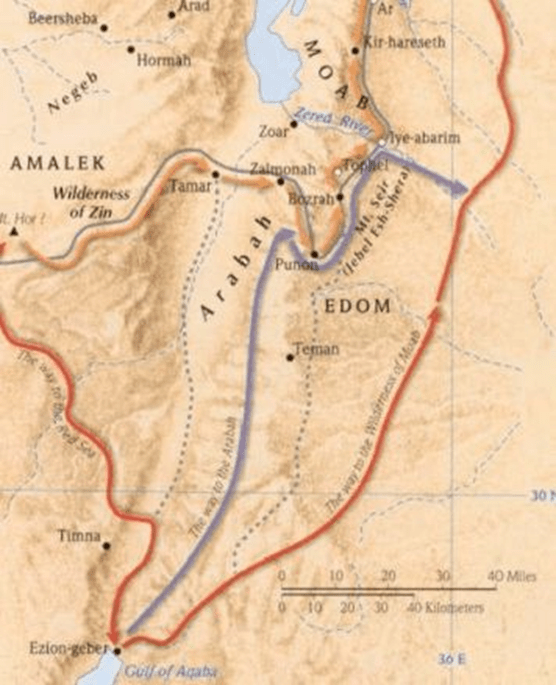
2 Then we turned around and went back into the wilderness following the route to the Red Sea, as God had instructed me. We worked our way in and around the hills of Seir for a long, long time.

* * *

2-6 Then God said, “You’ve been going around in circles in these hills long enough; go north. Command the people, You’re about to cut through the land belonging to your relatives, the People of Esau who settled in Seir. They are terrified of you, but restrain yourselves. Don’t try and start a fight. I am not giving you so much as a square inch of their land. I’ve already given all the hill country of Seir to Esau—he owns it all. Pay them up front for any food or water you get from them.”

7 God, your God, has blessed you in everything you have done. He has guarded you in your travels through this immense wilderness. For forty years now, God, your God, has been right here with you. You haven’t lacked one thing.

8 So we detoured around our brothers, the People of Esau who live in Seir, avoiding the Arabah Road that comes up from Elath and Ezion Geber; instead we used the road through the Wilderness of Moab.

9 God told me, “And don’t try to pick a fight with the Moabites. I am not giving you any of their land. I’ve given ownership of Ar to the People of Lot.”

10-12 The Emites (Monsters) used to live there—mobs of hulking giants, like Anakites. Along with the Anakites they were lumped in with the Rephaites (Ghosts) but in Moab they were called Emites. Horites also used to live in Seir, but the descendants of Esau took over and destroyed them, the same as Israel did in the land God gave them to possess.

13 God said, “It’s time now to cross the Brook Zered.” So we crossed the Brook Zered.

14-15 It took us thirty-eight years to get from Kadesh Barnea to the Brook Zered. That’s how long it took for the entire generation of soldiers from the camp to die off, as God had sworn they would. God was relentless against them until the last one was gone from the camp.

16-23 When the last of these soldiers had died, God said to me, “This is the day you cut across the territory of Moab, at Ar. When you approach the People of Ammon, don’t try and pick a fight with them because I’m not giving you any of the land of the People of Ammon for yourselves—I’ve already given it to the People of Lot.” It is also considered to have once been the land of the Rephaites. Rephaites lived there long ago—the Ammonites called them Zamzummites (Barbarians)—huge mobs of them, giants like the Anakites. God destroyed them and the Ammonites moved in and took over. It was the same with the People of Esau who live in Seir—God got rid of the Horites who lived there earlier and they moved in and took over, as you can see. Regarding the Avvites who lived in villages as far as Gaza, the Caphtorites who came from Caphtor (Crete) wiped them out and moved in.

* * *

God is the One who assigns land to nations. Notice God’s instructions to the Israelites: They bypass the People of Esau at Seir and avoid fighting with the People of Moab or Ammon, Lot’s descendants.

Also notice that God keeps the Israelites wandering around until all the soldiers from the camp who had refused to enter Canaan have died off. These guys are the ones who whined that they couldn’t tackle giants and that their children were going to die in the wilderness. Now those same children are the ones who will enter the Promised Land while they leave their parents’ bodies behind in the wilderness. These men have paid a terrible price for their lack of faith. But now God is about to give the Israelites prime land.

24-25 “On your feet now. Get started. Cross the Brook Arnon. Look: Here’s Sihon the Amorite king of Heshbon and his land. I’m handing it over to you—it’s all yours. Go ahead, take it. Go to war with him. Before the day is out, I’ll make sure that all the people around here are thoroughly terrified. Rumors of you are going to spread like wildfire; they’ll totally panic.”

26-28 From the Wilderness of Kedemoth, I sent messengers to Sihon, king of Heshbon. They carried a friendly message: “Let me cross through your land on the highway. I’ll stay right on the highway; I won’t trespass right or left. I’ll pay you for any food or water we might need. Let me walk through.

29 “The People of Esau who live in Seir and the Moabites who live in Ar did this, helping me on my way until I can cross the Jordan and enter the land that God, our God, is giving us.”

30 But Sihon king of Heshbon wouldn’t let us cross his land. God, your God, turned his spirit mean and his heart hard so he could hand him over to you, as you can see that he has done.

31 Then God said to me, “Look, I’ve got the ball rolling—Sihon and his land are soon yours. Go ahead. Take it. It’s practically yours!”

32-36 So Sihon and his entire army confronted us in battle at Jahaz. God handed him, his sons, and his entire army over to us and we utterly crushed them. While we were at it we captured all his towns and totally destroyed them, a holy destruction—men, women, and children. No survivors. We took the livestock and the plunder from the towns we had captured and carried them off for ourselves. From Aroer on the edge of the Brook Arnon and the town in the gorge, as far as Gilead, not a single town proved too much for us; God, our God, gave every last one of them to us.

37 The only land you didn’t take, obeying God’s command, was the land of the People of Ammon, the land along the Jabbok and around the cities in the hills.”

What lessons can we garner from this chapter? First, look at God’s orders. The Israelites have circled through the wilderness until all the faithless soldiers who refused to enter Canaan originally have died. Next, God has to order the Israelites to stop circling around and move forward. It’s quite possible that there were those who fought this order, feeling comfortable with the status quo. Now the Israelites must transform into a military force as they begin conquering territory. Change is neither easy nor painless.

Next, the Israelites must obey God’s specific orders, avoiding fights with some groups while engaging in battle with others. Want success? Follow God’s orders. Were the Israelites to fight every group they met, they might have nothing left when they reach the land of Sihon King of Heshbon. You have to pick your fights.

Finally, look at verse 7. “God, your God, has blessed you in everything you have done. He has guarded you in your travels through this immense wilderness. For forty years now, God, your God, has been right here with you. You haven’t lacked one thing.” It’s likely that the total number of Israelites and camp followers might have approached 2.4 million people. (https://www.gotquestions.org/Israelites-exodus.html) The same God who cared for all those people still cares for you today. Why not trust Him?

PRAYER: Father God, thank You for loving us and caring for us. Lord, help us to trust You for all our needs. In the mighty and precious Name of King Jesus. Amen.

OCTOBER 8, 2025 “BUT GOD, DO I REALLY HAVE TO OBEY YOU? WHY? #2 DEUTERONOMY 1 HOW TO LOSE THE PROMISED LAND BY LISTENING TO FEAR!

October 8, 2025

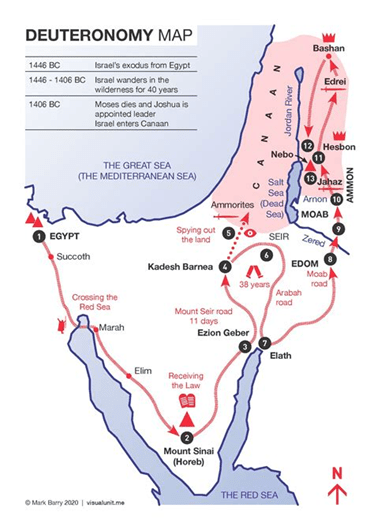
1 1-2 These are the sermons Moses preached to all Israel when they were east of the Jordan River in the Arabah Wilderness, opposite Suph, in the vicinity of Paran, Tophel, Laban, Hazeroth, and Dizahab. It takes eleven days to travel from Horeb to Kadesh Barnea following the Mount Seir route.

* * *

3-4 It was on the first day of the eleventh month of the fortieth year when Moses addressed the People of Israel, telling them everything God had commanded him concerning them. This came after he had defeated Sihon king of the Amorites, who ruled from Heshbon, and Og king of Bashan, who ruled from Ashtaroth in Edrei. It was east of the Jordan in the land of Moab that Moses set out to explain this Revelation.

Moses Preaches to Israel on the Plains of Moab

5 He said: 6-8 Back at Horeb, God, our God, spoke to us: “You’ve stayed long enough at this mountain. On your way now. Get moving. Head for the Amorite hills, wherever people are living in the Arabah, the mountains, the foothills, the Negev, the seashore—the Canaanite country and the Lebanon all the way to the big river, the Euphrates. Look, I’ve given you this land. Now go in and take it. It’s the land God promised to give your ancestors Abraham, Isaac, and Jacob and their children after them.”

The Israelites had been moving slowly through the wilderness while God gave them the Law and trained them, trying to get them to worship Him and to abandon their slave mentality.

Now God is shaking things up, telling the Israelites that they have stayed long enough at Mount Hor and that it’s time to get on with their calling. Why does God have to say these things? The Israelites have gotten used to their current situation and are reluctant to try anything new, even though they are currently migrants. Many times, God has to tell us, “You’ve stayed at this mountain long enough,” so that we will proceed with His calling on our lives.

9-13 At the time I told you, “I can’t do this, can’t carry you all by myself. God, your God, has multiplied your numbers. Why, look at you—you rival the stars in the sky! And may God, the God-of-Your-Fathers, keep it up and multiply you another thousand times, bless you just as he promised. But how can I carry, all by myself, your troubles and burdens and quarrels? So select some wise, understanding, and seasoned men from your tribes, and I will commission them as your leaders.”

14 You answered me, “Good! A good solution.”

15 So I went ahead and took the top men of your tribes, wise and seasoned, and made them your leaders—leaders of thousands, of hundreds, of fifties, and of tens, officials adequate for each of your tribes.

16-17 At the same time I gave orders to your judges: “Listen carefully to complaints and accusations between your fellow Israelites. Judge fairly between each person and his fellow or foreigner. Don’t play favorites; treat the little and the big alike; listen carefully to each. Don’t be impressed by big names. This is God’s judgment you’re dealing with. Hard cases you can bring to me; I’ll deal with them.”

18 I issued orders to you at that time regarding everything you would have to deal with.

In the beginning, Moses was trying to settle all the disputes by himself, wearing himself out in the process. Then Jethro, Moses’ father-in-law, made the sensible suggestion that Moses should establish officials with varying levels of responsibility who could handle everything but the most major problems. This decision not only empowered those men, giving them experience as leaders, but it also allowed Moses to focus on his main calling as a prophet and head of the group.

Delegating authority to unit heads is generally a good thing, as long as you are very careful about your choices. But you must ensure that those whom you select will handle power wisely and not merely degenerate into bullying people and mishandling resources.

19-21 Then we set out from Horeb and headed for the Amorite hill country, going through that huge and frightening wilderness that you’ve had more than an eyeful of by now—all under the command of God, our God—and finally arrived at Kadesh Barnea. There I told you, “You’ve made it to the Amorite hill country that God, our God, is giving us. Look, God, your God, has placed this land as a gift before you. Go ahead and take it now. God, the God-of-Your-Fathers, promised it to you. Don’t be afraid. Don’t lose heart.”

22 But then you all came to me and said, “Let’s send some men on ahead to scout out the land for us and bring back a report on the best route to take and the kinds of towns we can expect to find.”

23-25 That seemed like a good idea to me, so I picked twelve men, one from each tribe. They set out, climbing through the hills. They came to the Eshcol Valley and looked it over. They took samples of the produce of the land and brought them back to us, saying, “It’s a good land that God, our God, is giving us!”

When the Israelites sent out twelve spies, they brought glowing reports of the land; however, ten of the spies were whiners who complained about the giants they saw. Only Caleb and Joshua were willing to trust God to help them wipe out the giants. The remainder of the group portrayed God as having ordered them to do something impossible. Caleb and Joshua were so frustrated they tore their clothes as they tried to argue, but the remaining ten men frightened the Israelites, causing them to refuse to enter Canaan. The God whom these people were refusing to trust was the same God who had delivered them from Egypt and from Pharaoh’s army and fed and watered them miraculously. This same God was leading the Israelites by manifesting as a pillar of cloud in the daytime and a pillar of fire at night. But those miracles weren’t enough for these unbelieving cowards.

26-28 But then you weren’t willing to go up. You rebelled against God, your God’s plain word. You complained in your tents: “God hates us. He hauled us out of Egypt in order to dump us among the Amorites—a death sentence for sure! How can we go up? We’re trapped in a dead end. Our brothers took all the wind out of our sails, telling us, ‘The people are bigger and stronger than we are; their cities are huge, their defenses massive—we even saw Anakite giants there!’”

29-33 I tried to relieve your fears: “Don’t be terrified of them. God, your God, is leading the way; he’s fighting for you. You saw with your own eyes what he did for you in Egypt; you saw what he did in the wilderness, how God, your God, carried you as a father carries his child, carried you the whole way until you arrived here. But now that you’re here, you won’t trust God, your God—this same God who goes ahead of you in your travels to scout out a place to pitch camp, a fire by night and a cloud by day to show you the way to go.”

34-36 When God heard what you said, he exploded in anger. He swore, “Not a single person of this evil generation is going to get so much as a look at the good land that I promised to give to your parents. Not one—except for Caleb son of Jephunneh. He’ll see it. I’ll give him and his descendants the land he walked on because he was all for following God, heart and soul.”

37-40 But I also got it. Because of you God’s anger spilled over onto me. He said, “You aren’t getting in either. Your assistant, Joshua son of Nun, will go in. Build up his courage. He’s the one who will claim the inheritance for Israel. And your babies of whom you said, ‘They’ll be grabbed for plunder,’ and all these little kids who right now don’t even know right from wrong—they’ll get in. I’ll give it to them. Yes, they’ll be the new owners. But not you. Turn around and head back into the wilderness following the route to the Red Sea.”

41 You spoke up, “We’ve sinned against God. We’ll go up and fight, following all the orders that God, our God, has commanded.” You took your weapons and dressed for battle—you thought it would be so easy going into those hills!

42 But God told me, “Tell them, ‘Don’t do it; don’t go up to fight—I’m not with you in this. Your enemies will waste you.’”

43-46 I told you but you wouldn’t listen. You rebelled at the plain word of God. You threw out your chests and strutted into the hills. And those Amorites, who had lived in those hills all their lives, swarmed all over you like a hive of bees, chasing you from Seir all the way to Hormah, a stinging defeat. You came back and wept in the presence of God, but he didn’t pay a bit of attention to you; God didn’t give you the time of day. You stayed there in Kadesh a long time, about as long as you had stayed there earlier.”

God was fully prepared to aid the Israelites so that they could eliminate those giants. Centuries later, a shepherd boy with a sling would take out a giant with a single stone. Certainly, the Israelites must have had soldiers capable of doing the same thing.

There are times when God calls us to do the impossible. If we falter, we lose the chance forever. The annals of missions are packed with stories of people who stepped out in faith. Lillian Trasher went to Egypt as a young woman with little backing but great faith. She founded the Assiout Orphanage in 1911, depending on God for everything. It was said of Trasher, “Lillian Trasher operated by faith, praying each hour to God to meet the needs of God’s children. Many times, she was desperate for support, and she often went door-to-door on her donkey soliciting for donations of food or money from wealthy Egyptian locals. By asking boldly, both to God and to others, Trasher was able to uphold her two requirements: first, the orphanage should never go into debt; and second, no orphan should be turned away.” https://www.cbeinternational.org/resource/story-lillian-trasher/

It’s tempting to criticize the Israelites, but would we have done any better? Familiar situations are comforting, even if they are unpleasant. May God help us to follow hard after Him, even when all ways appear to be barred and fearsome giants threaten us!

PRAYER: Father God, thank You for loving us and caring for us. Lord, help us to trust You, even when You seem to be leading us into hopeless situations. You are the Father of Light and in You there is no darkness. In the mighty and precious Name of King Jesus. Amen.
OCTOBER 7, 2025 INTRODUCTION TO DEUTERONOMY –“BUT GOD, DO I REALLY HAVE TO OBEY YOU? WHY? #1

October 7, 2025

We have wound up our meditations on King Solomon’s expressions of ennui in Ecclesiastes and we are now turning back in time to the fifth book of the Pentateuch, the Book of Deuteronomy. You might ask how I know which book of the Bible to write about next. It’s simple: I don’t, but God does. God knows the hearts of those reading these devotions and He knows what we need. While I was writing from Ecclesiastes in September, we lost my sister-in-law as well as our long-time friend who had handled our business affairs and sheltered us whenever we returned to America. At that point, Ecclesiastes 3:1-8 became even more real to us.

“To everything there is a season, a time for every purpose under heaven: A time to be born,
And a time to die; A time to plant, And a time to pluck what is planted; A time to kill, And a time to heal; A time to break down, And a time to build up; 4 A time to weep, And a time to laugh; A time to mourn, And a time to dance; A time to cast away stones, And a time to gather stones; A time to embrace, And a time to refrain from embracing; A time to gain, And a time to lose; A time to keep, And a time to throw away; A time to tear, And a time to sew; A time to keep silence, And a time to speak; A time to love, And a time to hate; A time of war, And a time of peace.”

So now, we are about to begin a study of Deuteronomy. Moses is elderly but still strong, and the Israelites have not yet entered the Promised Land. Here is what Pastor Chuck Swindoll in his Insight for Living web site says about Deuteronomy:

Who wrote the book?

Deuteronomy means “second law,” a term mistakenly derived from the Hebrew word mishneh in Deuteronomy 17:18. In that context, Moses simply commands the king to make a “copy of the law.”1 But Deuteronomy does something more than give a simple copy of the Law. The book offers a restatement of the Law for a new generation, rather than a mere copy of what had gone before. Deuteronomy records this “second law”—namely Moses’s series of sermons in which he restated God’s commands originally given to the Israelites some forty years earlier in Exodus and Leviticus.

“These are the words which Moses spoke to all Israel,” says Deuteronomy 1:1. Mosaic authorship of this book finds the usual support from Jewish tradition (with the entire Pentateuch) but also from within the biblical text. Several times, Deuteronomy asserts Moses as author (1:1; 4:44; 29:1). Speaking to Joshua, Moses’s successor, the Lord referred to this “book of the law” as that which Moses commanded (Joshua 1:8). And when future Old Testament and New Testament writers quoted from Deuteronomy, they often referred to it as originating with Moses (1 Kings 2:32 Kings 14:6Ezra 3:2Nehemiah 1:7Malachi 4:4Matthew 19:7;

Some obvious editorial changes were made to the text sometime after Moses recorded the bulk of it. For instance, he could not have written the final chapter, which dealt with his death. However, these and other small changes do not affect the generally accepted authorship of Moses.

Where are we?

Deuteronomy was written around 1406 BC, at the end of the forty years of wandering endured by the nation of Israel. At the time, the people were camped on the east side of the Jordan River, on the plains of Moab, across from the city of Jericho (Deuteronomy 1:129:1). They were on the verge of entering the land that had been promised centuries earlier to their forefathers (Genesis 12:16–9). The children who had left Egypt were now adults, ready to conquer and settle the Promised Land. Before that could happen, the Lord reiterated through Moses His covenant with them.

Why is Deuteronomy so important?

Moses addressed his words to “all Israel” at least twelve times. This phrase emphasized the nation’s unity, initiated by their covenant with God at Mount Sinai and forged in the wilderness. In the midst of widespread polytheism, Israel was distinctive in that they worshiped one God, Yahweh. Their God was totally unique; there was none other like Him among all the “gods” of the nations surrounding them. Deuteronomy 6:4 codifies this belief in the Shema, the basic confession of faith in Judaism even today. “Hear, O Israel! The LORD [Yahweh] is our God, the LORD [Yahweh] is one!”

Deuteronomy also restates the Ten Commandments and many other laws given in Exodus and Leviticus. The book delivered to Israel God’s instructions on how to live a blessed life in the Promised Land. Chapters 27 and 28 specify the blessings of obedience and the curses of disobedience.

What’s the big idea?

Unlike the unconditional covenant God made with Abraham, the covenant between Yahweh and Israel was bilateral—a two-way street. God would keep His promise to bless the nation if the people remained faithful. The adult Israelites were too young to have participated in the first covenant ceremony at Mount Sinai. Therefore, Moses reviewed the Law at the doorstep to the Promised Land, urging this new generation to re-covenant with Yahweh, to recommit themselves to His ways. 

How do I apply this?

In Moses’s conclusion, he entreated the people,

“I have set before you life and death, the blessing and the curse. So choose life in order that you may live, you and your descendants, by loving the Lord your God, by obeying His voice, and by holding fast to Him; for this is your life and the length of your days.” (Deuteronomy 30:19–20)

I have chosen the title for this series because many of Moses’ followers whine like small children who hope that if they simply pout hard enough and long enough, they will get their own way, despite all warnings. Deuteronomy contains so many wonderful promises but also so many dire predictions of the consequences that will inevitably descend if the Israelites fail to uphold their side of the covenant.

Poor Moses! There must have been many times when Moses has longed to be back herding sheep, for the Israelites have proven to be a contentious lot. Reading some of the remarks God makes from time to time, you realize that many of the Israelites have never totally abandoned their idols, particularly their household gods, but have slyly carried them from Egypt and all through forty years of wandering, training their children in idolatry rather than in the worship of the One True Living God.

Hebrews 4:12 tells us, “For the word of God is living and powerful, and sharper than any two-edged sword, piercing even to the division of soul and spirit, and of joints and marrow, and is a discerner of the thoughts and intents of the heart.” As we study Deuteronomy, you may find yourself convicted by the things you read. Stop immediately and ask God to reveal the source of your unrest, for that conviction means God wants to deal with you on something. And never forget that no matter how God deals with you as you read, God has already dealt with me at an even deeper level, for true teaching only comes from a cleansed heart, and a cleansed heart only springs from confession and repentance.

PRAYER: Father God, thank You for loving us and for caring for us. Lord, open our eyes that we might see wonderful things in Your Law. Let everything we read in Your Word have its full effect in our hearts and lives. Don’t let us wriggle off into a spiritual corner. In the mighty and precious Name of King Jesus. Amen.

OCTOBER 6, 2025 WHEN HAVING IT ALL ISN’T ENOUGH #14 LIFE DOESN’T COME WITH GUARANTEES! DON’T WASTE IT!

October 6, 2025

Ecclesiastes 12 Seek God in Early Life

12:1-4 Remember now your Creator in the days of your youth, before the difficult days come, and the years draw near when you say, “I have no pleasure in them”: While the sun and the light, the moon and the stars, are not darkened, and the clouds do not return after the rain; in the day when the keepers of the house tremble, and the strong men bow down; when the grinders cease because they are few, and those that look through the windows grow dim; when the doors are shut in the streets, and the sound of grinding is low; when one rises up at the sound of a bird, and all the daughters of music are brought low.


5 Also they are afraid of height, and of terrors in the way; when the almond tree blossoms, the grasshopper is a burden, and desire fails. For man goes to his eternal home, and the mourners go about the streets.

6 Remember your Creator before the silver cord is loosed, or the golden bowl is broken, or the pitcher shattered at the fountain, or the wheel broken at the well.
7 Then the dust will return to the earth as it was, and the spirit will return to God who gave it.

8 “Vanity of vanities,” says the Preacher, “All is vanity.”

 One of the biggest mistakes people make is holding God at arm’s length while they enjoy “fun.” But none of us knows whether we will live long lives. Accidents, shootings, illnesses-all can strike without warning bringing a sudden end to our existence. There’s an old saying, “Only one life-twill soon be past. Only what’s done for God will last.” God has given us all good things to enjoy; why can’t we give Him our lives while we are young and strong?  

This week we buried a close friend in America who had lived faithfully for God his entire life. The tributes given at our friend’s funeral were both awe-inspiring and humbling, for he had served God faithfully and the influence of this quiet man was vast-prayer group partners, fellow short-term missionaries, family members, former colleagues-so many people testified of the blessings of this man’s life.

This morning during my rounds, I cared for a man in his 40’s who had come in with a TIA-a transient ischemic attack. I warned this man that he had to be faithful in taking his antihypertensive meds plus low dose aspirin. I’m praying that he does well and never has an actual stroke, but we do see fairly young patients with incapacitating strokes.

The Whole Duty of Man

9-10 And moreover, because the Preacher was wise, he still taught the people knowledge; yes, he pondered and sought out and set in order many proverbs. The Preacher sought to find acceptable words; and what was written was upright—words of truth. 

11-13 The words of the wise are like goads, and the words of scholars are like well-driven nails, given by one Shepherd. And further, my son, be admonished by these. Of making many books there is no end, and much study is wearisome to the flesh. Let us hear the conclusion of the whole matter: Fear God and keep His commandments, for this is man’s all. For God will bring every work into judgment, including every secret thing, whether good or evil.

This is Solomon’s final word on the matter. In this day of AI and pseudo-studies, it’s difficult to ascertain truth. Certainly, those of us who have carried back packs full of text books would agree that “of making many books there is no end, and much study is wearisome to the flesh.”

So Solomon ends Ecclesiastes by concluding “Fear God and keep His commandments, for this is man’s all. For God will bring every work into judgment, including every secret thing, whether good or evil.” Sadly, Solomon will fail to take his own advice and drift increasingly further away from God as he propitiates his idolatrous wives and concubines by creating places of worship for their demons.

Ecclesiastes is a fascinating and sometimes frustrating book. My advice remains: Chew up the meat and spit out the bones. Take the parts that point you toward God and follow those. But remember that when Solomon waxes negative, these are the thoughts of a man who has had it all and has found that things by themselves without God are not enough. May God help us to remember Saint Augustine’s observation and allow our hearts to find their rest in Him.

PRAYER: Father God, thank You for loving us and caring for us. Lord, help us to follow hard after You all the days of our lives. In the mighty and precious Name of King Jesus. Amen.
OCTOBER 5, 2025 WHEN HAVING IT ALL ISN’T ENOUGH #13 CAST YOUR BREAD UPON THE WATERS? WHAT GOOD IS SOGGY BREAD?

October 5, 2025

The Value of Diligence

11:1-8 Cast your bread upon the waters, for you will find it after many days. Give a serving to seven, and also to eight, for you do not know what evil will be on the earth. If the clouds are full of rain, they empty themselves upon the earth; and if a tree falls to the south or the north, in the place where the tree falls, there it shall lie.


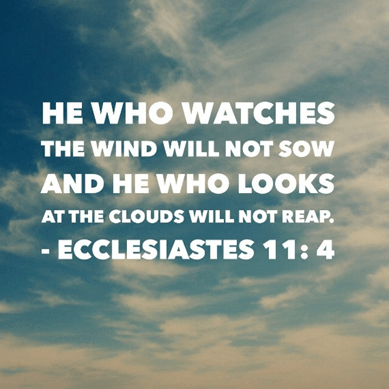
He who observes the wind will not sow, and he who regards the clouds will not reap. As you do not know what is the way of the wind, or how the bones grow in the womb of her who is with child, so you do not know the works of God who makes everything.
In the morning sow your seed, and in the evening do not withhold your hand; for you do not know which will prosper, either this or that, or whether both alike will be good. Truly the light is sweet, and it is pleasant for the eyes to behold the sun; but if a man lives many years and rejoices in them all, yet let him remember the days of darkness, for they will be many. All that is coming is vanity.

Seek God in Early Life

9-10 Rejoice, O young man, in your youth, and let your heart cheer you in the days of your youth; walk in the ways of your heart, and in the sight of your eyes; but know that for all these God will bring you into judgment. Therefore remove sorrow from your heart, and put away evil from your flesh, for childhood and youth are vanity.

This chapter of Ecclesiastes is one of my favorites for several reasons. First, the admonition to be generous: Cast your bread upon the waters. At first, this seems weird; why throw good bread out into a stream indiscriminately? But this is really an admonition to be generous, giving with no thought of getting anything in return.We live in a small northeastern Ghanaian village, working in a mission hospital that serves very poor people. Our patients and their families have very little money, and we frequently must assist in buying medicines, paying blood donors when no relative is available, and even feeding families while they are in hospital. But it’s also quite common for us to receive guinea fowls, guinea fowl eggs, and tubers of yam months or even years after having cared for someone, once the grateful family is able to organize a donation. It’s quite true that you can’t out-give God, and God has all kinds of ways of providing.

The law of the Kingdom of God is simple and Jesus enunciated it clearly: “Give, and it will be given to you. A good measure, pressed down, shaken together, and running over will be poured into your lap. For with the measure you use, it will be measured back to you.” (Luke 6:38) Rain falls on the earth whether anybody applauds it or not; rain falls because God has set natural events in motion and that is the nature of rain. In the same way, we are to be generous whether or not anyone is noticing.

He who observes the wind will not sow, and he who regards the clouds will not reap.” I grew up on an Illinois farm at a time when much of the work was done by hand. We were still caring for beef cattle, pigs, and chickens, and milking cows by hand. Our work had to go on no matter how bad the weather was. If an ancient farmer demanded a sunny day with no wind before he would sow crops, he would never reap a harvest, for such days are rare. You must determine God’s calling on your life and then do your best to fulfill it without waiting for conditions to become perfect. If you demand perfect conditions, you will waste your entire life.

Just as none of us can control the wind, none of us can control the development of a child in the womb. God is the One who makes all things possible.

“Truly the light is sweet, and it is pleasant for the eyes to behold the sun; but if a man lives many years and rejoices in them all, yet let him remember the days of darkness, for they will be many. All that is coming is vanity.” At first, this statement seems horrible as it speaks of “the days of darkness.” Days of darkness will come to all of us-losses, sickness, betrayals, disappointments. The important thing is to trust God in both the light and the darkness.  

The key to happiness is to seek God early in your youth and to serve Him faithfully all the days of your life. The Westminster Shorter Catechism tells us that the chief end of man is to “glorify God and to enjoy Him forever.” This week, they buried one of our close personal friends who had served God faithfully for 84 years. At the funeral service, countless people came forward with testimonies of this man’s kindness, compassion, and good works. Our friend’s children “rose up to call him blessed.” Our friend remained faithful to God despite daunting health challenges that might have discouraged a lessor individual.

Happiness has little to do with circumstances, for the Apostle Paul wrote the Book of Philippians, one of the happiest chapters of the Bible, while in prison. Roman prisons were anything but luxurious; yet, Paul says, “Rejoice in the Lord always. I will say it again: Rejoice! Let your gentleness be apparent to all. The Lord is near. Be anxious for nothing, but in everything, by prayer and petition, with thanksgiving, present your requests to God. And the peace of God, which surpasses all understanding, will guard your hearts and your minds in Christ Jesus.” (Philippians 4:4-7)  

Be generous! Be faithful! Trust God and find your happiness in Him! These are the lessons from this sparkling chapter. May God help us so that we will internalize these lessons and make them part of our lives.

PRAYER: Father God, thank You for loving us and caring for us. Lord, help us to be generous, faithful, trusting, and rejoicing in You. In the mighty and precious Name of King Jesus. Amen.

OCTOBER 4, 2025 WHEN HAVING IT ALL ISN’T ENOUGH #12 WATCH OUT FOR “DEAD FLY” THOUGHTS!

October 4, 2025

Ecclesiastes 10:1-4: Of fools and dead flies:

Dead flies in perfume make it stink, and a little foolishness decomposes much wisdom. Wise thinking leads to right living; stupid thinking leads to wrong living. Fools on the road have no sense of direction. The way they walk tells the story: “There goes the fool again!”

If a ruler loses his temper against you, don’t panic; a calm disposition quiets intemperate rage.

Many people living in climate-controlled environments might not appreciate how stinky dead flies can smell. My childhood farm had lots of animals and lots of manure, so we endured problems with dead flies. Sometimes we would have so many flies in our house in the summertime that we would have to close all the doors and windows, spray the whole house with insect spray, and then leave for a few hours. When we returned, we would have to sweep up piles of dead flies or they would fill the house with noxious odors.

Flies are so small that many people might not notice them; however, if enough dead flies are concentrated in one place, the odor can knock you off your feet. Foolishness mixed with wisdom can do the same thing. We have satellite TV, and one of the programs is devoted to proving that there were ancient aliens on planet earth. Sadly, highly educated people who refuse to believe in the One True Living God are more than willing to believe in ancient aliens. (Actually, there were ancient aliens; one third of the angels fell from heaven to earth with Lucifer. Sadly, those demons are still around and very active. But these programs are holding out for extraterrestrials.)

5-7 Here’s a piece of bad business I’ve seen on this earth, an error that can be blamed on whoever is in charge: Immaturity is given a place of prominence, while maturity is made to take a backseat. I’ve seen unproven upstarts riding in style, while experienced veterans are put out to pasture.

In 1969 Laurence Peter and Raymond Hull wrote a book entitled The Peter Principle. Wikipedia tells us: “The Peter principle is a concept in management developed by Laurence J. Peter which observes that people in a hierarchy tend to rise to “a level of respective incompetence”: employees are promoted based on their success in previous jobs until they reach a level at which they are no longer competent, as skills in one job do not necessarily translate to another…. Peter and Hull intended the book to be satire,[4] but it became popular as it was seen to make a serious point about the shortcomings of how people are promoted within hierarchical organizations.”

Part of the advice from that book was that if you wished to remain in a position in which you were doing well, practice a little “creative incompetence,” in other words, mess up small things that would not matter just sufficiently to prevent you from being elevated to a level of incompetence. Such thinking appears counter-intuitive. After all, why not strive for the highest position possible? But Shakespeare wrote, “Uneasy lies the head that wears the crown.” There’s a lot to be said for not being the boss, the ultimate authority, for then you are the one most culpable if things go wrong.

8-11 “Caution: The trap you set might catch you. Warning: Your accomplice in crime might double-cross you. Safety first: Quarrying stones is dangerous. Be alert: Felling trees is hazardous. Remember: The duller the ax the harder the work; use your head: The more brains, the less muscle. If the snake bites before it’s been charmed, what’s the point in then sending for the charmer?

12-13 The words of a wise person are gracious. The talk of a fool self-destructs—He starts out talking nonsense and ends up spouting insanity and evil.

14-15 Fools talk way too much, chattering stuff they know nothing about. A decent day’s work so fatigues fools that they can’t find their way back to town.

Many of us need a sign that reads “Engage brain before acting.” If you don’t consider the consequences of your actions, those consequences can become injurious or even fatal. A few years ago, young people in my home area were engaging in “ditch surfing,” that is, running a vehicle with most of it in the roadside ditch. But roads have culverts and bridges and ditches have unexpected pot holes. Several people were injured or killed before this practice was abandoned.

16-17 Unlucky the land whose king is a young pup, and whose princes party all night. Lucky the land whose king is mature, where the princes behave themselves and don’t drink themselves silly.

Sober mature leadership is a jewel beyond price. Matter what kind of organization you are discussing, leadership always sets the tone for the entire organization. The same thing is true for nations.

18 A shiftless man lives in a tumbledown shack; a lazy woman ends up with a leaky roof.

19 Laughter and bread go together, and wine gives sparkle to life—But it’s money that makes the world go around. These observations are self-explanatory.

20 Don’t bad-mouth your leaders, not even under your breath, and don’t abuse your betters, even in the privacy of your home. Loose talk has a way of getting picked up and spread around. Little birds drop the crumbs of your gossip far and wide. Even before the advent of smart phones and social media, gossip spreads faster than the speed of light. And when it comes to complaining about leaders, you can readily get yourself into trouble. Best advice: Keep quiet!

The major lesson from all these various remarks is simple: Avoid foolishness and be as discrete as possible. Where does true wisdom come from? Proverbs 8 tells us, “I am Lady Wisdom, and I live next to Sanity; Knowledge and Discretion live just down the street.
The Fear-of-God means hating Evil, whose ways I hate with a passion—pride and arrogance and crooked talk. Good counsel and common sense are my characteristics; I am both Insight and the Virtue to live it out. With my help, leaders rule, and lawmakers legislate fairly; with my help, governors govern, along with all in legitimate authority. I love those who love me; those who look for me find me. Wealth and Glory accompany me—also substantial Honor and a Good Name. My benefits are worth more than a big salary, even a very big salary; the returns on me exceed any imaginable bonus…

32-36 “So, my dear friends, listen carefully; those who embrace these my ways are most blessed. Mark a life of discipline and live wisely; don’t squander your precious life. Blessed the man, blessed the woman, who listens to me, awake and ready for me each morning, alert and responsive as I start my day’s work. When you find me, you find life, real life, to say nothing of God’s good pleasure. But if you wrong me, you damage your very soul; when you reject me, you’re flirting with death.”

May God help us to humbly seek wisdom and to be discrete!

PRAYER: Father God, thank You for loving us and caring for us. Lord, help us to seek Your wisdom and insight before we speak or act. In the mighty and precious Name of King Jesus. Amen.
OCTOBER 3, 2025 WHEN HAVING IT ALL ISN’T ENOUGH #11 WHERE THERE’S LIFE, THERE’S HOPE!

October 3, 2025

9:1-3 “Well, I took all this in and thought it through, inside and out. Here’s what I understood: The good, the wise, and all that they do are in God’s hands—but, day by day, whether it’s love or hate they’re dealing with, they don’t know.

Anything’s possible. It’s one fate for everybody—righteous and wicked, good people, bad people, the nice and the nasty, worshipers and non-worshipers, committed and uncommitted. I find this outrageous—the worst thing about living on this earth—that everyone’s lumped together in one fate. Is it any wonder that so many people are obsessed with evil? Is it any wonder that people go crazy right and left? Life leads to death. That’s it.”

These statements reveal a lot more about Solomon than they do about life. Solomon is trying to justify not living a righteous life by claiming that “everyone’s lumped together in one fate.”

How tragic! This is the same guy who had a personal interview with the One True Living God, who promised him knowledge and riches. But Solomon is already being spiritually seduced by the demons his wives and concubines are worshiping. The result is that Solomon needs spiritual glasses!

Solomon’s father David was a man of great faith who wrote at least half the psalms that have encouraged believers for centuries. Sadly, David failed to pass on his faith to his son, as we see from the rest of this chapter. Did David try and Solomon refused to listen or to remember, feeling that he was so intelligent he didn’t need to remember his father’s teachings? While Solomon’s case of ennui might frustrate us, we must ask ourselves what we are teaching our children and those around us.

We need to learn as much as possible from Solomon’s mistakes. Here is a man so renowned for his wisdom that rulers are coming from the ends of the earth to consult him, bringing rare gifts; yet, he refuses to commune with God.

Seize Life!

4-6 “Still, anyone selected out for life has hope, for, as they say, “A living dog is better than a dead lion.” The living at least know something, even if it’s only that they’re going to die. But the dead know nothing and get nothing. They’re a minus that no one remembers. Their loves, their hates, yes, even their dreams, are long gone. There’s not a trace of them left in the affairs of this earth.”

7-10 “Seize life! Eat bread with gusto, drink wine with a robust heart. Oh yes—God takes pleasure in your pleasure! Dress festively every morning. Don’t skimp on colors and scarves.
Relish life with the spouse you love each and every day of your precarious life. Each day is God’s gift. It’s all you get in exchange for the hard work of staying alive. Make the most of each one! Whatever turns up, grab it and do it. And heartily! This is your last and only chance at it, for there’s neither work to do nor thoughts to think in the company of the dead, where you’re most certainly headed.”

Well, if you want an excuse for hedonism “if it feels good, do it!” then Solomon is handing you one. The problem is that actions today have eternal consequences, no matter how much Solomon would like to object.

11-12 “I took another walk around the neighborhood and realized that on this earth as it is—The race is not always to the swift, nor the battle to the strong, nor satisfaction to the wise, nor riches to the smart, nor grace to the learned. Sooner or later bad luck hits us all. No one can predict misfortune. Like fish caught in a cruel net or birds in a trap, so men and women are caught by accidents evil and sudden.”

Wisdom Is Better than Muscle

13-15 “One day as I was observing how wisdom fares on this earth, I saw something that made me sit up and take notice. There was a small town with only a few people in it. A strong king came and mounted an attack, building trenches and attack posts around it. There was a poor but wise man in that town whose wisdom saved the town, but he was promptly forgotten. (He was only a poor man, after all.)”

16-18 “All the same, I still say that wisdom is better than muscle, even though the wise poor man was treated with contempt and soon forgotten. The quiet words of the wise are more effective than the ranting of a king of fools. Wisdom is better than warheads, but one hothead can ruin the good earth.”

Compare these grim statements with those of David, Solomon’s father, in Psalm 27: “27 The Lord is my light and my salvation; whom shall I fear? The Lord is the strength of my life; of whom shall I be afraid? When the wicked came against me to eat up my flesh, my enemies and foes, they stumbled and fell.
Though an army may encamp against me, my heart shall not fear; though war may rise against me, in this I will be confident.

One thing I have desired of the Lord, that will I seek: that I may dwell in the house of the Lord
all the days of my life, to behold the beauty of the Lord, and to inquire in His temple.
For in the time of trouble he shall hide me in His pavilion; in the secret place of His tabernacle he shall hide me; he shall set me high upon a rock. And now my head shall be lifted up above my enemies all around me; therefore I will offer sacrifices of joy in His tabernacle; I will sing, yes, I will sing praises to the Lord.

Hear, O Lord, when I cry with my voice! Have mercy also upon me, and answer me. When You said, “Seek My face,” my heart said to You, “Your face, Lord, I will seek.”

Do not hide Your face from me; do not turn Your servant away in anger; You have been my help; do not leave me nor forsake me, O God of my salvation. When my father and my mother forsake me, then the Lord will take care of me.

Teach me Your way, O Lord, and lead me in a smooth path, because of my enemies. Do not deliver me to the will of my adversaries; for false witnesses have risen against me, and such as breathe out violence.
I would have lost heart, unless I had believed that I would see the goodness of the Lord in the
land of the living. Wait on the Lord; be of good courage, and He shall strengthen your heart; wait, I say, on the Lord!

Life is all about choices: We can copy Solomon or David. Choose wisely! And remember that as long as we hope in the Lord, we will have eternal life.

PRAYER: Father God, thank You for loving us and caring for us. Lord, help us to remember to worship You while we are enjoying Your bounty. Help us to trust You when things become difficult and not to lose faith. In the mighty and precious Name of King Jesus. Amen.
OCTOBER 2, 2025 WHEN HAVING IT ALL ISN’T ENOUGH #10 LET’S LEAVE JUDGEMENT TO GOD!

October 2, 2025

Ecclesiastes 8 Wisdom is great…if you don’t get stuck on yourself!

“There’s nothing better than being wise, knowing how to interpret the meaning of life. Wisdom puts light in the eyes and gives gentleness to words and manners.” Is Solomon referring to himself here? Possibly. Here in Ghana, there are many lorry drivers who turn their rear-view mirrors so that they can admire themselves, rather than watching traffic. Solomon is busy admiring himself…and it gets worse, just wait.

No One Can Control the Wind

2-7 “Do what your king commands; you gave a sacred oath of obedience. Don’t worryingly second-guess your orders or try to back out when the task is unpleasant. You’re serving his pleasure, not yours. The king has the last word. Who dares say to him, “What are you doing?” Carrying out orders won’t hurt you a bit; the wise person obeys promptly and accurately. Yes, there’s a right time and way for everything, even though, unfortunately, we miss it for the most part. It’s true that no one knows what’s going to happen, or when. Who’s around to tell us?”

Okay. No doubt about the reference here. Solomon wants to make sure that everybody KNOWS that he is king and that HE HAS THE LAST WORD AND YOU HAD BEST GET WITH IT AND OBEY NOW!!! But even powerful King Solomon has his limits.

8-9 “No one can control the wind or lock it in a box. No one has any say-so regarding the day of death. No one can stop a battle in its tracks. No one who does evil can be saved by evil. All this I observed as I tried my best to understand all that’s going on in this world. As long as men and women have the power to hurt each other, this is the way it is.”

Well, this is fascinating. Immediately after declaring that he is sovereign and everybody must follow orders, now Solomon is backing off, talking about the wind and death and battle and how uncontrollable those things are. And then Solomon follows up those statements by figuratively shrugging his shoulders and saying, “As long as men and women have the power to hurt each other, this is the way it is.” Does this mean that Solomon realizes that some things are not under his control? And then Solomon proceeds to register more complaints.

One Fate for Everybody

10-11 “One time I saw wicked men given a solemn burial in holy ground. When the people returned to the city, they delivered flowery eulogies—and in the very place where wicked acts were done by those very men! More smoke. Indeed. Because the sentence against evil deeds is so long in coming, people in general think they can get by with murder.”

Obviously, there were plenty of sycophants (boot lickers) in Solomon’s day, prepared to publicly praise the wicked at elaborate funerals in hopes of gaining something from the dead person’s family or supporters. Why doesn’t God punish wicked people immediately for their evil deeds? God gives the wicked many opportunities to repent; in fact, God is far more merciful than most of us.

12-13 Even though a person sins and gets by with it hundreds of times throughout a long life, I’m still convinced that the good life is reserved for the person who fears God, who lives reverently in his presence, and that the evil person will not experience a “good” life. No matter how many days he lives, they’ll all be as flat and colorless as a shadow—because he doesn’t fear God.

* * *

14 Here’s something that happens all the time and makes no sense at all: Good people get what’s coming to the wicked, and bad people get what’s coming to the good. I tell you, this makes no sense. It’s smoke.

15 So, I’m all for just going ahead and having a good time—the best possible. The only earthly good men and women can look forward to is to eat and drink well and have a good time—compensation for the struggle for survival these few years God gives us on earth.

16-17 When I determined to load up on wisdom and examine everything taking place on earth, I realized that if you keep your eyes open day and night without even blinking, you’ll still never figure out the meaning of what God is doing on this earth. Search as hard as you like, you’re not going to make sense of it. No matter how smart you are, you won’t get to the bottom of it.”

Solomon is completely frustrated with God! Why can’t God simply deal with people the way Solomon would? Punish the wicked! Reward the virtuous! Settle everybody’s problems at once, instead of allowing evil to continue to triumph! Many of us might share Solomon’s feelings, but the Bible has a different answer.

Isaiah 55:8 tells us, “For My thoughts are not your thoughts, nor are My ways your ways,” says the Lord. “For as the heavens are higher than the earth, so are My ways higher than your ways, and My thoughts than your thoughts.”

One of our pastor friends was fond of saying that we are only in Advertising while God is in Management. God is the One who knows the end from the beginning, and only God can judge the human heart. There’s a saying in the American South that “Everybody’s trying to swallow something he just can’t get down.” No matter how wise we might be, we still have no idea of the challenges others are facing and therefore we are not qualified to judge. Besides that, let’s remember Jesus’ admonition to his disciples “Judge not so you won’t be judged.” Many of us are ready to make snap decisions about others’ behavior; however, the last thing we want is to be on the receiving end of somebody else’s verdicts.

May God help us to be gentle and merciful with those around us, just as we hope they will be gentle and merciful to us!

PRAYER: Father God, thank You for loving us and caring for us. Lord, help us to remember that You are the Ruler of the universe and You are the only One qualified to judge. Help us to be gentle and merciful to those around us. In the mighty and precious Name of King Jesus. Amen.